A 45 70 bullet drop chart provides the essential trajectory data needed for hunting with this legendary big bore cartridge. Your exact bullet drop relies entirely on the specific ammunition load, bullet weight, muzzle velocity, ballistic coefficient, chosen zero distance, and environmental conditions. By reviewing a reliable ballistic chart, hunters can understand the severe rainbow trajectory of this heavy projectile and make necessary optic or sight adjustments. The chart below details the critical flight metrics needed to effectively hunt with the .45-70 Government.
45 70 Bullet Drop Chart
| Distance (Yards) | Velocity (fps) | Energy (ft-lbs) | Bullet Drop (Inches) | Drop (MOA) | Drop (MIL) |
| 100 | 1720 | 2135 | 0.0 | 0.0 | 0.0 |
| 150 | 1572 | 1783 | -3.1 | 2.0 | 0.6 |
| 200 | 1436 | 1488 | -9.7 | 4.6 | 1.3 |
| 250 | 1317 | 1252 | -20.6 | 7.9 | 2.3 |
| 300 | 1215 | 1065 | -36.8 | 11.7 | 3.4 |
| 400 | 1066 | 820 | -88.0 | 21.0 | 6.1 |
| 500 | 964 | 670 | -172.5 | 33.0 | 9.6 |
The parameters for the table above are based on standard ballistic data for the highly popular Hornady LEVERevolution 325-grain FTX load. This provides an incredibly reliable baseline for modern deer and bear hunting with the .45-70 Government cartridge.
Ballistic Parameters:
- Ammunition Load: Hornady LEVERevolution .45-70 Government
- Bullet Weight & Type: 325-grain FTX (Flex Tip eXpanding)
- Muzzle Velocity: 2050 feet per second (fps)
- Ballistic Coefficient (G1): 0.230
- Zero Distance: 100 Yards
- Sight Height: 1.5 inches above bore
- Test Barrel Length: 24 inches
- Environmental Assumptions: Sea level altitude, 59 degrees Fahrenheit
Note: Velocity and energy figures are sourced from standard manufacturer ballistic charts for this specific load. Drop figures and extended data out to 500 yards are calculated using a 0.230 ballistic coefficient under standard atmospheric conditions. Extended distances are included to demonstrate the severe drop of this heavy caliber.
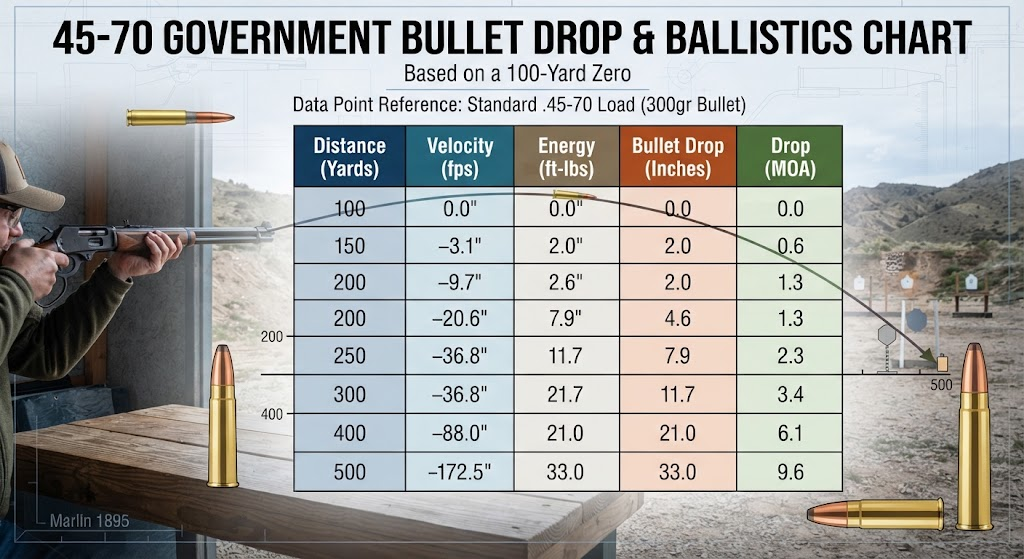
Understanding The 45 70 Bullet Drop Chart
45 70 Bullet Drop At 100 Yards
At 100 yards, the massive 325-grain projectile reaches its zero distance. It perfectly intersects your line of sight, resulting in zero bullet drop. The bullet travels at 1720 fps and retains a massive 2135 foot-pounds of energy. A 100-yard zero is the absolute standard for the .45-70 Government, providing a clean mathematical baseline for calculating holds at slightly longer hunting distances in dense brush.
45 70 Bullet Drop At 200 Yards
When the bullet reaches 200 yards, the trajectory limitations of the .45-70 begin to show. The projectile drops 9.7 inches below the center line. Shooters will need to hold high or dial 4.6 MOA. Retaining 1488 foot-pounds of energy, the bullet easily delivers the kinetic shock needed to cleanly harvest large game like elk, moose, or bear. This represents the optimal maximum range for many hunters using this cartridge.
45 70 Bullet Drop At 300 Yards
At 300 yards, the trajectory steepens significantly with a drop of 36.8 inches. You will need a precise elevation adjustment of 11.7 MOA or 3.4 MIL. The velocity drops to 1215 fps, nearing the transonic zone, and kinetic energy sits at 1065 foot-pounds. Hunting at this distance requires exact rangefinding, as misjudging the distance by just 25 yards will result in a complete miss due to the rapidly falling bullet.
45 70 Bullet Drop At 400 Yards
Crossing into 400 yards, the heavy bullet plunges 88.0 inches below the line of sight. A shooter must compensate by dialing 21.0 MOA or 6.1 MIL. The energy drops to 820 foot-pounds, which is well below the 1000 foot-pound minimum recommended for ethical hunting of medium to large game. The bullet is fully subsonic at this range, making it highly susceptible to wind drift and aerodynamic instability.
Frequently Asked Questions
What factors change my 45 70 bullet drop chart?
Your personal trajectory will vary depending on your specific ammunition and rifle configuration. A shorter 18.5-inch guide gun barrel will produce a lower muzzle velocity than a 24-inch test barrel, which directly increases bullet drop at every distance. Ammunition choice also plays a massive role. Modern high pressure loads shoot much flatter than traditional trapdoor safe loads that operate at lower velocities.
How does the 325-grain FTX compare to a traditional 405-grain lead bullet?
The 325-grain FTX bullet utilizes a polymer tip and an aerodynamic shape, allowing it to fly flatter and retain velocity better than traditional flat nose bullets. A classic 405-grain hard cast lead bullet leaves the muzzle much slower and has a worse ballistic coefficient. This means the 405-grain bullet will experience significantly more bullet drop past 100 yards, but it offers unmatched deep penetration for dangerous game defense.
What is the best zero distance for a 45-70 rifle?
A 100-yard zero is the standard and most highly recommended zero for a .45-70 rifle. Because the heavy cartridge sheds velocity rapidly and arcs severely, setting a 100-yard zero ensures your bullet is never more than a couple of inches above or below your line of sight for typical brush hunting distances. Using a 200-yard zero causes the bullet to rise far too high in the midrange, potentially causing you to shoot over your target.
What is the maximum effective hunting range for the 45-70?
The effective hunting range of the .45-70 Government is generally limited to 150 to 200 yards. For medium to large game, experts recommend a minimum of 1000 foot-pounds of energy upon impact to ensure a quick harvest. While modern loads like the 325-grain FTX maintain this energy slightly past 300 yards, the extreme bullet drop makes accurate shot placement incredibly difficult beyond 200 yards for most hunters.