A .22LR bullet drop chart provides the precise trajectory data needed for plinking, target shooting, and small game hunting. A rimfire projectile’s drop depends heavily on the specific load, bullet weight, muzzle velocity, ballistic coefficient, your chosen zero distance, and environmental conditions. Because the .22 Long Rifle is a low-velocity cartridge, the bullet drops dramatically at distances past 75 yards. Reviewing a reliable ballistic chart helps shooters understand exactly how much elevation to dial or hold to compensate for this severe arc.
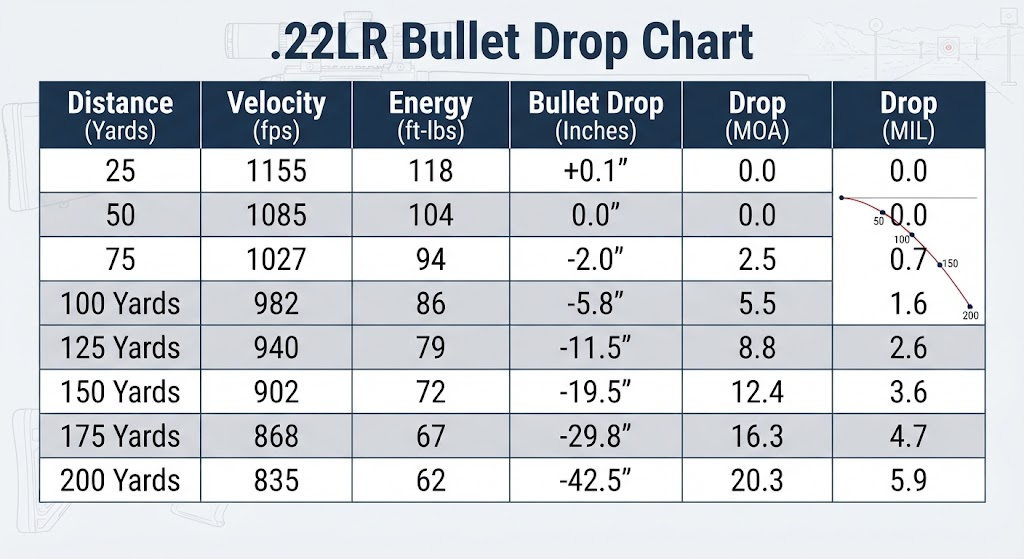
.22LR Bullet Drop Chart
| Distance (Yards) | Velocity (fps) | Energy (ft-lbs) | Bullet Drop (Inches) | Drop (MOA) | Drop (MIL) |
| 25 | 1155 | 118 | +0.1 | 0.0 | 0.0 |
| 50 | 1085 | 104 | 0.0 | 0.0 | 0.0 |
| 75 | 1027 | 94 | -2.0 | 2.5 | 0.7 |
| 100 | 982 | 86 | -5.8 | 5.5 | 1.6 |
| 125 | 940 | 79 | -11.5 | 8.8 | 2.6 |
| 150 | 902 | 72 | -19.5 | 12.4 | 3.6 |
| 175 | 868 | 67 | -29.8 | 16.3 | 4.7 |
| 200 | 835 | 62 | -42.5 | 20.3 | 5.9 |
The parameters for the table above are based on the highly popular CCI Mini-Mag high-velocity ammunition. This provides an excellent standard baseline for the .22 Long Rifle cartridge.
Ballistic Parameters:
- Ammunition Load: CCI Mini-Mag CPRN
- Bullet Weight & Type: 40-grain Copper Plated Round Nose
- Muzzle Velocity: 1235 feet per second (fps)
- Ballistic Coefficient (G1): 0.120
- Zero Distance: 50 Yards
- Sight Height: 1.5 inches above bore
- Test Barrel Length: 18 inches
- Environmental Assumptions: Sea level altitude, 59 degrees Fahrenheit
Note: Velocity and energy figures are sourced from standard CCI manufacturer ballistic charts. Drop figures and extended data out to 200 yards are calculated utilizing a 0.120 ballistic coefficient under standard atmospheric conditions.
Understanding The .22LR Bullet Drop Chart
.22LR Bullet Drop At 50 Yards
At 50 yards, the 40-grain bullet hits its exact zero distance. The projectile perfectly intersects your line of sight, meaning there is zero bullet drop. The bullet is traveling at 1085 fps and retains 104 foot-pounds of energy. This is widely considered the ideal zeroing distance for a .22LR rifle, providing the most usable trajectory for squirrel hunting and standard target shooting.
.22LR Bullet Drop At 100 Yards
When the bullet stretches to 100 yards, the rapid deceleration of the rimfire cartridge becomes obvious. The bullet drops 5.8 inches below your center line. Shooters need to adjust their optic by dialing 5.5 MOA or holding over 1.6 MIL. Velocity drops to roughly 982 fps, transitioning the bullet well into subsonic territory. The energy sits at 86 foot-pounds, which is still plenty for target shooting but requires precise shot placement for small game.
.22LR Bullet Drop At 150 Yards
At 150 yards, hitting a target becomes significantly more challenging. The bullet plunges 19.5 inches, requiring a major elevation correction of 12.4 MOA or 3.6 MIL. Kinetic energy drops to just 72 foot-pounds. Additionally, wind deflection is a major concern at this range, as a simple 5 mph crosswind will blow the lightweight projectile several inches off target.
.22LR Bullet Drop At 200 Yards
Reaching 200 yards with a .22LR requires true precision rimfire skills. The bullet drops a massive 42.5 inches. You will need to dial 20.3 MOA or 5.9 MIL on your turrets. Velocity bleeds down to 835 fps, and energy bottoms out near 60 foot-pounds. While hitting steel plates at this distance is highly rewarding, 200 yards is far beyond the ethical hunting range for any .22 Long Rifle ammunition.
Frequently Asked Questions
Should I zero my .22LR at 25 or 50 yards?
A 50-yard zero is the standard recommendation for most .22LR rifles. A 50-yard zero keeps the bullet path very close to the line of sight from the muzzle all the way out to 60 yards, making it ideal for hunting small game. If you choose a 25-yard zero, the bullet will actually hit quite high at 50 yards before arching back down, which can cause you to shoot directly over your target at medium ranges.
How does subsonic .22LR drop differently than high-velocity .22LR?
Subsonic ammunition leaves the barrel slower than high-velocity rounds like the CCI Mini-Mag, usually traveling around 1050 fps. Because it starts slower, subsonic ammo will experience significantly more bullet drop at distances like 75 and 100 yards. However, precision shooters often prefer subsonic ammunition because the bullet never breaks the sound barrier, preventing aerodynamic turbulence that can degrade accuracy at longer ranges.
What is the maximum effective hunting range for a .22LR?
For small game like squirrels and rabbits, ethical hunting requires a clean harvest. Most hunters consider 50 to 75 yards to be the maximum effective range for a standard .22 Long Rifle. Past 75 yards, the bullet drop becomes severe, wind drift dramatically increases the chance of a poor hit, and the projectile loses the kinetic energy necessary to guarantee a quick takedown.
Why does wind affect .22LR bullet drop and trajectory so much?
The .22LR utilizes a very lightweight bullet, typically between 36 and 40 grains. It also has a remarkably low ballistic coefficient, meaning it is not aerodynamically efficient. Because the bullet flies slowly and takes longer to reach the target, crosswinds have a greater amount of time to push the light projectile horizontally. This forces shooters to master wind holds for any shots taken past 75 yards.