A 300 Win Mag bullet drop chart provides the precise trajectory data necessary for extreme long-range shooting and big game hunting. Your exact bullet drop relies heavily on the specific ammunition load, bullet weight, muzzle velocity, ballistic coefficient, chosen zero distance, and environmental conditions. By reviewing established ballistic tables, shooters can make fast and accurate optic adjustments to compensate for gravity over immense distances. The chart below details the critical flight metrics needed to master this legendary heavy-hitting magnum cartridge.
300 Win Mag Bullet Drop Chart
| Distance (Yards) | Velocity (fps) | Energy (ft-lbs) | Bullet Drop (Inches) | Drop (MOA) | Drop (MIL) |
| 100 | 2707 | 3254 | 0.0 | 0.0 | 0.0 |
| 200 | 2569 | 2931 | -3.1 | 1.5 | 0.4 |
| 300 | 2436 | 2634 | -11.6 | 3.7 | 1.1 |
| 400 | 2307 | 2363 | -26.3 | 6.3 | 1.8 |
| 500 | 2182 | 2114 | -48.1 | 9.2 | 2.7 |
| 600 | 2061 | 1886 | -78.1 | 12.4 | 3.6 |
| 700 | 1944 | 1678 | -117.4 | 16.0 | 4.7 |
| 800 | 1831 | 1489 | -167.6 | 20.0 | 5.8 |
The parameters for the table above are based on standard ballistic data for the highly popular Hornady Precision Hunter 200-grain ELD-X load. This provides an incredibly reliable baseline for modern long-range hunting with the .300 Winchester Magnum.
Ballistic Parameters:
- Ammunition Load: Hornady Precision Hunter .300 Win Mag
- Bullet Weight & Type: 200-grain Extremely Low Drag eXpanding (Polymer Tip Boat Tail)
- Muzzle Velocity: 2850 feet per second (fps)
- Ballistic Coefficient (G1): 0.597
- Zero Distance: 100 Yards
- Sight Height: 1.5 inches above bore
- Test Barrel Length: 24 inches
- Environmental Assumptions: Sea level altitude, 59 degrees Fahrenheit
Note: Velocity and energy figures are sourced from standard manufacturer ballistic charts for this specific load. Drop figures and extended data out to 800 yards are calculated using a 0.597 ballistic coefficient under standard atmospheric conditions.
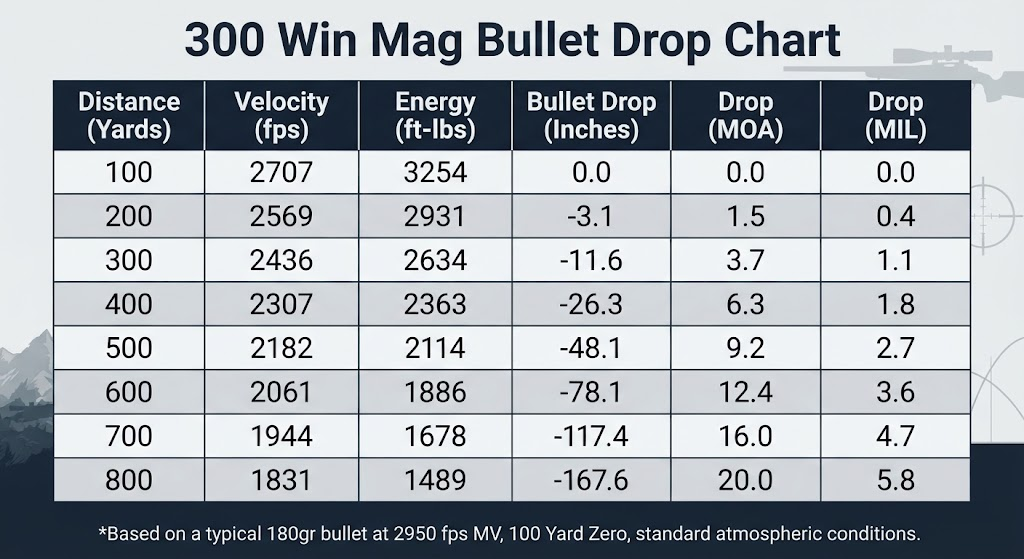
Understanding The 300 Win Mag Bullet Drop Chart
300 Win Mag Bullet Drop At 100 Yards
At 100 yards, the heavy 200-grain projectile reaches its zero distance, meaning it perfectly intersects your line of sight with zero bullet drop. The bullet travels at 2707 fps and retains a massive 3254 foot-pounds of energy. A 100-yard zero provides a clean mathematical baseline for modern tactical and hunting optics, allowing shooters to easily dial their turrets for extreme distances.
300 Win Mag Bullet Drop At 200 Yards
When the bullet reaches 200 yards, the massive powder charge of the .300 Win Mag keeps the trajectory incredibly flat. The projectile drops a mere 3.1 inches. Shooters need to dial only 1.5 MOA or hold 0.4 MIL on their reticle. Retaining nearly 3000 foot-pounds of energy, the bullet delivers devastating knockdown power for moose, elk, and large bears.
300 Win Mag Bullet Drop At 300 Yards
At 300 yards, the trajectory arcs slightly with a drop of 11.6 inches. You will need to make an elevation correction of 3.7 MOA or 1.1 MIL. Velocity remains very high at 2436 fps, and the kinetic energy sits at a staggering 2634 foot-pounds. Thanks to the high ballistic coefficient of the 200-grain bullet, it slices through crosswinds with ease compared to smaller calibers.
300 Win Mag Bullet Drop At 400 Yards
Crossing into 400 yards, the heavy bullet falls 26.3 inches below the line of sight. A shooter must compensate by dialing 6.3 MOA or 1.8 MIL. The energy drops to 2363 foot-pounds, which is still far more energy than a standard .308 Winchester carries at the muzzle. This allows the .300 Win Mag to perform flawlessly on large game at distances where other cartridges fail.
300 Win Mag Bullet Drop At 500 Yards
At 500 yards, the bullet drop reaches 48.1 inches. You will need a precise elevation adjustment of 9.2 MOA or 2.7 MIL. The velocity stays entirely supersonic at 2182 fps, and energy falls to 2114 foot-pounds. This distance represents a highly ethical and effective hunting range for experienced marksmen pursuing elk across wide canyons.
300 Win Mag Bullet Drop At 600 Yards
Reaching 600 yards firmly places the shooter in long-range territory. The bullet plunges 78.1 inches, demanding an elevation shift of 12.4 MOA or 3.6 MIL. Velocity sits at 2061 fps, and energy hovers at 1886 foot-pounds. Hitting targets at this distance requires precise rangefinding, an accurate atmospheric dope chart, and excellent recoil management.
Frequently Asked Questions
What factors change my 300 Win Mag bullet drop chart?
Your personal trajectory will vary depending on your specific ammunition and rifle setup. A barrel shorter than 24 inches will yield a lower muzzle velocity, which increases bullet drop at every distance. Environmental factors like high altitude, warm temperatures, and low barometric pressure reduce air density. Thinner mountain air allows the heavy bullet to experience less drag, causing it to fly much flatter and faster than it would at sea level.
How does a 180-grain 300 Win Mag compare to a 200-grain bullet?
A lighter 180-grain bullet leaves the muzzle faster, offering a slightly flatter trajectory out to roughly 400 yards. This is an excellent choice for deer and standard elk hunting. However, the 180-grain bullet typically has a lower ballistic coefficient. Past 500 yards, a heavier 200-grain or 212-grain bullet retains its velocity much better, resists wind drift far more effectively, and ultimately delivers more kinetic energy upon impact.
What is the best zero distance for a 300 Win Mag rifle?
A 100-yard zero is the standard recommendation for shooters using modern scopes with exposed dialing turrets, as it simplifies all long-range math. However, many hunters using traditional capped hunting scopes prefer a 200-yard zero. Because the .300 Winchester Magnum shoots so fast and flat, a 200-yard zero allows a hunter to hold dead center on an elk’s vitals out to roughly 300 yards without adjusting their aim.
What is the effective hunting range of a 300 Winchester Magnum?
The effective hunting range is dictated by your marksmanship skills and the energy required to ethically harvest the animal. For elk and moose, experts recommend a minimum of 1500 foot-pounds of energy upon impact. Looking at standard ballistic data for a 200-grain bullet, the .300 Win Mag maintains this incredible energy level out to 800 yards, making it one of the most capable long-range hunting cartridges in existence.