The main difference in the 44 Magnum Vs 30-30 comparison is that the .44 Magnum is a heavy, large-bore revolver cartridge that excels in close-range brush hunting and handgun defense, whereas the .30-30 Winchester is a dedicated rifle cartridge offering significantly higher velocity, flatter trajectories, and greater kinetic energy. While both are legendary lever-action chamberings, the .30-30 dominates medium-range hunting, while the .44 Magnum offers cross-platform versatility between handguns and carbines.
44 Magnum Vs 30-30 Comparison
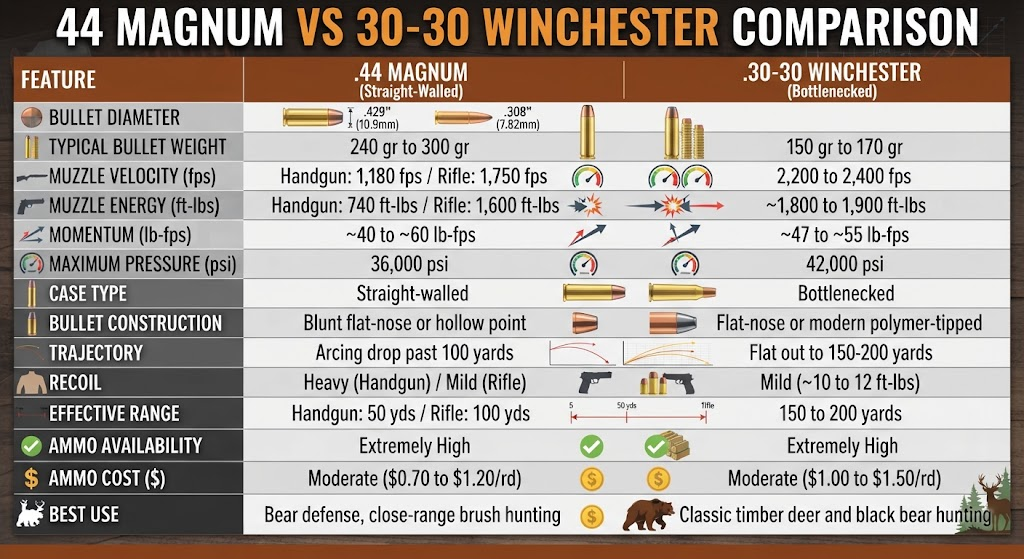
| Feature | 44 Magnum | 30-30 Winchester |
| Bullet Diameter | 0.429 inches (10.9 mm) | 0.308 inches (7.82 mm) |
| Typical Bullet Weight | 240 gr to 300 gr (typically 240 gr) | 150 gr to 170 gr (typically 150 gr) |
| Muzzle Velocity | 1,180 fps (Handgun) / 1,750 fps (Rifle) | 2,200 to 2,400 fps (20-inch Rifle) |
| Muzzle Energy | 740 ft-lbs (Handgun) / 1,600 ft-lbs (Rifle) | ~1,800 to 1,900 ft-lbs |
| Momentum | ~40 to ~60 lb-fps | ~47 to ~55 lb-fps |
| Maximum Pressure | 36,000 psi (SAAMI) | 42,000 psi (SAAMI) |
| Case Type | Straight-walled | Bottlenecked |
| Bullet Construction | Blunt flat-nose or hollow point | Flat-nose or modern polymer-tipped |
| Trajectory | Arcing drop past 100 yards | Flat out to 150-200 yards |
| Recoil | Heavy (Handgun) / Mild (Rifle) | Mild (~10 to 12 ft-lbs in a Rifle) |
| Effective Range | 50 yds (Handgun) / 100 yds (Rifle) | 150 to 200 yards (Hunting) |
| Ammo Availability | Extremely High | Extremely High |
| Ammo Cost | Moderate ($0.70 to $1.20/rd) | Moderate ($1.00 to $1.50/rd) |
| Best Use | Bear defense, close-range brush hunting | Classic timber deer and black bear hunting |
The table highlights the fundamental difference in their design origins. The .30-30 Winchester was introduced in 1895 as America’s first small-bore sporting rifle cartridge designed for smokeless powder, featuring a bottlenecked case that holds a large powder charge to drive .30-caliber bullets at high speeds. The .44 Remington Magnum was introduced in 1955 primarily as a massive, straight-walled handgun cartridge for large-frame revolvers. While the .44 Magnum eventually found a home in lever-action carbines to allow cowboys and hunters to share ammunition between their pistol and rifle, it remains constrained by its straight-walled pistol geometry.
44 Magnum Vs 30-30 Ballistics
To provide an apples-to-apples comparison, we must evaluate both cartridges as they perform when fired from typical lever-action hunting rifles (18 to 20-inch barrels), alongside a baseline for the .44 Magnum fired from a handgun.
- Load A (44 Magnum Handgun): Hornady 240-grain XTP. Tested from a 6-inch revolver barrel. Muzzle velocity is 1,350 feet per second. Muzzle energy is 971 foot-pounds.
- Load B (44 Magnum Rifle): Hornady 240-grain XTP. Tested from an 18-inch carbine barrel. Muzzle velocity is roughly 1,750 feet per second. Muzzle energy is 1,632 foot-pounds.
- Load C (30-30 Standard Hunting): Federal Premium 150-grain Soft Point. Tested from a 20-inch barrel. Muzzle velocity is 2,390 feet per second. Muzzle energy is 1,902 foot-pounds.
- Load D (30-30 Modern Polymer): Hornady 160-grain LEVERevolution. Tested from a 20-inch barrel. Muzzle velocity is 2,400 feet per second. Muzzle energy is 2,046 foot-pounds.
44 Magnum Vs 30-30 Velocity
Velocity is where the dedicated rifle cartridge pulls away.
Because the .30-30 Winchester utilizes a bottlenecked case with a larger powder capacity (roughly 45 grains of water volume compared to the .44 Magnum’s 37 grains), it pushes lighter 150-grain bullets at nearly 2,400 feet per second.
When fired from a carbine, the .44 Magnum gains a massive velocity boost over its handgun performance (jumping from ~1,350 fps to ~1,750 fps). However, pushing a blunt, heavy 240-grain bullet creates immense drag. Even at its absolute maximum out of a rifle barrel, the .44 Magnum is roughly 600 feet per second slower than a standard .30-30 load.
44 Magnum Vs 30-30 Muzzle Energy
Muzzle energy represents the raw kinetic work capacity of a projectile.
Out of a rifle, the .44 Magnum generates roughly 1,600 foot-pounds of energy. This is a tremendous amount of force for a pistol cartridge, hitting large game like a sledgehammer at close distances.
The .30-30 Winchester, however, generates roughly 1,900 to 2,000+ foot-pounds of energy. The .30-30 delivers roughly 20% to 25% more kinetic energy than a rifle-fired .44 Magnum, and it maintains that energy much better at 100 and 150 yards due to superior aerodynamic efficiency.
44 Magnum Vs 30-30 Momentum
Momentum calculates mass in motion, which dictates a bullet’s ability to crush through dense bone and heavy shoulder muscles without being deflected.
The .44 Magnum is a momentum monster. A heavy 240-grain bullet traveling at 1,750 fps from a carbine yields approximately 60.0 pound-feet per second of linear momentum.
A 150-grain .30-30 bullet traveling at 2,390 fps yields approximately 51.2 pound-feet per second.
This means that at close ranges (inside 50 yards), the massive frontal area and heavier mass of the .44 Magnum will often punch a wider, deeper hole through heavy bone than the lighter .30-30 bullet.
44 Magnum Vs 30-30 Trajectory
Understanding external ballistics highlights the strict range limitations of the .44 Magnum. The calculations below assume a standard rifle sight height of 1.5 inches above the bore and a 100-yard zero.
| Distance | 44 Magnum (240 gr at 1,750 fps) Drop | 30-30 Win (150 gr at 2,390 fps) Drop |
| Muzzle | -1.5 inches | -1.5 inches |
| 50 Yards | +1.2 inches | +0.4 inches |
| 100 Yards | 0.0 inches (Zero) | 0.0 inches (Zero) |
| 150 Yards | -4.8 inches | -1.5 inches |
| 200 Yards | -14.2 inches | -4.8 inches |
The trajectory data confirms that the .44 Magnum is strictly a close-range brush gun. Because its blunt bullet sheds velocity rapidly, it drops like a stone past 100 yards, plummeting over 14 inches by the 200-yard mark.
The .30-30 Winchester shoots vastly flatter. It only drops roughly 5 inches at 200 yards, allowing a hunter to aim confidently at the top of a deer’s vitals without complex holdovers.
44 Magnum Vs 30-30 Recoil
Recoil management is dependent on the firearm platform.
When fired from a lever-action rifle, both cartridges are remarkably mild. A standard .30-30 lever-action generates roughly 10 to 12 foot-pounds of free recoil energy. A .44 Magnum lever-action generates roughly 8 to 11 foot-pounds. Both are comfortable to shoot all day and are excellent choices for youth or recoil-sensitive hunters.
When fired from a revolver, the .44 Magnum is a different beast entirely, generating a punishing 22+ foot-pounds of recoil into the palm of the hand, accompanied by severe muzzle blast.
44 Magnum Vs 30-30 Penetration & Expansion
Both cartridges are legendary for their terminal performance on deer, black bear, and wild hogs.
The .30-30 utilizes soft-point bullets that mushroom beautifully at rifle velocities, creating massive internal trauma and reliable pass-throughs on deer.
The .44 Magnum utilizes large hollow points or flat-nosed hard-cast lead bullets. Because it starts at a massive 0.429 inches in diameter, it punches a massive hole before it even begins to expand. On heavy, dangerous animals (like bears), a 300-grain hard-cast .44 Magnum bullet will out-penetrate a .30-30 bullet by crushing straight through heavy cartilage without fragmenting.
44 Magnum Vs 30-30 Self Defense
The .44 Magnum offers a massive advantage in backcountry self-defense because it can be carried in a hip holster. For fishermen or hikers in grizzly bear country, a .44 Magnum revolver is the gold standard for portable, life-saving stopping power.
The .30-30 Winchester is strictly a rifle cartridge. While an excellent camp gun, it cannot be holstered, making it less practical as a dedicated, always-on-your-person defensive tool.
Which Has More Stopping Power: 44 Magnum Vs 30-30?
At close range (inside 50 yards), their practical stopping power is very similar, with the .44 Magnum offering a larger wound channel and the .30-30 offering more kinetic shock. Past 100 yards, the .30-30 Winchester possesses vastly superior stopping power as the .44 Magnum bleeds off speed and energy too rapidly.
Which Is More Powerful: 44 Magnum Vs 30-30?
Based on raw kinetic energy output, the .30-30 Winchester is the more powerful cartridge, consistently generating roughly 20% to 25% more muzzle energy than the .44 Magnum.
44 Magnum Pros And Cons
Pros
- Offers cross-platform versatility; allows you to carry a revolver and a lever-action rifle chambered in the same caliber
- Massive 0.429-inch diameter bullets create enormous permanent wound channels
- Heavy momentum provides exceptional bone-crushing penetration on bears and hogs
- Lever-action carbines hold more rounds in the tubular magazine due to the shorter case length
Cons
- Steep, rainbow trajectory limits ethical hunting shots to roughly 100 yards
- Blunt bullets bleed velocity and kinetic energy very rapidly in flight
- Produces punishing, heavy recoil when fired from a handgun
30-30 Pros And Cons
Pros
- The quintessential North American deer cartridge with a proven century-long track record
- Shoots significantly flatter than pistol-caliber carbines, allowing ethical shots out to 200 yards
- Generates roughly 25% more kinetic energy than the .44 Magnum
- Ubiquitous ammunition availability in every sporting goods store at affordable prices
Cons
- Strictly a rifle cartridge; cannot be paired with a traditional holster revolver
- Lighter bullet mass carries less raw momentum for crushing heavy bear skulls compared to heavy .44 loads
Final Comparison
| Category | Winner | Reason |
| Velocity | 30-30 Winchester | Bottlenecked case drives bullets roughly 600 fps faster |
| Muzzle Energy | 30-30 Winchester | Generates roughly 1,900+ ft-lbs of energy compared to 1,600 ft-lbs |
| Momentum | 44 Magnum | Heavier 240+ grain bullets carry superior linear driving mass |
| Penetration | Tie | 30-30 excels on deer; 44 Mag hard-cast excels on heavy dangerous game |
| Expansion | Tie | Both offer massive, reliable expansion with proper hunting bullets |
| Trajectory | 30-30 Winchester | Drastically flatter drop curve allows accurate shots out to 200 yards |
| Recoil Control | Tie | Both generate highly manageable, mild recoil (~10 ft-lbs) in a rifle |
| Effective Range | 30-30 Winchester | Doubles the practical hunting range of the .44 Magnum |
| Versatility | 44 Magnum | Can be loaded in both a primary rifle and a backup revolver |
| Ammo Cost | 44 Magnum | Standard pistol-caliber production makes range ammo slightly cheaper |
| Ammo Availability | Tie | Both are universal, staple calibers found on every shelf in America |
| Overall Performance | Depends on Role | 30-30 for dedicated deer hunting; 44 Mag for short-range brush/pistol combos |
44 Magnum Vs 30-30: Which Should You Choose?
Selecting between the two depends entirely on your hunting environment and whether you value range over cross-platform versatility.
Choose the 30-30 Winchester if your primary goal is hunting deer, black bear, or feral hogs in typical woodland environments. It is a dedicated rifle cartridge that hits harder, shoots flatter, and extends your ethical killing range out to 200 yards. There is a reason it has harvested more whitetail deer than nearly any other cartridge in history.
Choose the 44 Magnum if you hunt in incredibly thick brush where shots never exceed 100 yards, or if you want the ultimate cowboy logistics package. The ability to carry a powerful lever-action carbine and a heavy revolver that feed from the exact same box of ammunition provides unmatched utility for backcountry hikers, ranchers, and guides in dangerous bear country.
FAQs
Is 44 Magnum more powerful than 30-30?
No, the .30-30 Winchester is more powerful in terms of kinetic energy. The .30-30 generally produces roughly 1,900 foot-pounds of energy, whereas a rifle-fired .44 Magnum produces roughly 1,600 foot-pounds.
Which has more recoil in a rifle?
They produce virtually identical recoil when fired from lever-action rifles of similar weight, both generating a very mild and manageable 10 to 12 foot-pounds of free recoil energy.
Can a 30-30 shoot further than a 44 Magnum?
Yes, significantly further. The .30-30 has a much flatter trajectory and retains enough energy to ethically harvest deer out to roughly 200 yards. The .44 Magnum’s steep drop and rapid energy loss limit its practical hunting range to roughly 100 yards.
Which is better for bear defense?
For carrying on your hip in a holster, the .44 Magnum revolver is the definitive choice for bear defense. If carrying a rifle, a .44 Magnum lever-action loaded with heavy 300-grain hard-cast bullets provides devastating momentum and penetration, slightly outperforming the .30-30 at point-blank defensive ranges.
Which is better for deer hunting?
The .30-30 Winchester is universally considered the better dedicated deer hunting cartridge due to its flatter trajectory, higher kinetic energy, and longer effective range.
Can you shoot 44 Magnum in a 30-30 rifle?
No. They are completely different cartridges with incompatible case dimensions, pressures, and bullet diameters. Attempting to chamber one in the other is physically impossible.