The primary distinction between the .22 Creedmoor vs 6.5 Creedmoor comes down to caliber and bullet design. While both share the same parent case geometry, the .22 Creedmoor is necked down to fire lightweight, high-velocity .224-inch projectiles designed for ultra-flat trajectories, whereas the 6.5 Creedmoor fires heavier .264-inch bullets optimized for high sectional density, downrange energy retention, and all-around hunting and target work.
Table of Contents [Click to open]
.22 Creedmoor vs 6.5 Creedmoor: Main Difference
| Feature | .22 Creedmoor | 6.5 Creedmoor |
| Bullet Diameter | 0.224 in (5.70 mm) | 0.264 in (6.71 mm) |
| Common Bullet Weights | 60 gr to 90 gr | 120 gr to 147 gr |
| Case Length | 1.920 in (48.77 mm) | 1.920 in (48.77 mm) |
| Overall Cartridge Length | 2.700 in to 2.825 in | 2.825 in (71.76 mm) |
| Muzzle Velocity | 3,100 to 3,800+ fps | 2,650 to 3,050 fps |
| Muzzle Energy | 1,900 to 2,250 ft-lbs | 2,200 to 2,500 ft-lbs |
| Recoil | Very low (~7 to 9 ft-lbs) | Mild (~12 to 15 ft-lbs) |
| Trajectory | Extremely flat at medium-to-long range | Moderately flat with gradual drop |
| Common Uses | Varmints, predators, PRS/NRL, light big game | Medium-to-large game hunting, PRS/long-range match |
| Ammunition Availability | Moderate (expanding factory support) | Abundant (standard across all major manufacturers) |
The main difference between the two cartridges is that the .22 Creedmoor necks the 6.5 Creedmoor case down to fire smaller .224-caliber bullets at significantly higher velocities with less recoil, whereas the 6.5 Creedmoor fires heavier .264-caliber bullets that deliver superior downrange energy, momentum, and target penetration.
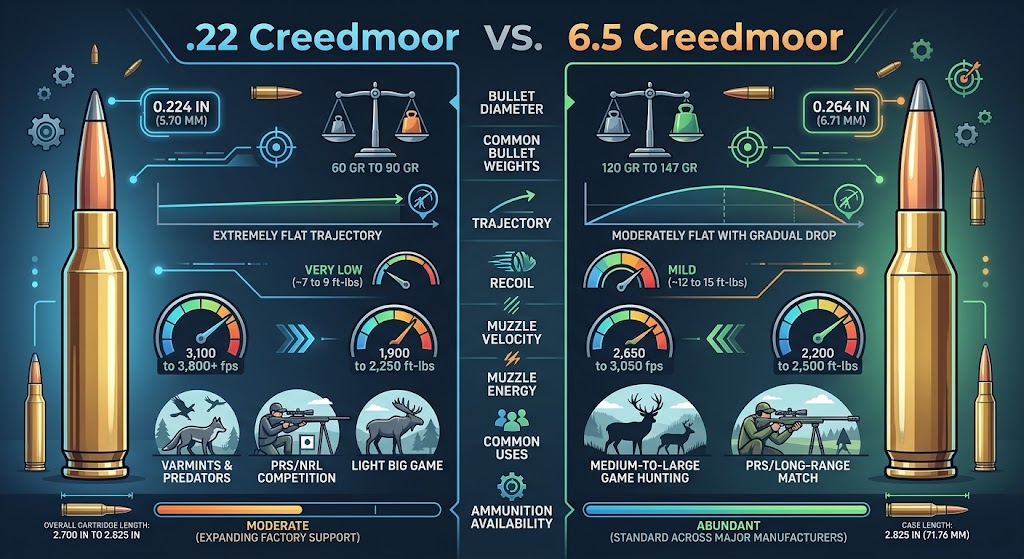
.22 Creedmoor vs 6.5 Creedmoor: Key Differences
- Bullet diameter: The fundamental caliber difference is bore size, where the .22 Creedmoor chambers a 0.224-inch projectile compared to the 0.264-inch (6.5 mm) bullet diameter of the 6.5 Creedmoor.
- Bullet weight: Factory .22 Creedmoor loads utilize projectiles weighing between 60 and 90 grains, compared to 6.5 Creedmoor factory ammunition that typically spans 120 to 147 grains.
- Velocity: The .22 Creedmoor drives sleek bullets at 3,100 to over 3,800 fps at the muzzle, producing much higher initial speeds compared to the 6.5 Creedmoor, where standard 140-grain factory offerings average 2,700 fps.
- Energy: While the .22 Creedmoor generates strong muzzle energy due to velocity, the 6.5 Creedmoor carries higher muzzle and retained kinetic energy downrange compared to the smaller bore.
- Trajectory: At standard field distances out to 500 yards, the .22 Creedmoor provides a significantly flatter trajectory compared to the 6.5 Creedmoor, requiring less vertical elevation holdover.
- Recoil: The .22 Creedmoor generates approximately 7 to 9 ft-lbs of free recoil energy in an 8-pound rifle, delivering roughly 35% to 45% less kick compared to the 13 to 15 ft-lbs produced by a 6.5 Creedmoor.
- Effective range: Both cartridges remain supersonic past 1,200 yards with high-BC match bullets, but the 6.5 Creedmoor holds a distinct advantage at extreme distances where heavier bullet weight better resists lateral wind deflection.
- Case dimensions: According to SAAMI standard specifications, both cartridges share the same 1.920-inch case length, 30-degree shoulder angle, and 0.473-inch rim diameter, with the only dimensional difference occurring at the neck.
- Rifle availability: The 6.5 Creedmoor is universally chambered by nearly every production rifle manufacturer, compared to the .22 Creedmoor, where factory rifle offerings are rapidly growing but still centered around specialized precision and predator rifle lines.
- Common applications: Shooters favor the .22 Creedmoor where maximum velocity and predator management are priorities, whereas the 6.5 Creedmoor remains the industry benchmark for general big-game hunting and long-range precision competition.
.22 Creedmoor vs 6.5 Creedmoor Ballistics
The data below compares standardized factory loads from Hornady Match ammunition, tested in standard 24-inch test barrels under standard atmospheric conditions (sea level, 59 degrees Fahrenheit). Velocity is listed in feet per second (fps) and energy in foot-pounds (ft-lbs).
| Cartridge | Bullet Weight | Muzzle Velocity | Muzzle Energy | 100 yd | 200 yd | 300 yd | 500 yd |
| .22 Creedmoor (Hornady ELD Match #83411) | 80 gr | 3,285 fps | 1,917 ft-lbs | 3,076 fps (1,680 ft-lbs) | 2,877 fps (1,470 ft-lbs) | 2,687 fps (1,282 ft-lbs) | 2,330 fps (964 ft-lbs) |
| 6.5 Creedmoor (Hornady ELD Match #81500) | 140 gr | 2,710 fps | 2,283 ft-lbs | 2,564 fps (2,043 ft-lbs) | 2,422 fps (1,823 ft-lbs) | 2,285 fps (1,622 ft-lbs) | 2,023 fps (1,273 ft-lbs) |
.22 Creedmoor vs 6.5 Creedmoor for Hunting
Varmints: The .22 Creedmoor is a superior varmint cartridge. Its high velocity produces rapid fragmentation, explosive terminal effects, and flat flight paths that minimize range estimation errors on small targets like groundhogs and prairie dogs.
Predators: For coyotes, bobcats, and foxes, the .22 Creedmoor offers quick target re-acquisition and minimal recoil. The 6.5 Creedmoor works on predators as well, but it causes substantially more pelt damage.
Deer: The 6.5 Creedmoor is a standard choice for whitetail and mule deer, offering broad wound channels and deep penetration. The .22 Creedmoor can take deer cleanly when paired with sturdy, controlled-expansion projectiles (such as monolithic copper or heavy bonded bullets), but it requires careful shot placement.
Medium game: For game such as antelope and wild hogs, the 6.5 Creedmoor provides higher momentum and penetration margins. The .22 Creedmoor is suited for pronghorn at distance, though it offers less tissue disruption on thick-skinned animals.
Long-range hunting: The 6.5 Creedmoor is better equipped for extended-range hunting on big game because its heavier bullets maintain adequate expansion velocity and terminal foot-pounds further downrange.
Note: Game suitability depends on bullet construction, game size, hunting regulations, and conditions. Many jurisdictions mandate a minimum bullet diameter of .243 inches (6mm) for big game, which legally precludes the .22 Creedmoor for deer in those areas.
.22 Creedmoor vs 6.5 Creedmoor Recoil and Range
The .22 Creedmoor generates roughly 40% less recoil than the 6.5 Creedmoor, enabling shooters to spot their own bullet impacts through the optic without losing the target image. It maintains higher velocity and a flatter trajectory across typical hunting distances out to 400 or 500 yards.
In terms of practical range, external factors such as wind drift, target size, and retained energy govern limits rather than a universal maximum distance. For paper and steel targets, both cartridges reliably reach beyond 1,000 yards in proper rifles with high-BC projectiles. For hunting, practical range depends on minimum terminal impact velocity and bullet expansion requirements: the .22 Creedmoor offers an extended flat-shooting envelope for varmints and predators, while the 6.5 Creedmoor maintains the terminal energy required for big game at longer distances.
.22 Creedmoor vs 6.5 Creedmoor FAQs
What is the main difference between .22 Creedmoor and 6.5 Creedmoor?
The main difference is bullet caliber and design purpose: the .22 Creedmoor shoots smaller .224-caliber bullets at higher velocities with less recoil, while the 6.5 Creedmoor shoots heavier .264-caliber bullets that carry more kinetic energy and penetration for big game and long-range shooting.
Which is bigger, .22 Creedmoor or 6.5 Creedmoor?
The 6.5 Creedmoor is bigger in bore size, bullet diameter (0.264 in vs 0.224 in), and overall bullet weight (120 to 147 grains vs 60 to 90 grains), although both share the same case length and diameter.
Which has more recoil, .22 Creedmoor or 6.5 Creedmoor?
The 6.5 Creedmoor produces more recoil, generating roughly 12 to 15 ft-lbs in standard hunting rifles compared to about 7 to 9 ft-lbs for the .22 Creedmoor.
Which has more velocity, .22 Creedmoor or 6.5 Creedmoor?
The .22 Creedmoor has significantly more velocity, launching factory ammunition between 3,100 and 3,800+ fps compared to 2,650 to 2,750 fps for common 140-grain 6.5 Creedmoor loads.
Which has more energy, .22 Creedmoor or 6.5 Creedmoor?
The 6.5 Creedmoor produces more kinetic energy, generating around 2,250 to 2,450 ft-lbs at the muzzle and maintaining higher foot-pounds downrange compared to approximately 1,900 to 2,100 ft-lbs for the .22 Creedmoor.
Which has a flatter trajectory, .22 Creedmoor or 6.5 Creedmoor?
The .22 Creedmoor has a noticeably flatter trajectory out to 500 yards due to its higher initial muzzle velocity.
Which has longer range, .22 Creedmoor or 6.5 Creedmoor?
Both can reach beyond 1,000 yards on target steel, but the 6.5 Creedmoor offers longer effective range on big game due to its heavier bullet mass, superior retained energy, and better resistance to wind deflection at extreme distances.
How does .22 Creedmoor compare to 6.5 Creedmoor for hunting?
The .22 Creedmoor is a specialized predator and varmint cartridge that can take small deer with premium bullets, whereas the 6.5 Creedmoor is an all-around big-game cartridge suited for deer, pronghorn, and larger game.
How does .22 Creedmoor compare to 6.5 Creedmoor for deer?
The 6.5 Creedmoor is widely considered the better and more reliable deer cartridge because its heavier bullets create deeper wound channels and larger exit margins. The .22 Creedmoor can take deer effectively with sturdy, expanding bullets where legal, but offers less margin for error.
How does .22 Creedmoor compare to 6.5 Creedmoor for varmints?
The .22 Creedmoor is superior for varmints compared to the 6.5 Creedmoor, offering flatter trajectories, higher speed, reduced recoil, and explosive terminal fragmentation while causing less unnecessary pelt destruction.