The main difference between the cartridges is that the 28 Nosler relies on a massive, overbore powder capacity to generate blistering muzzle velocities and absolute maximum kinetic energy, whereas the 7mm Precision Rifle Cartridge (7mm PRC) is an inherently efficient, modern design built around fast-twist barrels that seat heavy, high-BC bullets perfectly into standard long actions for superior consistency, reduced recoil, and longer barrel life.
Both cartridges represent the modern pinnacle of .284-caliber (7mm) hunting performance, but they arrive at their destinations through entirely different engineering philosophies. The 28 Nosler was released in 2015 as Nosler’s premier big-game magnum. Derived from a shortened 7mm Remington Ultra Magnum case, it was built to fit standard-length (3.340-inch) bolt actions while pushing 7mm bullets to hyper-velocities previously only seen in custom wildcat cartridges.
The 7mm PRC was introduced by Hornady in 2022 to optimize modern long-range shooting mechanics. Rather than chasing brute-force velocity, Hornady designed the case to fit long, sleek, heavy-for-caliber projectiles (175 to 195 grains) without encroaching on the powder capacity. Hornady standardized a fast 1:8-inch twist rate and exceptionally tight chamber tolerances directly from the factory, prioritizing long-range accuracy and aerodynamic efficiency over raw muzzle speed.
Table of Contents [Click to open]
28 Nosler vs 7mm PRC Comparison
| Feature | 28 Nosler | 7mm PRC |
| Bullet Diameter | 0.284 inches (7.21 mm) | 0.284 inches (7.21 mm) |
| Typical Bullet Weight | 160 gr to 180 gr (typically 160 or 175 gr) | 160 gr to 195 gr (typically 175 or 180 gr) |
| Muzzle Velocity | 3,125 to 3,300 fps (26-inch barrel) | 2,950 to 3,025 fps (24-inch barrel) |
| Muzzle Energy | 3,750 to 3,870+ ft-lbs | 3,400 to 3,550 ft-lbs |
| Momentum | ~75 to ~80 lb-fps | ~70 to ~75 lb-fps |
| Maximum Pressure | 65,000 psi (SAAMI) | 65,000 psi (SAAMI) |
| Standard Barrel Twist | 1:9 inches (Factory standard) | 1:8 inches (SAAMI standard) |
| Penetration | Deep (Severe impact velocity on game) | Deep and consistent across all ranges |
| Expansion | Rapid and violent at close range | Controlled and highly predictable |
| Trajectory | Laser-flat out to 500+ yards | Extremely flat with superior wind hold |
| Recoil | Heavy to Severe (~35 to 40 ft-lbs) | Moderate to Heavy (~26 to 30 ft-lbs) |
| Effective Range | 1,000+ yards (Hunting and ELR) | 1,000+ yards (Hunting and ELR) |
| Ammo Availability | Moderate (Specialty hunting runs) | High (Rapidly adopted global standard) |
| Ammo Cost | Very Expensive ($4.00 to $5.50+ per round) | Moderate to Expensive ($2.50 to $3.50 per round) |
| Best Use | Open-country big game, maximum speed hunting | Extreme long-range hunting, ELR target shooting |
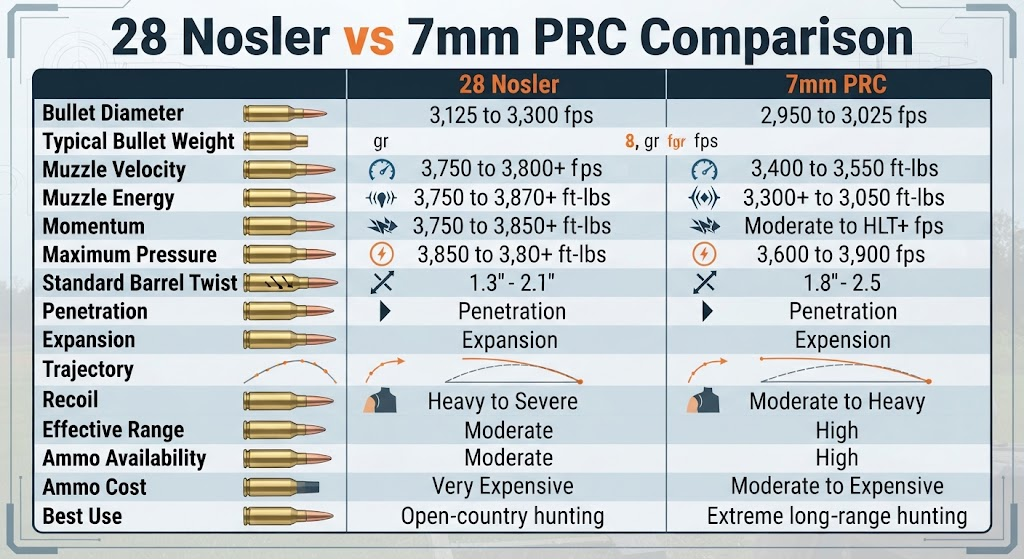
The comparison table highlights how case geometry dictates performance. The 28 Nosler burns massive amounts of slow-burning powder (often 80+ grains) in its fat, beltless case.This creates incredibly high chamber velocities, but at standard 3.340-inch overall lengths, very long modern bullets must be seated deep into the powder column, which takes up valuable case capacity unless custom extended-magazine boxes are installed.
The 7mm PRC features a slightly shorter 2.280-inch case body with a 30-degree shoulder, designed specifically so that when loaded to the same 3.340-inch standard action length, the base of modern high-BC projectiles sits neatly at the neck-shoulder junction. This modern geometry optimizes powder burn, prevents unpredictable pressure spikes, and allows standard off-the-shelf rifles to perfectly stabilize 180-grain class bullets out of the box.
28 Nosler vs 7mm PRC Ballistics
Both cartridges are apex predators built for western big-game hunting and extreme-distance shooting. To objectively evaluate the ballistic capabilities of the 28 Nosler against the 7mm PRC, we must examine real-world factory ammunition across heavy match and hunting loads.
- Load A (28 Nosler Standard Hunting): Nosler 160-grain AccuBond. Tested from a 26-inch barrel. Muzzle velocity is 3,300 feet per second. Muzzle energy is 3,869 foot-pounds. Ballistic Coefficient (G1) is 0.531.
- Load B (28 Nosler Long Range): Nosler 175-grain AccuBond Long Range (ABLR). Tested from a 26-inch barrel. Muzzle velocity is 3,125 feet per second.Muzzle energy is 3,794 foot-pounds. Ballistic Coefficient (G1) is 0.648.
- Load C (7mm PRC Precision Hunting): Hornady 175-grain ELD-X Precision Hunter. Tested from a 24-inch barrel. Muzzle velocity is 3,000 feet per second. Muzzle energy is 3,497 foot-pounds. Ballistic Coefficient (G1) is 0.689.
- Load D (7mm PRC Heavy Match): Hornady 180-grain ELD Match. Tested from a 24-inch barrel. Muzzle velocity is 2,975 feet per second. Muzzle energy is 3,537 foot-pounds. Ballistic Coefficient (G1) is 0.796.
Manufacturer-rated data is generally captured under controlled atmospheric conditions using standardized universal receiver barrels. Real-world velocities measured over a personal chronograph will vary depending on your specific firearm’s chamber tolerances, altitude, and barrel length.
28 Nosler vs 7mm PRC Velocity
Velocity is the undisputed calling card of the 28 Nosler. With a 160-grain bullet, it easily hits 3,300 feet per second, outrunning the 7mm PRC by roughly 250 to 300 fps.When launching identical heavy 175-grain bullets, the 28 Nosler maintains a distinct velocity advantage of approximately 125 to 150 fps over the 7mm PRC.
However, there is a physical cost to this speed. The 28 Nosler is massively overbore and requires a full 26-inch barrel to burn its massive powder charge efficiently. If a hunter chops a 28 Nosler down to a 22-inch or 24-inch barrel (which is highly popular for attaching suppressors), it loses 30 to 40 fps per inch, quickly falling to velocities that overlap directly with the 7mm PRC. The 7mm PRC utilizes a more compact and efficient powder column that performs exceptionally well even in shorter 22- to 24-inch barrels.
28 Nosler vs 7mm PRC Muzzle Energy
Muzzle energy represents the kinetic work capacity of a projectile. Because the 28 Nosler pushes identical bullet weights at significantly higher velocities, it dominates the muzzle energy category.
The 28 Nosler generates between 3,750 and 3,900 foot-pounds of kinetic energy at the muzzle. To put this into perspective, this puts the 7mm cartridge directly on par with full-power .300 Winchester Magnum loads, while utilizing narrower, more aerodynamically efficient projectiles.
The 7mm PRC generates roughly 3,400 to 3,550 foot-pounds of energy. While it gives up 300 to 400 foot-pounds of muzzle energy to the 28 Nosler, it easily exceeds the energy thresholds required to ethically take elk, moose, and large African plains game at extended ranges.
28 Nosler vs 7mm PRC Momentum
Momentum is a linear measurement calculating mass in motion. In terminal ballistics, high momentum correlates closely with the ability of a bullet to crush through dense bone, heavy winter hides, and thick shoulder muscles without being deflected or stopping prematurely inside the target cavity.
Because momentum relies equally on bullet weight and velocity, the faster 28 Nosler holds a measurable advantage over the 7mm PRC when firing identical bullet weights.
A 175-grain bullet traveling at 3,125 feet per second from a 28 Nosler yields approximately 78.1 pound-feet per second of linear momentum.
A 175-grain bullet traveling at 3,000 feet per second from a 7mm PRC yields approximately 75.0 pound-feet per second of linear momentum.
Both cartridges provide absolutely devastating momentum for 7mm projectiles, possessing the sheer driving force necessary to reliably track straight through heavy shoulder bones and anchor the absolute largest big game animals in North America.
28 Nosler vs 7mm PRC Trajectory
Understanding external ballistics and predictable bullet drop is critical for extreme long-range hunting. The aerodynamic efficiency (Ballistic Coefficient) of the modern, heavy bullets used in both cartridges makes them two of the flattest shooting commercial magnums in existence.
The calculations below assume a standard high-profile optic height of 1.5 inches above the bore and a clearly stated zero distance of 200 yards. We will compare the 175-grain Nosler ABLR against the 175-grain Hornady ELD-X to demonstrate their flight paths.
| Distance | 28 Nosler (175 gr ABLR at 3,125 fps) Drop | 7mm PRC (175 gr ELD-X at 3,000 fps) Drop |
| Muzzle | -1.5 inches | -1.5 inches |
| 200 Yards | 0.0 inches (Zero) | 0.0 inches (Zero) |
| 400 Yards | -16.0 inches | -17.2 inches |
| 600 Yards | -48.4 inches | -51.5 inches |
| 800 Yards | -118.0 inches | -125.7 inches |
| 1000 Yards | -228.5 inches | -241.0 inches |
Inside 600 yards, the 28 Nosler shoots slightly flatter due to its raw initial velocity advantage. However, the higher ballistic coefficient of modern 7mm PRC bullets helps close the trajectory gap as distance extends into the extreme long-range realm. At 1,000 yards, the 28 Nosler drops only 12.5 inches less than the 7mm PRC.
Wind deflection is the true test of an extreme long-range cartridge. Assuming a direct 10 mile per hour crosswind, the 175-grain 28 Nosler bullet will drift approximately 45.4 inches at 1,000 yards. The 175-grain 7mm PRC bullet, boasting a slightly better ballistic coefficient, will drift approximately 44.8 inches at the exact same distance. The 7mm PRC actually drifts less in the wind at a half-mile despite starting slower.
28 Nosler vs 7mm PRC Recoil
Recoil management is a major factor in rapid and accurate shooting. A shooter who flinches in anticipation of heavy recoil will inevitably pull their shots and miss the vital zone completely.
The 28 Nosler generates heavy, punishing recoil. Fired from a standard 8.5-pound hunting rifle, a full-power 175-grain load generates roughly 35 to 40 foot-pounds of free recoil energy. It has a sharp, violent recoil impulse and substantial muzzle blast due to the massive powder charge burning outside the muzzle. A highly efficient muzzle brake or a heavy rifle suppressor is practically mandatory to prevent shooter flinch.
The 7mm PRC generates significantly less recoil. Fired from an identical 8.5-pound hunting rifle, the 7mm PRC generates roughly 26 to 30 foot-pounds of free recoil energy. This represents roughly 25% less recoil than the 28 Nosler. It remains a heavy magnum impulse, but it is vastly easier to manage during extended range sessions and allows experienced shooters to spot their own bullet trace and impacts downrange through a magnified optic.
28 Nosler vs 7mm PRC Penetration
Terminal penetration is rigorously evaluated to ensure the ethical harvesting of game animals. A bullet must penetrate deep enough into soft tissue to reach critical cardiovascular structures regardless of the physical angle the target presents.
Because both cartridges fire heavy, high-sectional-density 7mm projectiles, they are both absolute penetration monsters. The 28 Nosler drives bullets faster, which generally results in slightly deeper penetration through heavy bone structures. However, at close ranges (inside 150 yards), the extreme hyper-velocity of the 28 Nosler can occasionally cause standard cup-and-core hunting bullets to over-expand and fragment prematurely before reaching the vitals. The slightly slower impact velocity of the 7mm PRC often provides more reliable, controlled straight-line penetration at close distances.
28 Nosler vs 7mm PRC Expansion
Bullet expansion dictates the diameter of the permanent wound channel inside the target. Wide expansion increases the likelihood of severing major arteries and causing rapid incapacitation through catastrophic blood loss.
Striking a target at over 3,000 feet per second generates immense hydraulic pressure on the nose of a polymer-tipped bullet. The 28 Nosler causes incredibly violent expansion and massive temporary stretch cavities upon impact. The 7mm PRC expands beautifully as well, though the slightly lower impact velocities generally result in a more controlled, classic mushroom shape that retains more of its core weight. Both cartridges will effortlessly expand premium hunting bullets out to 800 yards and beyond.
28 Nosler vs 7mm PRC Effective Range
The ethical effective range of a cartridge is determined by velocity retention, bullet drop predictability, and the minimum kinetic energy required to humanely kill the animal (typically 1,500 foot-pounds for elk).
Both cartridges are 1,000-yard capable hunting tools in the hands of elite marksmen. The 28 Nosler maintains 1,500 foot-pounds of kinetic energy out to approximately 900 yards. The 7mm PRC maintains 1,500 foot-pounds of kinetic energy out to approximately 850 yards. For extreme long-range target shooting on steel plates, the heavy, high-BC bullets allow both cartridges to remain supersonic and predictable well past one mile (1,760 yards).
28 Nosler vs 7mm PRC Self Defense
Neither the 28 Nosler nor the 7mm PRC is suitable for urban home defense. Firing a massive magnum rifle inside a residential hallway will cause immediate and permanent hearing damage due to the catastrophic concussive muzzle blast. Furthermore, both cartridges will effortlessly pass through an intruder, multiple interior drywall partitions, exterior walls, and continue flying into neighboring properties. The danger posed to innocent bystanders in an urban or suburban environment is extreme.
28 Nosler vs 7mm PRC Concealed Carry
Concealed carry with either the 28 Nosler or the 7mm PRC is physically impossible and entirely impractical. Both of these cartridges are massive centerfire rifle cartridges measuring roughly 3.340 inches in overall length. They require large long-action rifle receivers, heavy barrel contours, and substantial barrel lengths to safely contain their operating pressures. There are no practical handguns manufactured that can chamber these rounds for concealed carry.
Which Has More Stopping Power: 28 Nosler or 7mm PRC?
On large game animals like elk and moose, the 28 Nosler possesses slightly more instantaneous stopping power due to its raw velocity. Striking an animal with nearly 3,900 foot-pounds of kinetic energy creates a more violent temporary stretch cavity that induces rapid hydrostatic shock and massive tissue disruption. The 7mm PRC provides exceptional stopping power and deep penetration, but it cannot match the sheer blunt force trauma delivered by the faster Nosler cartridge at closer ranges.
Which Is More Powerful: 28 Nosler or 7mm PRC?
Power is defined quantitatively by kinetic energy and linear momentum calculations. Based on the laws of physics and the raw ballistic data, the 28 Nosler is vastly more powerful than the 7mm PRC.
The 28 Nosler generates roughly 3,750 to 3,900 foot-pounds of muzzle energy depending on the specific factory load. The 7mm PRC generates roughly 3,400 to 3,550 foot-pounds of muzzle energy. The 28 Nosler delivers over 300 more foot-pounds of kinetic energy to the target and boasts a massive advantage in linear momentum due to its faster muzzle velocity.
28 Nosler Pros and Cons
Pros
- Exceptional hyper-velocity provides an incredibly flat trajectory out to 500 yards, making long-range hits effortless
- Delivers massive kinetic energy, matching the performance of a .300 Winchester Magnum with a more aerodynamic bullet
- The ultimate western open-country hunting cartridge for taking massive bull elk at extended distances
- Fits perfectly into standard long-action receivers without requiring a specialized magnum length action
Cons
- Extreme velocities combined with massive powder charges significantly accelerate throat erosion, resulting in famously short barrel life (often 600 to 800 rounds)
- Ammunition is prohibitively expensive and heavily reliant on specialty hunting runs
- Generates severe, punishing recoil that requires a heavy rifle or an aggressive muzzle brake to manage comfortably
- Standard 1:9 factory twist rates are not optimized to stabilize the absolute heaviest 190+ grain 7mm match bullets
7mm PRC Pros and Cons
Pros
- Engineered specifically with tight chamber tolerances and a standardized fast 1:8 twist rate for the heaviest, highest-BC bullets on the market
- Highly efficient case design provides 94% of the 28 Nosler’s velocity with 25% less recoil and significantly longer barrel life
- Widespread availability of rifles and highly affordable ammunition from virtually every major manufacturer
- Case geometry ensures long bullets do not seat deeply into the powder column, guaranteeing highly consistent velocities
Cons
- Lacks the raw kinetic energy and hyper-velocity required to match the flat 500-yard trajectory of the 28 Nosler
- While efficient, it remains a heavy magnum cartridge that generates substantially more recoil than standard calibers like the 6.5 Creedmoor or .308 Winchester
Final Comparison
| Category | Winner | Reason |
| Velocity | 28 Nosler | Massive overbore powder capacity easily drives heavy bullets 150 fps faster |
| Muzzle Energy | 28 Nosler | Generates roughly 300 more ft-lbs of kinetic energy than the 7mm PRC |
| Momentum | 28 Nosler | Faster velocity applied to identical bullet weights yields superior linear momentum |
| Penetration | 7mm PRC | Slower impact velocity prevents premature bullet fragmentation at close ranges |
| Expansion | 28 Nosler | Higher impact velocities create more violent hydraulic pressure upon impact |
| Trajectory | 28 Nosler | Extreme velocity produces a significantly flatter curve out to 800 yards |
| Recoil Control | 7mm PRC | Highly efficient powder column generates roughly 25% less free recoil energy |
| Effective Range | Tie | Both confidently extend ethical hunting shots on elk out past 850 yards |
| Self Defense | Neither | Both present extreme over-penetration hazards in any residential setting |
| Concealed Carry | Neither | Both are massive rifle cartridges entirely unsuitable for concealment |
| Ammo Cost | 7mm PRC | Massive commercial adoption guarantees significantly cheaper retail price tags |
| Ammo Availability | 7mm PRC | Found in massive quantities in every sporting goods store nationwide |
| Overall Performance | Depends on Priority | 28 Nosler for raw speed and energy; 7mm PRC for efficiency and barrel life |
28 Nosler vs 7mm PRC: Which Should You Choose?
Selecting between the 28 Nosler and the 7mm PRC requires an honest practical assessment of your recoil tolerance, your ammunition budget, and how much you care about preserving barrel life.
Choose the 28 Nosler if you want the absolute fastest, hardest-hitting commercial 7mm cartridge on the market and do not mind heavy recoil, short barrel life, and expensive ammunition. It excels for western hunters who prioritize flat point-blank trajectories inside 500 yards on elk and open-country game. If you want .300 Winchester Magnum energy combined with 7mm aerodynamics, the 28 Nosler is an absolute hammer in the field.
Choose the 7mm PRC if you want a modern, balanced, and highly accurate long-range system. It delivers roughly 94% of the Nosler’s velocity with 25% less recoil, vastly longer barrel life, standardized fast-twist barrels, and significantly cheaper, widely available ammunition. It is a masterpiece of modern cartridge engineering that provides virtually identical wind drift characteristics at 1,000 yards while remaining much friendlier on your shoulder and your wallet.
FAQs
Is 28 Nosler more powerful than 7mm PRC?
Yes, the 28 Nosler is significantly more powerful. It generates approximately 300 more foot-pounds of muzzle energy and substantially higher linear momentum than the 7mm PRC due to its massive case capacity and higher velocities.
Which has more muzzle energy?
The 28 Nosler easily generates over 3,750 foot-pounds of muzzle energy with standard hunting loads. The 7mm PRC generates roughly 3,400 to 3,550 foot-pounds of muzzle energy depending on the bullet weight.
Which has more stopping power?
The 28 Nosler provides superior instantaneous stopping power on large game animals like elk and moose due to its higher velocity and massive kinetic energy transfer, ensuring rapid incapacitation.
Which has more recoil?
The 28 Nosler produces noticeably more recoil. Fired from a standard lightweight hunting rifle, the 28 Nosler generates roughly 35 to 40 foot-pounds of free recoil energy, whereas the 7mm PRC generates a more manageable 26 to 30 foot-pounds of recoil.
Which has better penetration?
The 7mm PRC often penetrates slightly deeper and more consistently at close ranges. Its slightly slower impact velocity prevents standard cup-and-core hunting bullets from over-expanding and fragmenting prematurely upon hitting heavy bone.
Which expands more?
Because it travels at a higher velocity, a premium 28 Nosler expanding bullet will generally experience more violent hydraulic pressure upon impact, leading to wider expansion and a more devastating temporary stretch cavity.
Which has a flatter trajectory?
The 28 Nosler has a significantly flatter trajectory. The extreme velocity of the 28 Nosler allows it to drop roughly 10 inches less than the 7mm PRC at the 800-yard marker.
Which is better for self defense?
Neither cartridge is suitable for civilian home defense due to the extreme danger of severe over-penetration through residential walls and the blinding, deafening muzzle blast indoors.
Which is better for concealed carry?
Neither. Both are large centerfire rifle cartridges fired from long, heavy rifles that absolutely cannot be concealed on the human body.
Is 28 Nosler faster than 7mm PRC?
Yes, the 28 Nosler is substantially faster. The 28 Nosler typically launches a heavy 175-grain bullet at roughly 3,125 fps, while the 7mm PRC launches the identical 175-grain bullet at roughly 3,000 fps.
Is 28 Nosler stronger than 7mm PRC?
Yes, in terms of sheer kinetic energy, powder capacity, and momentum crushing through tissue, the 28 Nosler is drastically stronger than the 7mm PRC.
Which is cheaper to shoot?
The 7mm PRC is significantly cheaper to shoot. Because it has seen massive commercial adoption by major manufacturers like Hornady, highly affordable match and hunting ammunition is widely available.
Can a 7mm PRC shoot 28 Nosler?
No. They are completely different calibers with vastly different case geometries. Attempting to chamber or fire a 7mm PRC in a 28 Nosler rifle is extremely dangerous.
Which is easier to shoot?
The 7mm PRC is drastically easier to shoot due to its milder recoil impulse, making it highly preferred for shooters who want extreme long-range performance without developing a severe flinch.
Which should you choose?
Choose the 28 Nosler for absolute maximum speed, kinetic energy, and a laser-flat trajectory inside 500 yards. Choose the 7mm PRC for superior efficiency, longer barrel life, manageable recoil, and modern fast-twist performance.