A 400 Legend bullet drop chart provides the essential trajectory data needed for hunting in straight-walled cartridge states. Your exact bullet drop relies entirely on the specific ammunition load, bullet weight, muzzle velocity, ballistic coefficient, chosen zero distance, and environmental conditions. By reviewing a reliable ballistic chart, hunters can understand the severe trajectory limitations of this heavy projectile and make necessary optic adjustments. The chart below details the critical flight metrics needed to effectively hunt with this specialized heavy-hitting cartridge.
400 Legend Bullet Drop Chart
| Distance (Yards) | Velocity (fps) | Energy (ft-lbs) | Bullet Drop (Inches) | Drop (MOA) | Drop (MIL) |
| 50 | 2025 | 1957 | +0.2 | 0.0 | 0.0 |
| 100 | 1815 | 1573 | 0.0 | 0.0 | 0.0 |
| 150 | 1620 | 1253 | -2.7 | 1.7 | 0.5 |
| 200 | 1445 | 997 | -8.8 | 4.2 | 1.2 |
| 250 | 1290 | 794 | -19.0 | 7.3 | 2.1 |
| 300 | 1160 | 642 | -34.8 | 11.1 | 3.2 |
The parameters for the table above are based on standard ballistic data for the highly popular Winchester 215-grain Power-Point load. This provides an incredibly reliable baseline for modern deer hunting with the .400 Legend.
Ballistic Parameters:
- Ammunition Load: Winchester Power-Point .400 Legend
- Bullet Weight & Type: 215-grain Power-Point (Soft Point)
- Muzzle Velocity: 2250 feet per second (fps)
- Ballistic Coefficient (G1): 0.220
- Zero Distance: 100 Yards
- Sight Height: 1.5 inches above bore
- Test Barrel Length: 20 inches
- Environmental Assumptions: Sea level altitude, 59 degrees Fahrenheit
Note: Velocity and energy figures are sourced from standard manufacturer ballistic charts for this specific load. Drop figures and extended data out to 300 yards are calculated using a 0.220 ballistic coefficient under standard atmospheric conditions. Extended distances are included to demonstrate the severe drop of straight-walled cartridges.
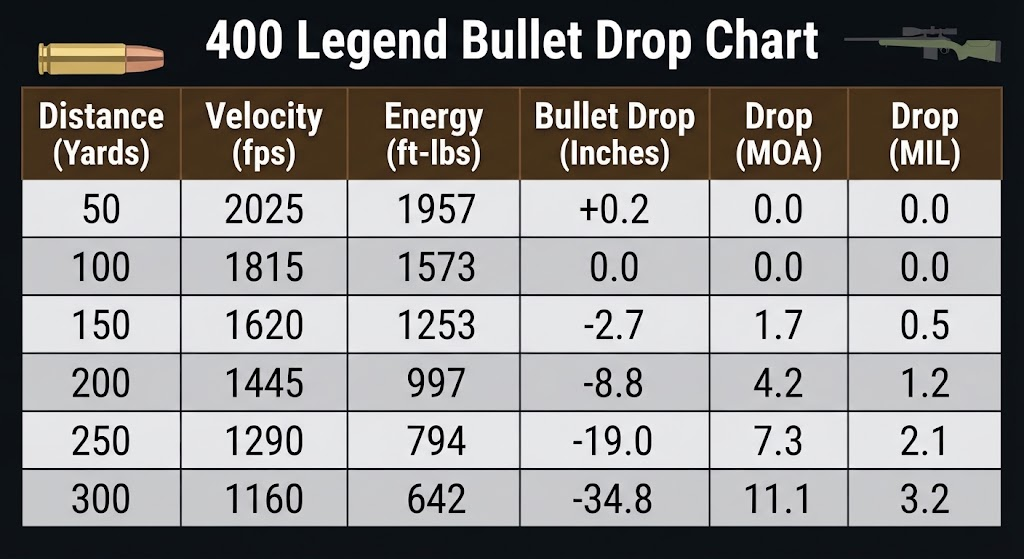
Understanding The 400 Legend Bullet Drop Chart
400 Legend Bullet Drop At 100 Yards
At 100 yards, the heavy 215-grain projectile reaches its zero distance. It perfectly intersects your line of sight, resulting in zero bullet drop. The bullet travels at 1815 fps and retains a massive 1573 foot-pounds of energy. A 100-yard zero is the absolute standard for the .400 Legend, providing a clean mathematical baseline for calculating holds at slightly longer hunting distances in dense woods.
400 Legend Bullet Drop At 150 Yards
When the bullet reaches 150 yards, the trajectory begins to arc downward. The projectile drops 2.7 inches below the center line. Shooters will need to hold slightly high or dial 1.7 MOA. Retaining 1253 foot-pounds of energy, the bullet easily delivers the kinetic shock needed to cleanly harvest a large whitetail deer or feral hog. This represents the optimal maximum range for many casual hunters using this cartridge.
400 Legend Bullet Drop At 200 Yards
At 200 yards, the .400 Legend demonstrates the ballistic limitations of straight-walled cartridges. The bullet drops 8.8 inches, requiring a deliberate elevation correction of 4.2 MOA or 1.2 MIL. Velocity slows to 1445 fps, and kinetic energy sits right at the 1000 foot-pound threshold. Careful shot placement is required at this distance, as the bullet is losing the energy necessary for massive tissue damage.
400 Legend Bullet Drop At 250 Yards
Crossing into 250 yards, the heavy, blunt bullet plunges rapidly. It falls 19.0 inches below the line of sight. A shooter must compensate by dialing 7.3 MOA or 2.1 MIL. The energy drops to 794 foot-pounds, which is well below the 1000 foot-pound minimum recommended for ethical deer hunting. Crosswinds also severely push the un-aerodynamic bullet off target at this range.
400 Legend Bullet Drop At 300 Yards
At 300 yards, the bullet drop steepens significantly to 34.8 inches. You will need a precise elevation adjustment of 11.1 MOA or 3.2 MIL. The velocity drops to 1160 fps, and energy falls to just 642 foot-pounds. Hunting medium game at this distance is highly discouraged. The .400 Legend simply does not possess the speed, aerodynamic efficiency, or retained energy to guarantee a clean harvest at 300 yards.
Frequently Asked Questions
What factors change my 400 Legend bullet drop chart?
Your personal trajectory will vary depending on your specific ammunition and rifle configuration. A shorter 16-inch barrel will produce a lower muzzle velocity than a 20-inch barrel, which directly increases bullet drop at every distance. Environmental factors also play a massive role. Cold, dense winter air will increase drag on the already inefficient bullet, causing it to drop even faster during late season hunts.
How does the 400 Legend compare to the 350 Legend?
Both are straight-walled cartridges designed for specific state hunting regulations, but they serve slightly different needs. The .400 Legend fires a heavier, wider bullet and delivers roughly 20 percent more kinetic energy than the .350 Legend. This gives the .400 Legend a distinct advantage in knockdown power for larger deer or black bear. However, both cartridges suffer from poor aerodynamic efficiency and experience very similar bullet drop once they pass 200 yards.
What is the best zero distance for a 400 Legend rifle?
A 100-yard zero is the standard and most highly recommended zero for a .400 Legend rifle. Because the cartridge sheds velocity so rapidly, setting a 100-yard zero ensures your bullet is never more than a couple of inches above or below your line of sight for the vast majority of practical hunting distances. Attempting to use a 200-yard zero will cause the bullet to impact far too high at 100 yards, which can easily result in a missed shot.
What is the maximum effective hunting range for the 400 Legend?
The effective hunting range of the .400 Legend is generally limited to 200 yards. For medium game like deer, experts recommend a minimum of 1000 foot-pounds of energy upon impact to ensure a quick and ethical harvest. Looking at standard ballistic data, a 215-grain .400 Legend bullet falls below this critical threshold just past the 200-yard mark.