A 6.5 Creedmoor bullet drop chart provides the precise trajectory data required for long-range target shooting and ethical hunting. Your actual bullet drop depends heavily on the specific ammunition load, bullet weight, muzzle velocity, ballistic coefficient, your chosen zero distance, and environmental conditions. By reviewing established ballistic tables, shooters can make fast and accurate optic adjustments to compensate for gravity over extended distances. The chart below details the critical flight metrics needed to master this incredibly popular modern cartridge.
6.5 Creedmoor Bullet Drop Chart
| Distance (Yards) | Velocity (fps) | Energy (ft-lbs) | Bullet Drop (Inches) | Drop (MOA) | Drop (MIL) |
| 100 | 2574 | 2059 | 0.0 | 0.0 | 0.0 |
| 200 | 2442 | 1853 | -3.8 | 1.8 | 0.5 |
| 300 | 2314 | 1664 | -13.2 | 4.2 | 1.2 |
| 400 | 2189 | 1490 | -28.9 | 6.9 | 2.0 |
| 500 | 2069 | 1330 | -51.7 | 9.9 | 2.9 |
| 600 | 1952 | 1184 | -82.4 | 13.1 | 3.8 |
| 700 | 1839 | 1051 | -122.0 | 16.6 | 4.8 |
| 800 | 1730 | 930 | -171.7 | 20.5 | 6.0 |
The parameters for the table above are based on standard ballistic data for the highly popular Hornady 140-grain ELD Match load. This provides an incredibly reliable baseline for modern precision shooting with the 6.5 Creedmoor cartridge.
Ballistic Parameters:
- Ammunition Load: Hornady 140-grain ELD Match
- Bullet Weight & Type: 140-grain Extremely Low Drag Match (Polymer Tip Boat Tail)
- Muzzle Velocity: 2710 feet per second (fps)
- Ballistic Coefficient (G1): 0.646
- Zero Distance: 100 Yards
- Sight Height: 1.5 inches above bore
- Test Barrel Length: 24 inches
- Environmental Assumptions: Sea level altitude, 59 degrees Fahrenheit
Note: Velocity and energy figures are sourced from standard manufacturer ballistic charts for this specific load. Drop figures and extended data out to 800 yards are established ballistic calculations based on the 0.646 ballistic coefficient under standard atmospheric conditions.
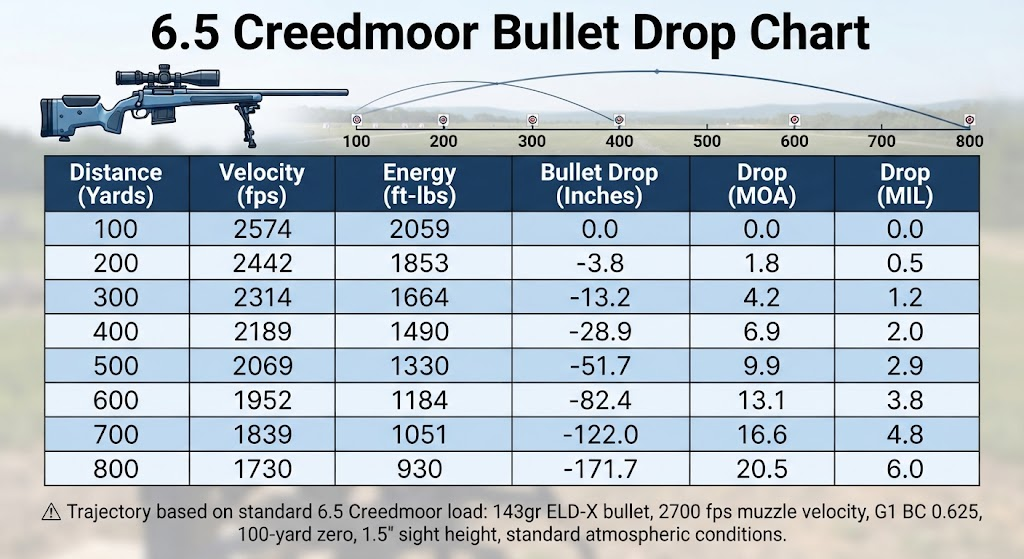
Understanding The 6.5 Creedmoor Bullet Drop Chart
6.5 Creedmoor Bullet Drop At 100 Yards
At 100 yards, the 140-grain projectile reaches its zero distance. It perfectly intersects your line of sight, resulting in exactly zero bullet drop. The bullet travels at 2574 fps and retains 2059 foot-pounds of energy. A 100-yard zero is the absolute standard for precision rifles, providing a clean mathematical baseline for dialing turrets at extreme distances.
6.5 Creedmoor Bullet Drop At 200 Yards
When the bullet reaches 200 yards, the exceptional aerodynamic efficiency of the 6.5 Creedmoor becomes apparent. It drops a mere 3.8 inches, requiring a small correction of 1.8 MOA or 0.5 MIL. Retaining over 1850 foot-pounds of energy, this distance is incredibly forgiving for both target shooters and hunters pursuing medium game.
6.5 Creedmoor Bullet Drop At 300 Yards
At 300 yards, the trajectory arcs slightly with a drop of 13.2 inches. Shooters will need to dial 4.2 MOA or hold over 1.2 MIL on their reticle. Velocity remains high at 2314 fps, and the kinetic energy sits at a robust 1664 foot-pounds. Thanks to the high ballistic coefficient, the bullet resists wind drift beautifully at this range compared to traditional cartridges.
6.5 Creedmoor Bullet Drop At 400 Yards
Crossing into 400 yards, the bullet falls 28.9 inches. Shooters must compensate by dialing 6.9 MOA or 2.0 MIL. The 140-grain projectile still carries 1490 foot-pounds of energy. This is a very common hunting distance for modern western hunters, as the bullet retains plenty of lethal energy and the flat trajectory makes accurate shot placement highly repeatable.
6.5 Creedmoor Bullet Drop At 500 Yards
At 500 yards, the bullet drop reaches 51.7 inches. You will need a precise elevation adjustment of 9.9 MOA or 2.9 MIL. The energy drops to 1330 foot-pounds, which is well above the minimum threshold required for cleanly harvesting deer and antelope. The projectile’s ability to maintain supersonic speed and stability at this distance is exactly why precision shooters love the caliber.
6.5 Creedmoor Bullet Drop At 600 Yards
Reaching 600 yards firmly places the shooter in long-range territory. The bullet plunges 82.4 inches, demanding an elevation shift of 13.1 MOA or 3.8 MIL. Velocity sits at 1952 fps, and energy drops to 1184 foot-pounds. Hitting steel targets at 600 yards is relatively easy with the 6.5 Creedmoor, provided the shooter has accurate environmental data and a solid understanding of wind calls.
Frequently Asked Questions
What factors change my 6.5 Creedmoor bullet drop chart?
Your specific bullet drop will shift based on your exact ammunition and rifle setup. A barrel shorter than 24 inches will yield a lower muzzle velocity, which increases bullet drop at every distance. Environmental factors like high altitude, warm temperatures, and low barometric pressure reduce air density. Thinner air allows your bullet to experience less drag, causing it to fly flatter and faster than it would at sea level.
How does a 120-grain 6.5 Creedmoor compare to a 140-grain bullet?
A lighter 120-grain bullet leaves the muzzle faster, offering a slightly flatter trajectory and less bullet drop out to roughly 400 yards. However, lighter bullets typically have lower ballistic coefficients. Past 500 yards, the heavier 140-grain bullet retains its velocity much better, resists wind drift far more effectively, and ultimately provides superior accuracy and energy retention for long-range shooting.
What is the best zero distance for a 6.5 Creedmoor rifle?
A 100-yard zero is the standard and highly recommended zero for a 6.5 Creedmoor precision rifle. Because this cartridge is designed for dialing turrets at long ranges, starting with a flat 100-yard baseline makes calculating dope for 800 or 1000 yards mathematically simpler. Some dedicated hunters prefer a 200-yard zero to maximize their point blank range, but target shooters almost universally stick to 100 yards.
Why is the 6.5 Creedmoor so popular for long-range shooting?
The popularity of the 6.5 Creedmoor comes from its combination of mild recoil and incredibly high ballistic coefficients. The long, slender 6.5mm bullets slice through the air with minimal drag. This allows the bullet to retain its velocity over massive distances and resist being blown off course by crosswinds. It provides trajectory performance similar to a .300 Winchester Magnum but with half the felt recoil.