A muzzleloader bullet drop chart provides the essential trajectory data required for accurate black powder and modern inline muzzleloading hunts. Your exact bullet drop relies heavily on your specific powder charge, bullet or sabot weight, muzzle velocity, ballistic coefficient, chosen zero distance, and environmental conditions. Because muzzleloading projectiles are often heavy and have lower ballistic coefficients than modern centerfire rifle rounds, they experience a steep trajectory arc past 100 yards. Reviewing a reliable ballistic chart helps hunters make the necessary scope adjustments to ensure a clean harvest.
Muzzleloader Bullet Drop Chart
| Distance (Yards) | Velocity (fps) | Energy (ft-lbs) | Bullet Drop (Inches) | Drop (MOA) | Drop (MIL) |
|---|---|---|---|---|---|
| 50 | 1650 | 1515 | +1.2 | -2.3 | -0.7 |
| 100 | 1485 | 1228 | 0.0 | 0.0 | 0.0 |
| 150 | 1335 | 992 | -5.5 | 3.5 | 1.0 |
| 200 | 1198 | 799 | -17.2 | 8.2 | 2.4 |
| 250 | 1079 | 648 | -37.0 | 14.1 | 4.1 |
| 300 | 980 | 534 | -67.2 | 21.4 | 6.2 |
The parameters for the table above are based on standard ballistic data for a popular modern inline muzzleloader using a 250-grain sabot bullet pushed by a heavy 150-grain black powder substitute charge (such as Triple Seven). This provides an excellent and widely applicable baseline for modern white-tailed deer hunting setups.
Ballistic Parameters:
- Ammunition Load: Modern Inline Sabot Load
- Bullet Weight & Type: 250-grain AeroTip / Polymer Tip Sabot
- Muzzle Velocity: 1800 feet per second (fps)
- Ballistic Coefficient (G1):0.190
- Zero Distance: 100 Yards
- Sight Height: 1.5 inches above bore
- Test Barrel Length: 28 inches
- Environmental Assumptions: Sea level altitude, 59 degrees Fahrenheit
Note: Velocity and energy figures are sourced from standard manufacturer ballistic charts for high-charge inline loads. Drop figures and extended data out to 300 yards are calculated using a 0.190 ballistic coefficient under standard atmospheric conditions.
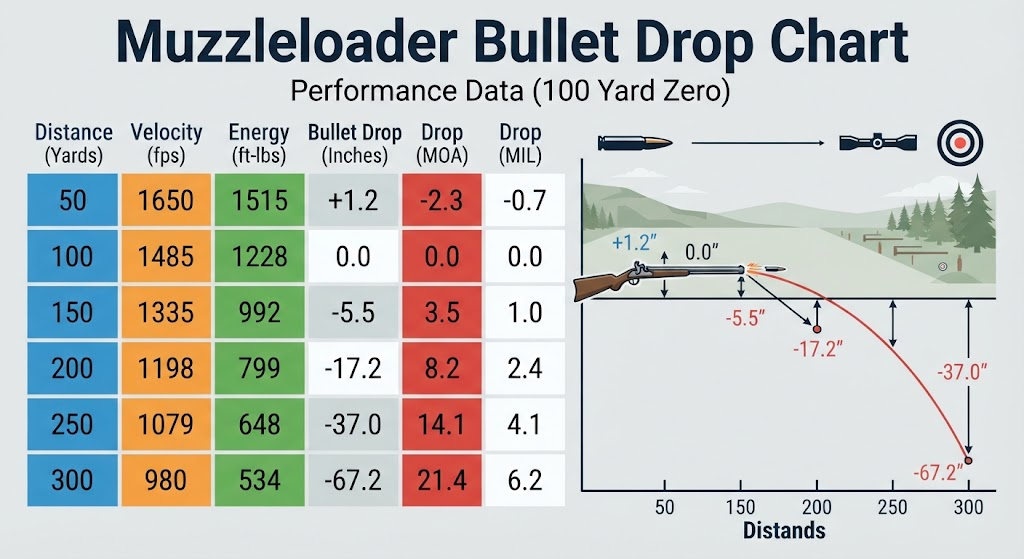
Understanding The Muzzleloader Bullet Drop Chart
Muzzleloader Bullet Drop At 50 Yards
At 50 yards, the 250-grain projectile sits approximately 1.2 inches above your line of sight when utilizing a 100-yard zero due to the height of the scope over the bore and the initial upward angle of the trajectory. It travels at 1650 fps and carries a massive 1515 foot-pounds of energy. This close range represents the traditional timber hunting distance where stopping power is absolute.
Muzzleloader Bullet Drop At 100 Yards
When the bullet reaches 100 yards, it intersects your optic’s line of sight perfectly, resulting in zero bullet drop. The velocity slows to 1485 fps, and kinetic energy sits at 1228 foot-pounds. This is the gold standard zeroing distance for almost all modern muzzleloaders, providing a reliable and straightforward baseline for the majority of forest and field shots.
Muzzleloader Bullet Drop At 150 Yards
At 150 yards, the trajectory requires a noticeable holdover as the bullet drops 5.5 inches below the center line. You will need to make an elevation correction of 3.5 MOA or 1.0 MIL. Velocity drops to 1335 fps, and energy falls to 992 foot-pounds. This distance marks the outer edge of comfortable ethical hunting for many traditional setups, as energy dips just below the standard 1000 foot-pound threshold.
Muzzleloader Bullet Drop At 200 Yards
Crossing into 200 yards, the heavy sabot projectile plunges 17.2 inches below the line of sight. A shooter must compensate by dialing 8.2 MOA or 2.4 MIL. The energy drops to 799 foot-pounds. While modern inline muzzleloaders paired with magnified scopes can hit steel targets at 200 yards and beyond, the severe bullet drop and rapid loss of velocity make ethical big game hunting difficult at this range.
Frequently Asked Questions
What factors change my muzzleloader bullet drop chart?
Your specific bullet drop will vary drastically depending on your powder charge. A maximum magnum charge of 150 grains yields higher velocity and a flatter trajectory, while a traditional 90-grain or 100-grain charge drops much faster. Bullet weight also plays a major role; heavy 300-grain bullets start slower and drop significantly more than lighter 250-grain bullets. Environmental factors like cold winter temperatures can also alter your powder’s burn rate and change your point of impact.
How does a traditional sidelock muzzleloader compare to a modern inline?
Modern inline muzzleloaders are designed to handle much higher powder pressures (often up to 150 grains of loose powder or three 50-grain pellets), allowing them to achieve muzzle velocities around 1800 to 2000 fps. Traditional sidelock or flintlock muzzleloaders typically use lower powder charges and shoot patched round balls or old-style conicals at slower speeds (around 1200 to 1400 fps). This results in a much more severe rainbow trajectory, limiting traditional muzzleloaders to effective shots under 75 to 100 yards.
What is the best zero distance for a muzzleloader?
A 100-yard zero is the standard and most widely recommended zero for a modern inline muzzleloader. It keeps the bullet’s flight path within a few inches of your line of sight from the muzzle out to roughly 125 yards, making it ideal for deer hunting. Some hunters utilizing high-velocity modern loads prefer a 125-yard zero to slightly extend their point-blank range, but 100 yards keeps the math simple in the field.
What is the maximum effective hunting range for a muzzleloader?
For medium game like whitetail deer, wildlife experts generally recommend a minimum of 1000 foot-pounds of energy upon impact to ensure a quick and ethical harvest. Looking at standard ballistic data for a 250-grain sabot, the projectile drops below this energy threshold right around 125 to 150 yards. While the gun can certainly shoot further, 150 yards is widely considered the practical maximum ethical hunting range for standard muzzleloading configurations.