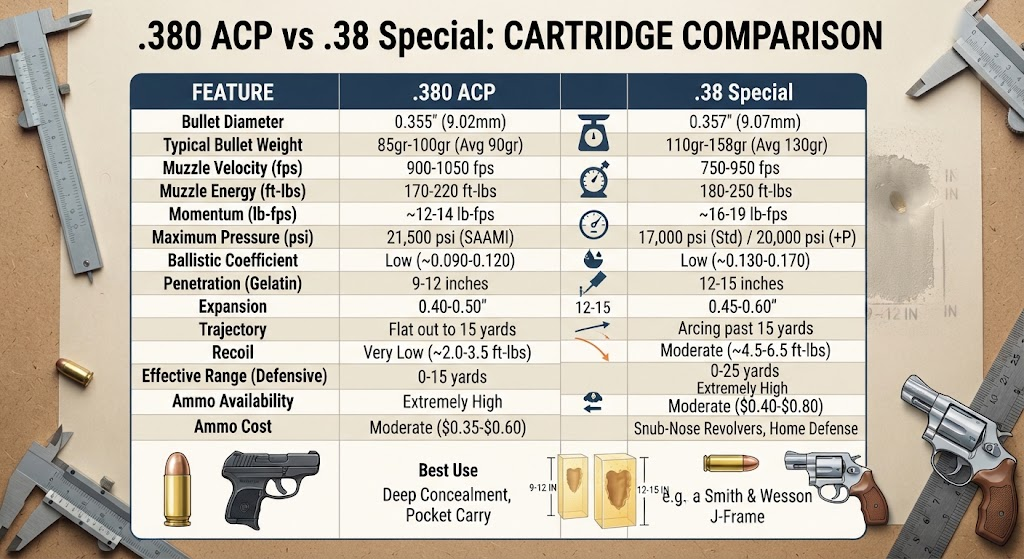
The main difference between the cartridges is that the .380 ACP is a rimless cartridge designed specifically for compact semi-automatic pistols that utilizes lightweight bullets to provide moderate recoil and higher magazine capacity, whereas the .38 Special is a rimmed cartridge designed for revolvers that relies on heavy bullets to achieve reliable penetration despite its lower capacity.
380 vs 38 special Comparison
| Feature | .380 ACP | .38 Special |
| Bullet Diameter | 0.355 inches (9.02 mm) | 0.357 inches (9.07 mm) |
| Typical Bullet Weight | 85 gr to 100 gr (typically 90 gr or 95 gr) | 110 gr to 158 gr (typically 130 gr or 158 gr) |
| Muzzle Velocity | 900 to 1,050 fps (2.5 to 3.5-inch barrel) | 750 to 950 fps (2-inch barrel) |
| Muzzle Energy | 170 to 220 ft-lbs | 180 to 250 ft-lbs |
| Momentum | ~12 to ~14 lb-fps (depending on load) | ~16 to ~19 lb-fps (depending on load) |
| Maximum Pressure | 21,500 psi (SAAMI) | 17,000 psi (Standard) / 20,000 psi (+P) |
| Ballistic Coefficient | Low (~0.090 to 0.120) | Low (~0.130 to 0.170) |
| Penetration | 9 to 12 inches (Gelatin) | 12 to 15 inches (Gelatin) |
| Expansion | 0.40 to 0.50 inches | 0.45 to 0.60 inches |
| Trajectory | Flat out to 15 yards | Arcing past 15 yards |
| Recoil | Very low (~2.0 to 3.5 ft-lbs in micro pistols) | Moderate (~4.5 to 6.5 ft-lbs in light revolvers) |
| Effective Range | 0 to 15 yards (Defensive) | 0 to 25 yards (Defensive) |
| Ammo Availability | Extremely High (Global civilian standard) | Extremely High (Global civilian standard) |
| Ammo Cost | Moderate ($0.35 to $0.60 per round) | Moderate ($0.40 to $0.80 per round) |
| Best Use | Deep concealment, pocket carry, low recoil handguns | Snub-nose revolvers, backup guns, home defense |
The table above outlines the foundational differences between an early twentieth-century semi-automatic pistol cartridge and one of the most prolific revolver cartridges in human history. To understand the 380 vs 38 special comparison, we must recognize that they were created for entirely different mechanical platforms. The .380 ACP (Automatic Colt Pistol) was designed by John Moses Browning in 1908 for Colt. Browning needed a cartridge that was powerful enough for self defense but operated at a low enough pressure to function safely in simple blowback semi-automatic pistols. By limiting the case length and using a 0.355-inch diameter bullet, he created a highly compact, rimless cartridge. Today, the .380 ACP is the absolute gold standard for micro-compact pocket pistols. The .38 Special, officially named the .38 Smith and Wesson Special, was introduced in 1898. It was originally a black powder cartridge designed to replace the weak .38 Long Colt. It utilizes a long, rimmed brass case that seats perfectly into the rotating cylinder of a revolver. Operating at a low maximum pressure of 17,000 psi, the .38 Special relies on heavy bullet mass rather than extreme velocity to achieve its terminal ballistics. For decades, it served as the primary duty weapon cartridge for American law enforcement, and today it remains the definitive cartridge for five-shot concealed carry snub-nose revolvers.
380 vs 38 special Ballistics
To objectively evaluate the 380 vs 38 special ballistics, we must examine real-world factory ammunition across their most common defensive applications. The most critical factor in this comparison is barrel length. The vast majority of .380 ACP ammunition is carried in micro-compact semi-automatic pistols featuring barrels measuring 2.5 to 3.5 inches. The vast majority of .38 Special ammunition carried for concealed self defense is utilized in snub-nose revolvers featuring barrels measuring roughly 1.875 to 2 inches long.
To provide a highly researched and accurate representation of what a civilian actually carries, we will compare premium defensive hollow points fired from realistic short barrels.
- Load A (.380 ACP): Speer 90-grain Gold Dot Jacketed Hollow Point. Tested from a short concealed carry barrel. Muzzle velocity is 918 feet per second. Muzzle energy is roughly 168 foot-pounds.
- Load B (.380 ACP): Hornady 90-grain Critical Defense FTX. Tested from a short concealed carry barrel. Muzzle velocity is 970 feet per second. Muzzle energy is 188 foot-pounds.
- Load C (.38 Special +P): Speer 135-grain Gold Dot Short Barrel Jacketed Hollow Point. Tested from a 2-inch barrel. Muzzle velocity is 860 feet per second. Muzzle energy is 222 foot-pounds.
- Load D (.38 Special +P): Federal Premium 125-grain Hi-Shok Jacketed Hollow Point. Tested from a 2-inch barrel. Muzzle velocity is 847 feet per second. Muzzle energy is approximately 199 foot-pounds.
The data reveals that despite their massive differences in cartridge size and firearm platforms, their final kinetic output from short barrels is remarkably similar, with the .38 Special providing slightly heavier bullet mass.
380 vs 38 special Velocity
Velocity is a critical metric for handgun ammunition. It determines how flat a projectile shoots and serves as the primary mechanical catalyst that forces fluid into the hollow point cavity to initiate expansion upon striking soft tissue. If a bullet travels too slowly, the hollow cavity can plug with heavy clothing like denim, turning the projectile into a solid drill that fails to expand.
The 380 vs 38 special velocity comparison favors the .380 ACP slightly when fired from typical carry guns. The .380 ACP operates at a SAAMI maximum pressure of 21,500 psi. Because it is fired from a semi-automatic pistol, the barrel has an integrated chamber, meaning no gas is lost during ignition. A standard 90-grain .380 ACP bullet easily achieves 900 to 1,000 feet per second from a short pocket pistol barrel. This speed is generally sufficient to guarantee reliable expansion from modern hollow point designs.
The .38 Special suffers from a phenomenon known as the cylinder gap. There is a microscopic physical space between the rotating cylinder that holds the ammunition and the forcing cone of the barrel. When a round is fired in a revolver, a noticeable amount of high-pressure expanding gas escapes out the sides of this gap before it can push the bullet down the barrel. When you combine this gas bleed with a microscopic 2-inch barrel and a low operating pressure of 17,000 psi, the .38 Special struggles to build speed. Standard pressure 130-grain or 158-grain bullets often exit the muzzle at a very slow 750 to 850 feet per second. To achieve reliable velocity from a snub-nose revolver, shooters often must utilize higher pressure +P ammunition or lighter 110-grain bullets.
380 vs 38 special Muzzle Energy
Muzzle energy represents the kinetic work capacity of a projectile. Because kinetic energy relies heavily on velocity, the faster .380 ACP competes surprisingly well against the much larger .38 Special case.
The 380 vs 38 special energy figures clearly illustrate that both cartridges belong in the backup or deep concealment power tier. A top-tier .380 ACP load generates roughly 170 to 220 foot-pounds of muzzle energy. A standard .38 Special load fired from a snub-nose revolver generates roughly 200 to 250 foot-pounds of muzzle energy.
Neither cartridge generates the 350 to 400 foot-pounds of energy typically associated with full-size duty calibers like the 9mm Luger. A shooter relying on either the .380 ACP or the .38 Special for personal protection must recognize that kinetic energy is limited. Neither cartridge produces enough velocity to induce the high-speed hydrostatic shockwaves seen in rifle cartridges. They rely entirely on crushing tissue directly in their physical path, making perfect shot placement the absolute most critical factor in stopping a threat.
380 vs 38 special Momentum
Momentum is a linear measurement of mass in motion. In terminal ballistics, high momentum correlates closely with the ability of a bullet to crush through dense bone, heavy winter clothing, and intermediate barriers without being deflected or stopping prematurely inside the target.
This is the category where the massive difference in bullet weight becomes the deciding factor.
A 90-grain .380 ACP bullet traveling at 1,000 feet per second yields approximately 12.8 pound-feet per second of linear momentum.
A 135-grain .38 Special bullet traveling at 860 feet per second yields roughly 16.6 pound-feet per second of momentum. If a shooter opts for a heavy 158-grain standard pressure bullet traveling at 800 feet per second, the momentum jumps to 18.0 pound-feet per second.
The .38 Special hits harder and pushes through resistance much more efficiently. The .380 ACP utilizes very lightweight bullets that can sometimes struggle to break through heavy bone or thick leather jackets while maintaining enough driving force to reach vital cardiovascular organs. The .38 Special overcomes its lack of velocity by relying on sheer brute mass to plow through tissue.
380 vs 38 special Trajectory
Because both cartridges are utilized almost exclusively in short-barreled defensive handguns for close-quarters protection, extreme long-range trajectory is rarely a primary concern. Handgun bullets are ballistically blunt and shed velocity rapidly, making them poor tools for long-range marksmanship.
The calculations below assume a standard pistol sight height of 0.75 inches above the bore and a clearly stated zero distance of 15 yards. We will compare a 90-grain .380 ACP load against a 135-grain .38 Special load.
| Distance | .380 ACP (90 gr at 1,000 fps) Drop | .38 Special (135 gr at 860 fps) Drop |
| Muzzle | -0.75 inches | -0.75 inches |
| 10 Yards | -0.1 inches | -0.2 inches |
| 15 Yards | 0.0 inches (Zero) | 0.0 inches (Zero) |
| 25 Yards | -0.8 inches | -1.2 inches |
| 50 Yards | -5.5 inches | -7.4 inches |
Both cartridges possess trajectories that are perfectly adequate for civilian self defense. At 25 yards, the bullet drop for both calibers is around one inch, which means a shooter can place their sights exactly where they want to hit on a human-sized target and guarantee a strike. Beyond 25 yards, the heavier, slower .38 Special bullet drops more rapidly, but engaging a threat at 50 yards with a pocket pistol or a snub-nose revolver is an extreme anomaly in civilian defensive scenarios.
380 vs 38 special Recoil
Recoil management is the single most significant factor in rapid and accurate defensive shooting. The 380 vs 38 special recoil is heavily influenced by the weight of the firearm, the mass of the powder charge, the weight of the bullet, and the mechanical action of the gun.
The .380 ACP is highly regarded for its low recoil. However, because it is almost exclusively chambered in ultra-lightweight micro-pistols weighing between 10 and 15 ounces, the felt recoil can be surprisingly snappy. Fired from a 12-ounce pocket pistol, a standard 90-grain .380 ACP load generates roughly 3.5 foot-pounds of free recoil energy. The reciprocating slide of the semi-automatic pistol absorbs a portion of the recoil impulse by compressing the recoil spring, which softens the blow to the hand.
The .38 Special fired from a lightweight snub-nose revolver is a completely different, and often more painful, experience. Most pocket revolvers feature aluminum or polymer frames and weigh roughly 14 to 16 ounces. Because revolvers have a fixed barrel and cylinder, there is no reciprocating slide to absorb energy. One hundred percent of the recoil force is driven straight back into the web of the shooter hand. A 135-grain .38 Special +P load fired from a 15-ounce revolver generates roughly 6.0 foot-pounds of free recoil energy. This creates a sharp, stinging slap in the palm that often induces severe flinching in novice shooters, causing them to pull their shots low and to the side under stress.
380 vs 38 special Penetration
Terminal penetration is rigorously evaluated using calibrated 10 percent ordnance gelatin, which simulates the density and resistance of human soft tissue. The Federal Bureau of Investigation standard dictates that a defensive bullet must penetrate a minimum of 12 inches and a maximum of 18 inches to reliably reach vital organs from any angle without posing a severe over-penetration risk to innocent bystanders.
The 380 vs 38 special penetration debate is a major point of contention in the firearms community. When tested side by side, the .38 Special generally performs slightly better in depth.
The .380 ACP often struggles to meet the FBI 12-inch minimum requirement when loaded with rapidly expanding hollow points. Because the bullet is incredibly light and lacks momentum, an aggressive hollow point acts like a parachute, slowing the bullet down rapidly and often halting its penetration around 10 or 11 inches. To ensure adequate penetration, many shooters carry specialized .380 ACP ammunition like the Hornady Critical Defense, or they opt for solid non-expanding bullets which utilize fluid displacement to cause damage while guaranteeing up to 18 inches of straight-line penetration.
The .38 Special easily passes the FBI protocol when loaded with high-quality ammunition. The heavier bullet mass ensures that the projectile retains its forward momentum even after passing through heavy winter coats or dense bone. A premium 135-grain .38 Special hollow point will reliably penetrate 13 to 14.5 inches in bare gelatin and heavy clothing, making it the more reliable choice for taking quartering-away shots on an attacker.
380 vs 38 special Expansion
Bullet expansion dictates the diameter of the permanent wound channel inside the target. Wide expansion increases the likelihood of severing major arteries and causing rapid incapacitation through catastrophic blood loss.
When analyzing 380 vs 38 special expansion, both cartridges must overcome the limitations of their short barrels. A bullet requires velocity to force fluid into the hollow cavity.
A standard 90-grain .380 ACP premium hollow point fired from a 3-inch barrel will typically expand to a final diameter of roughly 0.40 to 0.47 inches. Some incredibly well-engineered modern loads can reach 0.50 inches, but achieving wide expansion almost always results in a sacrifice of penetration depth.
A high-quality 135-grain .38 Special hollow point fired from a snub-nose revolver will typically expand to roughly 0.47 to 0.55 inches. The .38 Special starts at a slightly wider diameter and contains significantly more lead mass to peel back, generally resulting in a wider, heavier expanded mushroom than the .380 ACP.
380 vs 38 special Effective Range
The 380 vs 38 special effective range is practically identical. The effective range of a defensive cartridge is determined by the intersection of velocity retention, bullet drop, and the mechanical accuracy of the firearm platform.
Both cartridges are strictly close-quarters weapons. The incredibly short sight radius on both pocket pistols and snub-nose revolvers makes hitting targets beyond 15 yards very difficult under stress. Furthermore, the heavy double-action trigger pull of most revolvers, combined with the microscopic grips on most .380 semi-autos, requires immense shooter discipline to maintain accuracy at distance. The optimal defensive range of both platforms is realistically limited to 3 to 7 yards, stretching to 15 yards for highly capable shooters.
380 vs 38 special Self Defense
When choosing a platform for home defense or daily carry, practical firearm considerations heavily influence the 380 vs 38 special self defense comparison.
The .380 ACP offers a clear advantage in ammunition capacity and reload speed. Most modern micro-compact .380 ACP pistols hold six or seven rounds in the magazine, plus one in the chamber. Some slightly larger models hold ten rounds or more. If a defender empties the firearm, slamming a fresh magazine into the grip takes mere seconds. The downside is that semi-automatic pistols can suffer from limp-wristing malfunctions if the shooter fails to maintain a perfectly rigid grip under panic.
The .38 Special is severely limited in capacity. Standard small-frame concealed carry revolvers hold exactly five rounds of ammunition. Reloading a revolver under life-threatening stress using loose rounds or a speedloader requires fine motor skills that degrade massively during an adrenaline dump. However, revolvers are practically immune to contact malfunctions and shooter-induced feeding errors. If a primer fails to ignite, the shooter simply pulls the trigger a second time to fire the next round.
380 vs 38 special Concealed Carry
Both cartridges excel in the realm of deep concealment.
The .380 ACP is the undisputed king of modern pocket pistols. Firearms chambered for this round are often less than an inch thick and weigh under 11 ounces fully loaded. They sit incredibly flat against the body in inside-the-waistband holsters and disappear completely into the front pocket of a pair of jeans, making them highly popular for everyday carry.
The .38 Special snub-nose revolver remains fiercely competitive due to its organic, rounded shape. While the rotating cylinder is thicker than a semi-automatic slide, the rounded edges break up visual profiling incredibly well. More importantly, a hammerless snub-nose revolver can be fired from completely inside a jacket pocket multiple times without the fabric jamming a reciprocating slide. This unmatched close-quarters reliability makes the .38 Special a favorite for backup ankle holsters and winter coat pockets.
Which Has More Stopping Power: 380 or 38 special?
Stopping power is a non-scientific term generally used to describe the ability of a cartridge to quickly incapacitate a biological threat through blood loss or central nervous system disruption.
The .38 Special generally possesses slightly more stopping power than the .380 ACP. While the 380 vs 38 special stopping power debate is heavily nuanced, the combination of a heavier bullet, deeper terminal penetration, and reliable expansion gives the .38 Special an edge in crushing a larger volume of tissue and reaching vital cardiovascular organs through heavy clothing. The .380 ACP is certainly lethal and highly effective, but its lightweight bullets occasionally lack the momentum required for optimal penetration depth.
Which Is More Powerful: 380 or 38 special?
Power is defined quantitatively by kinetic energy and linear momentum.
Based on the raw data, the .38 Special is the more powerful cartridge, especially when loaded to +P specifications. While a standard pressure .38 Special and a high-velocity .380 ACP produce nearly identical muzzle energy from short barrels, the .38 Special generates significantly more linear momentum due to its massive bullet weight advantage. When encountering heavy resistance like bone or thick fabric, the heavier mass of the .38 Special delivers more blunt force power to the target.
.380 ACP Pros and Cons
Pros
- Exceptional portability; firearms are incredibly thin, lightweight, and easy to conceal in any wardrobe
- Higher magazine capacity compared to five-shot revolvers, allowing for more defensive opportunities before reloading
- Reloading is incredibly fast and efficient using standard detachable box magazines
- Very manageable recoil impulse in slightly larger frames encourages regular practice and faster follow-up shots
Cons
- Lightweight bullets occasionally fail to meet the FBI 12-inch minimum penetration standard when utilizing aggressive hollow points
- Tiny micro-compact grips can be difficult for shooters with large hands to control under stress
- Semi-automatic pistols can malfunction if pressed directly into an object or if the shooter fails to maintain a rigid wrist
.38 Special Pros and Cons
Pros
- Exceptional reliability in close-quarters physical struggles where semi-auto slides can be pushed out of battery
- Can be fired multiple times from completely inside a jacket pocket without jamming
- Heavy bullets ensure deep, reliable straight-line penetration through heavy clothing and bone
- Double-action revolvers are simple to operate under extreme panic with no external safeties to disengage
Cons
- Severely limited ammunition capacity, typically holding only five rounds
- Produces sharp, painful recoil when fired from lightweight 15-ounce aluminum or polymer pocket revolvers
- Reloading under extreme stress with speedloaders requires complex fine motor skills and significant practice
- Short barrels rob the cartridge of velocity, requiring premium +P ammunition to guarantee expansion
Final Comparison
| Category | Winner | Reason |
| Velocity | .380 ACP | Operates at higher pressures in closed chambers to drive light bullets faster |
| Muzzle Energy | Tie | Both produce roughly 170 to 230 ft-lbs from their respective short barrels |
| Momentum | .38 Special | Heavy 130-grain to 158-grain bullets carry superior linear driving mass |
| Penetration | .38 Special | High momentum ensures reliable 12 to 15 inch gelatin penetration |
| Expansion | .38 Special | Contains more lead mass to peel back into a wider final profile |
| Trajectory | .380 ACP | Flatter shooting curve out to 25 yards due to high initial speed |
| Recoil Control | .380 ACP | Slide reciprocation absorbs energy, creating a softer impulse than a revolver |
| Effective Range | Tie | Both are restricted to 0 to 15 yards due to short barrels and small sights |
| Self Defense | Depends on User | .380 ACP for capacity and reloads; .38 Special for absolute mechanical reliability |
| Concealed Carry | Tie | Both fit effortlessly into deep concealment holsters and pockets |
| Ammo Cost | .380 ACP | Massive civilian semi-auto popularity provides slightly cheaper bulk practice |
| Ammo Availability | Tie | Found on the shelves of virtually every sporting goods store worldwide |
| Overall Performance | .38 Special | Superior terminal ballistics, penetration, and momentum for personal protection |
380 vs 38 special: Which Should You Choose?
Selecting between the .380 ACP and the .38 Special requires an honest assessment of your daily wardrobe, your willingness to practice complex reloading drills, and your physical recoil tolerance.
Choose the .380 ACP if you prioritize deep concealment in restrictive clothing, require a higher ammunition capacity, and want the ability to reload your firearm in seconds. The exceptionally thin profile of modern .380 pocket pistols makes them the easiest guns in the world to carry every single day. If you choose this caliber, ensure you test your defensive hollow points to verify they penetrate deep enough, or opt for modern fluid-displacement solid copper projectiles.
Choose the .38 Special if you prioritize absolute mechanical reliability, deep terminal penetration, and simplicity of use under panic. The snub-nose revolver is a point-and-shoot tool that ignores limp-wristing and contact malfunctions, making it the ultimate backup gun or close-quarters defensive weapon. You must be willing to accept a five-round capacity limitation and endure the sharp recoil that comes with firing heavy bullets from a lightweight frame.
FAQs
Is 380 more powerful than 38 special?
No. While they share similar kinetic energy from short barrels, the .38 Special generates much higher momentum and provides significantly deeper penetration due to its heavy bullet mass.
Which has more muzzle energy?
From typical concealed carry barrel lengths, both hover between 170 and 230 foot-pounds. A .38 Special loaded to +P pressures can occasionally exceed 240 foot-pounds, giving it a slight edge.
Which has more stopping power?
The .38 Special has superior practical stopping power due to its heavy bullet mass, which ensures deep, reliable penetration through thick clothing and wider permanent wound channels.
Which has more recoil?
The .38 Special produces noticeably sharper and more painful recoil when fired from an identical lightweight frame because revolvers do not have a reciprocating slide to absorb the rearward energy.
Which has better penetration?
The .38 Special penetrates deeper and more consistently in ballistic gelatin compared to the lightweight .380 ACP bullets, which often struggle to surpass 12 inches if they expand rapidly.
Which expands more?
Because it contains significantly more lead and copper mass, a premium .38 Special hollow point will generally expand to a wider, heavier final diameter than the much smaller .380 ACP projectile.
Which has a flatter trajectory?
The .380 ACP shoots noticeably flatter inside of 25 yards because it travels several hundred feet per second faster than a standard .38 Special.
Which is better for self defense?
The .380 ACP is better for shooters wanting higher capacity and fast reloads, while the .38 Special is better for shooters wanting absolute mechanical reliability and deep tissue penetration.
Which is better for concealed carry?
Both are the absolute gold standard for deep concealed carry. The .380 ACP is thinner and easier to hide in a pocket, while the .38 Special organic shape breaks up printing very well.
Is 380 faster than 38 special?
Yes, the .380 ACP easily achieves 950 to 1,050 feet per second from short barrels, whereas the heavy bullets of the .38 Special typically remain subsonic between 750 and 850 feet per second.
Is 38 special stronger than 380?
In terms of kinetic impact, momentum, and bullet mass crushing through tissue, the .38 Special is the stronger cartridge, even though it operates at a lower internal chamber pressure.
Which is cheaper to shoot?
The .380 ACP is generally slightly cheaper to shoot due to the massive global popularity of semi-automatic pocket pistols, allowing for very affordable bulk practice ammunition.
Can a 380 shoot 38 special?
No. They are completely different calibers with different chamber dimensions. A semi-automatic .380 pistol cannot chamber rimmed revolver cartridges.
Which is easier to shoot?
The .380 ACP is drastically easier to shoot due to its semi-automatic slide absorbing recoil, allowing for faster follow-up shots and less pain during practice sessions.
Which should you choose?
Choose the .380 ACP for high-capacity, ultra-thin pocket carry and fast reloads. Choose the .38 Special for heavy bullet penetration, extreme mechanical reliability, and classic snub-nose performance.