The main difference between the cartridges is that the .22 ARC utilizes a shorter, fatter case (based on the 6.5 Grendel) to pack more powder behind heavy .22 caliber bullets to achieve higher velocities from the AR-15 platform, whereas the .224 Valkyrie utilizes a slightly narrower case (based on the 6.8 SPC) to achieve similar long-range ballistics while generating slightly less bolt thrust, though it often falls marginally short of the ARC’s raw speed.
Both cartridges represent the firearms industry’s quest to turn the standard AR-15 into a legitimate 1,000-yard precision rifle using .22 caliber (0.224-inch) projectiles. For decades, long-range shooters knew that heavy, high-Ballistic Coefficient (BC) .22 caliber bullets (weighing 75 to 90 grains) could aggressively resist wind drift. However, seating these incredibly long bullets into a standard .223 Remington case meant pushing the bullet so deep that it crushed the powder column, crippling velocity.
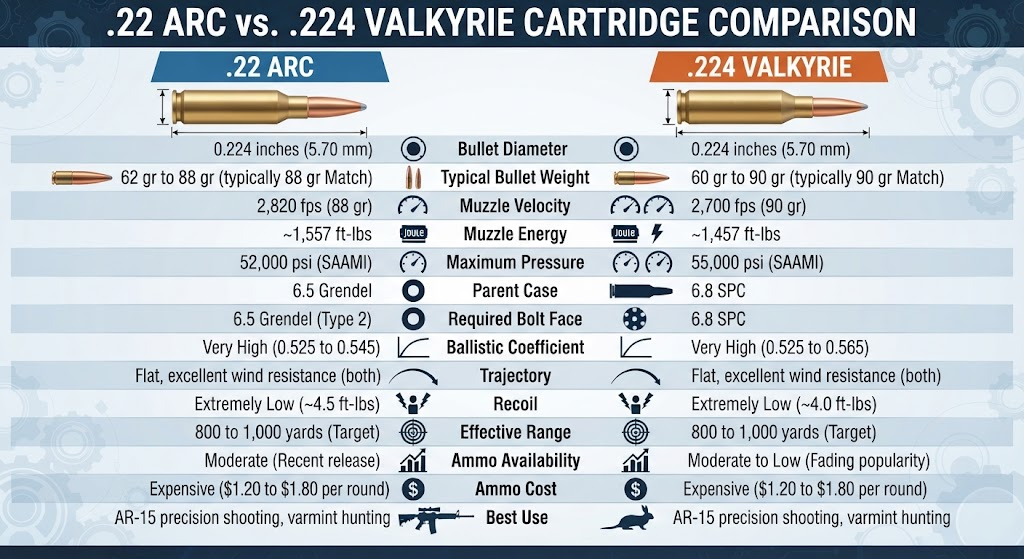
22 ARC vs 224 Valkyrie Comparison
| Feature | .22 ARC | .224 Valkyrie |
| Bullet Diameter | 0.224 inches (5.70 mm) | 0.224 inches (5.70 mm) |
| Typical Bullet Weight | 62 gr to 88 gr (typically 88 gr Match) | 60 gr to 90 gr (typically 90 gr Match) |
| Muzzle Velocity | 2,820 fps (88 gr from 24-inch barrel) | 2,700 fps (90 gr from 24-inch barrel) |
| Muzzle Energy | ~1,557 ft-lbs | ~1,457 ft-lbs |
| Momentum | ~35.4 lb-fps | ~34.7 lb-fps |
| Maximum Pressure | 52,000 psi (SAAMI) | 55,000 psi (SAAMI) |
| Ballistic Coefficient | Very High (0.525 to 0.545) | Very High (0.525 to 0.565) |
| Parent Case | 6.5 Grendel | 6.8 SPC |
| Required Bolt Face | 6.5 Grendel (Type 2) | 6.8 SPC |
| Trajectory | Flat, excellent wind resistance | Flat, excellent wind resistance |
| Recoil | Extremely Low (~4.5 ft-lbs) | Extremely Low (~4.0 ft-lbs) |
| Effective Range | 800 to 1,000 yards (Target) | 800 to 1,000 yards (Target) |
| Ammo Availability | Moderate (Recent release) | Moderate to Low (Fading popularity) |
| Ammo Cost | Expensive ($1.20 to $1.80 per round) | Expensive ($1.20 to $1.80 per round) |
| Best Use | AR-15 precision shooting, varmint hunting | AR-15 precision shooting, varmint hunting |
The table above details the incredibly close mechanical similarities between the two cartridges. Because the .22 ARC utilizes the 6.5 Grendel case, it has a slightly larger internal water capacity (roughly 34 grains compared to the Valkyrie’s 31 grains). However, because the Grendel case has a wider case head, it removes more steel from the AR-15 bolt lugs. To prevent bolt lug shearing, SAAMI restricted the .22 ARC to a maximum pressure of 52,000 psi. The .224 Valkyrie, utilizing the narrower 6.8 SPC case head, leaves thicker bolt lugs and is permitted to operate at 55,000 psi. Despite the pressure advantage, the raw volume of the ARC case generally allows it to win the velocity race.
22 ARC vs 224 Valkyrie Ballistics
To objectively evaluate the ballistic capabilities of the .22 ARC against the .224 Valkyrie, we must examine real-world factory ammunition across their most common applications in precision target shooting and predator hunting.
For a fair comparison reflecting their maximum potential, all loads listed below are recorded from standard 24-inch test barrels. Shooters utilizing 18-inch tactical barrels will see noticeably lower velocities from both cartridges.
- Load A (.22 ARC Heavy Match): Hornady 88-grain ELD Match. Tested from a 24-inch barrel. Muzzle velocity is 2,820 feet per second. Muzzle energy is 1,557 foot-pounds. Ballistic Coefficient (G1) is 0.545.
- Load B (.22 ARC Varmint): Hornady 62-grain ELD-VT. Tested from a 24-inch barrel. Muzzle velocity is 3,300 feet per second. Muzzle energy is 1,499 foot-pounds. Ballistic Coefficient (G1) is 0.395.
- Load C (.224 Valkyrie Heavy Match): Federal Premium 90-grain Sierra MatchKing. Tested from a 24-inch barrel. Muzzle velocity is 2,700 feet per second. Muzzle energy is 1,457 foot-pounds. Ballistic Coefficient (G1) is 0.563.
- Load D (.224 Valkyrie Varmint): Federal Premium 60-grain Nosler Ballistic Tip. Tested from a 24-inch barrel. Muzzle velocity is 3,300 feet per second. Muzzle energy is 1,451 foot-pounds. Ballistic Coefficient (G1) is 0.267.
22 ARC vs 224 Valkyrie Velocity
Velocity dictates how flat a projectile shoots across unknown distances. High initial velocity also drastically reduces the time of flight to the target, which is critical when shooting at 1,000 yards.
When evaluating heavy match loads, the .22 ARC holds a distinct advantage. Pushing an 88-grain bullet at 2,820 feet per second, it outruns the .224 Valkyrie’s 90-grain load (2,700 fps) by roughly 120 feet per second. While a 2-grain difference in bullet weight accounts for a tiny fraction of that speed difference, the .22 ARC’s larger powder column simply generates more horsepower.
When dropping down to lightweight varmint bullets (roughly 60 grains), both cartridges achieve a blistering 3,300 feet per second from a 24-inch barrel, successfully replicating the historical performance of the .22-250 Remington in a semi-automatic platform.
22 ARC vs 224 Valkyrie Muzzle Energy
Muzzle energy represents the kinetic work capacity of a projectile. Because both cartridges fire identical-diameter projectiles at very similar speeds, their energy outputs are virtually indistinguishable in the field.
The .22 ARC produces roughly 1,500 to 1,560 foot-pounds of energy at the muzzle. The .224 Valkyrie produces roughly 1,450 to 1,460 foot-pounds of energy. The .22 ARC holds a mathematical advantage of roughly 100 foot-pounds due to its slightly higher velocity with heavy bullets, but this difference is not practically measurable when striking a coyote or a steel plate.
22 ARC vs 224 Valkyrie Momentum
Momentum is a linear measurement calculating mass in motion. High momentum correlates closely with the ability of a bullet to crush through bone or intermediate barriers without being deflected.
Because both cartridges utilize identically constructed .22 caliber bullets weighing roughly 90 grains, their momentum profiles are nearly identical.
An 88-grain bullet traveling at 2,820 feet per second (.22 ARC) yields approximately 35.4 pound-feet per second of linear momentum.
A 90-grain bullet traveling at 2,700 feet per second (.224 Valkyrie) yields approximately 34.7 pound-feet per second of linear momentum.
Neither cartridge possesses the heavy momentum of a true big-game hunting caliber (like a .308 Winchester), but both carry enough mass to reliably anchor predators and ring heavy steel targets at extended ranges.
22 ARC vs 224 Valkyrie Trajectory
Understanding external ballistics and predictable bullet drop is the entire reason these cartridges exist. The calculations below assume a standard rifle optic height of 1.5 inches above the bore and a zero distance of 200 yards. We will compare the heavy match loads designed for 1,000-yard shooting.
| Distance | .22 ARC (88 gr at 2,820 fps) Drop | .224 Valkyrie (90 gr at 2,700 fps) Drop |
| Muzzle | -1.5 inches | -1.5 inches |
| 200 Yards | 0.0 inches (Zero) | 0.0 inches (Zero) |
| 400 Yards | -21.2 inches | -23.7 inches |
| 600 Yards | -67.1 inches | -74.9 inches |
| 800 Yards | -144.5 inches | -161.4 inches |
| 1000 Yards | -262.1 inches | -293.5 inches |
The trajectory data confirms that the .22 ARC shoots significantly flatter due to its higher initial velocity. At 1,000 yards, the .22 ARC drops over 30 inches less than the .224 Valkyrie. This means the ARC requires less vertical elevation dialed into the riflescope to hit the same target.
Assuming a direct 10 mile per hour crosswind, the 88-grain .22 ARC bullet will drift approximately 73.5 inches at 1,000 yards. The 90-grain .224 Valkyrie bullet will drift approximately 74.5 inches at the exact same distance. Despite the Valkyrie bullet possessing a marginally higher BC, the ARC’s superior velocity gets the bullet to the target faster, giving the wind less time to push it off course.
22 ARC vs 224 Valkyrie Recoil
Recoil management is a major factor in rapid follow-up shots. A shooter who flinches will inevitably pull their shots.
Both cartridges are considered practically recoilless. Fired from a standard 8-pound AR-15, both cartridges generate roughly 4.0 to 4.5 foot-pounds of free recoil energy. The gas system and heavy buffer spring of the AR-15 absorb so much rearward energy that shooters can effortlessly watch their own bullet impacts strike the target through a highly magnified optic.
22 ARC vs 224 Valkyrie Effective Range
For precision target shooting on steel plates, both cartridges are completely capable of making consistent hits out to 1,000 yards, as their heavy bullets remain supersonic past that distance. The .22 ARC simply requires slightly less holdover to do so.
For ethical hunting applications on predators (coyotes, bobcats), both cartridges are highly effective out to 500 or 600 yards. Neither cartridge is widely recommended for medium game like deer due to their small caliber and lightweight projectiles, and many states legally prohibit .22 caliber centerfires for deer hunting regardless of energy levels.
22 ARC vs 224 Valkyrie Self Defense & Concealed Carry
Neither cartridge is optimal for standard urban home defense. The extreme velocities of these lightweight bullets present severe over-penetration hazards through standard drywall construction, and the muzzle blast from an 18-inch or 16-inch AR-15 barrel indoors is deafening. Both cartridges are centerfire rifle rounds, making them physically impossible to conceal on the body.
Which Has More Stopping Power: 22 ARC or 224 Valkyrie?
Their stopping power is functionally identical. Both rely on .224-inch diameter expanding or fragmenting bullets striking at roughly 3,000 fps (or 2,700 fps for heavy match loads). On coyotes and small predators, they deliver massive, identical hydrostatic shock and instantaneous incapacitation.
Which Is More Powerful: 22 ARC or 224 Valkyrie?
Based on the raw data, the .22 ARC is slightly more powerful. It generates roughly 100 more foot-pounds of kinetic energy at the muzzle and drives heavy bullets roughly 100 to 120 fps faster than the .224 Valkyrie.
.22 ARC Pros and Cons
Pros
- Generates roughly 100 to 120 fps more velocity with heavy match bullets compared to the Valkyrie.
- Flatter trajectory at 1,000 yards requires less scope elevation adjustment.
- Backed by Hornady’s massive marketing and continuous ammunition development cycle.
Cons
- Requires a specialized 6.5 Grendel bolt face which removes more steel from the bolt lugs, theoretically reducing bolt lifespan under heavy firing schedules.
- Operates at a slightly lower maximum pressure limit (52,000 psi) due to the bolt lug constraints.
.224 Valkyrie Pros and Cons
Pros
- Utilizes the 6.8 SPC bolt face, which leaves thicker bolt lugs for a stronger mechanical lockup in the AR-15.
- Operates at a higher SAAMI maximum pressure (55,000 psi).
- Exceptionally accurate and perfectly capable of 1,000-yard target engagements.
Cons
- Suffered from severe early-adoption issues involving incorrect factory barrel twist rates, heavily damaging its reputation at launch.
- Commercial support is fading rapidly as manufacturers pivot to newer cartridges like the .22 ARC and 6mm ARC.
Final Comparison
| Category | Winner | Reason |
| Velocity | .22 ARC | Larger case capacity effortlessly drives heavy bullets faster |
| Muzzle Energy | .22 ARC | Generates roughly 100 more ft-lbs of kinetic energy |
| Momentum | .22 ARC | Faster velocity applied to similar bullet weights yields superior momentum |
| Penetration | Tie | Both provide identical penetration based on specific bullet construction |
| Expansion | Tie | Both expand massively depending entirely on specific bullet construction |
| Trajectory | .22 ARC | Higher velocity produces a significantly flatter curve out to 1,000 yards |
| Recoil Control | Tie | Both generate almost zero felt recoil (~4.0 to 4.5 ft-lbs) |
| Effective Range | Tie | Both remain supersonic and predictable out past 1,000 yards |
| Ammo Cost | Tie | Both are premium modern cartridges carrying expensive retail price tags |
| Ammo Availability | .22 ARC | Currently receiving much stronger commercial support from manufacturers |
| Overall Performance | .22 ARC | Superior velocity, flatter trajectory, and stronger industry backing |
22 ARC vs 224 Valkyrie: Which Should You Choose?
Choose the .22 ARC.
While the .224 Valkyrie was a brilliant concept that paved the way for modern heavy-bullet .22 caliber AR-15s, it suffered from severe launch issues (specifically, many early rifles shipped with 1:7 twist barrels that failed to stabilize the heaviest 90-grain bullets, ruining accuracy). The industry has largely moved on.
The .22 ARC offers a slightly larger engine room, delivering faster velocities and a flatter trajectory at 1,000 yards. More importantly, it currently has the massive marketing and manufacturing weight of Hornady behind it, ensuring that factory ammunition, brass, and rifle components will be widely available for the foreseeable future.