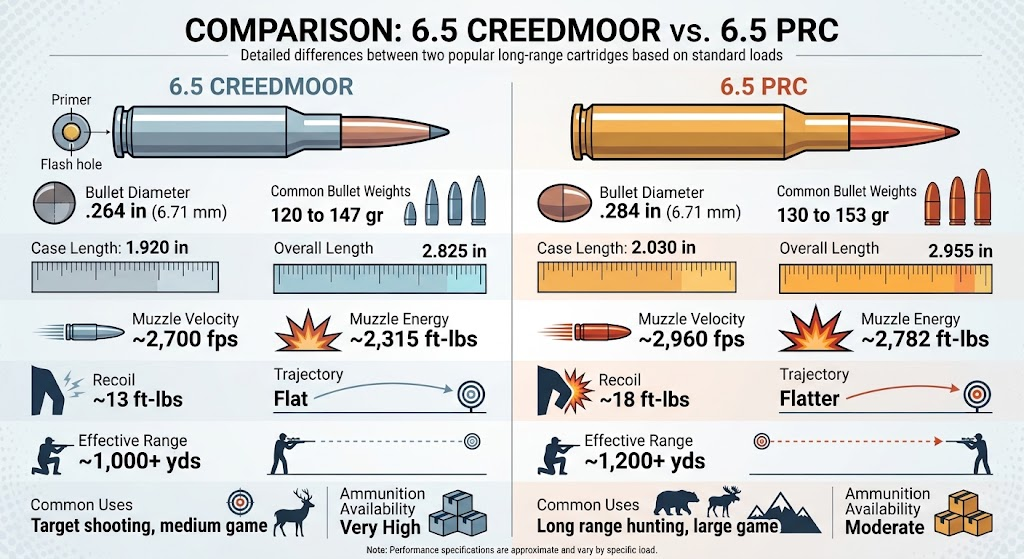
The 6.5 Creedmoor and 6.5 PRC both fire the same .264 caliber bullets, but the 6.5 PRC utilizes a larger case capacity to achieve higher velocities and flatter trajectories. The 6.5 Creedmoor is built for low recoil and high efficiency in short action rifles, while the 6.5 PRC is a modern magnum cartridge designed for extended range performance.
6.5 Creedmoor vs 6.5 PRC: Main Difference
| Feature | 6.5 Creedmoor | 6.5 PRC |
| Bullet Diameter | .264 inches | .264 inches |
| Common Bullet Weights | 120 to 147 grains | 130 to 153 grains |
| Case Length | 1.920 inches | 2.030 inches |
| Overall Length | 2.825 inches | 2.955 inches |
| Muzzle Velocity | ~2,700 fps | ~2,960 fps |
| Muzzle Energy | ~2,315 ft-lbs | ~2,782 ft-lbs |
| Recoil | ~13 ft-lbs | ~18 ft-lbs |
| Trajectory | Flat | Flatter |
| Effective Range | 1,000+ yards | 1,200+ yards |
| Common Uses | Target shooting, medium game | Long range hunting, large game |
| Ammunition Availability | Very High | Moderate |
The main difference is case capacity, allowing the 6.5 PRC to push identical bullets up to 250 feet per second faster and deliver significantly more energy downrange.
6.5 Creedmoor vs 6.5 PRC: Key Differences
- Bullet weight: Both cartridges utilize identical bullet diameters, but the PRC can comfortably stabilize heavier 147 to 153 grain bullets.
- Velocity: The difference in velocity is noticeable, with the PRC averaging 200 to 250 feet per second faster than the Creedmoor across similar bullet weights.
- Energy: Due to higher powder volume, the PRC hits harder at all distances compared to the standard Creedmoor.
- Trajectory: The PRC shoots flatter over longer distances, where the Creedmoor requires more elevation adjustment.
- Recoil: The 6.5 Creedmoor produces about 30 percent less recoil compared to the heavier push of the PRC.
- Range: The PRC stays supersonic further downrange, where the Creedmoor drops into transonic speeds sooner.
- Case size: The PRC features a wider magnum style case that holds significantly more powder.
- Rifle size: Both fit in short action receivers, but the PRC requires a magnum bolt face compared to a standard bolt face.
- Ammunition availability: 6.5 Creedmoor ammunition is abundant globally, where PRC loads are more specialized and sometimes harder to find in local stores.
- Hunting applications: The Creedmoor excels for medium game, where the PRC provides more kinetic energy and confidence on larger animals.
6.5 Creedmoor vs 6.5 PRC Ballistics
Data based on Hornady Precision Hunter 143 gr ELD-X factory loads fired from a 24 inch test barrel. Drop calculated with a 200 yard zero.
| Load | Bullet Weight | Muzzle Velocity | Muzzle Energy | 200 yd | 300 yd | 500 yd |
| Hornady 6.5 Creedmoor | 143 gr | 2,700 fps | 2,315 ft-lbs | 0.0 in | -7.9 in | -36.1 in |
| Hornady 6.5 PRC | 143 gr | 2,960 fps | 2,782 ft-lbs | 0.0 in | -6.3 in | -29.3 in |
6.5 Creedmoor vs 6.5 PRC for Hunting
When evaluating 6.5 Creedmoor vs 6.5 PRC for hunting, both cartridges are highly capable but serve different primary needs. For deer hunting and medium game, the 6.5 Creedmoor is exceptional. It provides deep penetration and rapid expansion without ruining excessive amounts of meat.
For elk hunting, mountain hunting, and wide open terrain, the 6.5 PRC carries a distinct advantage. The extra velocity means the bullet retains sufficient terminal energy to humanely harvest large game at extended distances. The PRC also bucks the wind better in mountain environments. The Creedmoor can certainly take elk within reasonable distances, but the PRC provides a wider margin of error for long-range hunting.
6.5 Creedmoor vs 6.5 PRC Recoil and Range
The trade off for magnum performance is recoil. The 6.5 Creedmoor is famous for its mild recoil profile, making it easy to spot your own impacts through the rifle scope. The 6.5 PRC generates roughly 18 to 20 foot pounds of recoil energy, which is still manageable but noticeably sharper than the 13 foot pounds generated by the Creedmoor.
This extra velocity extends the practical range of the 6.5 PRC. Because environmental factors and shooter skill vary wildly, there is no single universal effective range for either cartridge. However, the PRC will maintain supersonic flight and proper bullet expansion thresholds roughly 200 to 300 yards further than the Creedmoor.
6.5 Creedmoor vs 6.5 PRC FAQs
What is the main difference between 6.5 Creedmoor and 6.5 PRC?
The main difference is case capacity. The 6.5 PRC holds more powder, driving the same .264 caliber bullets significantly faster than the 6.5 Creedmoor.
Which is bigger, 6.5 Creedmoor or 6.5 PRC?
The 6.5 PRC is physically larger. It has a wider case body, a magnum bolt face requirement, and a longer overall length compared to the 6.5 Creedmoor.
Which has more recoil, 6.5 Creedmoor or 6.5 PRC?
The 6.5 PRC has noticeably more recoil due to its heavier powder charge and higher muzzle velocities.
Which has more velocity, 6.5 Creedmoor or 6.5 PRC?
The 6.5 PRC produces roughly 200 to 250 feet per second more velocity than the 6.5 Creedmoor when firing identical bullet weights.
Which has more energy, 6.5 Creedmoor or 6.5 PRC?
The 6.5 PRC generates substantially more muzzle energy and retains more energy downrange compared to the 6.5 Creedmoor.
Which has a flatter trajectory, 6.5 Creedmoor or 6.5 PRC?
The 6.5 PRC has a flatter trajectory because its higher starting velocity minimizes time in flight and bullet drop.
Which has longer range, 6.5 Creedmoor or 6.5 PRC?
The 6.5 PRC has a longer effective range for both target shooting and hunting because it stays supersonic longer.
How does 6.5 Creedmoor compare to 6.5 PRC for deer?
The 6.5 Creedmoor is generally preferred for deer because it offers plenty of knockdown power with lower recoil and less meat damage at close range.
How does 6.5 Creedmoor compare to 6.5 PRC for elk?
The 6.5 PRC is preferred for elk because it retains the necessary kinetic energy required for clean harvests on large, tough animals at longer distances.
Is 6.5 Creedmoor or 6.5 PRC better for long range?
The 6.5 PRC is better for long range shooting because its higher velocity translates to less wind drift and less elevation holdover.