The main difference between the cartridges is that the .300 HAMR is specifically engineered to maximize supersonic ballistic performance, velocity, and terminal energy from a standard AR-15 for medium-game hunting, whereas the 300 Blackout is designed primarily as a versatile military cartridge optimized for reliable suppressed subsonic performance and short-barreled close-quarters combat.
Both cartridges share the exact same .308-inch projectile diameter and utilize modified 5.56 NATO brass, allowing them to feed from standard AR-15 magazines and operate using a standard bolt face. The 300 Blackout (300 AAC Blackout) was standardized in 2011 to replace the 9mm submachine gun, giving operators the unique ability to seamlessly swap between whisper-quiet subsonic rounds suppressed and full-velocity supersonic rounds from a short 9-inch barrel. The .300 HAM’R was developed later in 2018 by Wilson Combat to solve a perceived limitation of the Blackout in the hunting fields: while the Blackout excels in short-barrel tactical roles, its case capacity limits its velocity and energy when pushing heavier hunting bullets at longer ranges. By optimizing powder capacity for supersonic loads, the .300 HAM’R pushes .30-caliber bullets faster, bridging the gap between an AR-15 and a traditional .30-30 Winchester.
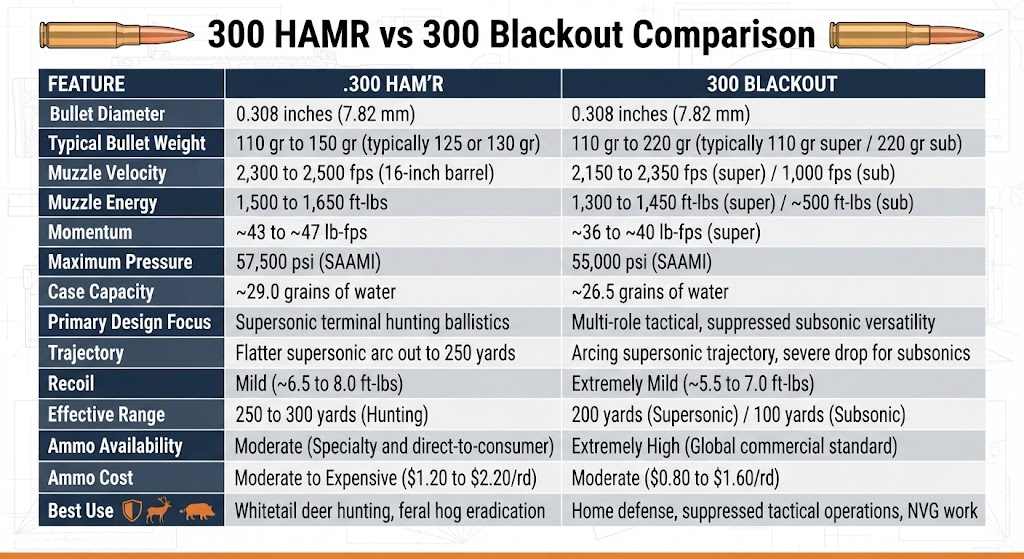
300 HAMR vs 300 Blackout Comparison
| Feature | .300 HAM’R | 300 Blackout |
| Bullet Diameter | 0.308 inches (7.82 mm) | 0.308 inches (7.82 mm) |
| Typical Bullet Weight | 110 gr to 150 gr (typically 125 or 130 gr) | 110 gr to 220 gr (typically 110 gr super / 220 gr sub) |
| Muzzle Velocity | 2,300 to 2,500 fps (16-inch barrel) | 2,150 to 2,350 fps (super) / 1,000 fps (sub) |
| Muzzle Energy | 1,500 to 1,650 ft-lbs | 1,300 to 1,450 ft-lbs (super) / ~500 ft-lbs (sub) |
| Momentum | ~43 to ~47 lb-fps | ~36 to ~40 lb-fps (super) |
| Maximum Pressure | 57,500 psi (SAAMI) | 55,000 psi (SAAMI) |
| Case Capacity | ~29.0 grains of water | ~26.5 grains of water |
| Primary Design Focus | Supersonic terminal hunting ballistics | Multi-role tactical, suppressed subsonic versatility |
| Trajectory | Flatter supersonic arc out to 250 yards | Arcing supersonic trajectory, severe drop for subsonics |
| Recoil | Mild (~6.5 to 8.0 ft-lbs) | Extremely Mild (~5.5 to 7.0 ft-lbs) |
| Effective Range | 250 to 300 yards (Hunting) | 200 yards (Supersonic) / 100 yards (Subsonic) |
| Ammo Availability | Moderate (Specialty and direct-to-consumer) | Extremely High (Global commercial standard) |
| Ammo Cost | Moderate to Expensive ($1.20 to $2.20/rd) | Moderate ($0.80 to $1.60/rd) |
| Best Use | Whitetail deer hunting, feral hog eradication | Home defense, suppressed tactical operations, NVG work |
The table above highlights the core engineering divergence. The .300 HAM’R features a slightly longer powder column and a higher operating pressure ceiling (57,500 psi vs 55,000 psi). This extra capacity allows the HAM’R to push standard hunting bullets roughly 150 to 200 feet per second faster than the Blackout. However, this extra powder capacity comes at a distinct operational cost: the .300 HAM’R is fundamentally designed around supersonic projectiles and lacks the case geometry required to reliably cycle heavy 220-grain subsonic bullets through standard gas systems.
300 HAM’R vs 300 Blackout Ballistics
To objectively evaluate the ballistic capabilities, we must examine real-world factory ammunition designed for hunting and tactical defense.
- Load A (.300 HAM’R Standard Hunting): Wilson Combat 130-grain HAM’R Speer Hot-Core. Tested from a 16-inch barrel. Muzzle velocity is 2,500 feet per second. Muzzle energy is 1,802 foot-pounds. Ballistic Coefficient (G1) is 0.330.
- Load B (.300 HAM’R Heavy Hunting): Wilson Combat 150-grain Federal Fusion. Tested from a 16-inch barrel. Muzzle velocity is 2,260 feet per second. Muzzle energy is 1,699 foot-pounds. Ballistic Coefficient (G1) is 0.385.
- Load C (300 Blackout Supersonic Defense): Barnes 110-grain Vor-TX TTSX. Tested from a 16-inch barrel. Muzzle velocity is 2,350 feet per second. Muzzle energy is 1,348 foot-pounds. Ballistic Coefficient (G1) is 0.292.
- Load D (300 Blackout Subsonic Suppressed): Hornady 208-grain A-MAX Subsonic. Tested from a 16-inch barrel. Muzzle velocity is 1,020 feet per second. Muzzle energy is 480 foot-pounds. Ballistic Coefficient (G1) is 0.600.
300 HAM’R Vs 300 Blackout Velocity
Velocity is the primary advantage of the .300 HAM’R. Because its case is optimized to pack maximum powder behind lighter, aerodynamic hunting bullets, it consistently outruns the 300 Blackout across equivalent bullet weights.
When firing a standard 130-grain to 150-grain hunting load, the .300 HAM’R maintains a 150 fps velocity advantage over the Blackout. This extra speed ensures that expanding hunting bullets maintain the necessary velocity threshold to mushroom reliably even as distance increases downrange.
The 300 Blackout shines in velocity flexibility rather than raw speed. It can launch light 110-grain supersonic varmint bullets at respectable speeds (~2,350 fps), but it can also drop down to 1,020 fps for whisper-quiet subsonic performance through a suppressor—a trick the .300 HAM’R cannot perform reliably with heavy loads.
300 HAM’R Vs 300 Blackout Muzzle Energy
Muzzle energy represents the raw kinetic work capacity of a projectile.
A supersonic 300 Blackout hunting load generates roughly 1,300 to 1,450 foot-pounds of muzzle energy. A subsonic Blackout load drops down to roughly 450 to 500 foot-pounds (comparable to a heavy .45 ACP handgun round).
The .300 HAM’R generates roughly 1,600 to 1,800 foot-pounds of muzzle energy at the muzzle. This gives the HAM’R a commanding 200 to 350 foot-pound energy advantage over supersonic Blackout loads, translating to more authoritative terminal tissue disruption on medium game.
300 HAM’R Vs 300 Blackout Momentum
Momentum correlates closely with a bullet’s ability to crush through dense bone and heavy muscle tissue without deflecting.
Because momentum relies equally on mass and speed, the higher velocity of the .300 HAM’R gives it a distinct edge in supersonic configurations. A 130-grain .300 HAM’R bullet traveling at 2,500 feet per second yields approximately 46.4 pound-feet per second of linear momentum, whereas a 110-grain Blackout supersonic bullet yields roughly 36.9 lb-fps.
However, when comparing the heavy 220-grain subsonic Blackout, its momentum sits around 31.5 lb-fps, relying entirely on heavy weight and deep, silent tumbling rather than raw speed to achieve terminal effect.
300 HAM’R Vs 300 Blackout Trajectory
Understanding external ballistics highlights the performance envelope of these short-range intermediate cartridges. The calculations below assume a standard rifle optic height of 1.5 inches above the bore and a 150-yard zero for supersonic loads.
| Distance | .300 HAM’R (130 gr Supersonic) Drop | 300 Blackout (110 gr Supersonic) Drop | 300 Blackout (220 gr Subsonic) Drop |
| Muzzle | -1.5 inches | -1.5 inches | -1.5 inches |
| 100 Yards | +1.2 inches | +1.4 inches | +2.8 inches |
| 150 Yards | 0.0 inches (Zero) | 0.0 inches (Zero) | -8.5 inches |
| 200 Yards | -4.5 inches | -5.8 inches | -24.2 inches |
| 250 Yards | -12.8 inches | -16.2 inches | -52.5 inches |
| 300 Yards | -26.1 inches | -33.4 inches | -98.0 inches |
The trajectory comparison shows that both cartridges are designed for close-to-medium ranges (inside 250 yards). However, the .300 HAM’R shoots noticeably flatter due to its higher velocity and slightly better aerodynamics, suffering less bullet drop at 300 yards.
The subsonic 300 Blackout column illustrates why subsonic rounds are strictly limited to short ranges: gravity pulls them down drastically, resulting in an extreme rainbow arc that requires precise holdovers past 100 yards.
300 HAM’R Vs 300 Blackout Recoil
Recoil management is virtually identical and exceptionally mild for both cartridges. Fired from a standard 7.5-pound AR-15, both the .300 HAM’R and supersonic 300 Blackout generate roughly 6.0 to 8.0 foot-pounds of free recoil energy. Subsonic 300 Blackout produces virtually zero felt recoil, feeling more like a .22 Magnum. Both platforms allow for rapid follow-up shots and effortless tracking through a scope.
300 HAM’R Vs 300 Blackout Penetration & Expansion
When utilizing proper hunting projectiles (such as the Barnes TTSX or Wilson Combat Speer Hot-Core), both cartridges provide deep, reliable penetration (16 to 22 inches in gelatin) and wide expansion.
However, because the .300 HAM’R retains higher velocities at further distances, its hunting bullets are guaranteed to expand reliably even when a shot stretches out past 200 yards. The 300 Blackout supersonic load expands brilliantly inside 150 yards, but its lower velocity causes expansion to become marginal past 200 yards. Subsonic Blackout relies on specialized expanding solid copper bullets (like the Lehigh Defense Maker or Controlled Chaos) to open up at low speeds, or it relies on tumbling upon impact.
300 HAM’R Vs 300 Blackout Self Defense & Home Defense
The 300 Blackout is widely considered the superior choice for urban home defense. Its ability to cycle short-barreled rifles (9-inch or shorter) effortlessly with a suppressor makes it the absolute king of indoor tactical maneuvering. Furthermore, supersonic 110-grain Barnes bullets fragment rapidly in drywall, minimizing over-penetration risks compared to traditional rifle rounds, while subsonic loads offer hearing-safe operation in emergency situations.
The .300 HAM’R can be configured for home defense, but its longer barrel requirements (typically 16 inches for optimal velocity) make it less maneuverable in tight indoor hallways than a suppressed short-barreled Blackout.
Which Has More Stopping Power: .300 HAM’R Vs 300 Blackout?
On medium game like whitetail deer and feral hogs, the .300 HAM’R possesses superior stopping power due to its higher velocity, greater kinetic energy, and deeper supersonic penetration.
In close-quarters tactical defense against human threats, their stopping power is functionally identical when utilizing high-end supersonic expanding loads.
Which Is More Powerful: .300 HAM’R Vs 300 Blackout?
Based on raw muzzle energy and velocity, the .300 HAM’R is the more powerful supersonic cartridge, delivering roughly 200 to 350 more foot-pounds of energy to the target.
.300 HAM’R Pros And Cons
Pros
- Delivers superior velocity and terminal energy for ethical whitetail deer and hog hunting
- Flatter supersonic trajectory extends effective hunting range out to 300 yards
- Utilizes standard AR-15 lower receivers, magazines, and bolt carriers (only requires a barrel and magazine follower swap)
- Brings .30-30 Winchester performance levels into the semi-automatic AR-15 platform
Cons
- Ammunition is specialized and less commercially ubiquitous than 300 Blackout
- Not optimized for suppressed subsonic ammunition performance
- Typically requires a 16-inch barrel to achieve its advertised ballistic potential
300 Blackout Pros And Cons
Pros
- The undisputed master of suppressed subsonic performance and short-barreled tactical efficiency
- Massive global commercial adoption ensures ubiquitous ammunition availability everywhere
- Incredible platform versatility (seamlessly transitions between quiet subsonic and supersonic loads)
- Ideal for home defense and close-quarters tactical applications
Cons
- Supersonic hunting range is strictly limited to inside 200 yards due to rapid velocity decay
- Subsonic rounds suffer from extreme bullet drop and low kinetic energy
Final Comparison
| Category | Winner | Reason |
| Velocity | .300 HAM’R | Optimized case capacity pushes bullets 150-200 fps faster |
| Muzzle Energy | .300 HAM’R | Delivers 200 to 350 more ft-lbs of kinetic energy at the muzzle |
| Momentum | .300 HAM’R | Higher velocity applied to matching bullet weights yields superior momentum |
| Penetration | .300 HAM’R | Higher downrange velocities ensure deep tissue penetration at distance |
| Expansion | .300 HAM’R | Maintains expanding velocity thresholds further downrange than Blackout |
| Trajectory | .300 HAM’R | Flatter supersonic arc reduces bullet drop past 200 yards |
| Recoil Control | Tie | Both generate exceptionally mild recoil in standard AR-15 platforms |
| Effective Range | .300 HAM’R | Extends ethical supersonic hunting ranges out to 250-300 yards |
| Self Defense | 300 Blackout | Dominates short-barreled suppressed roles and indoor home defense |
| Concealed Carry | Neither | Both are intermediate rifle cartridges unsuited for concealment |
| Ammo Cost | 300 Blackout | Massive commercial popularity guarantees wider pricing competition |
| Ammo Availability | 300 Blackout | Found on store shelves much more consistently nationwide |
| Overall Performance | Depends on Role | .300 HAM’R for hunting; 300 Blackout for tactical versatility and suppression |
.300 HAM’R Vs 300 Blackout: Which Should You Choose?
Selecting between the .300 HAM’R and the 300 Blackout depends entirely on whether your rifle’s primary mission is harvesting medium game or tactical defense.
Choose the .300 HAM’R if your primary goal is hunting whitetail deer, mule deer, or feral hogs with an AR-15. It bridges the gap between traditional hunting rifles and modern semi-automatics, delivering the extra velocity, flat trajectory, and terminal energy required for clean, ethical kills out to 300 yards.
Choose the 300 Blackout if you want the ultimate tactical short-barreled rifle, home defense carbine, or suppressed platform. Its ability to run whisper-quiet subsonic ammunition paired with massive commercial parts availability makes it one of the most versatile tactical cartridges ever fielded.
FAQs
Is .300 HAM’R Faster Than 300 Blackout?
Yes, the .300 HAM’R is consistently faster by roughly 150 to 200 feet per second across equivalent bullet weights when fired from standard 16-inch barrels, due to its optimized powder capacity and higher pressure rating.
Which Has More Muzzle Energy?
The .300 HAM’R generates more muzzle energy, typically producing between 1,600 and 1,800 foot-pounds compared to the supersonic 300 Blackout’s 1,300 to 1,450 foot-pounds.
Can 300 Blackout Magazines Be Used For .300 HAM’R?
Yes, but with caveats. Standard AR-15 magazines work well for supersonic HAM’R rounds, but Wilson Combat recommends specific modified magazine followers or dedicated HAM’R magazines when feeding heavier, blunt-nosed hunting bullets to ensure flawless feeding.
Can You Shoot Subsonic Ammunition In A .300 HAM’R?
While you can physically chamber heavy subsonic bullets, the .300 HAM’R gas system and case capacity are explicitly designed for supersonic hunting loads. It will not reliably cycle heavy 220-grain subsonic rounds through a suppressor the way a 300 Blackout does.
Which Is Better For Deer Hunting?
The .300 HAM’R is superior for deer hunting because its higher velocity ensures that hunting bullets retain enough energy and speed to expand reliably at distances beyond 150 yards.
Can A 300 Blackout Rifle Shoot .300 HAM’R Ammunition?
No. Absolutely not. Attempting to chamber and fire a .300 HAM’R round in a 300 Blackout rifle is catastrophic and extremely dangerous. While both share a .308 projectile, their case dimensions and shoulder angles differ enough that firing a HAM’R in a Blackout chamber will result in a severe over-pressure explosion, destroying the firearm and risking severe injury.
Which Should You Choose?
Choose the .300 HAM’R for dedicated AR-15 medium-game hunting. Choose the 300 Blackout for suppressed tactical use, short-barrel maneuverability, and home defense.