The .357 Magnum is traditionally known as a premier revolver cartridge, but it transforms into an entirely different class of weapon when fired from a 20 inch rifle barrel. Firing this cartridge from a lever action or single shot rifle allows the slow burning pistol powders to fully combust before the bullet exits the muzzle. This results in massive velocity gains, effectively bridging the gap between a standard handgun round and a medium range rifle cartridge like the .30-30 Winchester.
While handgun velocities for the .357 Magnum typically hover between 1,200 and 1,400 feet per second (FPS), a 20 inch barrel pushes those exact same loads to velocities of 1,700 to over 2,100 FPS.
Tested Load Data and Performance
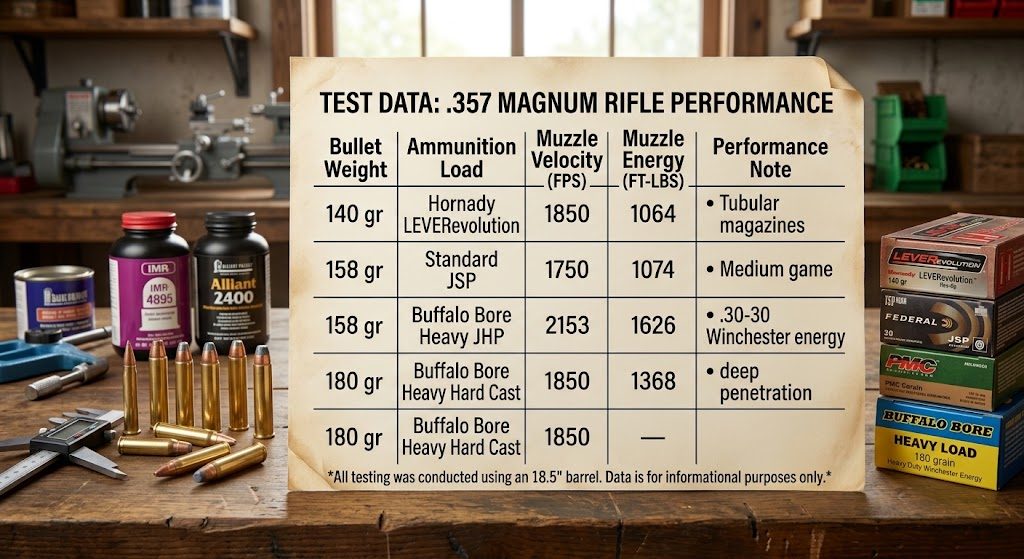
The data below highlights the dramatic increase in muzzle velocity and kinetic energy when shooting factory ammunition through a 20 inch carbine barrel.
| Bullet Weight | Ammunition Load | Muzzle Velocity (FPS) | Muzzle Energy (FT-LBS) | Performance Note |
| 140 gr | Hornady LEVERevolution | 1,850 | 1,064 | Specifically designed for tubular magazines |
| 158 gr | Standard JSP (Federal/PMC) | 1,750 | 1,074 | Balanced load for practice and medium game |
| 158 gr | Buffalo Bore Heavy JHP | 2,153 | 1,626 | Rivals .30-30 Winchester muzzle energy |
| 180 gr | Buffalo Bore Heavy Hard Cast | 1,850 | 1,368 | Deep penetration for thick skinned game |
Understanding the Ballistic Capabilities
The table above illustrates just how potent the .357 Magnum becomes in a rifle format. When you evaluate the muzzle energy of standard handgun loads, they typically produce around 500 to 600 foot-pounds (FT-LBS) of energy. Out of a 20 inch barrel, standard 158 grain loads easily eclipse 1,000 FT-LBS, while specialty heavy loads from manufacturers like Buffalo Bore can exceed 1,600 FT-LBS at the muzzle.
This massive jump in kinetic energy makes the .357 Magnum rifle an exceptionally capable tool for hunting deer, feral hogs, and black bears at ranges up to 150 yards. The 158 grain projectile is generally considered the optimal weight for carbines. It offers a high enough ballistic coefficient to maintain its velocity downrange while having enough mass to ensure deep penetration.
One critical factor to keep in mind is bullet construction. Because you are adding up to 600 FPS of velocity over what the bullet was originally designed to handle, standard cup and core hollow points intended for personal defense revolvers may fragment or over-expand upon impact when fired from a rifle. For hunting applications, it is highly recommended to use jacketed soft points (JSP), bonded bullets, or hard cast lead projectiles that can withstand the structural stress of hitting a target at 2,000 FPS.
Frequently Asked Questions
1. Is 20 inches the optimal barrel length for .357 Magnum?
From a strict velocity standpoint, the .357 Magnum cartridge reaches its maximum velocity potential in 16 to 18 inch barrels. Pushing pistol powder through a 20 inch barrel does not yield much additional speed, and friction may even cause a negligible drop in velocity with some fast burning powders. However, a 20 inch barrel is highly desirable because it provides a longer sight radius for iron sights, improves balance, and allows for a longer tubular magazine to increase ammunition capacity.
2. Can I use a .357 Magnum 20 inch rifle for deer hunting?
Yes, it is highly effective for deer hunting at close to medium ranges. With proper hunting ammunition, the .357 Magnum from a rifle delivers well over the widely accepted 1,000 foot pounds of energy threshold required for ethical kills on medium game out to 100 yards.
3. Will shooting .38 Special out of a 20 inch barrel damage the rifle?
No, shooting .38 Special is perfectly safe and will not damage a .357 Magnum rifle. In fact, .38 Special fired from a 20 inch barrel has almost zero recoil and is incredibly quiet, making it excellent for target practice or small game hunting. You must thoroughly clean the chamber afterward, as the shorter .38 Special cases leave a carbon ring that can make chambering the longer .357 Magnum rounds difficult or dangerous later on.
4. What is the maximum effective range of a .357 Magnum rifle?
For hunting medium game, the effective ethical range is generally capped at 150 yards. While the bullet will travel much further, pistol projectiles have poor ballistic coefficients. They lose velocity and kinetic energy rapidly. Beyond 150 yards, bullet drop becomes severe and the projectile may not have enough retained energy to expand properly on game.
5. Why do standard hollow points sometimes fail when fired from a rifle?
Standard .357 Magnum hollow points are designed to expand reliably at handgun velocities between 1,200 and 1,400 FPS. When you push those same cup and core bullets out of a 20 inch barrel at over 1,800 FPS, the impact velocity exceeds their structural limits. This causes the bullet to over expand, fragment, or disintegrate on impact, leading to shallow penetration instead of passing cleanly through the vital organs.
6. What bullet weight is best for a 20 inch .357 Magnum rifle?
The 158 grain bullet is widely considered the sweet spot for the .357 Magnum carbine. It offers the perfect balance of retained velocity, flat trajectory, and deep penetration. Heavier 180 grain hard cast bullets are excellent for thick skinned game like feral hogs or black bears, while lighter 110 to 125 grain bullets are best reserved for varmints or target shooting.
7. Does the .357 Magnum trajectory allow for a 200 yard zero?
No, it drops too rapidly for a practical 200 yard zero. Most shooters zero their .357 Magnum rifles at 100 yards. With a 100 yard zero, a standard 158 grain bullet will shoot about 2 to 3 inches high at 50 yards and will drop roughly 10 to 14 inches at 200 yards.
8. How much recoil does a .357 Magnum rifle have compared to a .30-30 Winchester?
The .357 Magnum rifle produces significantly less recoil than a .30-30 Winchester. A standard .357 Magnum load in a typical 6 pound lever action rifle generates about 4 to 5 foot pounds of felt recoil. In contrast, a .30-30 Winchester generates around 10 to 12 foot pounds of recoil. This makes the .357 Magnum carbine an excellent choice for young shooters or those sensitive to recoil.
9. Do I need to use slow burning powders when reloading .357 Magnum for a rifle?
Yes, to take full advantage of the 20 inch barrel, reloaders must use slow burning magnum pistol powders like H110, Winchester 296, or Lil’Gun. Fast burning powders will peak in pressure too early in the barrel and will not generate the massive velocity gains that make the .357 Magnum rifle so capable.
10. Can I use pointed bullets in a .357 Magnum lever action rifle?
Generally, you cannot safely use traditional pointed spitzer bullets in a lever action rifle with a tubular magazine. Under the recoil of firing, a hard pointed bullet can act as a firing pin against the primer of the cartridge sitting in front of it in the tube, causing a catastrophic chain detonation. You must use flat nose bullets, hollow points, or specialized polymer tipped ammunition like the Hornady LEVERevolution, which is soft enough to safely rest against primers.