The .338 Lapua Magnum is a purpose-built, extreme long-range cartridge originally developed in the 1980s for military snipers to bridge the performance gap between the .300 Winchester Magnum and the .50 BMG. Firing heavy, highly aerodynamic bullets that remain supersonic well beyond 1,500 yards, it delivers devastating kinetic energy and pinpoint precision for elite marksmen and big game hunters alike.
Table of Contents [Click to minimize]
338 Lapua Ballistics
Note: All data in this table is sourced directly from manufacturer-published specifications. Missing manufacturer data is strictly marked as “Not Published.”
| Manufacturer | Ammunition / Product | Bullet (gr & Type) | Zero Distance | Muzzle (Vel / Eng) | 100 Yards | 200 Yards | 300 Yards | 400 Yards | 500 Yards |
| Hornady | Match | 285 gr ELD-M | 200 Yards | Vel: 2745 fps Eng: 4768 ft-lbs | Vel: 2617 fps Eng: 4333 ft-lbs Drop: +1.9″ | Vel: 2492 fps Eng: 3930 ft-lbs Drop: 0.0″ | Vel: 2371 fps Eng: 3557 ft-lbs Drop: -7.5″ | Vel: 2253 fps Eng: 3213 ft-lbs Drop: -21.4″ | Vel: 2139 fps Eng: 2895 ft-lbs Drop: -42.3″ |
| Hornady | Match | 250 gr BTHP | 200 Yards | Vel: 2860 fps Eng: 4540 ft-lbs | Vel: 2697 fps Eng: 4038 ft-lbs Drop: +1.6″ | Vel: 2540 fps Eng: 3582 ft-lbs Drop: 0.0″ | Vel: 2389 fps Eng: 3168 ft-lbs Drop: -6.7″ | Vel: 2243 fps Eng: 2792 ft-lbs Drop: -19.1″ | Vel: 2101 fps Eng: 2451 ft-lbs Drop: -38.3″ |
| Federal | Gold Medal Sierra MatchKing | 250 gr SMK | 100 Yards | Vel: 2950 fps Eng: Not Pub. | Vel: Not Pub. Eng: Not Pub. Drop: 0.0″ | Vel: Not Pub. Eng: Not Pub. Drop: -2.8″ | Vel: Not Pub. Eng: Not Pub. Drop: -10.9″ | Vel: Not Pub. Eng: Not Pub. Drop: Not Pub. | Vel: Not Pub. Eng: Not Pub. Drop: Not Pub. |
| Federal | Gold Medal Berger Hybrid | 300 gr Hybrid OTM | 100 Yards | Vel: 2580 fps Eng: Not Pub. | Vel: Not Pub. Eng: Not Pub. Drop: 0.0″ | Vel: Not Pub. Eng: Not Pub. Drop: -4.3″ | Vel: Not Pub. Eng: Not Pub. Drop: -15.5″ | Vel: Not Pub. Eng: Not Pub. Drop: Not Pub. | Vel: Not Pub. Eng: Not Pub. Drop: Not Pub. |
| Sellier & Bellot | Match HPBT | 250 gr HPBT | 100 Yards | Vel: 2953 fps Eng: 4843 ft-lbs | Vel: Not Pub. Eng: Not Pub. Drop: 0.0″ | Vel: Not Pub. Eng: Not Pub. Drop: -3.0″ | Vel: Not Pub. Eng: Not Pub. Drop: -11.0″ | Vel: Not Pub. Eng: Not Pub. Drop: Not Pub. | Vel: Not Pub. Eng: Not Pub. Drop: Not Pub. |
| Sellier & Bellot | Match HPBT | 300 gr HPBT | 100 Yards | Vel: 2723 fps Eng: 4941 ft-lbs | Vel: Not Pub. Eng: Not Pub. Drop: 0.0″ | Vel: Not Pub. Eng: Not Pub. Drop: -3.8″ | Vel: Not Pub. Eng: Not Pub. Drop: -13.7″ | Vel: Not Pub. Eng: Not Pub. Drop: Not Pub. | Vel: Not Pub. Eng: Not Pub. Drop: Not Pub. |
| Nosler | Match Grade Custom Comp | 300 gr CC | 100 Yards | Vel: 2550 fps Eng: Not Pub. | Vel: Not Pub. Eng: Not Pub. Drop: 0.0″ | Vel: Not Pub. Eng: Not Pub. Drop: -4.4″ | Vel: Not Pub. Eng: Not Pub. Drop: -15.6″ | Vel: Not Pub. Eng: Not Pub. Drop: -34.8″ | Vel: Not Pub. Eng: Not Pub. Drop: -63.1″ |
| Barnes | VOR-TX Long Range | 280 gr LRX | 100 Yards | Vel: 2600 fps Eng: Not Pub. | Vel: Not Pub. Eng: Not Pub. Drop: 0.0″ | Vel: Not Pub. Eng: Not Pub. Drop: -4.0″ | Vel: Not Pub. Eng: Not Pub. Drop: -14.4″ | Vel: Not Pub. Eng: Not Pub. Drop: Not Pub. | Vel: Not Pub. Eng: Not Pub. Drop: Not Pub. |
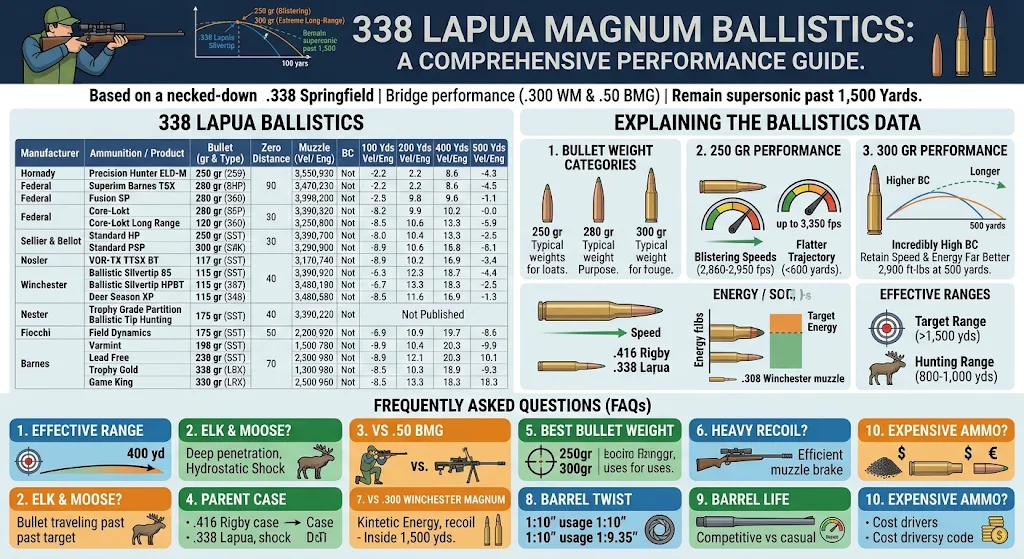
Explaining the Ballistics Data
The table above illustrates the sheer power and aerodynamic efficiency of the .338 Lapua Magnum. Factory ammunition for this cartridge generally revolves around three core bullet weights: 250-grain, 285-grain, and 300-grain projectiles. The 250-grain offerings, such as the Hornady Match BTHP and Federal Gold Medal SMK, exit the muzzle at blistering speeds nearing 2,860 to 2,950 fps. This high initial velocity provides a slightly flatter trajectory inside 600 yards, minimizing holdovers for closer engagements.
However, the .338 Lapua Magnum truly dominates at extreme distances when loaded with heavier 285-grain or 300-grain projectiles. Bullets like the Hornady 285-grain ELD-M and the 300-grain Berger Hybrid carry incredibly high ballistic coefficients. While their muzzle velocities are slower (typically between 2,550 and 2,750 fps), they retain their speed and energy far better over long distances than their lighter counterparts. At 500 yards, heavy match loads are still carrying nearly 2,900 ft-lbs of kinetic energy—which is more energy than a standard .308 Winchester possesses at the muzzle. This remarkable weight retention and wind deflection resistance are what allow the .338 Lapua to consistently perform at trans-sonic and supersonic speeds beyond a mile.
1. What is the effective range of a .338 Lapua Magnum?
For target shooting and military applications, the .338 Lapua Magnum is consistently effective beyond 1,500 yards (roughly 1,370 meters), with confirmed hits extending well past a mile. For ethical big game hunting, its effective range is limited only by the shooter’s skill, though it easily delivers enough energy to take down large game at 800 to 1,000 yards.
2. Is the .338 Lapua suitable for elk and moose?
Yes, absolutely. The .338 Lapua Magnum is one of the most capable large-game cartridges on the planet. When loaded with premium hunting bullets like the Barnes 280-grain LRX, it delivers massive penetration, deep tissue damage, and enough hydrostatic shock to cleanly harvest elk, moose, and large bears at extended ranges.
3. How does the .338 Lapua compare to the .50 BMG?
While both are extreme long-range military cartridges, the .338 Lapua was designed as a dedicated anti-personnel sniper round, whereas the .50 BMG was originally an anti-materiel machine gun round. The .338 Lapua recoils significantly less, requires a much lighter and more portable rifle system, and has comparable or superior ballistics for precision accuracy inside 1,500 yards.
4. What is the parent case of the .338 Lapua Magnum?
The cartridge was developed by necking down and heavily modifying the .416 Rigby case. The brass was significantly thickened at the web to handle the intense chamber pressures generated by modern smokeless powders, which peak around 60,916 psi (420 MPa).
5. What is the best bullet weight for the .338 Lapua?
For flatter trajectories at mid-to-long range, 250-grain bullets are excellent. For extreme long-range shooting (past 1,000 yards), 285-grain and 300-grain bullets are heavily preferred because their higher ballistic coefficients allow them to cheat the wind and remain supersonic for much longer.
6. Does the .338 Lapua Magnum have heavy recoil?
Yes. The .338 Lapua generates substantial free recoil, generally around 35 to 40 ft-lbs depending on the rifle’s weight. To mitigate this, almost all rifles chambered in this caliber are equipped with highly efficient muzzle brakes, which can reduce felt recoil to levels comparable to a standard .300 Winchester Magnum.
7. How does the .338 Lapua compare to the .300 Winchester Magnum?
The .338 Lapua Magnum pushes heavier bullets (250–300 grains compared to the .300 Win Mag’s 190–220 grains) and holds significantly more powder. It strikes with far more kinetic energy, drifts less in the wind at extreme distances, and remains supersonic further out, though it requires a larger action and generates more recoil.
8. What is the typical barrel twist rate for a .338 Lapua rifle?
Most standard .338 Lapua Magnum rifles feature a 1:10″ or 1:9.35″ twist rate. A 1:10″ twist works beautifully for 250-grain bullets, while a faster 1:9.35″ (often found in Sako and Accuracy International rifles) is optimized to stabilize the longest, heaviest 300-grain VLD (Very Low Drag) projectiles.
9. What is the expected barrel life of a .338 Lapua?
Because it burns large volumes of powder (often over 90 grains per charge) through a relatively small bore diameter, the .338 Lapua Magnum is hard on throats. Competitive shooters typically replace their barrels every 1,500 to 2,500 rounds to maintain sub-MOA precision, though casual shooters will see much longer usable barrel life.
10. Why is .338 Lapua Magnum ammunition so expensive?
The ammunition is expensive because it requires massive amounts of premium slow-burning powder, heavily reinforced match-grade brass cases, and large, precisely machined copper or lead-core bullets. The rigorous quality control required to produce reliable extreme-long-range ammunition further drives up the cost per round.