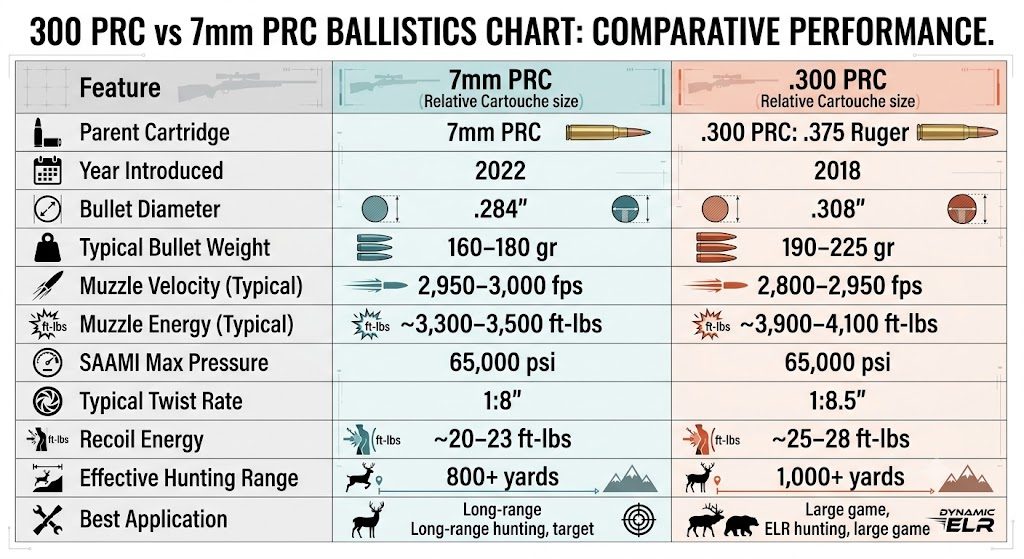
The main difference between the .300 PRC and the 7mm PRC is their caliber focus and ballistic efficiency: the 7mm PRC is designed to offer a perfect balance of high ballistic coefficients and manageable recoil in a 7mm package, whereas the .300 PRC provides the raw power and terminal authority of a .30-caliber magnum. Although both represent the cutting edge of modern cartridge design, the 7mm PRC typically shoots flatter with significantly less recoil, whereas the .300 PRC delivers more downrange kinetic energy for larger or tougher game. Choosing between them depends on whether your priority is a versatile, high-BC long-range performer for mid-to-large game or a heavier-hitting option for extended distances, making this 300 PRC vs 7mm PRC ballistics chart essential for optimizing your next long-range rifle build.
300 PRC vs 7mm PRC Ballistics Chart
| Feature | 7mm PRC | .300 PRC |
| Parent Cartridge | .300 PRC | .375 Ruger |
| Year Introduced | 2022 | 2018 |
| Bullet Diameter | .284″ | .308″ |
| Typical Bullet Weight | 160–180 gr | 190–225 gr |
| Muzzle Velocity (Typical) | 2,950–3,000 fps | 2,800–2,950 fps |
| Muzzle Energy (Typical) | ~3,300–3,500 ft-lbs | ~3,900–4,100 ft-lbs |
| SAAMI Max Pressure | 65,000 psi | 65,000 psi |
| Typical Twist Rate | 1:8″ | 1:8.5″ |
| Recoil Energy | ~20–23 ft-lbs | ~25–28 ft-lbs |
| Effective Hunting Range | 800+ yards | 1,000+ yards |
| Best Application | Long-range hunting, target | ELR hunting, large game |
Muzzle Velocity Comparison
The 7mm PRC is optimized to push high-BC 7mm bullets at impressive velocities, frequently reaching the 3,000 fps mark with 175-grain match projectiles. In contrast, the .300 PRC launches heavier .30-caliber bullets at slightly lower muzzle velocities but compensates with superior mass. While the 7mm PRC maintains speed well due to its sleek bullet profile, the .300 PRC retains its velocity across long distances efficiently compared with traditional .30-caliber magnums.
Muzzle Energy Comparison
The .300 PRC acts as the heavy hitter, generating muzzle energy in the 4,000 ft-lbs range, which is significantly higher than the 3,400 ft-lbs typically produced by the 7mm PRC. On the other hand, the 7mm PRC offers ample energy for most North American big game, but the .300 PRC provides a higher margin of terminal performance for elk, moose, or large bear compared with the 7mm PRC.
Downrange Energy Comparison
At extended distances, the .300 PRC’s heavier bullet weights ensure it maintains higher energy levels well past 800 yards. While the 7mm PRC remains highly effective at long range due to its excellent ballistic coefficient, the .300 PRC delivers more kinetic impact energy at the target compared to the 7mm PRC. Both cartridges are designed to remain supersonic at extreme distances, but the .300 PRC carries more momentum.
Bullet Drop and Trajectory
The 7mm PRC is widely considered to have one of the flattest trajectories available, often requiring less holdover than the .300 PRC at mid-to-long ranges. In contrast, the .300 PRC is no slouch, but because its projectiles are heavier, it experiences more drop at extreme distances compared with the 7mm PRC. If flat trajectory and wind resistance in a lighter recoil package are the goal, the 7mm PRC is superior, whereas the .300 PRC is built for heavier long-range precision.
Recoil Comparison
Recoil is the most notable functional difference for the shooter. The 7mm PRC offers a surprisingly soft recoil impulse for a magnum cartridge, making it easier to manage during long shooting sessions. In contrast, the .300 PRC produces noticeably more recoil energy. Shooters who are recoil-sensitive will find the 7mm PRC much more pleasant to shoot compared with the more authoritative push of the .300 PRC.
Accuracy and Performance
Both cartridges benefit from modern, short-magnum-style design philosophies that prioritize accuracy and consistent seating depth. The 7mm PRC is often praised for its inherent precision and efficiency, while the .300 PRC has become the gold standard for .30-caliber ELR shooting. Both cartridges offer exceptional potential for sub-MOA accuracy when paired with high-quality barrels and factory match ammunition.
Which Is Better?
The better choice depends on your hunting goals and your tolerance for recoil. The 7mm PRC is better for the hunter who wants an all-around long-range rifle capable of taking deer, elk, and sheep with less recoil and a flatter trajectory. It is an incredibly efficient choice for those who do not need the extra mass of a .30-caliber bullet.
The .300 PRC is better for the shooter whose primary focus is larger game or extreme-long-range (ELR) precision where terminal energy and wind-bucking capability are paramount. If you are pursuing moose or brown bear at distance, the .300 PRC provides the extra terminal energy that the 7mm PRC lacks.
FAQ
Is 7mm PRC better than 300 PRC for long range?
The 7mm PRC is often easier to shoot due to lower recoil and flatter trajectory, but the .300 PRC offers superior ballistics for heavy, long-range projectiles at extreme distances.
Does 7mm PRC have enough power for elk?
Yes, the 7mm PRC is an exceptional elk cartridge that provides high energy and deep penetration, making it a very popular choice for western big game hunters.
Which cartridge has better barrel life?
Generally, the 7mm PRC will have a slightly longer barrel life compared to the .300 PRC, as the latter consumes more powder per shot, which can accelerate throat erosion.
Can I use the same rifle for both?
No, while they share similar bolt faces or magazine lengths, they require different caliber barrels; however, many modern rifles are chambered in both, allowing for a similar platform experience.