Understanding your .308 bullet drop chart is essential for long-range precision and ethical hunting. A projectile’s trajectory relies heavily on the specific load, bullet weight, muzzle velocity, ballistic coefficient, your chosen zero distance, and environmental conditions. By studying reliable ballistic data, shooters can make rapid elevation adjustments to compensate for gravity over distance. The chart below breaks down the most critical metrics needed to confidently hit targets at extended ranges.
.308 Bullet Drop Chart
| Distance (Yards) | Velocity (fps) | Energy (ft-lbs) | Bullet Drop (Inches) | Drop (MOA) | Drop (MIL) |
| 100 | 2460 | 2257 | 0.0 | 0.0 | 0.0 |
| 200 | 2277 | 1935 | -4.2 | 2.0 | 0.6 |
| 300 | 2103 | 1650 | -15.5 | 5.2 | 1.5 |
| 400 | 1936 | 1398 | -35.0 | 8.7 | 2.5 |
| 500 | 1778 | 1179 | -64.5 | 12.9 | 3.8 |
| 600 | 1630 | 990 | -106.1 | 17.7 | 5.1 |
| 700 | 1495 | 833 | -162.6 | 23.2 | 6.7 |
| 800 | 1370 | 700 | -237.2 | 29.6 | 8.6 |
The parameters for the table above are based on the highly popular Federal Premium Gold Medal Match ammunition. This provides a highly accurate benchmark for the .308 Winchester cartridge.
Ballistic Parameters:
- Ammunition Load: Federal Premium Gold Medal Match
- Bullet Weight & Type: 168-grain Sierra MatchKing BTHP
- Muzzle Velocity: 2650 feet per second (fps)
- Ballistic Coefficient (G1): 0.462
- Zero Distance: 100 Yards
- Sight Height: 1.5 inches above bore
- Test Barrel Length: 24 inches
- Environmental Assumptions: Sea level altitude, 59 degrees Fahrenheit
Note: Velocity and energy figures from 100 to 500 yards are sourced directly from Federal Premium manufacturer data. Drop figures and extended data out to 800 yards are established ballistic calculations based on the 0.462 ballistic coefficient and standard atmospheric conditions.
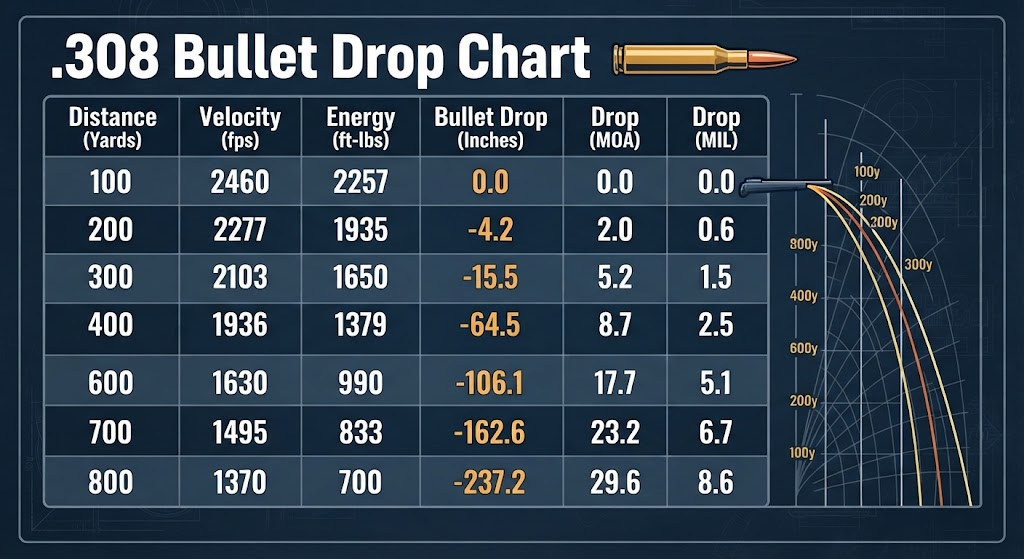
Understanding The .308 Bullet Drop Chart
.308 Bullet Drop At 100 Yards
At 100 yards, the 168-grain .308 bullet reaches its zero distance. The projectile crosses the exact line of sight of your optic, meaning there is zero bullet drop. The bullet retains a massive 2257 foot-pounds of energy and travels at 2460 fps. This makes 100 yards the standard zeroing distance for most tactical and hunting setups.
.308 Bullet Drop At 200 Yards
When the bullet reaches 200 yards, gravity pulls it down approximately 4.2 inches. Shooters using a scope with MOA turrets will need to dial up 2.0 MOA, while MIL users will adjust by 0.6 MIL. The bullet still carries over 1900 foot-pounds of energy, making it incredibly effective for hunting medium to large game at this range without complex calculations.
.308 Bullet Drop At 300 Yards
At 300 yards, the trajectory becomes steeper as the bullet drops 15.5 inches. Dialing 5.2 MOA or holding over 1.5 MIL is required to impact the target. Velocity drops to 2103 fps, but the 1650 foot-pounds of retained energy is still well above the minimum threshold recommended for harvesting deer and elk ethically.
.308 Bullet Drop At 400 Yards
Crossing the 400-yard mark requires precise dope adjustments. The bullet drops 35.0 inches below the line of sight. Wind deflection also becomes a major factor at this distance. With a velocity of 1936 fps, the bullet is slowing down but remains supersonically stable. Shooters must dial 8.7 MOA or 2.5 MIL to achieve center impacts.
.308 Bullet Drop At 500 Yards
At 500 yards, the .308 Winchester experiences a substantial drop of 64.5 inches. You will need an elevation adjustment of 12.9 MOA or 3.8 MIL. The energy dips to 1179 foot-pounds, which borders on the minimum required kinetic energy for large game hunting. This is generally considered the maximum ethical hunting range for the .308 cartridge.
.308 Bullet Drop At 600 Yards
Reaching 600 yards puts the shooter firmly in long-range territory. The bullet plummets 106.1 inches, requiring an elevation shift of 17.7 MOA or 5.1 MIL. Velocity bleeds off to an estimated 1630 fps. At this range, target shooting is highly satisfying, but unpredictable environmental conditions make ethical hunting shots extremely difficult for all but the most experienced marksmen.
Frequently Asked Questions
What factors change my .308 bullet drop chart?
Your personal trajectory will vary depending on your specific load and rifle. A shorter barrel produces lower muzzle velocity, which increases bullet drop at range. Altitude, temperature, humidity, and barometric pressure also alter the air density. Thinner air at higher altitudes allows the bullet to fly flatter compared to heavy sea-level conditions.
Does a 150-grain .308 drop differently than a 168-grain .308?
Yes, bullet weight changes the flight path. A 150-grain bullet leaves the muzzle faster, resulting in less drop at closer distances like 300 yards. However, lighter bullets typically have lower ballistic coefficients. At extended ranges past 500 yards, the heavier 168-grain or 175-grain bullets retain their velocity better and resist wind drift more effectively, making them superior for long-range accuracy.
What is the best zero distance for a .308 rifle?
A 100-yard zero is the standard recommendation for a .308 Winchester rifle. This provides a clean baseline that makes dialing elevation for longer shots mathematically simpler. Hunters who want a maximum point blank range setup sometimes prefer a 200-yard zero, which allows them to aim dead center on a vital zone out to 250 yards without adjusting their optic.
At what distance does a .308 go subsonic?
The distance a .308 bullet becomes subsonic depends on the muzzle velocity and bullet design. For a standard 168-grain match bullet fired at 2650 fps, the projectile usually drops below the speed of sound around 900 to 1000 yards. When a bullet transitions into subsonic speeds, it can experience aerodynamic buffeting that destabilizes its flight path.