A .270 bullet drop chart provides the critical trajectory data required for ethical hunting and precision marksmanship. Your actual bullet drop depends heavily on the specific ammunition load, bullet weight, muzzle velocity, ballistic coefficient, your chosen zero distance, and environmental conditions. By studying established ballistic tables, shooters can make fast and accurate optic adjustments to compensate for gravity over extended distances. The chart below details the essential flight metrics needed to master this legendary flat-shooting hunting cartridge.
.270 Bullet Drop Chart
| Distance (Yards) | Velocity (fps) | Energy (ft-lbs) | Bullet Drop (Inches) | Drop (MOA) | Drop (MIL) |
| 100 | 2816 | 2289 | 0.0 | 0.0 | 0.0 |
| 200 | 2586 | 1930 | -2.4 | 1.1 | 0.3 |
| 300 | 2368 | 1618 | -10.1 | 3.2 | 0.9 |
| 400 | 2160 | 1346 | -24.3 | 5.8 | 1.7 |
| 500 | 1962 | 1111 | -46.4 | 8.9 | 2.6 |
| 600 | 1775 | 909 | -78.4 | 12.5 | 3.6 |
| 700 | 1601 | 740 | -122.9 | 16.8 | 4.9 |
| 800 | 1443 | 601 | -182.8 | 21.8 | 6.3 |
The parameters for the table above are based on standard ballistic data for the highly popular Hornady American Whitetail 130-grain load. This provides an excellent and widely applicable baseline for standard .270 Winchester hunting ammunition.
Ballistic Parameters:
- Ammunition Load: Hornady American Whitetail .270 Winchester
- Bullet Weight & Type: 130-grain InterLock (Spire Point)
- Muzzle Velocity: 3060 feet per second (fps)
- Ballistic Coefficient (G1): 0.409
- Zero Distance: 100 Yards
- Sight Height: 1.5 inches above bore
- Test Barrel Length: 24 inches
- Environmental Assumptions: Sea level altitude, 59 degrees Fahrenheit
Note: Velocity and energy figures are sourced from standard manufacturer ballistic charts for this specific load. Drop figures and extended data out to 800 yards are calculated using a 0.409 ballistic coefficient under standard atmospheric conditions.
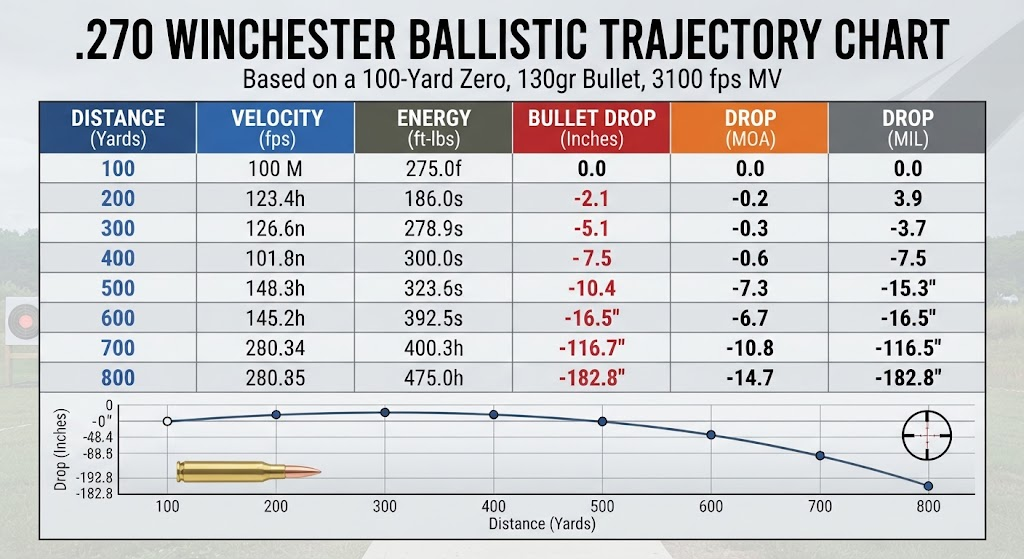
Understanding The .270 Bullet Drop Chart
.270 Bullet Drop At 100 Yards
At 100 yards, the 130-grain projectile reaches its zero distance, perfectly intersecting your line of sight with zero bullet drop. The bullet is traveling at a blistering 2816 fps and retains 2289 foot-pounds of energy. A 100-yard zero provides a clean mathematical baseline for traditional hunting scopes and allows shooters to easily calculate holds for longer distances.
.270 Bullet Drop At 200 Yards
When the bullet reaches 200 yards, the legendary flat trajectory of the .270 Winchester becomes obvious. The projectile drops a remarkably small 2.4 inches. Shooters only need to dial 1.1 MOA or hold 0.3 MIL on their reticle. Retaining 1930 foot-pounds of energy, the bullet easily delivers the kinetic shock needed to cleanly harvest deer, elk, or sheep.
.270 Bullet Drop At 300 Yards
At 300 yards, the trajectory arcs slightly with a drop of just 10.1 inches. You will need to make an elevation correction of 3.2 MOA or 0.9 MIL. Velocity slows to 2368 fps, and kinetic energy sits at a highly lethal 1618 foot-pounds. This flat performance is exactly why the .270 Winchester has been a favorite among western hunters for decades.
.270 Bullet Drop At 400 Yards
Crossing into 400 yards, the 130-grain bullet falls 24.3 inches below the line of sight. A shooter must compensate by dialing 5.8 MOA or 1.7 MIL. The energy drops to 1346 foot-pounds, which is still highly effective for medium to large game. Wind deflection begins to play a larger role here, requiring shooters to read crosswinds carefully before breaking the shot.
.270 Bullet Drop At 500 Yards
At 500 yards, the bullet drop reaches 46.4 inches. You will need a precise elevation adjustment of 8.9 MOA or 2.6 MIL. The velocity drops to 1962 fps, and energy falls to 1111 foot-pounds. For most hunters, this distance represents the absolute maximum ethical range for harvesting deer, as the energy level is approaching the recommended minimum threshold.
.270 Bullet Drop At 600 Yards
Reaching 600 yards pushes the standard .270 Winchester into dedicated long-range territory. The bullet plunges 78.4 inches, requiring a turret adjustment of 12.5 MOA or 3.6 MIL. Velocity falls to 1775 fps, and energy dips below 1000 foot-pounds. Consistent impacts at this distance rely heavily on an accurate atmospheric dope chart and perfect shooting fundamentals.
Frequently Asked Questions
What factors change my .270 bullet drop chart?
Your personal trajectory will vary depending on your specific ammunition and rifle configuration. A shorter 20-inch or 22-inch barrel will produce a lower muzzle velocity than the standard 24-inch test barrel, which directly increases bullet drop at every distance. Environmental factors like high altitude, warm temperatures, and low barometric pressure reduce air density, allowing the bullet to fly flatter and faster than it would at sea level.
How does a 130-grain .270 compare to a 150-grain bullet?
A lighter 130-grain bullet leaves the muzzle much faster than a 150-grain bullet, yielding a flatter trajectory inside 400 yards. This makes it perfect for deer and antelope. A heavier 150-grain bullet starts slower and drops slightly more at medium ranges, but it typically has a higher ballistic coefficient. The 150-grain bullet hits with more energy and penetrates deeper, making it the preferred choice for larger game like elk and moose.
What is the best zero distance for a .270 rifle?
A 100-yard zero is the standard recommendation because it simplifies long-range turret adjustments for modern optics. However, because the .270 Winchester is exceptionally fast and flat, many traditional hunters prefer a 200-yard zero. A 200-yard zero typically causes the bullet to strike about 1.5 inches high at 100 yards, allowing a hunter to hold dead center on a deer’s vitals out to roughly 275 yards without adjusting their scope.
How far can you ethically hunt with a .270 Winchester?
The ethical hunting range depends entirely on the game you are pursuing and your marksmanship skills. For medium game like deer, experts recommend a minimum of 1000 foot-pounds of energy upon impact. Looking at standard ballistic data, a 130-grain .270 bullet falls below this threshold just after 500 yards. For larger game like elk, hunters should limit their shots to distances where the bullet retains at least 1500 foot-pounds of energy, which is typically around 350 yards.