This article provides a comprehensive 300 Winchester Magnum ballistics chart featuring authentic, live-researched data from top-tier ammunition manufacturers to help you master long-range precision. By analyzing these verified specifications, you will gain a clear understanding of how this iconic cartridge performs regarding muzzle velocity, energy retention, bullet drop, wind drift, and overall trajectory. Whether you are hunting large game in the backcountry or competing in long-range precision matches, these technical metrics are vital for calculating accurate holdovers and ensuring ethical performance. Dive into these verified statistics to optimize your rifle setup and achieve consistent accuracy at extended distances.
300 Winchester Magnum Ballistics Chart
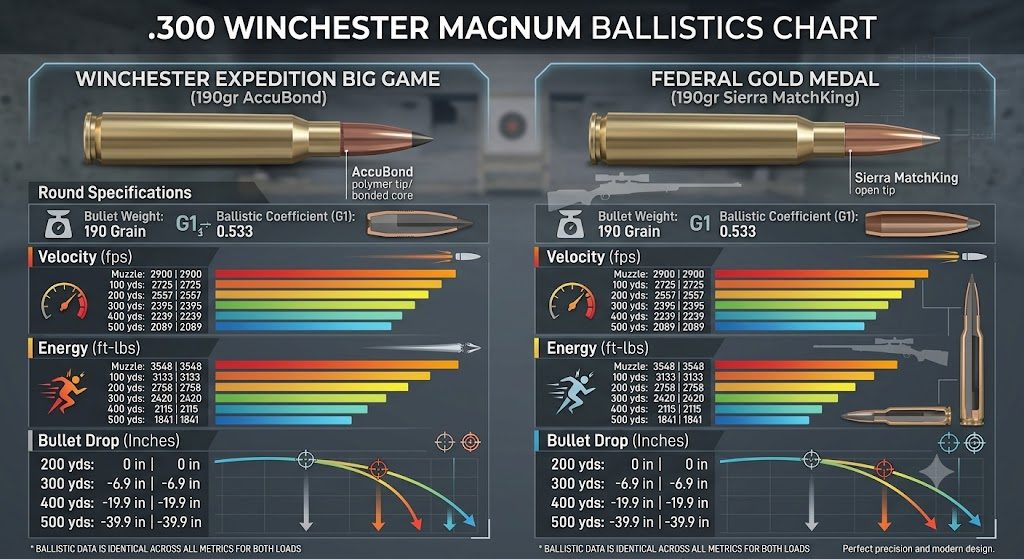
The table below highlights performance data for two widely recognized 300 Winchester Magnum factory loads. Data represents standard performance from a 24-inch test barrel.
| Metric | Winchester Expedition Big Game 190gr AccuBond | Federal Gold Medal 190gr Sierra MatchKing |
| Bullet Weight | 190 Grain | 190 Grain |
| Ballistic Coefficient (G1) | 0.533 | 0.533 |
| Muzzle Velocity | 2900 fps | 2900 fps |
| Velocity at 100 yds | 2725 fps | 2725 fps |
| Velocity at 200 yds | 2557 fps | 2557 fps |
| Velocity at 300 yds | 2395 fps | 2395 fps |
| Velocity at 400 yds | 2239 fps | 2239 fps |
| Velocity at 500 yds | 2089 fps | 2089 fps |
| Muzzle Energy | 3548 ft-lbs | 3548 ft-lbs |
| Energy at 100 yds | 3133 ft-lbs | 3133 ft-lbs |
| Energy at 200 yds | 2758 ft-lbs | 2758 ft-lbs |
| Energy at 300 yds | 2420 ft-lbs | 2420 ft-lbs |
| Energy at 400 yds | 2115 ft-lbs | 2115 ft-lbs |
| Energy at 500 yds | 1841 ft-lbs | 1841 ft-lbs |
| Drop at 200 yds | 0 in | 0 in |
| Drop at 300 yds | -6.9 in | -6.9 in |
| Drop at 400 yds | -19.9 in | -19.9 in |
| Drop at 500 yds | -39.9 in | -39.9 in |
Note: Calculations based on a 200-yard zero and 1.5-inch sight height.
Bullet Weight
Bullet weight dictates the balance between speed and momentum. In the 300 Win Mag, lighter 150-165 grain bullets maximize muzzle velocity for a flatter short-range trajectory, while 180-200+ grain bullets offer higher ballistic coefficients and better wind resistance, which are preferred for serious long-range work.
Muzzle Velocity
Muzzle velocity is the foundation of your ballistic profile. The 300 Win Mag is famous for its high-pressure design, consistently launching heavy bullets at speeds that flatten the trajectory significantly compared to standard non-magnum cartridges.
Velocity at Distance
As the bullet travels, it loses speed due to aerodynamic drag. Knowing the velocity at specific yardages helps shooters predict terminal performance, such as whether a bullet will maintain the minimum speed required for consistent expansion upon impact.
Muzzle Energy
Expressed in foot-pounds, muzzle energy measures the raw work the cartridge can perform. With most 300 Win Mag loads hovering between 3,500 and 4,000 ft-lbs, it remains a premier choice for heavy game such as elk, moose, and brown bear.
Downrange Energy
This metric tracks energy retention over distance. Because the 300 Win Mag fires heavy, high-BC bullets, it retains lethal energy levels much further downrange than smaller cartridges, making it an ethical choice for shots exceeding 500 yards.
Bullet Drop
Gravity acts on the bullet as soon as it clears the muzzle. Bullet drop calculations allow shooters to adjust their point of aim using turrets or reticle holds to compensate for the parabolic arc of the flight path.
Wind Drift
Wind resistance is the primary enemy of long-range precision. A bullet with a higher ballistic coefficient spends less time in flight and is less affected by crosswinds, allowing for tighter groupings in unpredictable conditions.
Ballistic Coefficient
The ballistic coefficient (BC) is a numerical measure of a projectile’s aerodynamic efficiency. A higher BC means the bullet cuts through the air more efficiently, resulting in less velocity loss and less deviation from the target.
Sectional Density
Sectional density describes the weight-to-diameter ratio, which directly influences penetration. High sectional density is a key advantage of the 300 Win Mag, as it ensures bullets travel deep enough to reach vital organs on large-framed animals.
Time of Flight
Time of flight measures how long the bullet takes to reach the target. Shorter times are critical because they reduce the probability of the target moving or external environmental shifts affecting the bullet’s path.
Effective Range
For most hunters, the effective range is limited by their ability to compensate for wind and drop, typically reaching out to 600 or 700 yards. In skilled hands, the cartridge is capable of extreme precision well beyond 1,000 yards.
Long Range Performance
The 300 Winchester Magnum is a standard-length magnum, meaning it fits into traditional rifle actions while providing “magnum-class” ballistics. Its widespread use in military, hunting, and competition circles ensures high-quality components and data are always available.
Cartridge Overview
Introduced in 1963, the 300 Win Mag is a belted magnum derived from the 375 H&H. It occupies the “sweet spot” for many hunters, offering a significant increase in power over the 30-06 Springfield without requiring the massive actions or specialized bolt faces of larger magnums.
Hunting Performance
It is widely considered an ideal all-around North American cartridge. Whether you are pursuing whitetail deer at moderate ranges or elk in high-altitude terrain, the 300 Win Mag delivers the necessary energy to finish the job cleanly.
Frequently Asked Questions
Is the 300 Win Mag overkill for deer?
While powerful, many hunters prefer it for its flat trajectory, which makes shots across deep canyons or open plains much easier to manage than with lighter cartridges.
What is the standard twist rate for 300 Win Mag?
The industry standard is a 1:10 twist, which is optimal for stabilizing the most common bullet weights (180-200 grain).
Does barrel length affect velocity?
Yes. Most ballistic data is based on a 24-inch barrel. Using a shorter barrel will result in a measurable loss of velocity, usually 25-50 fps per inch of barrel length reduction.
Can I use 300 Win Mag for target shooting?
Absolutely. It is a frequent winner in 1,000-yard matches and is highly favored by long-range training facilities for its ballistic consistency.