A 300 Savage Ballistics Chart is an essential reference table that maps out the precise velocity, kinetic energy, and flight trajectory of this classic short action hunting cartridge from the muzzle out to extended ranges. Created over a century ago to match military ballistics in a lever action platform, this incredible round continues to offer mild recoil and exceptional knockdown power for modern hunters. By studying this specific data marksmen can accurately dial their optical elevation turrets and select the perfect factory load for deep woods tracking or open field white tailed deer hunting. Utilizing this comprehensive chart guarantees responsible shots and ethical harvesting with vintage rifles.
300 Savage Ballistics Chart
| Manufacturer | Bullet Weight | Bullet Type | Ballistic Coefficient | Sectional Density | Muzzle Velocity | Velocity At 100 Yards | Velocity At 200 Yards | Velocity At 300 Yards | Velocity At 400 Yards | Velocity At 500 Yards | Muzzle Energy | Energy At 100 Yards | Energy At 200 Yards | Energy At 300 Yards | Energy At 400 Yards | Energy At 500 Yards | Trajectory At 100 Yards | Trajectory At 200 Yards | Trajectory At 300 Yards | Trajectory At 400 Yards | Trajectory At 500 Yards |
|---|---|---|---|---|---|---|---|---|---|---|---|---|---|---|---|---|---|---|---|---|---|
| Hornady Superformance | 150 gr | SST | 0.415 | 0.226 | 2740 fps | 2520 fps | 2311 fps | 2112 fps | 1922 fps | 1745 fps | 2500 ft lbs | 2115 ft lbs | 1779 ft lbs | 1485 ft lbs | 1230 ft lbs | 1014 ft lbs | 1.8 in High | 0.0 in | 8.5 in Low | 25.4 in Low | 52.8 in Low |
| Remington Core Lokt | 150 gr | PSP | 0.314 | 0.226 | 2630 fps | 2362 fps | 2110 fps | 1874 fps | 1656 fps | 1459 fps | 2303 ft lbs | 1858 ft lbs | 1483 ft lbs | 1170 ft lbs | 913 ft lbs | 709 ft lbs | 2.2 in High | 0.0 in | 10.1 in Low | 31.0 in Low | 66.5 in Low |
| Federal Power Shok | 150 gr | JSP | 0.313 | 0.226 | 2630 fps | 2360 fps | 2108 fps | 1872 fps | 1654 fps | 1457 fps | 2303 ft lbs | 1855 ft lbs | 1480 ft lbs | 1167 ft lbs | 911 ft lbs | 707 ft lbs | 2.2 in High | 0.0 in | 10.2 in Low | 31.1 in Low | 66.7 in Low |
| Winchester Super X | 150 gr | Power Point | 0.294 | 0.226 | 2630 fps | 2345 fps | 2078 fps | 1829 fps | 1602 fps | 1400 fps | 2303 ft lbs | 1831 ft lbs | 1438 ft lbs | 1114 ft lbs | 855 ft lbs | 653 ft lbs | 2.2 in High | 0.0 in | 10.3 in Low | 32.0 in Low | 69.5 in Low |
| Federal Power Shok | 180 gr | JSP | 0.380 | 0.271 | 2350 fps | 2150 fps | 1960 fps | 1780 fps | 1612 fps | 1458 fps | 2207 ft lbs | 1847 ft lbs | 1535 ft lbs | 1266 ft lbs | 1039 ft lbs | 850 ft lbs | 3.2 in High | 0.0 in | 13.5 in Low | 40.5 in Low | 85.2 in Low |
| Remington Core Lokt | 180 gr | SP | 0.383 | 0.271 | 2350 fps | 2145 fps | 1952 fps | 1770 fps | 1601 fps | 1445 fps | 2207 ft lbs | 1839 ft lbs | 1523 ft lbs | 1252 ft lbs | 1024 ft lbs | 835 ft lbs | 3.2 in High | 0.0 in | 13.6 in Low | 40.8 in Low | 86.0 in Low |
| Winchester Super X | 180 gr | Power Point | 0.360 | 0.271 | 2350 fps | 2130 fps | 1922 fps | 1726 fps | 1545 fps | 1382 fps | 2207 ft lbs | 1813 ft lbs | 1476 ft lbs | 1191 ft lbs | 954 ft lbs | 764 ft lbs | 3.2 in High | 0.0 in | 13.8 in Low | 41.6 in Low | 88.5 in Low |
Reviewing this comprehensive table reveals that modern powder developments have drastically improved the downrange efficiency of this century old hunting cartridge.
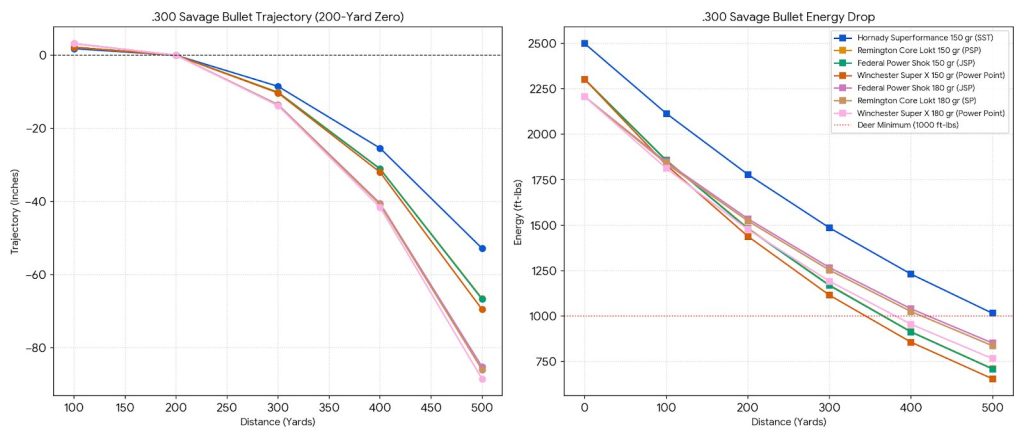
Understanding The 300 Savage Ballistics Chart
Velocity Analysis
Looking closely at the velocity figures shows that the Hornady Superformance 150 grain SST easily claims the top spot with an impressive muzzle velocity of 2740 feet per second.
This elevated starting speed gives the polymer tipped projectile a massive advantage over standard hunting loads across the first two hundred yards.
Evaluating velocity retention reveals how aerodynamic efficiency dictates performance over extended open field hunting gaps.
The Hornady Superformance load retains 1745 feet per second at the five hundred yard mark.
In contrast the traditional Winchester Super X 150 grain Power Point slows down significantly reaching only 1400 feet per second at the same distance.
This data proves that hunters targeting medium game at longer ranges should completely rely on modern aerodynamic projectiles to preserve supersonic stability.
Energy Analysis
Muzzle energy determines the immediate structural shock delivered to an animal upon initial bullet impact in the field.
The table data highlights that the Hornady Superformance 150 grain SST produces the highest initial strike force with 2500 foot pounds of muzzle energy.
Standard traditional options like the Remington Core Lokt 150 grain PSP start with a highly respectable 2303 foot pounds of energy at the muzzle.
Downrange energy retention clearly illustrates the superior design of modern tipped bullets for medium sized game hunting.
By the time the projectiles reach three hundred yards the Hornady load still carries 1485 foot pounds of lethal kinetic force.
The heavy Federal Power Shok 180 grain JSP retains 1266 foot pounds of energy at three hundred yards which ensures massive tissue damage on tough targets.
High retained energy values guarantee that the bullet maintains enough momentum to penetrate thick hide and expand reliably across any practical hunting distance.
Trajectory Analysis
Analyzing the trajectory profile with a standard two hundred yard zero demonstrates the excellent mid range capability of this classic cartridge.
The flattest shooting factory load at mid range distances is the Hornady Superformance 150 grain SST.
This polymer tipped projectile exhibits a minimal bullet drop of only 8.5 inches at the three hundred yard mark.
Traditional heavy woods configurations like the Remington Core Lokt 180 grain SP plunge much faster dropping 13.6 inches at three hundred yards.
As distance increases to five hundred yards the heavy soft point bullets fall drastically making ethical long range shots incredibly difficult without careful optical dialing.
The trajectory data confirms that shooters utilizing standard exposed lead bullets must memorize their holdovers strictly inside three hundred yards.
Ballistic Coefficient Analysis
The ballistic coefficient values listed in the table reveal a massive technological divide between traditional hunting ammunition and modern aerodynamic designs.
The Hornady Superformance 150 grain SST dominates this specific category with a high rating of 0.415.
Traditional brush hunting configurations like the Winchester Super X 150 grain Power Point feature a much lower aerodynamic rating of 0.294.
The superior rating of the polymer tipped bullet allows it to slice through dense atmospheric resistance without shedding precious velocity as rapidly.
According to the chart data this massive aerodynamic advantage guarantees that high coefficient bullets arrive at distant targets with significantly flatter pathways and reduced lateral wind drift.
Sectional Density Analysis
Sectional density directly influences how stable a hunting bullet remains during flight and how deeply it penetrates thick muscle and bone upon arrival.
The chart confirms that all 180 grain projectiles possess the highest sectional density rating of 0.271.
The lighter 150 grain options exhibit a lower sectional density value of 0.226.
A higher sectional density means the bullet concentrates its physical mass over a smaller cross sectional area forcing it deeper into the vital cavity of large game animals.
This specific data confirms that hunters pursuing heavy bodied animals like black bears should rely entirely on the heavy 180 grain projectiles to maximize deep pass through penetration.
Best Factory Loads Based On The Chart
For Extreme Long Range Shooting within ethical limits the Hornady Superformance 150 grain SST is the absolute best choice due to its superior velocity retention.
For Precision Woods Hunting inside two hundred yards the Remington Core Lokt 180 grain SP provides massive terminal shock and incredibly deep penetration.
If Maximum Initial Velocity is your primary goal the Hornady Superformance 150 grain SST takes the top spot by reaching 2740 feet per second.
When seeking Maximum Retained Energy at extended distances the Hornady Superformance 150 grain SST wins easily by preserving 1014 foot pounds of strike force at five hundred yards.
For General Purpose Deer Hunting the Federal Power Shok 150 grain JSP offers reliable terminal expansion and moderate velocities that prevent excessive meat damage.
Key Takeaways From The Chart
The fastest factory load in the entire chart is the Hornady Superformance 150 grain SST at 2740 feet per second.
The highest initial muzzle energy is produced by the Hornady Superformance 150 grain SST at 2500 foot pounds.
The highest retained kinetic energy at five hundred yards belongs to the Hornady Superformance 150 grain SST at 1014 foot pounds.
The flattest trajectory at five hundred yards is achieved by the Hornady Superformance 150 grain SST with a minimal 52.8 inches of bullet drop.
The highest overall ballistic coefficient listed is the Hornady Superformance 150 grain SST at 0.415.
The best overall long range hunting performer based on combined energy retention and trajectory metrics is the Hornady Superformance 150 grain SST.
Common 300 Savage Bullet Weights
The classic short action case capacity allows manufacturers to offer distinct bullet weights optimized for totally different hunting environments.
125 Grain
The 125 grain projectile weight is a highly specialized option used by custom ammunition loaders to maximize raw muzzle speed on small targets.
Typical muzzle velocity for this specific lightweight bullet easily breaks the 2900 feet per second barrier when paired with optimized propellants.
The primary advantage of this weight is its incredibly explosive initial velocity which creates a laser flat flight path inside two hundred yards.
The main disadvantage is that the extremely light mass limits penetration making it completely unsuitable for large heavy bodied big game animals.
This specific weight is best applied in general target practice and short distance explosive predator control on calm weather days.
150 Grain
The 150 grain projectile represents the absolute standard for commercial factory loaded ammunition in this historic caliber.
Typical muzzle velocity is roughly 2630 feet per second which translates into an excellent 2303 foot pounds of initial muzzle energy.
The single biggest advantage of this weight is its exceptional balance of flat mid range trajectory and reliable expansion on medium sized game.
The primary disadvantage is that these specific bullets lack the extreme mass required for reliable pass through shots on thick shoulder bones.
This weight is the absolute ideal choice for open country white tailed deer hunting and general sporting use.
165 Grain
The 165 grain projectile weight represents the perfect sweet spot for custom handloaders who want high ballistic coefficients and deep penetration.
Typical muzzle velocity sits comfortably around 2500 feet per second generating incredibly consistent terminal performance.
The primary advantages of 165 grain options are brilliant rotational stability and a massive selection of premium match grade hunting bullets.
The primary disadvantage is the severely restricted selection of commercial factory loaded options requiring shooters to load their own ammunition.
This weight is the ultimate choice for hunters who require reliable performance on elk alongside a very predictable trajectory curve.
180 Grain
The 180 grain bullet is the heaviest practical option available in modern commercial factory loads for this specific short action cartridge.
Typical muzzle velocity drops down to around 2350 feet per second though it maintains immense structural momentum at close yardages.
The advantage of the 180 grain bullet is its unmatched deep tissue penetration capabilities making it devastating on heavy timber black bears.
The main disadvantage is a severely arched rainbow trajectory which complicates elevation adjustments beyond two hundred yards.
This extreme weight is reserved almost exclusively for specialized heavy brush hunting where deep penetration is prioritized over absolute maximum muzzle velocity.
Effective Range
Understanding the realistic limits of this vintage cartridge helps hunters select the correct equipment and optical setups for their specific field goals.
Target Shooting
For standard large scale paper targets the effective range easily spans from one hundred yards out to five hundred yards.
Beyond five hundred yards the inherent velocity drop of the short action case makes reliable grouping difficult without premium custom handloads.
Shooters must accept that this specialized classic cartridge prioritizes medium range hunting knockdown power over benchrest level precision.
Extreme Long Range Shooting
When participating in extreme long range hunting activities ethical marksmen restrict this cartridge to a maximum distance of three hundred yards.
Achieving success at this specific distance requires premium aerodynamic ammunition to ensure the bullet retains enough kinetic energy for rapid ethical expansion.
Shooting past three hundred yards at live game risks severely wounding the animal due to low retained velocity.
Military Applications
This specific cartridge was never officially adopted by any major global military force for standard front line infantry combat.
However it served as the direct foundational inspiration for the extremely popular modern military sniper cartridge known as the 308 Winchester.
The classic round proved that compact cases could perfectly duplicate large heavy military cartridge ballistics without requiring massive long bolt actions.
Today its military connection remains purely historical serving as a brilliant testament to twentieth century firearm engineering.
Competition Shooting
Within local sporting rifle matches and vintage lever action events the cartridge performs admirably out to the three hundred yard line.
At this specific distance the mild recoil allows shooters to achieve incredible accuracy during rapid fire offhand stages.
The round remains highly popular in specialized lever action silhouette matches where heavy knockdown power is required to topple steel targets.
Factors That Affect 300 Savage Ballistics
External environmental variables and physical firearm attributes combine to drastically shape how this unique projectile behaves once it leaves the muzzle.
Barrel Length
Barrel length plays a crucial role in determining how much velocity the powder charge can generate before the bullet exits into the open atmosphere.
A standard twenty four inch barrel allows the medium burning rifle powder to completely ignite maximizing the initial push on the projectile.
Shorter twenty inch carbine barrels can cause a noticeable loss of velocity which slightly diminishes the maximum effective ethical hunting range.
Bullet Weight
Bullet weight dictates the core relationship between quick initial exit speed and late flight momentum conservation over open ground.
Lighter 150 grain bullets leave the barrel much faster but lose speed rapidly due to atmospheric friction dragging on their surface area.
Heavier 180 grain bullets start noticeably slower but hold their forward momentum incredibly well when smashing through heavy bone and dense muscle.
Bullet Construction
The physical design of the projectile heavily affects its ability to fly straight and expand reliably upon reaching the target.
Modern polymer tipped boat tail bullets always provide superior aerodynamic performance compared to traditional flat base exposed lead soft point designs.
Shooters must ensure they utilize bullets with sufficiently robust copper jackets to withstand impact without fragmenting entirely on the surface.
Ballistic Coefficient
The ballistic coefficient measures exactly how easily the bullet overcomes raw air resistance during its long journey to the target.
A higher ballistic coefficient directly reduces vertical bullet drop and minimizes the lateral drift caused by harsh crosswinds in the field.
Hunters operating in open terrain must prioritize high ballistic coefficient bullets to guarantee exact shot placement during windy conditions.
Altitude
High altitude mountain environments feature much thinner air which drastically reduces the aerodynamic drag forces acting against the flying bullet.
Hunters operating in elevated regions will notice flatter overall pathways and slightly higher retained velocities than those shooting near sea level.
Temperature
Air temperature heavily impacts atmospheric density with freezing cold temperatures creating denser air that slows down projectiles much faster.
Additionally extreme ammunition temperature fluctuations can alter powder burn rates inside the cartridge case causing unexpected changes in initial muzzle velocity.
Wind
Due to the moderate velocities of this classic cartridge crosswinds have a profound and massive effect on the downrange trajectory.
A strong lateral crosswind will push the bullet sideways over long distances requiring precise windage alignment based on detailed ballistic chart evaluations.
Zero Distance
The specific distance at which a rifle is zeroed determines the entire arc of the flight trajectory relative to the shooter looking through the optic.
An inappropriate zero distance can cause the bullet to impact several inches high at close range leading to frustrating misses on small vital zones.
Best Zero Distance
Choosing the correct zero distance establishes an incredibly efficient baseline for holding the crosshairs perfectly steady during fast paced hunts.
100 Yard Zero
A one hundred yard zero is highly popular among civilian hunters who frequent dense heavy timber woods and thick brush environments.
The primary advantage is that wind interference is practically eliminated during the sight in process ensuring a perfectly centered rifle alignment.
The main disadvantage is that the bullet will drop noticeably when taking unexpected shots at deer standing at the two hundred yard line.
This zero is absolute perfection for general target practice and short range lever action brush hunting where shots happen extremely fast.
200 Yard Zero
A two hundred yard zero serves as the absolute optimal baseline for a wide variety of open country deer hunting conditions.
As demonstrated in our primary chart utilizing a two hundred yard zero keeps the bullet path incredibly flat through the first two hundred yards of travel.
The disadvantage is a very slight mid range rise near one hundred yards though it remains small enough to completely ignore when aiming at large game.
This zero is highly recommended for hunters who require instant readiness without touching their elevation turrets during a fast moving hunt.
300 Yard Zero
A three hundred yard zero is an incredibly specialized configuration utilized only by hunters operating in massive open agricultural fields with extremely precise optics.
The massive advantage is that it eliminates the need to hold above the target when engaging distant animals right at the absolute edge of the effective range.
The severe disadvantage is that the bullet flies significantly higher than the line of sight at mid range distances which guarantees high misses on close targets.
This approach is best reserved for dedicated medium range field shooting where target distances are consistently uniform and properly laser ranged.
1000 Yard Zero
A one thousand yard zero is entirely impossible for this specific ammunition type due to the massive loss of velocity past five hundred yards.
The major detriment of attempting this zero is that the bullet trajectory forms a massive rainbow arc making mid range hits mathematically impossible.
The cartridge simply lacks the powder capacity and aerodynamic efficiency to maintain a predictable supersonic path at this extreme distance.
This zero concept should never be applied to practical hunting scenarios or target shooting with this specific vintage cartridge.
300 Savage Compared To Similar Cartridges
To understand exactly where this classic ammunition stands it helps to compare its performance against other dedicated medium game hunting cartridges.
| Cartridge | Velocity | Energy | Trajectory At 300 Yards | Ballistic Coefficient | Effective Range | Recoil | Deer Hunting Performance |
|---|---|---|---|---|---|---|---|
| 300 Savage | 2630 fps | 2303 ft lbs | 10.1 in Low | 0.314 | 300 yd | Moderate | Excellent Inside 300 Yards |
| 308 Winchester | 2820 fps | 2648 ft lbs | 8.0 in Low | 0.415 | 500 yd | Moderate Heavy | Supreme General Purpose Accuracy |
| 30 30 Winchester | 2390 fps | 1902 ft lbs | 20.0 in Low | 0.254 | 200 yd | Mild | Ultimate Short Range Brush Gun |
| 30 06 Springfield | 2910 fps | 2820 ft lbs | 7.0 in Low | 0.415 | 600 yd | Heavy | Massive Long Range Power |
| 300 Blackout | 2200 fps | 1182 ft lbs | 35.0 in Low | 0.280 | 150 yd | Extremely Low | Superb Suppressed Performance |
The major difference shown above is that the classic round sits perfectly between the legendary lever action brush guns and modern bolt action powerhouses. It delivers vastly superior range and energy compared to the old thirty caliber brush cartridges while generating less recoil than heavy modern magnums. This unique balance makes it an incredibly versatile and deeply respected option for any medium game hunter utilizing a vintage rifle platform.
Frequently Asked Questions
What exactly is the 300 Savage cartridge?
It is a classic thirty caliber centerfire rifle cartridge developed over a century ago to deliver military grade ballistics inside a compact lever action rifle platform.
Can you still find factory loaded ammunition for this classic caliber?
Yes major ammunition manufacturers like Hornady Remington and Federal still produce limited seasonal batches of factory loaded ammunition for this legendary round.
Is this cartridge powerful enough for ethical elk hunting?
Yes when loaded with heavy premium one hundred and eighty grain bullets it possesses adequate kinetic energy to ethically harvest elk inside two hundred yards.
What makes this round different from the highly popular 308 Winchester?
The classic cartridge uses a slightly shorter case with a very short neck which limits its powder capacity and slightly reduces overall muzzle velocity compared to its modern successor.
Does the short neck design cause issues for custom handloaders?
The short neck provides less surface area to grip the bullet making it slightly more challenging to achieve perfectly consistent neck tension during the reloading process.
What is the maximum ethical effective range for deer hunting with this load?
Due to the rapid loss of velocity and traditional bullet designs the absolute maximum ethical effective range for clean kills on deer is roughly three hundred yards.
How much energy does the projectile retain at three hundred yards?
A standard one hundred and fifty grain factory load retains approximately one thousand one hundred and seventy foot pounds of kinetic energy at the three hundred yard mark.
Are polymer tipped bullets safe to use in the legendary Model 99 rifle?
Yes because the legendary rifle utilizes a unique rotary magazine rather than a tubular magazine sharp pointed polymer tipped bullets are completely safe to load and fire.
Why was this specific factory cartridge eventually overshadowed by modern designs?
It was heavily overshadowed because global militaries adopted longer cartridges which commercial manufacturers quickly standardized leading hunters to abandon older proprietary designs.
Will modern high pressure loads damage a vintage rifle chambered in this caliber?
Modern factory ammunition is strictly loaded to safe established pressure specifications ensuring it remains completely safe to fire in well maintained vintage firearms.