The main difference between the 300 PRC and the 300 Winchester Magnum is that the 300 PRC is a modern, beltless cartridge designed with a longer overall length and faster rifling twist to perfectly stabilize heavy, high ballistic coefficient bullets for extreme long range precision, while the 300 Winchester Magnum is a legacy belted cartridge that fits into standard long actions and offers unparalleled ammunition availability for standard hunting distances. In this comprehensive guide, we compare velocity, muzzle energy, recoil, trajectory, bullet drop, penetration, expansion, effective range, hunting capability, ammunition cost, and ideal use cases to help you choose the ultimate .30 caliber magnum.
300 Win Mag vs 300 PRC Comparison Table
To accurately compare these two powerhouse cartridges, we must examine their physical dimensions and baseline ballistic performance. The data below represents standard premium factory loads from Hornady’s Precision Hunter line, firing the bullets each cartridge was optimally designed to shoot.
| Specification | 300 PRC (Precision Rifle Cartridge) | 300 Winchester Magnum |
| Cartridge Type | Beltless Magnum Rifle | Belted Magnum Rifle |
| Parent Case | .375 Ruger | .375 H&H Magnum |
| Bullet Diameter | .308 in (7.62 mm) | .308 in (7.62 mm) |
| Case Length | 2.580 in | 2.620 in |
| Overall Length (COAL) | 3.700 in | 3.340 in |
| Typical Bullet Weights | 212 gr to 250 gr | 150 gr to 200 gr |
| Muzzle Velocity (24″ bbl) | 2,860 fps (212gr ELD-X) | 2,850 fps (200gr ELD-X) |
| Muzzle Energy (24″ bbl) | 3,850 ft-lbs (212gr ELD-X) | 3,607 ft-lbs (200gr ELD-X) |
| Maximum Pressure | 65,000 psi (SAAMI) | 64,000 psi (SAAMI) |
| Effective Range | 1,500+ yds (Target) / 1,000 yds (Hunting) | 1,200+ yds (Target) / 800 yds (Hunting) |
| Trajectory | Extremely Flat (High BC) | Very Flat |
| Bullet Drop (500 yds) | Approx. 33 inches | Approx. 35 inches |
| Wind Drift | Minimal (Superior BC) | Moderate to Low |
| Recoil | Heavy (Approx. 29 ft-lbs) | Heavy (Approx. 26 ft-lbs) |
| Barrel Length Performance | Requires 24 to 26 inch barrels | Excels in 24 inch barrels |
| Suppressor Performance | Good (If overall length is manageable) | Good |
| Short Barrel Performance | Poor (Massive velocity loss) | Poor (Massive velocity loss) |
| Action Size | Magnum Long Action | Standard Long Action |
| Accuracy | Sub-MOA (Optimized throat design) | Sub-MOA |
| Penetration | Extreme (Heavy, long bullets) | Excellent |
| Expansion | Reliable at extended ranges | Reliable out to 800 yards |
| Hunting Performance | Elite (Elk, Moose at extreme range) | Excellent (All North American Game) |
| Home Defense | Not Recommended | Not Recommended |
| Tactical Use | Elite Long Range Sniper | Historical Military Sniper |
| AR-15 Compatibility | No | No |
| Magazine Compatibility | Requires Magnum Length Box | Fits Standard Long Action Box |
| Ammunition Cost | High | Moderate |
| Ammo Availability | Moderate (Specialty / Online) | Ubiquitous |
| Reloading | Excellent (No belt, easy to size) | Good (Belt can cause case stretching) |
| Best Uses | Extreme Long Range (ELR) shooting, big game | General purpose big game hunting |
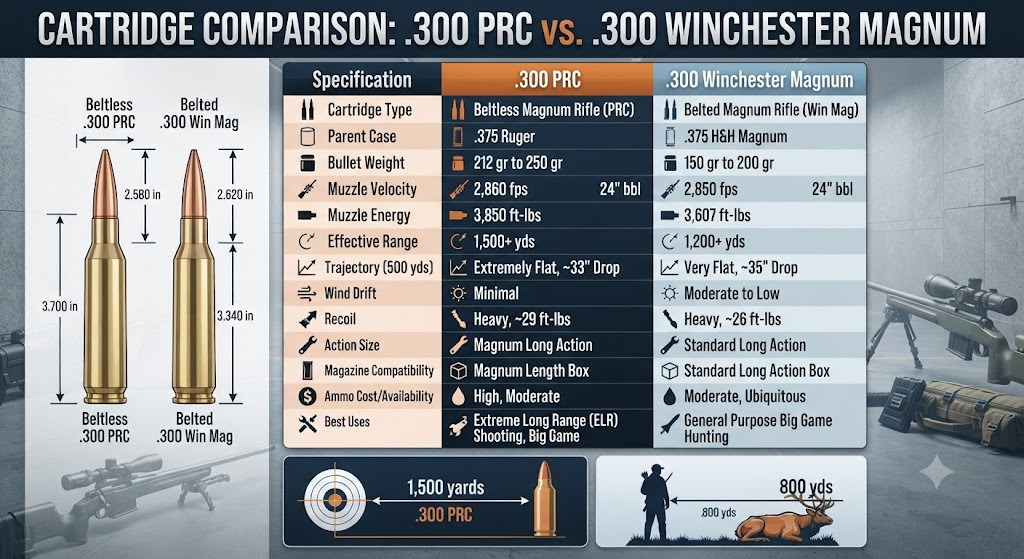
Understanding the Numbers
The technical differences between these cartridges represent a generational shift in rifle design philosophy. The 300 Winchester Magnum was introduced in 1963. To make it fit into a standard long action rifle (the same size action used for the .30-06 Springfield), Winchester limited the overall cartridge length to 3.340 inches. Because the case itself is relatively long (2.620 inches), the bullet must be seated deeply into the case. When you try to load modern, ultra long, heavy bullets (like a 212 grain or 225 grain) into a 300 Winchester Magnum, the base of the bullet protrudes deep into the powder column, stealing powder capacity and limiting velocity.
Hornady introduced the 300 PRC (Precision Rifle Cartridge) in 2018 to solve this exact geometric problem. Hornady designed the 300 PRC with a massive overall length of 3.700 inches. This allows the longest, heaviest, most aerodynamic .30 caliber bullets in existence to be seated completely forward of the powder column. To accommodate this length, the 300 PRC requires a true magnum length action. Furthermore, the 300 PRC is beltless and headspaces off the shoulder, promoting better chamber alignment than the traditional belted 300 Win Mag.
Velocity Comparison
Velocity is the engine that drives long range performance, but it must be paired with aerodynamic efficiency.
Muzzle Velocity Data (24 inch barrel):
- 300 PRC (Hornady 212gr ELD-X): 2,860 fps
- 300 Win Mag (Hornady 200gr ELD-X): 2,850 fps
At the muzzle, the velocities look nearly identical. However, the 300 PRC is pushing a bullet that is 12 grains heavier. If you attempt to load that same 212 grain bullet into a 300 Winchester Magnum, the velocity drops significantly because the bullet displaces powder capacity. The 300 PRC achieves its velocity through sheer volumetric efficiency.
Muzzle Energy Comparison
Muzzle energy measures the kinetic force transferred to the target upon impact.
Muzzle Energy Data (24 inch barrel):
- 300 PRC (212gr ELD-X): 3,850 ft-lbs
- 300 Win Mag (200gr ELD-X): 3,607 ft-lbs
Because the 300 PRC pushes a heavier bullet at a slightly faster speed, it generates nearly 250 foot pounds more kinetic energy at the muzzle. More importantly, because the 300 PRC bullet is more aerodynamic, it retains that kinetic energy much further downrange, ensuring violent expansion and massive tissue damage at distances where the 300 Winchester Magnum begins to run out of steam.
Trajectory Comparison
A flat trajectory minimizes the margin of error when estimating range in the field.
Because both cartridges leave the muzzle at roughly 2,850 fps, their initial trajectories are very similar inside 300 yards. However, the 300 PRC utilizes bullets with exceptionally high Ballistic Coefficients (BC). A high BC means the bullet cuts through the air more efficiently, losing less velocity over time. As the distance stretches past 500 yards, the 300 PRC shoots noticeably flatter because it retains its speed better than the lighter bullets typically fired from the 300 Win Mag.
Bullet Drop Comparison
Assuming a 200 yard zero, the mathematical drop at 500 yards illustrates the aerodynamic advantage of the heavier bullet.
- 300 PRC (212gr ELD-X): Drops approximately 33 inches at 500 yards.
- 300 Win Mag (200gr ELD-X): Drops approximately 35 inches at 500 yards.
Trimming two inches of drop at 500 yards might seem minor, but at 1,000 yards, the superior BC of the 300 PRC bullet results in significantly less vertical drop, requiring less dialing on your rifle scope turrets.
Wind Drift Comparison
Wind deflection is often the primary reason hunters and target shooters miss at extreme ranges. Wind drift is mitigated strictly by a bullet’s velocity and its Ballistic Coefficient (BC).
The 300 PRC was built specifically to dominate the wind. A 212 grain ELD-X bullet has a G1 BC of .673. The 200 grain ELD-X used in the 300 Win Mag has a G1 BC of .597.
Because the 300 PRC bullet is significantly more aerodynamic and retains its velocity longer, it spends less time exposed to crosswinds. At 1,000 yards in a 10 mph crosswind, the 300 PRC will drift noticeably less than the 300 Winchester Magnum, making it a far more forgiving cartridge in unpredictable mountain weather.
Recoil Comparison
You cannot launch massive .30 caliber projectiles at nearly 2,900 fps without generating serious physical recoil.
The 300 Winchester Magnum is famously known for a stout but manageable recoil impulse, usually hovering around 25 to 27 foot pounds of free recoil in a standard 8.5 pound hunting rifle.
The 300 PRC generates more recoil simply because it pushes a heavier bullet. In a similarly weighted rifle, the 300 PRC will generate roughly 28 to 30 foot pounds of free recoil. While both cartridges are considered heavy hitters, practically every modern rifle chambered in 300 PRC is equipped with a highly efficient muzzle brake to tame the violent recoil impulse.
Stopping Power Comparison
For hunting, stopping power refers to how much energy is transferred into the animal’s vitals to anchor it quickly.
Both cartridges deliver exceptional stopping power on deer, elk, and moose. However, the 300 PRC delivers superior stopping power at extended ranges. Hunting bullets require a minimum velocity threshold (usually around 1,600 to 1,800 fps) to physically expand upon impact. Because the high BC bullet of the 300 PRC retains its speed better, it stays above that expansion threshold for roughly 150 to 200 yards further downrange than the 300 Winchester Magnum.
Penetration Comparison
Deep penetration is required to punch through the heavy shoulder bones of bull elk or Alaskan moose.
Sectional Density (SD) measures a bullet’s weight relative to its diameter. A heavier bullet in the same caliber will always have a higher SD, making it longer and more needle like.
- The 200 grain bullet (.300 Win Mag) has an SD of .301.
- The 212 grain bullet (.300 PRC) has an SD of .319.
Because the 300 PRC bullet is heavier and longer, it inherently possesses better sectional density, allowing it to penetrate deeper through heavy bone and dense muscle tissue than the lighter bullets typically fired from the 300 Winchester Magnum.
Expansion Comparison
If a bullet fails to expand, it acts like an ice pick, slipping through the lungs without causing enough tissue damage for a rapid kill.
The 300 Winchester Magnum expands beautifully out to roughly 700 or 800 yards with premium ammunition. Beyond that, velocity drops rapidly, risking bullet failure.
Because the 300 PRC retains its velocity so efficiently, it guarantees reliable bullet expansion at extreme distances where the 300 Winchester Magnum would struggle to open the projectile.
Accuracy Comparison
Both cartridges are capable of elite precision, but the 300 PRC has a distinct mechanical advantage built into its chamber design.
The 300 Winchester Magnum uses a belted case and traditionally features a relatively loose chamber throat. While it can be incredibly accurate, handloaders often have to experiment with seating depth to find the perfect “jump” to the rifling.
Hornady designed the 300 PRC chamber with a tight, match grade throat specifically optimized for modern long heavy bullets. The beltless case headspaces perfectly on the 30 degree shoulder, ensuring absolute concentricity with the bore. Out of the box, with factory ammunition, the 300 PRC is statistically one of the most inherently accurate magnum cartridges ever designed.
Effective Range Comparison
The 300 Winchester Magnum is a proven 1,200 yard target cartridge and a highly ethical 800 yard hunting cartridge in the hands of a capable marksman.
The 300 PRC extends that envelope. Because it retains more energy downrange, drifts less in the wind, and guarantees bullet expansion further out, it is effectively a 1,500+ yard target cartridge and a 1,000 yard hunting cartridge (though taking game at such distances requires immense skill and perfect conditions).
Suppressor Performance Comparison
Suppressors are highly recommended for both of these cartridges to mitigate their massive concussive blast and heavy recoil.
Both cartridges are entirely supersonic and push massive volumes of gas. They perform identically well when suppressed. However, because both cartridges require 24 to 26 inch barrels to burn their powder efficiently, adding a 7 or 8 inch suppressor turns the rifle into an extremely long, unwieldy system that can be difficult to maneuver in dense brush.
Short Barrel Performance Comparison
Magnum cartridges require large volumes of slow burning powder.
If you cut a 300 Winchester Magnum or 300 PRC barrel down to 20 inches, a massive amount of unburnt powder blasts out of the muzzle. This results in a blinding fireball, deafening concussion, and severe velocity loss. Neither cartridge should be fired from a barrel shorter than 22 inches, and 24 inches is the widely accepted minimum for maximum performance.
Home Defense Comparison
Neither cartridge should ever be used for home defense in a suburban or urban environment. Both fire high mass projectiles at nearly 2,900 fps. If fired indoors, the extreme over penetration will easily punch through the target, multiple interior walls, and exterior siding, posing a lethal threat to bystanders and neighbors. Furthermore, the indoor concussive blast of a magnum rifle without a suppressor will cause permanent hearing damage.
Hunting Comparison
Both cartridges are absolute hammers in the hunting woods.
- Deer and Antelope: Both are devastating, though arguably overkill at close ranges.
- Elk and Moose: The 300 PRC is vastly superior at long range. The extra kinetic energy, superior wind deflection, and deeper penetration capability make it a more forgiving choice for quartering shots on 800 pound animals across windy canyons.
- General Purpose: The 300 Winchester Magnum remains the practical king simply because a standard long action rifle is slightly lighter and handier to carry up a mountain than a magnum length action rifle.
Tactical and Duty Use Comparison
The 300 Winchester Magnum has a legendary pedigree in military circles, serving as the primary chambering for the U.S. Military’s M2010 Enhanced Sniper Rifle. It is a proven man stopper at 1,200 meters.
However, the U.S. Department of Defense (specifically SOCOM) recently evaluated the 300 PRC and adopted it for their extreme long range sniper programs. The 300 PRC’s ability to consistently hit targets past 1,500 meters with higher hit probabilities in variable winds makes it the superior modern tactical choice.
AR-15 Compatibility
Neither cartridge is compatible with the AR-15 platform. The AR-15 can only accommodate cartridges with a maximum overall length of 2.260 inches. Both the 300 Winchester Magnum (3.340 inches) and 300 PRC (3.700 inches) are far too massive. To shoot either semi automatically, you would need an upsized, specialized magnum AR platform (like the NEMO Omen or a custom AR-300).
Magazine Compatibility
This is a critical logistical difference when building or buying a rifle.
The 300 Winchester Magnum fits perfectly into standard long action box magazines and AICS pattern long action magazines. This makes finding chassis systems, bottom metal, and spare magazines incredibly easy and affordable.
The 300 PRC requires a true magnum length action (CIP length) magazine. Because the cartridge is 3.700 inches long, standard long action magazines will not work. You must purchase specific CIP length AICS magazines, which are slightly harder to find and generally more expensive.
Ammo Cost Comparison
The 300 Winchester Magnum has been on the market for over six decades. There are dozens of factory load options ranging from cheap practice ammunition to premium hunting loads.
The 300 PRC, released in 2018, is a premium, specialized cartridge. Budget practice ammo essentially does not exist. A box of 20 premium rounds for the 300 PRC typically costs significantly more than a comparable box of 300 Winchester Magnum.
Ammo Availability Comparison
You can walk into almost any rural hardware store, hunting outfitter, or big box sporting goods store in North America and find a box of 300 Winchester Magnum. It is universally available.
The 300 PRC is a modern specialty cartridge. While supported heavily by Hornady and widely available online or at large sporting goods retailers, it is rarely stocked in small rural gun shops. If you lose your ammunition on a hunting trip in rural Alaska, you will not find 300 PRC on the shelf of the local general store.
Reloading Comparison
The 300 Winchester Magnum has mountains of published load data, cheap brass, and infinite bullet choices. However, belted magnums can stretch at the web just above the belt after repeated firings, limiting case life. Furthermore, the short case neck can make seating modern, ultra long bullets difficult.
The 300 PRC is a reloader’s dream. It uses a modern, beltless case that headspaces on the shoulder, resulting in excellent brass life. The long neck holds heavy bullets perfectly concentric, and the massive overall length allows you to seat the bullets entirely out of the powder column.
Pros and Cons
300 PRC
Pros
- Modern beltless design with a match grade chamber throat.
- Massive 3.700 inch overall length allows for heavy, high BC bullets.
- Retains lethal velocity and energy at extreme distances.
- Drifts significantly less in the wind than standard magnums.
- Exceptionally easy and rewarding to reload.
Cons
- Requires a specialized magnum length action and CIP length magazines.
- Ammunition is expensive and not widely available in rural areas.
- Generates slightly heavier recoil than the 300 Winchester Magnum.
300 Winchester Magnum
Pros
- Fits perfectly in standard long action rifles.
- Proven track record on all North American big game since 1963.
- Ammunition is widely available and highly affordable.
- Massive ecosystem of rifles, magazines, and aftermarket parts.
- Slightly milder recoil impulse.
Cons
- Belted case can cause headspacing and reloading stretching issues.
- Short neck limits the ability to use modern, ultra long high BC bullets.
- Drifts more in the wind at extreme distances.
Final Verdict
The 300 PRC is an objective, mathematical upgrade over the 300 Winchester Magnum for extreme long range shooting, but choosing between them depends entirely on your budget, rifle action preference, and hunting style.
- For Extreme Long Range (ELR) Shooting: Choose the 300 PRC. The ability to seat massive 212 grain and 225 grain bullets perfectly out of the powder column provides superior aerodynamics, less wind drift, and unmatched precision past 1,000 yards.
- For the Practical Elk Hunter: Choose the 300 Winchester Magnum. If you are taking shots inside 600 yards, the 300 Win Mag does exactly the same job, but in a lighter standard long action rifle with cheaper, universally available ammunition.
- For Reloaders Seeking Perfection: Choose the 300 PRC. The beltless case, long neck, and match grade chamber throat make load development a dream compared to the belted 300 Win Mag.
- For Budget Conscious Shooters: Choose the 300 Winchester Magnum. You will save massive amounts of money on factory ammunition and have an infinitely larger selection of affordable rifles to choose from.
FAQ
Is the 300 PRC better than the 300 Win Mag?
Ballistically and mechanically, yes. The 300 PRC uses a modern, beltless case and a longer overall length to perfectly stabilize heavy, high ballistic coefficient bullets. It drifts less in the wind and retains more energy at extreme ranges than the 300 Winchester Magnum.
Can I shoot 300 Win Mag in a 300 PRC rifle?
No. They are completely different cartridge designs. The 300 PRC is a beltless cartridge based on the .375 Ruger, while the 300 Win Mag is a belted cartridge based on the .375 H&H Magnum. Attempting to mix them will cause a catastrophic firearm failure.
Does the 300 PRC kick harder?
Yes. Because the 300 PRC drives heavier bullets (like the 212 grain or 225 grain) at high velocities, it generates slightly more free recoil than the 300 Winchester Magnum when fired from identically weighted rifles. Most 300 PRC rifles require a muzzle brake.
Why is the 300 PRC so long?
Hornady designed the 300 PRC with a 3.700 inch overall length so that modern, ultra long, aerodynamic bullets could be seated entirely outside of the powder column. This maximizes powder capacity and ensures the bullet enters the rifling perfectly straight.
Is the 300 Win Mag accurate enough for long range?
Absolutely. The 300 Winchester Magnum is world renowned for its precision and served as the standard U.S. Military sniper cartridge for decades. It is highly capable out to 1,200 yards, but the 300 PRC simply handles the wind better at those extreme distances.
Which ammo is easier to find?
300 Winchester Magnum is significantly easier to find. It is a legacy cartridge available in almost every sporting goods store globally, whereas 300 PRC is a newer, specialty offering that is often only found online or at major retailers.