The main difference between these cartridges is that the 5.56 NATO utilizes lightweight .22-caliber bullets driven at high speeds for close-to-medium range tactical applications and high-volume training, whereas the 6mm ARC utilizes heavier, highly aerodynamic 6mm bullets to stretch the effective range of the AR-15 platform out to 1,000 yards. While the 5.56 NATO dominates in cost-efficiency, magazine capacity, and low recoil for home defense, the 6mm ARC delivers vastly superior kinetic energy, wind resistance, and terminal performance for medium-game hunting and precision long-range shooting.
6mm ARC vs 5.56 NATO Comparison
| Feature | 6mm ARC | 5.56 NATO / .223 Remington |
| Bullet Diameter | 0.243 inches (6.17 mm) | 0.224 inches (5.70 mm) |
| Typical Bullet Weight | 103 gr to 108 gr (typically 108 gr) | 55 gr to 77 gr (typically 55 gr or 62 gr) |
| Muzzle Velocity | 2,750 fps (24-inch barrel) | 2,800 to 3,100 fps (16- to 20-inch barrel) |
| Muzzle Energy | ~1,813 ft-lbs | ~1,250 to 1,300 ft-lbs |
| Momentum | ~42.4 lb-fps (108 gr at 2,750 fps) | ~26.4 lb-fps (62 gr at 3,000 fps) |
| Maximum Pressure | 52,000 psi (SAAMI limitation for AR-15) | 62,366 psi (EPVAT) / 55,000 psi (SAAMI .223) |
| Ballistic Coefficient | Very High (0.512 to 0.536) | Low to Moderate (0.243 to 0.372) |
| Required Bolt Face | 6.5 Grendel (Type 2) | Standard AR-15 (0.378 inch) |
| Magazine Capacity | 25 rounds (in standard 30-rd size mag) | 30 rounds (Standard AR-15) |
| Trajectory | Very flat, excellent wind resistance | Flat inside 300 yds, heavy wind drift beyond |
| Recoil | Low (~7.5 ft-lbs in an AR-15) | Extremely Low (~4.5 ft-lbs in an AR-15) |
| Effective Range | 800 to 1,000 yards | 400 to 600 yards |
| Ammo Availability | Moderate (Growing commercial presence) | Extremely High (Global standard) |
| Ammo Cost | Expensive ($1.20 to $2.00 per round) | Cheap ($0.40 to $0.80 per round) |
| Best Use | Precision long-range, deer/antelope hunting | Close-quarters defense, high-volume training |
The table above details the critical differences in case geometry. The 5.56 NATO utilizes a narrow case that allows 30 rounds to fit into a standard magazine and leaves plenty of steel on the AR-15 bolt lugs, allowing it to operate safely at high pressures.
The 6mm ARC utilizes a much fatter case body. Because the case head is wider, you must use a specialized 6.5 Grendel bolt carrier group. This wider bolt face removes more steel from the locking lugs of the AR-15 bolt. To prevent the bolt from breaking under heavy use, SAAMI restricts the 6mm ARC to a maximum pressure of 52,000 psi. Furthermore, because the cases are fatter, they require specialized magazines, and a standard-sized magazine body will only hold 25 rounds of 6mm ARC instead of 30.
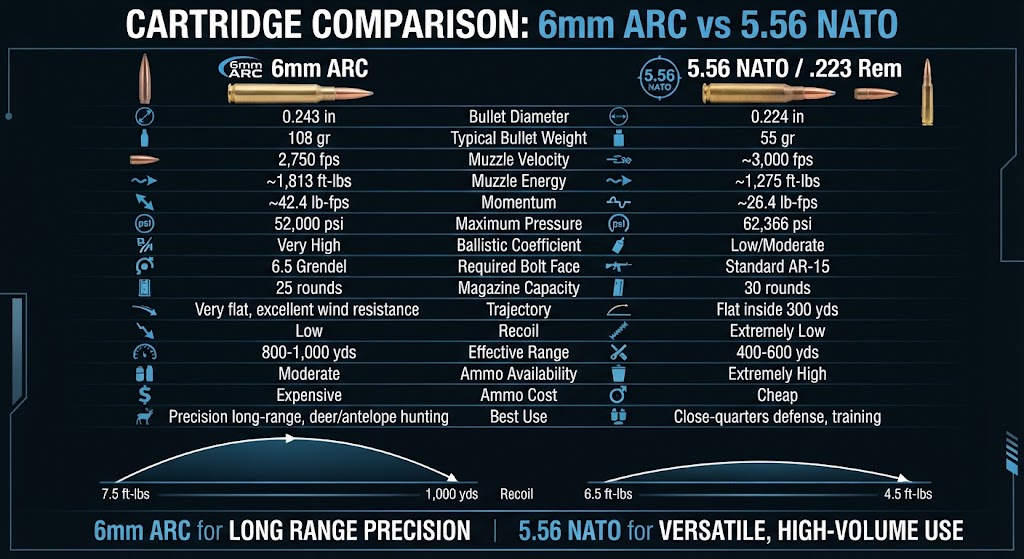
6mm ARC vs 5.56 NATO Ballistics
To objectively evaluate the ballistic capabilities, we must examine real-world factory ammunition. For the 6mm ARC, we will look at its flagship heavy match load. For the 5.56 NATO, we will examine the standard military M855 load (which uses a 62-grain bullet) and the heavy 77-grain Mk262 Mod 1 load, which the military specifically designed to increase the 5.56’s range and lethality.
- Load A (6mm ARC Heavy Match): Hornady 108-grain ELD Match. Tested from a 24-inch barrel. Muzzle velocity is 2,750 feet per second. Muzzle energy is 1,813 foot-pounds. Ballistic Coefficient (G1) is 0.536.
- Load B (5.56 NATO Standard Military): M855 62-grain “Green Tip” FMJ. Tested from a 20-inch barrel. Muzzle velocity is roughly 3,020 feet per second. Muzzle energy is 1,255 foot-pounds. Ballistic Coefficient (G1) is 0.304.
- Load C (5.56 NATO Heavy Precision): Mk262 Mod 1 77-grain OTM (Open Tip Match). Tested from an 18-inch barrel. Muzzle velocity is 2,750 feet per second. Muzzle energy is 1,293 foot-pounds. Ballistic Coefficient (G1) is 0.372.
(Note: AR-15 barrel lengths heavily influence velocity. The 6mm ARC loses roughly 20-25 fps per inch of barrel reduction. Fired from a 16-inch tactical carbine, the 108-grain 6mm ARC will typically yield around 2,550 fps).
6mm ARC vs 5.56 NATO Velocity
Velocity dictates how flat a projectile shoots at closer ranges. The 5.56 NATO is inherently a high-velocity cartridge when firing standard 55-grain or 62-grain bullets. From a full-length barrel, it easily exceeds 3,000 feet per second, providing an incredibly flat trajectory out to 300 yards.
The 6mm ARC is generally slower at the muzzle because it is pushing a bullet that is nearly twice as heavy as standard 5.56 ammunition. A 108-grain bullet fired from a 24-inch barrel achieves roughly 2,750 fps.
However, muzzle velocity is only half the equation. The heavy 108-grain 6mm ARC bullets possess vastly superior Ballistic Coefficients (aerodynamic efficiency). This means they cut through the air with less drag. By the time both bullets reach 500 yards, the 6mm ARC is actually traveling faster than the 62-grain 5.56 NATO bullet because the 5.56 sheds its initial speed much faster in the atmosphere.
6mm ARC vs 5.56 NATO Muzzle Energy
Muzzle energy represents the kinetic work capacity of a projectile. Because the 6mm ARC pushes significantly heavier bullets, it dominates the kinetic energy category.
A standard 5.56 NATO load produces roughly 1,200 to 1,300 foot-pounds of energy at the muzzle. This is more than adequate for self-defense and tactical engagements, but it is considered by many hunters to be too light for ethically harvesting medium game like deer, especially at longer distances.
The 6mm ARC generates roughly 1,800 foot-pounds of energy at the muzzle. This massive 500 foot-pound advantage elevates the AR-15 from a varmint platform to a highly capable medium-game hunting rifle. At 500 yards, the 6mm ARC retains roughly 1,000 foot-pounds of energy (the ethical minimum for deer hunting). The 5.56 NATO drops below 1,000 ft-lbs of energy just past 100 yards.
6mm ARC vs 5.56 NATO Momentum
Momentum correlates closely with a bullet’s ability to crush through dense bone, heavy barriers, and structural resistance without deflecting or stopping prematurely.
Because momentum relies heavily on bullet weight, the 6mm ARC thoroughly outclasses the 5.56 NATO.
A 62-grain 5.56 NATO bullet traveling at 3,020 feet per second yields approximately 26.7 pound-feet per second of linear momentum.
A 108-grain 6mm ARC bullet traveling at 2,750 feet per second yields approximately 42.4 pound-feet per second of linear momentum.
This heavy momentum is exactly why the military requested the cartridge. The 6mm ARC carries the mass necessary to punch straight through intermediate barriers (like auto glass or thin walls) and still deliver lethal terminal performance to the target behind it.
6mm ARC vs 5.56 NATO Trajectory
Understanding external ballistics separates a 300-yard carbine from a 1,000-yard precision rifle. The calculations below assume a standard rifle optic height of 1.5 inches above the bore and a zero distance of 200 yards.
| Distance | 6mm ARC (108 gr at 2,750 fps) Drop | 5.56 NATO (77 gr at 2,750 fps) Drop |
| Muzzle | -1.5 inches | -1.5 inches |
| 200 Yards | 0.0 inches (Zero) | 0.0 inches (Zero) |
| 400 Yards | -22.5 inches | -26.3 inches |
| 600 Yards | -70.9 inches | -88.9 inches |
| 800 Yards | -154.5 inches | -211.5 inches |
| 1000 Yards | -283.5 inches | -425.5 inches |
Out to 300 yards, both cartridges behave similarly. However, as distances stretch to extreme ranges, the aerodynamic superiority of the 6mm ARC takes over. At 1,000 yards, the 5.56 NATO heavy match load drops almost 12 feet (142 inches) more than the 6mm ARC.
More importantly, wind deflection is the primary cause of missed targets at long range. Assuming a direct 10 mile per hour crosswind, the heavy 108-grain 6mm ARC bullet will drift approximately 73 inches at 1,000 yards. The 77-grain 5.56 NATO bullet will drift approximately 125 inches at the exact same distance. The 6mm ARC cuts wind drift nearly in half.
6mm ARC vs 5.56 NATO Recoil
Recoil management is critical for rapid follow-up shots in tactical environments and competition.
The 5.56 NATO is famous for having practically non-existent recoil. Fired from a standard 7.5-pound AR-15, it generates roughly 4.0 to 4.5 foot-pounds of free recoil energy. The gas system and buffer tube completely soak up the rearward impulse, allowing shooters to stay perfectly on target during rapid fire.
The 6mm ARC pushes a bullet that is twice as heavy, requiring more powder. As a result, it generates roughly 7.5 foot-pounds of free recoil energy in an identical rifle. While this is nearly double the recoil of a 5.56 NATO, it is still exceptionally mild—comparable to a .243 Winchester—and remains highly controllable for fast follow-up shots.
6mm ARC vs 5.56 NATO Penetration
The 5.56 NATO relies on speed and fragmentation to cause tissue damage. Military M855 “Green Tip” ammunition utilizes a mild steel penetrator core to defeat light barriers, but on soft tissue, standard 5.56 bullets often yaw (tumble) and fragment rapidly, leading to relatively shallow penetration profiles (typically 12 to 16 inches).
The 6mm ARC provides vastly superior penetration capabilities on medium game. Because the 103-grain to 108-grain bullets feature a higher sectional density and heavier mass, they track remarkably straight through heavy muscle without deflecting. A proper 6mm ARC hunting bullet (like the Hornady ELD-X) will consistently penetrate 16 to 22 inches in soft tissue, easily passing through the shoulder bones of a deer.
6mm ARC vs 5.56 NATO Expansion
Striking fluid-filled tissue at high speeds forces a hunting bullet to mushroom. The 5.56 NATO provides violent, explosive expansion and fragmentation at close ranges (inside 200 yards). However, if the 5.56 velocity drops below 2,500 fps, many standard bullets fail to expand or fragment reliably, acting like solid drills.
The 6mm ARC utilizes heavier, robust bullets that expand in a controlled manner. A standard 103-grain precision hunting bullet will initiate expansion immediately upon entering tissue, peeling back into a classic mushroom shape. Because the bullet is heavy, it retains its core lead weight and continues driving deep into the target while fully expanded, creating a massive permanent crush cavity out to distances where the 5.56 NATO has completely run out of steam.
6mm ARC vs 5.56 NATO Effective Range
The 5.56 NATO is a highly capable combat cartridge inside 300 yards. With heavy match ammunition (Mk262), skilled designated marksmen can push its effective range out to 600 yards. Beyond that, the bullet goes subsonic, loses stability, and is blown aggressively off course by the wind.
The 6mm ARC effectively doubles the useful range of the AR-15. The heavy, high-BC bullets allow the 6mm ARC to remain supersonic and predictable out to 1,000 yards. It allows military operators and civilian competitors to engage targets with a lightweight AR-15 at distances normally reserved for heavy AR-10s chambered in .308 Winchester or 6.5 Creedmoor.
6mm ARC vs 5.56 NATO Self Defense
When choosing a platform for home defense, the 5.56 NATO is generally the superior choice. The 5.56 NATO provides higher magazine capacities (30 rounds vs 25 rounds) and absolute mechanical reliability due to standard bolt face dimensions. More importantly, lightweight 55-grain expanding or fragmenting 5.56 bullets shed their energy incredibly fast upon hitting intermediate barriers like interior drywall. They tend to break apart and stop faster than heavy pistol bullets, drastically reducing the risk of over-penetration in a residential environment.
The heavy, deep-penetrating bullets of the 6mm ARC pose a much higher risk of passing completely through an intruder and into neighboring rooms.
Which Has More Stopping Power: 6mm ARC or 5.56 NATO?
Stopping power is a combination of kinetic energy, tissue disruption, and penetration depth.
On human-sized targets at close range (inside 100 yards), their practical stopping power is highly similar, as the high-velocity fragmentation of the 5.56 NATO creates massive temporary cavities.
However, on medium game (deer, hogs) or at extended distances (past 300 yards), the 6mm ARC possesses vastly superior stopping power. The ability to launch 108-grain bullets provides a level of bone-shattering momentum and deep penetration that .22 caliber bullets simply cannot replicate.
Which Is More Powerful: 6mm ARC or 5.56 NATO?
Based on kinetic energy and linear momentum, the 6mm ARC is completely dominant. It generates roughly 500 more foot-pounds of muzzle energy and carries significantly higher linear momentum due to its massive bullet weight advantage.
6mm ARC Pros and Cons
Pros
- Exceptional long-range ballistics keep heavy bullets supersonic out to 1,000 yards from a compact AR-15.
- High Ballistic Coefficient bullets aggressively resist wind deflection.
- Delivers true medium-game hunting capabilities, making it a highly ethical deer and antelope rifle.
- Drops directly into standard AR-15 lower receivers with just a bolt, barrel, and magazine swap.
Cons
- Requires a specialized 6.5 Grendel bolt face, which leaves thinner bolt lugs that can be a point of mechanical failure under heavy use.
- Ammunition is expensive and primarily limited to specialty precision or hunting loads.
- Reduces standard magazine capacity from 30 rounds down to 25 rounds.
5.56 NATO Pros and Cons
Pros
- The undisputed global standard for modern sporting rifles, ensuring ubiquitous availability of cheap parts and magazines.
- Extremely cheap surplus ammunition allows for high-volume tactical training and target practice.
- Exceptionally low recoil and excellent indoor fragmentation make it the absolute ideal home defense cartridge.
- Thick bolt lugs provide unparalleled mechanical reliability in the AR-15 platform.
Cons
- Lightweight bullets lack the mass to effectively penetrate heavy bone on medium game like deer or hogs.
- Low-BC bullets suffer from severe wind drift at extended ranges.
- Rapid energy loss limits its ethical hunting envelope to closer ranges inside 200 yards.
Final Comparison
| Category | Winner | Reason |
| Velocity | 5.56 NATO | Lighter bullets achieve slightly faster muzzle speeds |
| Muzzle Energy | 6mm ARC | Massive bullet weight yields roughly 500 more ft-lbs of kinetic energy |
| Momentum | 6mm ARC | 108-grain bullets carry immense linear driving mass and momentum |
| Penetration | 6mm ARC | High sectional density pushes heavy bullets deep through bone and muscle |
| Expansion | 6mm ARC | Heavier mass creates a wider, deeper permanent wound channel |
| Trajectory | 6mm ARC | Superior aerodynamics drastically reduce drop and wind drift past 400 yards |
| Recoil Control | 5.56 NATO | Generates almost zero felt recoil, allowing for faster follow-up shots |
| Effective Range | 6mm ARC | Superior retained energy confidently extends accurate shots out to 1,000 yards |
| Self Defense | 5.56 NATO | The global gold standard for capacity, reliability, and safe indoor fragmentation |
| Concealed Carry | Neither | Both are rifle cartridges entirely unsuitable for concealment on the body |
| Ammo Cost | 5.56 NATO | Extreme global military popularity provides massive, cheap bulk options |
| Ammo Availability | 5.56 NATO | Found in massive quantities in literally every sporting goods store worldwide |
| Overall Performance | Depends on Target | 6mm ARC for 1,000-yard precision/deer; 5.56 for home defense and volume training |
6mm ARC vs 5.56 NATO: Which Should You Choose?
Selecting between the 6mm ARC and the 5.56 NATO is entirely dependent on your intended target distance and what you want the rifle to accomplish.
Choose the 6mm ARC if you want to turn your AR-15 into a highly capable 1,000-yard precision target rifle or an ethical deer and antelope hunting platform. The 6mm ARC provides the heavy bullet mass and deep tissue penetration required for quick, ethical kills on medium game that the 5.56 simply cannot guarantee. The exceptional wind resistance makes it mathematically superior for anyone shooting past 400 yards.
Choose the 5.56 NATO for home defense, high-volume tactical training, and general-purpose carbine use. It is the most reliable, proven, and economical intermediate cartridge in existence. The incredibly low recoil allows you to shoot faster and more accurately under stress, it maximizes your magazine capacity, and the ammunition is cheap enough to allow for constant, high-volume practice.
FAQs
Is 6mm ARC more powerful than 5.56 NATO?
Yes, the 6mm ARC is significantly more powerful. It generates approximately 500 more foot-pounds of muzzle energy and carries substantially higher linear momentum than the 5.56 NATO due to its massive 100+ grain bullets.
Which has more muzzle energy?
The 6mm ARC generally produces roughly 1,800 foot-pounds of muzzle energy, whereas the 5.56 NATO produces roughly 1,200 to 1,300 foot-pounds of energy depending on the specific load.
Which has more stopping power?
At close ranges on human-sized targets, stopping power is similar due to the violent fragmentation of the 5.56 NATO. However, on medium game or at extended ranges, the 6mm ARC possesses vastly superior stopping power due to its ability to crush heavy bone and deliver deeper penetration.
Which has more recoil?
The 6mm ARC generates slightly more recoil. Fired from a standard AR-15, it produces roughly 7.5 foot-pounds of free recoil energy, compared to the 4.0 to 4.5 foot-pounds generated by the 5.56 NATO. Both are exceptionally mild.
Which has better penetration?
The 6mm ARC penetrates deeper on heavy game. Its heavier bullet mass and higher sectional density allow it to push through thick shoulder muscles and bone without deflecting or halting prematurely.
Which expands more?
While the 5.56 NATO fragments more violently at close ranges, a premium 6mm ARC expanding hunting bullet will create a wider and deeper permanent wound channel due to its larger starting diameter and heavier retained mass.
Which has a flatter trajectory?
Inside 300 yards, the 5.56 NATO shoots slightly flatter due to its higher muzzle velocity. Beyond 400 yards, the superior aerodynamics of the heavy 6mm ARC bullet take over, resulting in significantly less bullet drop and wind drift at 1,000 yards.
Which is better for self defense?
The 5.56 NATO is widely considered the superior choice for home defense. It offers a 30-round magazine capacity, absolute mechanical reliability, and lightweight bullets that fragment rapidly in residential walls to reduce over-penetration hazards.
Which is better for concealed carry?
Neither. Both are centerfire rifle cartridges fired from long, heavy platforms that cannot be concealed on the human body.
Is 6mm ARC faster than 5.56 NATO?
No, the 5.56 NATO is faster at the muzzle. A standard 5.56 bullet easily exceeds 3,000 fps, while the heavier 6mm ARC bullet typically launches at roughly 2,750 fps. However, the 6mm ARC retains its speed better and becomes faster than the 5.56 at extreme ranges.
Is 6mm ARC stronger than 5.56 NATO?
Yes, in terms of sheer kinetic energy, bullet mass, and momentum crushing through tissue and barriers, the 6mm ARC is drastically stronger.
Which is cheaper to shoot?
The 5.56 NATO is significantly cheaper to shoot due to massive global military production and the widespread availability of affordable bulk practice ammunition.
Can a 5.56 NATO shoot 6mm ARC?
No. They are different calibers with vastly different case geometries. However, a standard 5.56 NATO AR-15 can be converted to shoot 6mm ARC simply by swapping the barrel, the bolt carrier group (to a 6.5 Grendel type 2), and the magazines.
Which is easier to shoot?
The 5.56 NATO is slightly easier to shoot due to its practically non-existent recoil impulse, making it highly preferred for teaching new shooters and maintaining accuracy during high-speed tactical drills.
Which should you choose?
Choose the 5.56 NATO for home defense, high-volume tactical training, and cheap plinking. Choose the 6mm ARC for precision target shooting out to 1,000 yards and ethical medium-game hunting.