The main difference between the 22-250 and the 6.5 creedmoor is their intended hunting application and ballistic philosophy. The 22-250 is a specialized varmint and predator cartridge that relies on extreme muzzle velocity and ultra lightweight bullets to deliver explosive impacts at close to medium ranges. The 6.5 creedmoor is a versatile long range precision and medium game hunting cartridge that relies on heavy, highly aerodynamic bullets to retain energy and resist wind drift at extreme distances.
Table of Contents [Click to minimize]
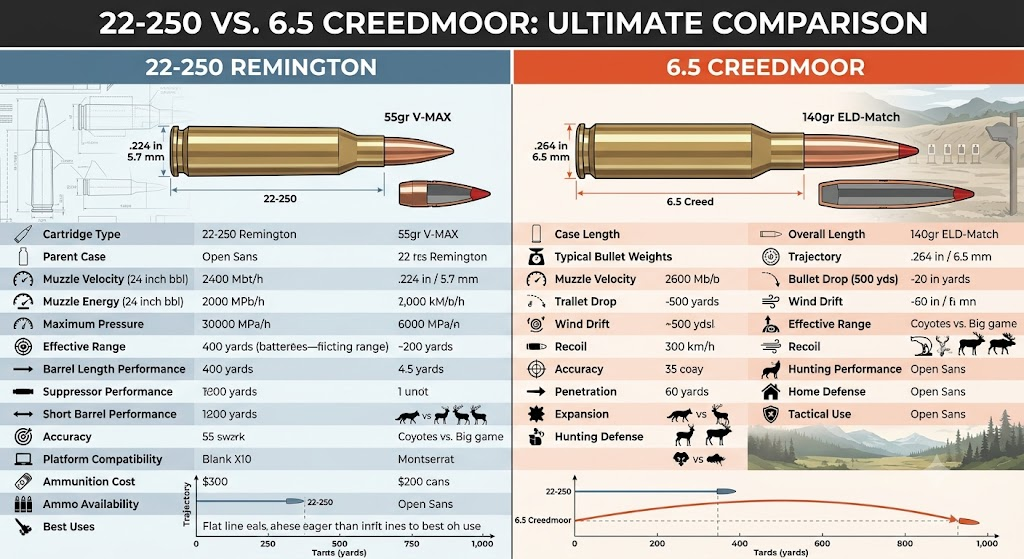
22-250 vs 6.5 creedmoor Comparison Table
To accurately compare these two highly popular short action cartridges, we must examine their physical dimensions, pressure limits, and baseline ballistic performance. The data below represents standard premium factory loads. For the 22-250, we reference a standard 55 grain V-MAX polymer tipped load. For the 6.5 creedmoor, we reference the widely popular 140 grain ELD Match load.
| Specification | 22-250 (Remington) | 6.5 creedmoor |
| Cartridge Type | Centerfire Rifle | Centerfire Rifle |
| Parent Case | .250-3000 Savage | .30 T/C |
| Bullet Diameter | .224 inches (5.7 mm) | .264 inches (6.5 mm) |
| Case Length | 1.912 inches | 1.920 inches |
| Overall Length | 2.350 inches | 2.825 inches |
| Typical Bullet Weights | 40 grains to 60 grains | 120 grains to 147 grains |
| Muzzle Velocity (24 inch bbl) | 3,680 fps (55gr V-MAX) | 2,710 fps (140gr ELD-M) |
| Muzzle Energy (24 inch bbl) | 1,654 foot pounds | 2,283 foot pounds |
| Maximum Pressure | 65,000 psi (SAAMI) | 62,000 psi (SAAMI) |
| Effective Range | 400 to 500 yards | 1,000 to 1,200+ yards |
| Trajectory | Laser Flat (Inside 400 yds) | Extremely Flat |
| Bullet Drop (500 yds) | Approximately 34 inches | Approximately 44 inches |
| Wind Drift | High past 300 yards | Exceptionally Low (High BC) |
| Recoil | Very Mild (Approx. 5 foot pounds) | Moderate (Approx. 15 foot pounds) |
| Barrel Length Performance | Excels in 22 to 26 inch barrels | Excels in 20 to 24 inch barrels |
| Suppressor Performance | Good | Good |
| Short Barrel Performance | Massive velocity loss | Moderate velocity loss |
| Accuracy | High | Elite (Match grade precision) |
| Penetration | Shallow (Explosive fragmentation) | Deep penetration at all ranges |
| Expansion | Devastating | Reliable at extreme distances |
| Hunting Performance | Elite (Coyotes, prairie dogs, foxes) | Elite (Mule deer, elk, antelope) |
| Home Defense | Not Recommended | Not Recommended |
| Tactical Use | None | Military Sniper / Marksman |
| Platform Compatibility | Short Action Bolt Rifles | Short Action Bolt Rifles, AR-10 |
| Ammunition Cost | Moderate | Moderate to High |
| Ammo Availability | Ubiquitous | Ubiquitous |
| Best Uses | Dedicated predator hunting | Precision rifle competition, big game |
Understanding the Engineering
The 22-250 began its life as a wildcat cartridge in the 1930s when shooters necked down the .250-3000 Savage case to accept a .224 caliber bullet. Remington officially standardized it as a commercial cartridge in 1965. It was engineered with one singular goal in mind, which was to push lightweight bullets as fast as mechanically possible to eradicate varmints with flat trajectories and explosive terminal ballistics.
The 6.5 creedmoor was introduced by Hornady in 2007. It was designed from the ground up for competitive long range target shooting. The cartridge features a minimal body taper and a sharp shoulder, allowing it to efficiently burn powder while seating incredibly long, aerodynamic 6.5mm bullets without exceeding the magazine constraints of a standard short action rifle or an AR-10 platform.
Velocity Comparison
Velocity is the defining characteristic of the 22-250.
When firing a standard 55 grain bullet, the 22-250 is an absolute speed demon. It leaves the muzzle at a blistering 3,680 feet per second. If loaded with ultra light 40 grain bullets, the 22-250 can easily exceed 4,000 feet per second.
The 6.5 creedmoor utilizes a much heavier bullet and operates at a slightly lower pressure. Pushing a 140 grain projectile, it leaves the barrel at roughly 2,710 feet per second. While the 6.5 creedmoor is significantly slower at the muzzle, its heavy, aerodynamic bullets retain their velocity much better over extreme distances.
Muzzle Energy Comparison
Muzzle energy measures the absolute kinetic force transferred to a target upon impact.
Because kinetic energy relies heavily on projectile mass, the 6.5 creedmoor completely outclasses the 22-250. The 140 grain 6.5 creedmoor bullet generates roughly 2,283 foot pounds of energy at the muzzle. The 55 grain 22-250 bullet generates approximately 1,654 foot pounds of energy.
This massive energy advantage is exactly why the 6.5 creedmoor is highly trusted for hunting large game like elk and mule deer, whereas the 22-250 lacks the necessary kinetic force and mass to reliably and ethically anchor large, heavy boned animals.
Trajectory Comparison
A flat trajectory minimizes the margin of error when estimating range in the field.
Inside of 400 yards, the 22-250 shoots significantly flatter than the 6.5 creedmoor. The extreme muzzle velocity gets the bullet to the target so fast that gravity has very little time to pull the projectile downward. A predator hunter using a 22-250 can confidently aim dead center on a coyote out to 300 yards without calculating any vertical holdover.
However, as distances stretch past 500 yards, the 6.5 creedmoor begins to shine. Its highly aerodynamic bullets maintain velocity efficiently, whereas the blunt, lightweight .22 caliber bullets shed speed rapidly and begin to drop steeply at long ranges.
Bullet Drop Comparison
Assuming a standard 100 yard zero for both rifles, the mathematical bullet drop illustrates the mid range trajectory advantage of the 22-250.
At 300 yards, the 22-250 drops approximately 5.5 inches. The 6.5 creedmoor drops roughly 12.5 inches.
At 500 yards, the 22-250 drops roughly 34 inches. The 6.5 creedmoor drops approximately 44 inches. While the 22-250 stays flatter to 500 yards, it runs out of steam quickly thereafter, dropping into the transonic speed zone much sooner than the 6.5 creedmoor.
Wind Drift Comparison
Wind deflection is the absolute greatest enemy of the precision shooter. Wind drift is mitigated strictly by a bullet’s velocity and its Ballistic Coefficient.
This is the exact category where the 6.5 creedmoor dominates. A 140 grain ELD Match bullet has a phenomenal G1 Ballistic Coefficient of .646. The standard 55 grain V-MAX used in the 22-250 has a G1 Ballistic Coefficient of only .255.
At 500 yards in a 10 mph crosswind, the heavy, sleek 6.5 creedmoor bullet will drift roughly 15 inches. The lightweight 22-250 bullet will get blown completely off target, drifting nearly 30 inches. For open country hunting or long range competition, the wind defying capabilities of the 6.5 creedmoor are vastly superior.
Recoil Comparison
Recoil dictates a shooter’s ability to spot their own impacts through a rifle scope and fire rapid follow up shots.
The 22-250 produces exceptionally mild recoil. In a standard 8 pound hunting rifle, it generates roughly 5 foot pounds of free recoil. It is completely pleasant to shoot, allowing varmint hunters to watch their bullets impact through magnified optics without losing their sight picture.
The 6.5 creedmoor generates noticeably more recoil. In a standard weight rifle, it generates approximately 15 foot pounds of free recoil. While this is still considered very mild compared to heavy magnum calibers like the .300 Winchester Magnum, it produces more muzzle flip than the 22-250.
Stopping Power Comparison
Stopping power on game animals requires massive energy transfer and tissue disruption.
The 22-250 delivers elite stopping power on coyotes, prairie dogs, and small varmints. The .22 caliber bullets impact at over 3,000 feet per second and expand violently, creating devastating temporary wound cavities that anchor predators instantly.
The 6.5 creedmoor delivers superior stopping power on medium and large game. The hydrostatic shock generated by a heavy 140 grain bullet impacting vital organs creates massive internal trauma required to stop an elk or antelope ethically.
Penetration Comparison
Penetration is critical for ensuring the bullet reaches the vital organs of heavily muscled animals on quartering angles.
The 22-250 offers very shallow penetration. Because it relies on highly frangible, lightweight bullets traveling at hyper velocities, the bullet is designed to explode on contact. This prevents the bullet from exiting the predator and minimizes pelt damage, but it makes the cartridge a poor choice for deep penetration.
The 6.5 creedmoor features exceptionally long, heavy bullets with high sectional density. These projectiles will easily punch through the thick shoulder bones of a mule deer and penetrate deeply into the chest cavity, guaranteeing lethal terminal performance.
Expansion Comparison
To accurately test bullet expansion, the ballistics industry relies on calibrated ordinance gel.
Both cartridges expand reliably when loaded with proper hunting ammunition. The 22-250 essentially detonates upon impact due to its blistering speed, turning the projectile into shrapnel. The 6.5 creedmoor utilizes controlled expansion hunting bullets like the Hornady CX or Barnes LRX that mushroom perfectly and retain their weight as they plow through thick tissue.
Accuracy Comparison
Both cartridges are capable of elite mechanical accuracy.
The 22-250 is legendary for its precision in heavy barreled varmint rifles. Many factory rifles will shoot sub MOA groups at 100 yards easily.
The 6.5 creedmoor is the undisputed king of modern precision rifle series competitions. Its strict chamber tolerances, long case neck, and highly concentric factory ammunition allow off the shelf rifles to routinely shoot tiny groups at extreme distances.
Effective Range Comparison
The effective range of a rifle is severely limited by bullet drop, wind deflection, and retained energy.
The 22-250 is a highly effective 400 to 500 yard varmint cartridge in the hands of a skilled marksman. Past 500 yards, wind drift becomes very difficult to manage with lightweight bullets.
The 6.5 creedmoor is a proven 1,200 yard target cartridge. For hunting, a skilled marksman can ethically harvest medium game out to 600 yards with perfect wind calls and accurate rangefinders.
Suppressor Performance Comparison
Both cartridges are strictly supersonic and push immense volumes of expanding powder gases. Adding a quality titanium or steel suppressor will tame the concussive blast and reduce the visual muzzle flash, but neither cartridge can be made completely silent. The supersonic crack of the bullet breaking the sound barrier will always remain loud.
Short Barrel Performance Comparison
The 22-250 performs terribly in short barrels. It requires a massive column of slow burning powder to achieve its advertised hyper velocities. If you chop a 22-250 barrel down to 16 inches, a massive amount of unburnt powder blasts out of the muzzle, resulting in severe velocity loss and completely ruining its flat trajectory. It requires a minimum of 22 to 24 inches to function as designed.
The 6.5 creedmoor also excels in 20 to 24 inch barrels, but it retains its performance slightly better than the 22-250 when cut down. However, dropping below 18 inches with a 6.5 creedmoor still results in significant velocity loss and heavy muzzle blast.
Platform Compatibility
Both cartridges share the exact same overall length category, meaning they both fit perfectly into standard short action bolt rifles.
However, the 6.5 creedmoor holds a massive logistical advantage in the semi automatic market. It fits perfectly into standard AR-10 style magazines and platforms, making it incredibly popular for tactical shooters and semi automatic hunters. The heavily tapered case of the 22-250 makes it very difficult to feed reliably from double stack box magazines, meaning it is almost exclusively chambered in bolt action rifles.
Ammo Cost Comparison
To become proficient with a precision rifle, you must practice frequently.
The 22-250 is moderately priced. Commercial 55 grain practice or varmint hunting ammunition is produced in large quantities by every major manufacturer, making it relatively affordable for high volume prairie dog shoots.
The 6.5 creedmoor is a premium precision cartridge. Even standard practice ammunition is typically priced at a premium, often costing significantly more per round than the 22-250. Premium match grade ammunition can be very expensive.
Ammo Availability Comparison
Walk into any sporting goods store or rural hardware store in North America, and you will almost certainly find both 22-250 and 6.5 creedmoor ammunition sitting on the shelf. They are two of the most universally adopted short action rifle cartridges on the market today.
Reloading Comparison
Both cartridges are absolute favorites in the precision reloading community.
The 22-250 is highly economical to reload, with infinite load data, cheap brass, and abundant powder choices.
The 6.5 creedmoor is a handloader’s dream for extreme long range precision. The market is flooded with high quality brass cases, premium primers, and the most aerodynamic 6.5mm bullets ever designed.
Pros and Cons
22-250
Pros
- Laser flat trajectory inside 400 yards.
- Extreme velocity ensures explosive fragmentation on varmints.
- Practically zero recoil allows shooters to easily spot their own hits.
- Ammunition is highly affordable and universally available.
- Perfect for high volume predator control.
Cons
- Lacks the kinetic energy to ethically harvest large game.
- Ultra light bullet is highly susceptible to wind drift at long ranges.
- Heavily tapered case does not feed well in semi automatic platforms.
- Fast throat erosion if fired rapidly without letting the barrel cool.
6.5 creedmoor
Pros
- Exceptionally high Ballistic Coefficient bullets defeat wind drift.
- Elite stopping power and deep penetration on large game animals.
- Mild recoil compared to traditional long range magnum cartridges.
- Massive ecosystem of premium match grade factory ammunition.
- Fits perfectly into standard AR-10 semi automatic rifles.
Cons
- Ammunition is more expensive than standard varmint cartridges.
- Heavier recoil than dedicated .22 caliber predator rounds.
- Overkill for hunting small pests at close ranges.
Final Verdict
Choosing between the 22-250 and the 6.5 creedmoor comes down entirely to the size of your target and the distances you intend to shoot.
- For the Dedicated Predator Hunter: Choose the 22-250. It provides the blistering velocity and laser flat trajectory necessary to anchor coyotes and foxes at 300 yards without calculating complex holdovers, and the minimal recoil ensures you can watch the impact through your scope.
- For Extreme Long Range Target Shooting: Choose the 6.5 creedmoor. The aerodynamic efficiency and heavy bullet mass will allow you to ring steel at 1,000 yards with far more consistency and less wind drift than the lightweight .22 caliber bullet.
- For Big Game Hunting: Choose the 6.5 creedmoor. It delivers the deep penetration and massive kinetic energy required to ethically harvest deer, elk, and antelope across wide open plains.
- For the AR Platform Enthusiast: Choose the 6.5 creedmoor. The cartridge geometry is perfectly suited for reliable feeding in heavy AR-10 combat and hunting rifles, offering semi automatic firepower for large game and precision shooting.
FAQ
Is the 6.5 creedmoor more powerful than the 22-250?
Yes, significantly. Because the 6.5 creedmoor pushes a much heavier bullet out of a modern, highly efficient case, it generates roughly 2,280 foot pounds of kinetic energy at the muzzle. The 22-250 generates approximately 1,650 foot pounds of energy.
Can a 22-250 kill a deer?
While a 22-250 can kill a deer with absolute perfect shot placement in the neck or brain, it is universally considered underpowered and unethical for deer hunting. The highly frangible, lightweight bullets lack the mass to reliably penetrate the chest cavity and reach vital organs. Many states legally prohibit using .22 caliber rifles for deer hunting.
Does the 22-250 burn out barrels?
Because the 22-250 pushes a massive amount of hot, high pressure powder gas through a tiny .224 caliber bore, it can cause accelerated throat erosion and barrel wear. However, for the average hunter, a modern 22-250 barrel will easily last thousands of rounds. Barrel life only becomes an issue if the rifle is fired rapidly on hot days without allowing the steel to cool.
What is the effective range of the 6.5 creedmoor?
For target shooting on steel plates, the 6.5 creedmoor is highly effective out to 1,200 yards. For hunting medium game like deer or antelope, a skilled marksman can make ethical, lethal shots out to roughly 600 yards before the kinetic energy drops below acceptable thresholds.
Can I shoot a coyote with a 6.5 creedmoor?
Yes. The 6.5 creedmoor is highly lethal on coyotes at any range. However, hunters should be aware that the heavy, high energy bullets will cause catastrophic pelt damage and will likely pass completely through the animal, so a safe backstop is absolutely necessary.