The main difference between the cartridges is that the .300 Blackout is a lightweight, intermediate cartridge designed to replicate 5.56mm performance while optimizing short-barreled and suppressed platforms, whereas the 8.6 Blackout is a heavy-bore, ultra-fast-twist magnum cartridge engineered to maximize terminal energy and stability with massive .338-caliber projectiles at both supersonic and subsonic speeds.
.300 Blackout vs 8.6 Blackout Comparison
| Feature | .300 Blackout | 8.6 Blackout |
| Bullet Diameter | 0.308 in (7.82 mm) | 0.338 in (8.58 mm) |
| Typical Bullet Weight | 110 gr – 220 gr (typically 110 gr / 220 gr) | 160 gr – 350 gr (typically 210 gr / 300+ gr) |
| Muzzle Velocity | 2,250 – 2,350 fps (Supersonic, 9–16 in) / ~1,050 fps (Subsonic) | 2,200 – 2,500 fps (Supersonic, 12–16 in) / ~1,050 fps (Subsonic) |
| Muzzle Energy | 1,200 – 1,350 ft-lbs (Supersonic) / ~530 ft-lbs (Subsonic) | 2,500 – 3,000 ft-lbs (Supersonic) / ~800–900 ft-lbs (Subsonic) |
| Momentum | ~50 lb-fps (Supersonic 110 gr) / ~68 lb-fps (Subsonic 220 gr) | ~75 lb-fps (Supersonic) / ~100+ lb-fps (Subsonic 300+ gr) |
| Maximum Pressure | 55,000 psi (SAAMI) | 65,000 psi (SAAMI) |
| Barrel Twist Rate | 1:7 or 1:8 inches | 1:3 inches (Ultra-fast twist) |
| Effective Range | 300 – 400 yds (Supersonic) / 100 – 150 yds (Subsonic) | 600 – 800+ yds (Supersonic) / 300 – 400 yds (Subsonic) |
| Platform Compatibility | Standard AR-15 (Standard bolt, mag, upper swap) | AR-10 / Large-frame platform (Unique bolt & barrel) |
| Recoil Energy | Low (~4–6 ft-lbs) | Moderate to Heavy (~12–18 ft-lbs depending on load) |
| Ammo Availability | High (Widely produced by major manufacturers) | Low to Moderate (Boutique and specialty manufacturing) |
| Ammo Cost | Moderate ($0.60 – $1.50 per round) | Expensive ($2.00 – $4.00+ per round) |
| Best Use | CQB, suppressed personal defense, short-barrel AR-15s, medium game | Heavy suppression, barrier penetration, extended-range subsonic performance |
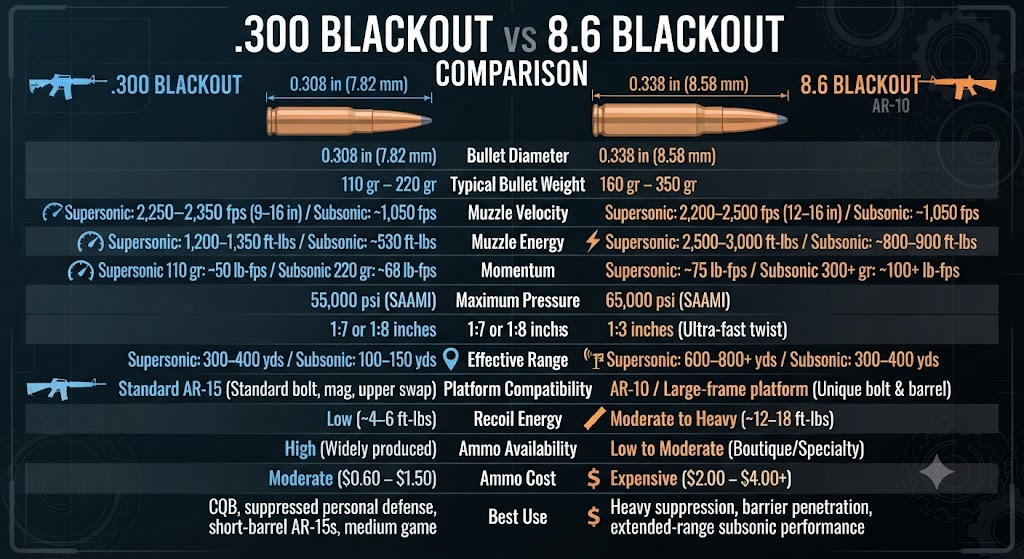
.300 Blackout vs 8.6 Blackout Ballistics
The .300 AAC Blackout was standardized in 2011 to provide .30-caliber performance from standard AR-15 magazines and bolt faces without losing capacity, primarily serving close-quarters combat and suppressed operations. Operating at a 55,000 psi SAAMI pressure ceiling, it uses fast-burning powders to achieve complete powder burn in barrels as short as 9 inches.
In contrast, the 8.6 Blackout (developed by Q alongside Hornady) is built by shortening a 6.5 Creedmoor case to accept a massive .338-caliber bullet. Operating at 65,000 psi, its defining engineering characteristic is an extreme 1:3 inch barrel twist rate. This ultra-fast twist imparts massive centrifugal stabilization to both heavy supersonic bullets and extreme sub-caliber weights, allowing tumbling-on-impact terminal performance even at subsonic speeds.
Representative factory loads illustrate their operational envelopes:
- Load A (.300 BLK Supersonic): Hornady 110-grain V-MAX. Tested from a 16-inch barrel: Muzzle Velocity = 2,350 fps, Muzzle Energy = 1,348 ft-lbs.
- Load B (.300 BLK Subsonic): Hornady 208-grain Sub-X JHP. Tested from a 9-inch barrel: Muzzle Velocity = 1,020 fps, Muzzle Energy = 480 ft-lbs.
- Load C (8.6 BLK Supersonic): Gorilla Ammunition 210-grain monolithic. Tested from a 16-inch barrel: Muzzle Velocity = 2,250 fps, Muzzle Energy = 2,360 ft-lbs.
- Load D (8.6 BLK Subsonic): Gorilla Ammunition 342-grain Monolithic Solid. Tested from a 12-inch barrel: Muzzle Velocity = 1,050 fps, Muzzle Energy = 838 ft-lbs.
Velocity and Energy Comparison
- Supersonic Performance: The .300 Blackout generates respectable intermediate energy (~1,300 ft-lbs) comparable to a hot 7.62x39mm round. The 8.6 Blackout operates in an entirely different power class, pushing heavy .338 bullets at speeds that generate 2,500 to 3,000 ft-lbs of muzzle energy—rivaling traditional short-action magnums like the .308 Win or .300 WSM from compact carbines.
- Subsonic Performance: While both can be loaded safely below the speed of sound (~1,050 fps) for ultra-quiet suppressor use, the .300 Blackout subsonic round tops out around 450 to 500 ft-lbs of energy. The 8.6 Blackout subsonic load utilizes massive 300 to 350-grain projectiles, delivering nearly double the kinetic energy (~800–900 ft-lbs) at the muzzle.
Trajectory and Bullet Drop
Calculations assume a standard scope height of 1.5 inches above the bore and a zero distance of 100 yards for supersonic loadings.
| Distance | .300 BLK (110 gr at 2,350 fps Supersonic) Drop | 8.6 BLK (210 gr at 2,250 fps Supersonic) Drop |
| Muzzle | -1.5 inches | -1.5 inches |
| 50 Yards | +0.4 inches | +0.2 inches |
| 100 Yards | 0.0 inches (Zero) | 0.0 inches (Zero) |
| 200 Yards | -8.5 inches | -6.8 inches |
| 300 Yards | -26.4 inches | -18.2 inches |
Because the 8.6 Blackout fires aerodynamic .338-caliber projectiles with superior ballistic coefficients compared to stubby .300 BLK supers, it flattens out noticeably at distances past 200 yards, retaining energy far more efficiently. Subsonic drops for both calibers are severe past 150 yards due to low velocity.
Recoil and Platform Dynamics
- Platform Size: The .300 Blackout drops directly into a standard AR-15 lower receiver, utilizing standard 5.56 magazines (though modified follower specs help with heavy subsonics) and standard bolt carriers. The 8.6 Blackout requires an AR-10 / large-frame platform (or bolt-action rifle) due to its larger case head and overall length.
- Recoil Energy: The .300 Blackout produces light, manageable recoil (4–6 ft-lbs), making it exceptionally soft to shoot. The 8.6 Blackout produces a distinct, heavier push (12–18 ft-lbs), though heavy suppressor weight or muzzle brakes easily tame it.
Terminal Ballistics and The 1:3 Twist Phenomenon
- The .300 Blackout relies on traditional expansion mechanisms. Subsonic .300 BLK bullets require specialized expanding designs (like Hornady Sub-X or Lehigh Defense projectiles) to open up at low impact velocities; otherwise, non-expanding subsonics behave like .32-caliber ball ammo.
- The 8.6 Blackout changes terminal physics via its 1:3 twist rate. Because the bullet spins at extreme RPMs (exceeding 300,000 RPM even at subsonic speeds), the projectile possesses high gyroscopic instability upon impact with fluid media. Even solid copper or monolithic bullets destabilize and tumble violently immediately upon entering tissue, creating massive permanent wound channels regardless of whether standard hollow points expand.
.300 Blackout Pros and Cons
Pros
- Compatible with standard AR-15 lower receivers and magazines (simple barrel/upper swap)
- Outstanding suppression performance with heavy subsonic rounds
- Widespread commercial ammunition and component availability
- Lightweight, compact personal defense weapon (PDW) profile
Cons
- Mediocre energy and velocity drop-off past 300 yards for supersonic loads
- Subsonic terminal ballistics rely heavily on specialty expanding bullet designs
- Lower overall kinetic energy and stopping power compared to full-sized hunting rounds
8.6 Blackout Pros and Cons
Pros
- Tremendous kinetic energy output in both supersonic and subsonic configurations
- Revolutionary 1:3 twist rate creates devastating terminal wound channels even with subsonic non-expanding bullets
- Effective hunting range exceeds 600+ yards for supersonic configurations
- Exceptional suppressed performance with massive payload weights
Cons
- Requires a large-frame AR-10 platform or custom bolt-action rifle (heavier overall weapon system)
- Expensive ammunition and limited off-the-shelf retail availability
- Accelerated barrel wear due to the extreme 1:3 twist rate and high pressures
Final Comparison
| Category | Winner | Reason |
| Velocity (Supersonic) | .300 BLK | Lighter bullets achieve higher muzzle speeds in short barrels |
| Muzzle Energy | 8.6 BLK | Massive powder capacity and heavy .338 projectiles generate double the energy |
| Subsonic Performance | 8.6 BLK | Heavier payload (~300 gr) and 1:3 twist provide devastating terminal effect |
| Terminal Ballistics | 8.6 BLK | Ultra-fast twist rate causes immediate bullet tumble and massive tissue disruption |
| Platform Versatility & Size | .300 BLK | Fits standard AR-15 lower receivers and compact PDW builds |
| Recoil Control | .300 BLK | Extremely light recoil profile for rapid follow-up shots |
| Effective Range | 8.6 BLK | Flatter trajectory and high-BC .338 bullets extend range past 600 yards |
| Ammo Availability | .300 BLK | Ubiquitous across major manufacturers and local sporting goods stores |
| Ammo Cost | .300 BLK | Far more economical for practice and high-volume training |
| Overall Performance | Depends on Application | .300 BLK wins on compact AR-15 integration and economy; 8.6 BLK wins on sheer power and terminal physics |
.300 Blackout vs 8.6 Blackout: Which Should You Choose?
- Choose the .300 Blackout if you want a lightweight, highly maneuverable short-barreled AR-15 platform that excels with suppressed subsonic and supersonic rounds without breaking the bank on ammunition.
- Choose the 8.6 Blackout if you want maximum terminal ballistic performance from a suppressed rifle, desire exceptional energy transfer at subsonic speeds via a 1:3 twist rate, or need a compact platform capable of ethical big-game hunting at extended ranges.
FAQs
Is .300 Blackout more powerful than 8.6 Blackout?
No, the 8.6 Blackout is significantly more powerful, generating nearly double the kinetic energy (2,500–3,000+ ft-lbs) compared to the .300 Blackout (1,200–1,350 ft-lbs).
Which has more muzzle energy?
The 8.6 Blackout produces substantially higher muzzle energy due to its larger .338-caliber case and higher powder capacity.
Which is better for suppressed shooting?
Both are exceptional suppressed calibers, but the 8.6 Blackout delivers much higher mass and energy (300+ grain bullets at subsonic speeds) while leveraging a 1:3 twist for superior terminal performance.
Which has more recoil?
The 8.6 Blackout produces moderate to heavy recoil (12–18 ft-lbs), whereas the .300 Blackout produces very light, easily managed recoil (4–6 ft-lbs).
Which fits in a standard AR-15?
The .300 Blackout drops directly into a standard AR-15 platform using standard magazines and bolts, while the 8.6 Blackout requires an AR-10 or large-frame platform.
What is the 1:3 twist rate in 8.6 Blackout?
The 8.6 Blackout utilizes an extreme 1-turn-in-3-inches barrel twist rate, spinning projectiles at over 300,000 RPM to induce immediate gyroscopic tumble upon impact in soft tissue.
Which has better ammunition availability?
The .300 Blackout has widespread commercial availability and is stocked globally, while 8.6 Blackout ammunition is primarily produced by specialty and boutique manufacturers.
Which is cheaper to shoot?
The .300 Blackout is significantly cheaper and more accessible for high-volume training and practice.
Which is better for hunting big game?
The 8.6 Blackout is vastly superior for medium-to-large big game (elk, hogs, deer) at extended ranges, especially with its heavy supersonic loads.
Is .300 Blackout effective past 300 yards?
Supersonic .300 Blackout loads can reach out to 300–400 yards, but energy and velocity drop off rapidly compared to larger cartridges.
Which has a longer effective range?
The 8.6 Blackout maintains effective supersonic ballistics and energy retention out to 600–800 yards.
Which requires a larger rifle?
The 8.6 Blackout requires a larger rifle action (AR-10 or long-range bolt action), resulting in a heavier overall firearm system than a compact .300 Blackout AR-15.
Which is easier to shoot accurately?
The .300 Blackout is generally easier to shoot rapidly and accurately due to its minimal recoil and lighter rifle weight.
Which should you choose?
Choose the .300 Blackout for a compact, economical, suppressed AR-15 personal defense weapon, or choose the 8.6 Blackout for cutting-edge terminal ballistics, heavy suppressed energy, and extended-range capability.