The typical .300 Blackout muzzle energy ranges from 450 to 510 foot-pounds for heavy subsonic loads and 1,200 to 1,400 foot-pounds for lighter supersonic loads. For example, standard Remington 220-grain subsonic ammunition produces 503 ft-lbs of energy, while high velocity Barnes 110-grain TAC-TX supersonic ammunition generates a much higher 1,349 ft-lbs. This massive .300 Blackout muzzle energy variance depends entirely on whether the ammunition is supersonic or subsonic, the specific bullet weight, and the barrel length of the rifle. A standard 16-inch barrel will safely maximize the supersonic energy output, while shorter 9-inch barrels are highly efficient for maintaining subsonic performance. Originally designed for special operations, the .300 Blackout relies on extreme versatility to deliver both quiet subsonic energy and hard hitting supersonic power from the exact same firearm.
Table of Contents [Click to minimize]
.300 Blackout Muzzle Energy
| Ammunition / Load | Bullet Weight | Muzzle Velocity | Muzzle Energy |
| Hornady Subsonic Sub-X | 190 grain | 1,050 fps | 465 ft-lbs |
| Sig Sauer Elite Marksman Subsonic | 220 grain | 1,000 fps | 488 ft-lbs |
| Remington UMC Subsonic OTFB | 220 grain | 1,015 fps | 503 ft-lbs |
| Federal Power-Shok Soft Point | 150 grain | 1,900 fps | 1,202 ft-lbs |
| Winchester Deer Season XP | 150 grain | 1,900 fps | 1,202 ft-lbs |
| Sig Sauer Elite Supersonic FMJ | 125 grain | 2,200 fps | 1,343 ft-lbs |
| Barnes VOR-TX TAC-TX Supersonic | 110 grain | 2,350 fps | 1,349 ft-lbs |
| Hornady Black V-MAX Supersonic | 110 grain | 2,375 fps | 1,378 ft-lbs |
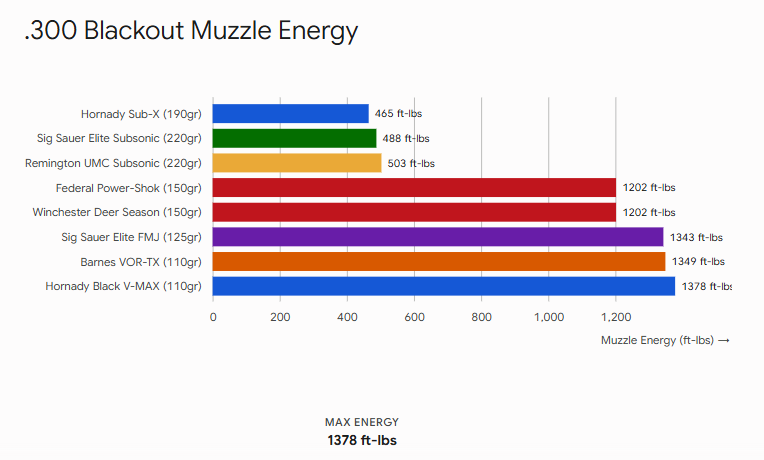
Explaining The 300 Blackout Muzzle Energy Chart
Based on the real world chronograph and factory test data above, we can identify several key performance baselines:
- Lowest Tested Muzzle Energy: The Hornady Subsonic 190-grain Sub-X yields 465 ft-lbs. This load is intentionally kept under the speed of sound to eliminate the supersonic crack, making it incredibly quiet when suppressed but drastically lowering its kinetic output.
- Highest Tested Muzzle Energy: The Hornady Black 110-grain V-MAX supersonic load generates 1,378 ft-lbs of energy. By utilizing a lightweight bullet and maximum powder charges, it operates much like a traditional intermediate rifle cartridge.
- Typical Range: The standard 300 Blackout energy baseline is split into two categories. Subsonic ammunition typically produces 450 to 510 ft-lbs, while supersonic ammunition typically produces 1,200 to 1,400 ft-lbs.
- How Bullet Weight Affects Energy: The .300 Blackout uses bullet weight to control speed. Heavy 220-grain bullets are used to force the velocity below the speed of sound, which results in lower energy. Lighter 110-grain bullets are driven at high speeds, which creates significantly more kinetic energy.
- How Velocity Affects Energy: Velocity has an exponential physical effect on kinetic energy. Because supersonic rounds travel more than twice as fast as subsonic rounds, they produce nearly three times the foot-pounds of energy at the muzzle despite using lighter bullets.
Importantly, muzzle energy is strictly a physics measurement of a bullet’s mass and speed as it leaves the barrel. It is not a direct measurement of terminal performance, tissue damage, or absolute stopping power.
What Is The Muzzle Energy Of .300 Blackout?
The muzzle energy of .300 Blackout ammunition is effectively two completely different numbers depending on the type of ammunition loaded. Subsonic .300 Blackout energy generally sits around 480 foot-pounds, which is very similar to standard .45 ACP handgun energy. Conversely, supersonic .300 Blackout energy generally sits around 1,300 foot-pounds, closely mirroring the kinetic energy output of traditional intermediate rifle cartridges.
.300 Blackout Muzzle Energy By Bullet Weight
Because manufacturers load this cartridge across wildly different projectile types to achieve either stealth or speed, muzzle energy shifts dramatically depending on the weight selected. The .300 Blackout muzzle energy by bullet weight table below uses specific factory load examples to illustrate how energy scales with physical mass and velocity.
| Bullet Weight | Example Velocity | Muzzle Energy |
| 110 grain (Barnes TAC-TX) | 2,350 fps | 1,349 ft-lbs |
| 125 grain (Sig Sauer FMJ) | 2,200 fps | 1,343 ft-lbs |
| 150 grain (Federal Soft Point) | 1,900 fps | 1,202 ft-lbs |
| 190 grain (Hornady Sub-X) | 1,050 fps | 465 ft-lbs |
| 220 grain (Remington OTFB) | 1,015 fps | 503 ft-lbs |
Note: These figures represent specific factory test loads. Not every .300 Blackout load of the same bullet weight produces the exact same energy.
.300 Blackout 110 Grain Muzzle Energy
The 110-grain bullet is the most popular lightweight supersonic option for hunting and self defense. Because a 110-grain projectile is incredibly light for a .30 caliber bore, it can be driven exceptionally fast. Standard .300 Blackout 110 grain muzzle energy typically produces between 1,300 and 1,400 ft-lbs. Premium hunting loads like the Barnes TAC-TX reach 2,350 fps out of a 16-inch barrel, generating a massive 1,349 ft-lbs of energy and expanding reliably on medium game.
.300 Blackout 150 Grain Muzzle Energy
The 150-grain bullet is a mid weight option that sits at the heavy end of the supersonic spectrum. Standard 150-grain supersonic loads typically produce between 1,150 and 1,250 ft-lbs of energy. Moving at a moderate 1,900 fps, these loads provide excellent barrier penetration but offer slightly less kinetic energy and a steeper trajectory than their lighter 110-grain counterparts.
.300 Blackout 220 Grain Muzzle Energy
The heavy 220-grain bullet is the undisputed standard for suppressed subsonic shooting. To keep the round quiet, manufacturers must ensure it leaves the barrel slower than the speed of sound, which is roughly 1,125 fps depending on elevation and temperature. As a result, standard .300 Blackout 220 grain muzzle energy typically measures between 480 and 510 ft-lbs. While the kinetic energy is relatively low for a rifle, the massive bullet weight ensures excellent momentum and reliable cycling in AR-15 platforms.
.300 Blackout Muzzle Energy By Barrel Length
A cartridge’s advertised muzzle energy is usually derived from a standard 16-inch test barrel. However, the .300 Blackout was engineered specifically to achieve full powder burn in just 9 inches of barrel length.
Using standard 110-grain supersonic ammunition, here is how .300 Blackout muzzle energy by barrel length generally performs:
- 6 inches (e.g., Ultra compact PDWs): ~1,950 fps | 928 ft-lbs
- 9 inches (e.g., Optimal tactical length): ~2,150 fps | 1,129 ft-lbs
- 10.5 inches (e.g., Standard AR pistols): ~2,220 fps | 1,203 ft-lbs
- 16 inches (e.g., Standard carbines): ~2,350 fps | 1,349 ft-lbs
While you do gain velocity and energy by stepping up to a 16-inch barrel, the .300 Blackout is remarkably efficient in short configurations. An incredibly short 9-inch barrel still retains over 1,100 foot-pounds of energy, making it a highly capable close quarters platform.
.300 Blackout Velocity And Muzzle Energy
To understand how .300 Blackout muzzle velocity and energy are related, it is critical to look at the differences between its subsonic and supersonic capabilities. Kinetic energy relies exponentially on speed. Because velocity has this exponential physical effect, speed plays a much larger role in generating high foot-pounds of energy than bullet weight alone.
For example, a subsonic 220-grain bullet is exactly twice as heavy as a supersonic 110-grain bullet. However, because the lighter 110-grain bullet is traveling more than twice as fast, it produces nearly three times the total kinetic energy. Any loss or gain in speed will drastically alter the total foot-pounds produced at the muzzle.
.300 Blackout Muzzle Energy vs 5.56 NATO and 7.62x39mm
When analyzing military ballistics, shooters frequently compare the .300 Blackout against the 5.56 NATO and the Russian 7.62x39mm cartridge. The table below compares standard supersonic military and defensive loads across all three calibers.
| Cartridge | Bullet Weight | Muzzle Velocity | Muzzle Energy |
| 5.56 NATO (Winchester M193) | 55 grain | 3,240 fps | 1,282 ft-lbs |
| .300 Blackout (Barnes TAC-TX) | 110 grain | 2,350 fps | 1,349 ft-lbs |
| 7.62x39mm (Sellier & Bellot FMJ) | 123 grain | 2,350 fps | 1,508 ft-lbs |
The supersonic .300 Blackout perfectly bridges the gap between the high speed 5.56 NATO and the heavy hitting 7.62x39mm. It offers slightly more kinetic energy than a standard 5.56 NATO round while firing a heavier projectile. However, the Russian 7.62x39mm pushes a slightly heavier bullet at identical speeds, resulting in the highest overall muzzle energy of the three.
What Muzzle Energy Actually Tells You
Muzzle energy is a useful comparative metric, but it has severe limitations when analyzing a cartridge’s effectiveness in real world shooting scenarios.
- Muzzle Energy vs. Downrange Energy: Muzzle energy is measured inches from the muzzle. Because .300 Blackout bullets are relatively short and blunt compared to longer precision rifle bullets, they shed velocity and energy very rapidly past 200 yards.
- Subsonic Limitations: Subsonic loads have very low muzzle energy numbers. They rely entirely on heavy mass and specialized, rapidly expanding bullet designs to cause tissue damage, not raw kinetic shock.
- Energy vs. Penetration: High muzzle energy does not guarantee deep penetration. A lightweight 110-grain V-MAX bullet with massive energy expands explosively and stops shallow, whereas a heavy 220-grain subsonic solid will penetrate deeply despite having only one third of the kinetic energy.
.300 Blackout Muzzle Energy Pros
- Supersonic loads deliver kinetic energy levels comparable to standard intermediate rifle cartridges from very short, maneuverable barrels.
- Achieves maximum powder burn in 9-inch barrels, reducing wasted kinetic energy and eliminating massive fireballs.
- The wide variety of factory loads allows shooters to seamlessly transition from heavy subsonic stealth loads to high energy supersonic hunting loads with a simple magazine swap.
.300 Blackout Muzzle Energy Limitations
- Subsonic rounds produce kinetic energy levels comparable to a .45 ACP handgun, making them poorly suited for hunting medium game beyond 100 yards.
- Poor ballistic coefficients across most bullet weights mean the energy drops off rapidly at distance.
- Supersonic variants cannot match the sheer kinetic foot-pounds generated by the competing 7.62x39mm cartridge.
.300 Blackout Muzzle Energy: How Much Energy Does It Produce?
The .300 Blackout produces a typical muzzle-energy range of 1,200 to 1,400 foot-pounds for standard supersonic ammunition and 450 to 510 foot-pounds for heavy subsonic ammunition.
Common 110-grain supersonic loads reliably produce around 1,300 to 1,400 ft-lbs. Mid weight 150-grain supersonic loads typically yield 1,150 to 1,250 ft-lbs. The heavy 220-grain subsonic loads predictably produce 480 to 510 ft-lbs to ensure they stay safely under the speed of sound. The highest verified example in our research is the Hornady Black 110-grain V-MAX, which generates an impressive 1,378 ft-lbs out of a 16-inch barrel.
Ultimately, there is no single universal .300 Blackout muzzle energy number. The final output depends entirely on whether you prioritize heavy, silent subsonic performance or the high speed, high energy impact of supersonic ammunition.
FAQs
How much muzzle energy does a .300 Blackout have?
Supersonic .300 Blackout loads typically generate between 1,200 and 1,400 foot-pounds of muzzle energy, while heavy subsonic ammunition produces between 450 and 510 foot-pounds.
What is the muzzle energy of a 110 grain .300 Blackout?
A standard 110-grain supersonic load traveling at roughly 2,350 fps produces approximately 1,350 foot-pounds of muzzle energy when fired from a 16-inch barrel.
How much energy does a 220 grain subsonic .300 Blackout have?
Heavy 220-grain subsonic loads produce roughly 480 to 510 ft-lbs of energy. They must be kept under the speed of sound to remain quiet, which heavily restricts their kinetic output.
What is the muzzle energy of a 150 grain .300 Blackout?
Most 150-grain supersonic factory loads produce between 1,150 and 1,250 ft-lbs of energy, offering moderate velocity and heavy barrier penetration capabilities.
Does barrel length affect .300 Blackout muzzle energy?
Yes. Firing a supersonic .300 Blackout from a 9-inch barrel will result in less velocity and lower muzzle energy compared to a 16-inch barrel. However, the cartridge is incredibly efficient and still produces over 1,100 ft-lbs from short 9-inch configurations.
What is the highest energy .300 Blackout load?
Lightweight 110-grain supersonic loads produce the highest kinetic energy numbers. Ammunition like the Hornady Black 110-grain V-MAX can generate nearly 1,380 ft-lbs of muzzle energy.
How does .300 Blackout muzzle energy compare with 5.56 NATO?
A supersonic 110-grain .300 Blackout produces slightly more raw muzzle energy than a standard 55-grain 5.56 NATO load. However, the 5.56 NATO relies on extreme velocity for its terminal effects, while the .300 Blackout relies on a heavier, wider projectile.
How does .300 Blackout muzzle energy compare with 7.62x39mm?
The Russian 7.62x39mm produces slightly more overall muzzle energy than the .300 Blackout. While both cartridges fire .30 caliber projectiles at similar speeds, the 7.62x39mm utilizes a larger cartridge case with more powder capacity.
Is subsonic .300 Blackout powerful enough for hunting?
Subsonic .300 Blackout produces energy levels similar to a .45 ACP pistol. While it is fully capable of taking small game and feral hogs at very close ranges, it lacks the kinetic energy required for ethical shots on medium game like deer at distances beyond 75 yards.
Does higher muzzle energy mean more stopping power for self defense?
No. Muzzle energy is just a kinetic measurement of speed and mass. Stopping power in a defensive scenario relies heavily on using proper expanding ammunition, achieving adequate penetration depths, and ensuring accurate shot placement.
How is .300 Blackout muzzle energy calculated?
It is calculated using a standard kinetic energy physics concept that mathematically combines the physical weight of the bullet with its flight speed. Because velocity has an exponential effect in this physics calculation, the much faster supersonic loads generate nearly three times the total energy of the slower subsonic loads.