The typical .410 slug muzzle energy ranges from 400 to nearly 800 foot-pounds for standard factory shotgun loads. For example, a lightweight Sellier & Bellot 2.5-inch slug produces roughly 435 ft-lbs, while a heavy Winchester 3-inch magnum slug generates an impressive 791 ft-lbs of energy. This 410 slug muzzle energy variance depends entirely on the specific shell length, the physical bullet weight, the shotgun barrel length, and the resulting muzzle velocity. A full length 24-inch shotgun barrel will naturally yield significantly higher energy levels than a short barrel revolver. Despite its small bore diameter, the .410 bore relies on extreme rifle-like velocities to deliver surprisingly potent kinetic energy.
Table of Contents [Click to minimize]
.410 Slug Muzzle Energy
| Ammunition / Load | Bullet Weight | Muzzle Velocity | Muzzle Energy |
| Sellier & Bellot 2.5-inch Rifled Slug | 1/5 oz (87 grain) | 1,500 fps | 435 ft-lbs |
| Brenneke Silver Slug 3-inch | 1/4 oz (114 grain) | 1,500 fps | 569 ft-lbs |
| Fiocchi Exacta 2.5-inch Aero Slug | 1/4 oz (109 grain) | 1,635 fps | 647 ft-lbs |
| Remington Slugger 2.5-inch Rifled Slug | 1/5 oz (87 grain) | 1,830 fps | 647 ft-lbs |
| Winchester Super-X 2.5-inch Rifled Slug | 1/5 oz (87 grain) | 1,830 fps | 647 ft-lbs |
| Federal Power-Shok 2.5-inch Rifled Slug | 1/4 oz (109 grain) | 1,775 fps | 762 ft-lbs |
| Brenneke Magnum 3-inch | 1/4 oz (114 grain) | 1,755 fps | 780 ft-lbs |
| Winchester Super-X 3-inch Rifled Slug | 1/4 oz (110 grain) | 1,800 fps | 791 ft-lbs |
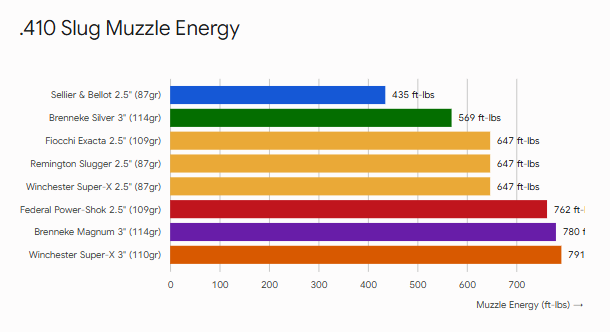
Explaining The 410 Slug Muzzle Energy Chart
Based on the real world factory and chronograph data above, we can identify several key performance baselines:
- Lowest Tested Muzzle Energy: The Sellier & Bellot 2.5-inch rifled slug yields 435 ft-lbs. This load is slightly slower than American factory loads, generating less recoil but sacrificing raw kinetic power.
- Highest Tested Muzzle Energy: The Winchester Super-X 3-inch load generates 791 ft-lbs of energy by pushing a 1/4 ounce, or 110-grain, lead slug at 1,800 fps. The Brenneke Magnum follows closely behind at 780 ft-lbs.
- Typical Range: The standard 410 slug muzzle energy baseline falls between 640 and 790 ft-lbs for traditional hunting ammunition fired from a long barrel.
- How Bullet Weight Affects Energy: The .410 bore uses extremely light payloads. Moving from a 1/5 ounce slug to a slightly heavier 1/4 ounce slug provides the projectile with more physical mass to carry energy downrange.
- How Velocity Affects Energy: Velocity has an exponential physical effect on kinetic energy, making it the most critical factor. Pushing an 87-grain slug at 1,830 fps creates just as much energy as pushing a heavier 109-grain slug at 1,635 fps.
Importantly, muzzle energy is strictly a physics measurement of a projectile’s mass and speed as it leaves the barrel. It is not a direct measurement of terminal performance, tissue damage, or absolute stopping power.
What Is The Muzzle Energy Of A .410 Slug?
The muzzle energy of a .410 slug typically sits around 640 to 650 foot-pounds for standard 2.5-inch shells, while 3-inch magnum shells push the energy up to roughly 750 to 790 foot-pounds. This assumes the ammunition is fired from a traditional 24-inch shotgun test barrel. Depending on the specific application, ranging from short barrel self defense revolvers to full size hunting shotguns, the 410 slug muzzle energy spectrum spans from roughly 150 ft-lbs up to nearly 800 ft-lbs.
.410 Slug Muzzle Energy By Bullet Weight
Because manufacturers load .410 ammunition using two primary payload weights, muzzle energy shifts predictably depending on the size selected. The 410 slug muzzle energy by bullet weight table below uses specific factory load examples to illustrate how energy scales with physical mass and speed.
| Bullet Weight | Example Velocity | Muzzle Energy |
| 1/5 oz (87 grain) (Remington Slugger 2.5-inch) | 1,830 fps | 647 ft-lbs |
| 1/4 oz (109 grain) (Federal Power-Shok 2.5-inch) | 1,775 fps | 762 ft-lbs |
| 1/4 oz (110 grain) (Winchester Super-X 3-inch) | 1,800 fps | 791 ft-lbs |
| 1/4 oz (114 grain) (Brenneke Magnum 3-inch) | 1,755 fps | 780 ft-lbs |
Note: These figures represent specific factory test loads. Not every .410 load of the same bullet weight produces the exact same energy.
.410 1/5 oz Slug Muzzle Energy
The 1/5 ounce slug, which weighs approximately 87 or 88 grains, is the standard for 2.5-inch .410 shotgun shells. Because this projectile is incredibly light for a shotgun, it can be driven exceptionally fast. Standard 1/5 ounce loads typically produce between 640 and 650 ft-lbs of energy out of a long barrel. Reaching velocities of 1,830 fps, these slugs offer a very flat trajectory at close ranges.
.410 1/4 oz Slug Muzzle Energy
The heavier 1/4 ounce slug weighs between 109 and 114 grains depending on the manufacturer. It is commonly found in both 2.5-inch and 3-inch magnum shells. Standard .410 1/4 oz slug muzzle energy typically measures between 760 and 790 ft-lbs. Pushing this extra weight to roughly 1,775 to 1,800 fps provides significantly deeper penetration on medium sized game like deer and feral hogs.
.410 Slug Muzzle Energy By Barrel Length
A shotgun shell’s advertised muzzle energy is nearly always derived from a 24-inch factory test barrel. Firing that same ammunition from an 18-inch tactical shotgun or a small .410 revolver will result in much lower velocity and proportionally lower muzzle energy.
Using standard 1/5 ounce (87 grain) 2.5-inch ammunition, here is how .410 slug muzzle energy changes across common barrel lengths:
- 3 inches (e.g., Taurus Judge Revolver): ~950 fps | 174 ft-lbs
- 14 inches (e.g., Shockwave style firearms): ~1,550 fps | 464 ft-lbs
- 18 inches (e.g., Tactical home defense shotguns): ~1,700 fps | 558 ft-lbs
- 24 inches (e.g., Traditional hunting shotguns): 1,830 fps | 647 ft-lbs
Because standard shotgun powders burn rapidly to accelerate the projectile, shooting a .410 slug out of a handgun wastes a massive amount of potential energy. The powder turns into a loud fireball outside the muzzle rather than pushing the slug forward.
.410 Velocity And Muzzle Energy
To understand how .410 muzzle velocity and energy are related, it is important to know that kinetic energy relies heavily on speed. Because velocity has an exponential physical effect on energy calculations, adding just 100 fps to a .410 slug yields a much larger increase in muzzle energy than adding a few grains of bullet weight.
For example, a standard 87-grain slug traveling at 1,830 fps reliably generates 647 ft-lbs of energy simply because of how the physics of mass and speed interact. If you fire that exact same slug out of a short revolver barrel at only 950 fps, the energy plummets to 174 ft-lbs. Because velocity is mathematically more important to the final energy output, any loss in speed will drastically reduce the total foot-pounds produced.
.410 Slug Muzzle Energy vs 12 Gauge and 20 Gauge
How does the .410 slug energy compare to the larger, more traditional shotgun gauges? The table below compares standard high velocity slug ammunition across the three most popular hunting gauges.
| Cartridge | Bullet Weight | Muzzle Velocity | Muzzle Energy |
| .410 Bore (3-inch shell) | 1/4 oz (110 grain) | 1,800 fps | 791 ft-lbs |
| 20 Gauge (2.75-inch shell) | 3/4 oz (328 grain) | 1,600 fps | 1,865 ft-lbs |
| 12 Gauge (2.75-inch shell) | 1 oz (438 grain) | 1,610 fps | 2,518 ft-lbs |
While the .410 bore is highly effective for its size, it cannot compete with the massive kinetic energy generated by the 20 gauge or the 12 gauge. The 12 gauge pushes a slug that is nearly four times heavier than the .410 slug at highly comparable speeds, resulting in over three times the kinetic energy at the muzzle.
What Muzzle Energy Actually Tells You
Muzzle energy is a useful comparative metric, but it has severe limitations when analyzing a shotgun slug’s effectiveness in the field.
- Muzzle Energy vs. Downrange Energy: Muzzle energy is measured inches from the muzzle. Because .410 slugs are exceptionally light and have incredibly poor aerodynamic profiles, they shed velocity and energy very rapidly at distances past 50 yards.
- Energy vs. Penetration: High muzzle energy does not guarantee deep penetration. A lightweight .410 slug sheds its momentum much faster upon impact than a heavier rifle bullet traveling at the same speed.
- Energy vs. Handgun Performance: A .410 slug fired from a revolver often produces less kinetic energy than a standard 9mm pistol.
.410 Slug Muzzle Energy Pros
- Generates roughly 650 to 790 foot-pounds of energy with exceptionally mild recoil in a full size shotgun.
- Standard energy levels from a long barrel easily surpass popular handgun calibers like the .357 Magnum and .45 ACP.
- Provides a flat, high velocity trajectory for hunting small game and deer at close ranges.
.410 Slug Muzzle Energy Limitations
- Loses a massive percentage of its kinetic energy when fired from popular .410 revolvers due to unburnt powder and cylinder gap pressure loss.
- Poor ballistic coefficients cause the 410 slug energy chart to drop off incredibly fast beyond 75 yards.
- Lacks the sheer kinetic mass and frontal diameter required to compete with traditional 20 gauge or 12 gauge stopping power.
.410 Slug Muzzle Energy: How Much Energy Does It Produce?
The .410 slug produces a typical muzzle-energy range of 640 to 790 foot-pounds for standard factory ammunition fired from a long barrel shotgun.
Common 2.5-inch shells carrying a 1/5 ounce slug reliably yield 640 to 650 ft-lbs. The slightly heavier 2.5-inch shells carrying a 1/4 ounce slug can reach roughly 760 ft-lbs. The heavy 3-inch magnum shells predictably push past 780 ft-lbs. The highest verified example in our research is the Winchester Super-X 3-inch 1/4 ounce load, which generates an impressive 791 ft-lbs.
Ultimately, there is no single universal .410 slug muzzle energy number. The final output depends entirely on the ammunition selected, the projectile weight, and crucially the length of the barrel firing it.
FAQs
How much muzzle energy does a .410 slug have?
Standard 2.5-inch .410 slug loads typically generate between 640 and 760 foot-pounds of muzzle energy, while 3-inch magnum ammunition pushes close to 800 foot-pounds out of a full length barrel.
What is the muzzle energy of a 1/5 oz .410 slug?
A standard 1/5 ounce (87 grain) .410 slug traveling at roughly 1,830 fps produces approximately 647 foot-pounds of muzzle energy.
How much energy does a 1/4 oz .410 slug have?
Heavier 1/4 ounce (110 grain) 3-inch magnum slugs fired from a shotgun produce roughly 780 to 790 ft-lbs of energy, relying on increased mass to generate their power.
Does barrel length affect .410 slug muzzle energy?
Yes, drastically. Firing a .410 slug from a short barrel revolver will result in a massive loss of velocity, dropping the muzzle energy to around 150 to 200 foot-pounds compared to the 650 foot-pounds generated by a 24-inch shotgun barrel.
What is the highest energy .410 slug load?
Heavy 3-inch magnum loads utilizing 1/4 ounce cast slugs produce the highest energy. Loads like the Winchester Super-X 3-inch consistently reach 791 ft-lbs of muzzle energy.
How does .410 slug muzzle energy compare with 12 gauge?
A 12 gauge slug is vastly more powerful than a .410 slug. While a .410 slug produces around 790 ft-lbs of energy at its absolute maximum, a standard 12 gauge slug comfortably exceeds 2,500 ft-lbs.
How does .410 slug muzzle energy compare with 20 gauge?
The 20 gauge produces significantly more muzzle energy than the .410 bore. A standard 20 gauge slug produces roughly 1,865 ft-lbs of energy, easily doubling the kinetic power of the .410 slug.
Is a .410 slug more powerful than a .357 Magnum?
When both are fired from long barrels, they are highly comparable. A .410 slug produces roughly 700 to 790 foot-pounds from a shotgun, while a .357 Magnum fired from a lever action rifle can easily exceed 900 foot-pounds. However, out of a short handgun, the .357 Magnum is vastly more powerful.
Does higher muzzle energy mean more stopping power on deer?
Not always. Muzzle energy is just a kinetic measurement. Stopping power on deer relies heavily on the slug’s ability to maintain momentum and penetrate deeply, which is why the .410 is typically restricted to very close ranges.
How is .410 slug muzzle energy calculated?
It is calculated using a standard kinetic energy physics calculation that mathematically combines the physical weight of the slug with its flight speed. Because velocity has an exponential effect in this physics calculation, the extreme speed of the shotgun powder plays a major role in generating high foot-pounds of energy.