The typical .50 BMG muzzle energy ranges from 12,000 to 15,000 foot-pounds for standard factory loads. For example, standard Federal American Eagle 660-grain FMJ produces 12,666 ft-lbs, while heavy 800-grain Barnes loads generate an incredible 14,895 ft-lbs of energy.This 50 BMG muzzle energy variance depends entirely on the bullet weight, the powder charge of the ammunition, the barrel length of the firearm, and the resulting muzzle velocity. A massive 45-inch test barrel will yield significantly higher energy levels than a shorter 29-inch tactical barrel. Originally built as an anti-materiel machine gun cartridge, the .50 BMG relies on unmatched projectile mass and velocity to generate its devastating kinetic payload.
.50 BMG Muzzle Energy
| Ammunition / Load | Bullet Weight | Muzzle Velocity | Muzzle Energy |
| Speer Factory Load | 647 grain | 3,044 fps | 13,310 ft-lbs |
| Federal American Eagle FMJ | 660 grain | 2,940 fps | 12,666 ft-lbs |
| PMC Bronze FMJ Boat Tail | 660 grain | 2,950 fps | 12,752 ft-lbs |
| Barnes TSX Solid | 700 grain | 2,978 fps | 13,971 ft-lbs |
| PMC Solid Brass Match | 740 grain | 2,830 fps | 13,337 ft-lbs |
| Hornady A-MAX Match | 750 grain | 2,820 fps | 13,241 ft-lbs |
| Hornady A-Tip Match | 750 grain | 2,815 fps | 13,196 ft-lbs |
| Barnes Bore Rider | 800 grain | 2,895 fps | 14,895 ft-lbs |
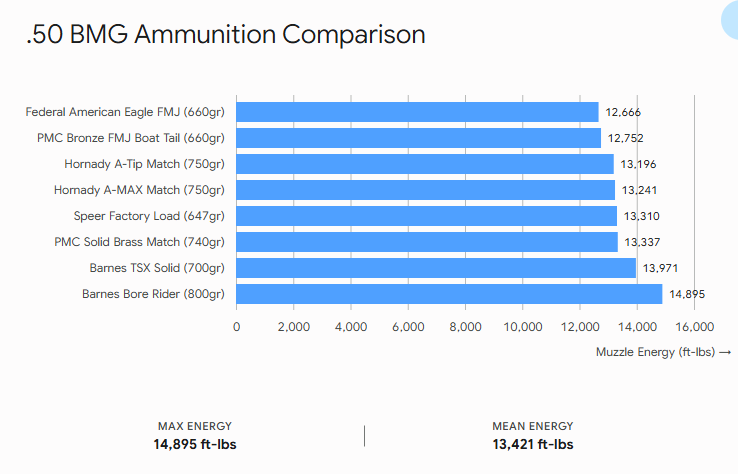
Explaining The 50 BMG Muzzle Energy Chart
Based on the real world chronograph and factory test data above, we can identify several key performance baselines:
- Lowest Tested Muzzle Energy:The Federal American Eagle 660-grain FMJ yields 12,666 ft-lbs. While this is the lowest on our specific chart, it still carries over five times the energy of a typical full size hunting rifle cartridge.
- Highest Tested Muzzle Energy: The 800-grain Barnes load generates an absolutely staggering 14,895 ft-lbs. By combining an exceptionally heavy monolithic bullet with high velocities, it pushes the physical limits of the cartridge.
- Typical Range: The standard 50 BMG energy baseline falls between 12,500 and 13,500 ft-lbs. This is where most traditional 660-grain ball ammunition and 750-grain match bullets operate.
- How Bullet Weight Affects Energy: Heavier bullets generate massive energy numbers when driven fast. Because the .50 BMG case holds well over 200 grains of powder, it has the capacity to push incredibly heavy 700 to 800-grain bullets at speeds that most rifles can only achieve with lightweight projectiles.
- How Velocity Affects Energy: Velocity has an exponential effect on kinetic energy, making it the dominant mathematical factor. Pushing a 647-grain bullet over 3,000 fps generates more kinetic energy than pushing a much heavier 750-grain bullet at 2,820 fps.
Importantly, muzzle energy is strictly a physics measurement of a bullet’s mass and speed as it leaves the barrel. It is not a direct measurement of armor penetration or absolute terminal performance, though in the case of the .50 BMG, the kinetic energy is universally devastating.
What Is The Muzzle Energy Of .50 BMG?
The muzzle energy of .50 BMG ammunition generally sits around 12,500 to 13,500 foot-pounds (ft-lbs) for standard pressure, 660-grain to 750-grain loads fired from a full size rifle barrel. However, depending on the specific application, ranging from standard military ball ammo to high pressure specialty hunting or armor piercing cartridges, the .50 BMG energy spectrum spans from roughly 12,000 ft-lbs up to nearly 15,000 ft-lbs.
.50 BMG Muzzle Energy By Bullet Weight
Because manufacturers load the .50 BMG across several extreme bullet weights, muzzle energy shifts significantly depending on the projectile selected. The table below uses specific factory load examples to illustrate how energy scales with weight and velocity.
| Bullet Weight | Example Velocity | Muzzle Energy |
| 647 grain (Speer) | 3,044 fps | 13,310 ft-lbs |
| 660 grain (PMC Bronze FMJ) | 2,950 fps | 12,752 ft-lbs |
| 700 grain (Barnes TSX) | 2,978 fps | 13,971 ft-lbs |
| 740 grain (PMC Match Solid) | 2,830 fps | 13,337 ft-lbs |
| 750 grain (Hornady A-MAX) | 2,820 fps | 13,241 ft-lbs |
| 800 grain (Barnes Bore Rider) | 2,895 fps | 14,895 ft-lbs |
Note: These figures represent specific factory test loads. Not every .50 BMG load of the same bullet weight produces the exact same energy.
.50 BMG 660 Grain Muzzle Energy
The 660-grain bullet is the historic and undisputed standard for .50 BMG military ball and commercial range ammunition. Moving at a blistering 2,900 to 2,950 fps out of a long barrel, a standard .50 BMG 660 grain muzzle energy typically measures between 12,300 and 12,800 ft-lbs. These projectiles are designed for sheer momentum and volume, offering excellent long range performance out to a mile.
.50 BMG 700 Grain Muzzle Energy
The 700-grain projectile offers a step up in mass for specialized barrier penetration and extreme long range shooting. Standard pressure 700-grain loads usually hover around 13,500 to 14,000 ft-lbs of energy. Premium solid brass or copper ammunition, such as the Barnes TSX, can push this weight to nearly 2,980 fps, yielding an impressive 13,971 ft-lbs of energy.
.50 BMG 750 Grain Muzzle Energy
The 750-grain bullet is the preferred weight for extreme precision and competitive long range match shooting. Moving at a relatively fast 2,800 to 2,850 fps, standard .50 BMG 750 grain muzzle energy typically measures between 13,000 and 13,300 ft-lbs. Premium match ammunition, such as the Hornady 750-grain A-MAX or A-Tip Match, boasts incredible ballistic coefficients that allow the bullet to retain its massive energy for well over a mile.
.50 BMG Muzzle Energy By Barrel Length
A cartridge’s advertised muzzle energy is usually derived from a massive test barrel, often 36 to 45 inches in length for the .50 BMG. Firing that same ammunition from a shorter semi automatic sniper system or tactical rifle will result in lower velocity and proportionally lower muzzle energy.
Because the .50 BMG uses over 220 grains of very slow burning powder, it relies heavily on barrel length to fully ignite the charge.
- 20 to 24 inches (e.g., CQB or compact variants): The powder does not fully burn, resulting in massive fireballs, extreme muzzle blast, and a significant drop in velocity and kinetic energy.
- 29 inches (e.g., Barrett M82A1): This is a standard tactical length. While highly effective, it still bleeds some velocity compared to factory test numbers, dropping common loads closer to the 11,500 to 12,000 ft-lbs range.
- 36 to 45 inches (e.g., Heavy test barrels or target bolt actions): This length allows for a complete powder burn, maximizing the kinetic potential and reliably producing the 13,000 to 14,000+ ft-lbs numbers seen on ammunition boxes.
.50 BMG Velocity And Muzzle Energy
To understand how .50 BMG muzzle velocity and energy are related, it is important to know that kinetic energy relies heavily on speed. Because velocity has an exponential effect on kinetic energy, adding just 100 fps to a .50 BMG load yields a much larger increase in muzzle energy than adding a few grains of bullet weight.
For example, pushing a 647-grain bullet slightly over 3,000 fps generates over 13,300 ft-lbs of energy simply because of how the physics of mass and speed interact. You can push a lighter bullet slightly faster to achieve those same energy numbers, or you can use a heavier 750-grain bullet traveling slightly slower. Because velocity is mathematically more important to the final energy output, any loss in speed out of a shorter barrel will drastically reduce the total foot-pounds produced.
.50 BMG Muzzle Energy vs .338 Lapua and .308 Winchester
How does the .50 BMG energy compare to other dominant long range sniper and hunting calibers? The table below compares premium ammunition across three respected distance calibers.
| Cartridge | Bullet Weight | Muzzle Velocity | Muzzle Energy |
| .308 Winchester | 175 grain | 2,600 fps | 2,627 ft-lbs |
| .338 Lapua Magnum | 285 grain | 2,745 fps | 4,768 ft-lbs |
| .50 BMG | 750 grain | 2,820 fps | 13,241 ft-lbs |
While the .338 Lapua Magnum is an exceptionally powerful cartridge capable of taking game and ringing steel beyond a mile, the .50 BMG completely outclasses it in raw kinetic energy.The massive powder capacity of the .50 BMG allows it to push a bullet that is more than twice as heavy at identical speeds, resulting in nearly three times the muzzle energy of the .338 Lapua Magnum.
What Muzzle Energy Actually Tells You
Muzzle energy is a useful comparative metric, but it has limitations when analyzing a cartridge’s effectiveness in real world scenarios.
- Muzzle Energy vs. Downrange Energy: Muzzle energy is measured inches from the barrel. However, the .50 BMG shines downrange. Thanks to aerodynamically perfect bullet designs with ballistic coefficients exceeding 1.0, a 750-grain .50 BMG bullet still retains over 3,000 ft-lbs of energy at 2,000 yards.
- Energy vs. Penetration: High muzzle energy does not guarantee optimal penetration if the bullet construction is weak. The .50 BMG utilizes solid brass, steel core, or monolithic copper projectiles to ensure its 13,000 ft-lbs of energy punches through concrete, steel plates, and light vehicle armor.
- Stopping Power: The .50 BMG does not rely on typical hollow point expansion to be effective. It derives its devastating anti-materiel effectiveness from deep penetration, crushing momentum, and a virtually unstoppable mass.
.50 BMG Muzzle Energy Pros
- Unmatched kinetic energy output makes it capable of disabling engine blocks, penetrating armored glass, and destroying materiel at extreme distances.
- Exceptional energy retention allows the bullet to remain supersonic and lethal beyond a mile and a half.
- Generates enough force to push heavy 750-grain and 800-grain solid brass bullets through virtually any standard barrier.
.50 BMG Muzzle Energy Limitations
- Extreme energy levels translate directly to severe, punishing recoil that requires massive, heavy rifles and large muzzle brakes to safely manage.
- The tremendous powder charge required to generate this energy creates excessive muzzle blast, flash, and concussive overpressure.
- Short barrels completely handicap the cartridge, turning potential kinetic energy into unburnt powder and flash outside the muzzle.
.50 BMG Muzzle Energy: How Much Energy Does It Produce?
The .50 BMG produces a typical muzzle-energy range of 12,000 to 14,000 foot-pounds for standard pressure ammunition fired from a full size heavy barrel.
Common 660-grain ball loads reliably yield 12,300 to 12,800 ft-lbs. High performance 750-grain match loads produce around 13,000 to 13,300 ft-lbs. Heavy 800-grain specialty loads typically push the boundaries of the cartridge. The highest verified example in our research is the Barnes 800-grain Bore Rider, which generates an immense 14,895 ft-lbs.
Ultimately, there is no single universal .50 BMG muzzle-energy number. The final output depends entirely on the ammunition selected and the length of the barrel firing it, with 36-inch to 45-inch test barrels safely maximizing the cartridge’s kinetic potential, while shorter tactical barrels bleed off a noticeable percentage of that power.
FAQs
How much muzzle energy does a .50 BMG have?
Standard pressure .50 BMG loads typically generate between 12,000 and 14,000 foot-pounds of muzzle energy, while specialty heavy ammunition can push close to 15,000 foot-pounds.
What is the muzzle energy of a 660 grain .50 BMG?
A standard 660-grain .50 BMG load traveling at roughly 2,900 to 2,950 fps produces between 12,300 and 12,800 foot-pounds of muzzle energy.
How much energy does a 750 grain .50 BMG have?
Standard 750-grain match loads produce roughly 13,000 to 13,300 ft-lbs, combining heavy mass with excellent aerodynamics to retain that power over vast distances.
What is the muzzle energy of a 700 grain .50 BMG?
Most 700-grain factory loads produce around 13,500 to 14,000 ft-lbs of energy, relying on a balance of extreme velocity and heavy mass to generate their power.
Does barrel length affect .50 BMG muzzle energy?
Yes. Firing a .50 BMG from a shorter 29-inch tactical barrel will result in less velocity and lower muzzle energy compared to firing the exact same ammunition from a massive 45-inch test barrel designed to burn every grain of powder.
What is the highest-energy .50 BMG load?
Ammunition utilizing extremely heavy bullets produces the highest kinetic numbers. A Barnes 800-grain monolithic bullet fired at nearly 2,900 fps produces just under 14,900 ft-lbs of muzzle energy.
How does .50 BMG muzzle energy compare with .338 Lapua Magnum?
The .50 BMG produces nearly three times the raw kinetic energy of a standard .338 Lapua Magnum.While a .338 Lapua generally sits around 4,700 to 4,900 ft-lbs, the .50 BMG comfortably operates in the 12,000 to 14,000 ft-lbs range.
How does .50 BMG muzzle energy compare with .308 Winchester?
The .50 BMG is in a completely different class than the .308 Winchester. Standard .308 loads generally top out around 2,600 ft-lbs, whereas standard .50 BMG loads are nearly five times as powerful.
Is .50 BMG more powerful than .50 AE?
Yes, by a massive margin. The .50 Action Express used in the Desert Eagle handgun produces roughly 1,500 ft-lbs of energy, while the .50 BMG rifle cartridge produces well over 12,000 ft-lbs. They simply share a bullet diameter, nothing else.
Does higher muzzle energy mean more stopping power on vehicles?
Yes, but penetration is equally important. When destroying materiel like engine blocks, deep penetration through solid steel matters just as much as raw kinetic energy. A heavy solid brass or steel core bullet is required to ensure that 13,000 ft-lbs of energy successfully breaches the target.
How is .50 BMG muzzle energy calculated?
It is calculated using a standard kinetic energy physics calculation that mathematically combines the bullet’s physical weight with its speed. Because velocity has an exponential mathematical effect during this calculation, speed plays a slightly larger role in generating high foot-pounds of energy than the raw weight of the bullet alone.