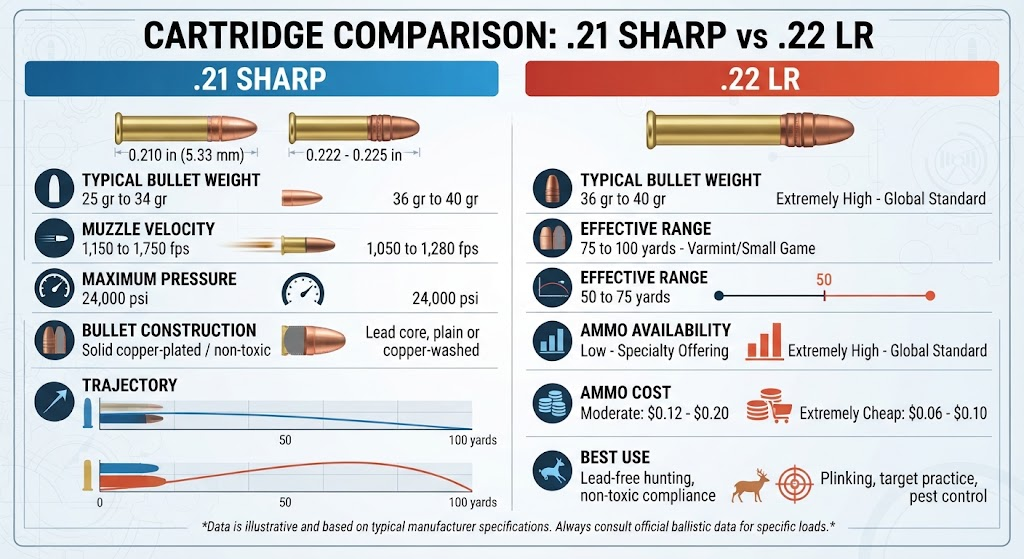
The main difference between the cartridges is that the .21 Sharp is a modern rimfire cartridge introduced by Winchester in 2024 utilizing a true .210-caliber copper-plated bullet designed for flat-shooting accuracy and safer non-toxic small game hunting, whereas the .22 LR is the most popular rimfire cartridge in global history, utilizing a heel-seated lubricated lead bullet optimized for cheap, high-volume plinking and small-game control.
Both cartridges occupy the rimfire ecosystem, but they approach small-bore shooting from opposite eras. The .22 Long Rifle (.22 LR) was developed in 1887 by J.P. Sauer and Son by combining the case of the .22 Long with the heavier 40-grain bullet of the .22 Short. It became an undisputed global standard used by millions. The .21 Sharp was released by Winchester to solve a modern regulatory and performance problem: many state wildlife agencies and conservation areas are increasingly restricting or outright banning traditional lead ammunition for hunting small game. Instead of simply loading lead-free solid copper bullets into a standard .22 LR case (which ruins accuracy and performance due to bullet sizing constraints), Winchester engineered an entirely new cartridge using a slightly narrower case body and a true .210-caliber bullet, allowing non-toxic copper-plated projectiles to achieve higher velocities and flatter trajectories than traditional lead .22 LR loads.
21 Sharp vs 22 LR Comparison
| Feature | .21 Sharp | .22 LR (Long Rifle) |
| Bullet Diameter | 0.210 inches (5.33 mm) | 0.222 to 0.225 inches (heel-seated) |
| Typical Bullet Weight | 25 gr to 34 gr (typically 25 gr or 34 gr) | 36 gr to 40 gr (typically 40 gr) |
| Muzzle Velocity | 1,150 to 1,750 fps (18 to 22-inch barrel) | 1,050 to 1,280 fps (Standard / High Velocity) |
| Muzzle Energy | ~110 to 180+ ft-lbs | ~140 to 200 ft-lbs |
| Momentum | ~5.0 to 6.2 lb-fps | ~5.8 to 6.8 lb-fps |
| Maximum Pressure | 24,000 psi (Estimated rimfire operational limit) | 24,000 psi (SAAMI) |
| Bullet Construction | Solid copper-plated / non-toxic | Lead core (Plain lead or copper-washed) |
| Trajectory | Flat out to 75 to 100 yards | Arcing beyond 50 yards |
| Recoil | Negligible (~0.5 ft-lbs) | Negligible (~0.3 to 0.5 ft-lbs) |
| Effective Range | 75 to 100 yards (Varmint/Small Game) | 50 to 75 yards |
| Ammo Availability | Low (New release specialty offering) | Extremely High (Global rimfire standard) |
| Ammo Cost | Moderate ($0.12 to $0.20 per round) | Extremely Cheap ($0.06 to $0.10 per round) |
| Best Use | Lead-free small game hunting, non-toxic compliance | Plinking, target practice, pest control, training |
The table above illustrates the mechanical divergence. Traditional .22 LR ammunition utilizes a “heeled” bullet meaning the rear shank of the bullet is narrower and pushed down inside the brass case, while the outer diameter matches the full width of the case mouth. This unique heel-seating design prevents .22 LR from easily transitioning to modern non-toxic copper matrix or solid copper bullets without causing feeding and dimension issues.
The .21 Sharp solves this by utilizing a modern, interior-seated bottlenecked or straight-walled case design that accepts a true .210-caliber copper-plated bullet. This allows the bullet to engage the rifling cleanly and achieve significantly higher muzzle velocities, especially when pushing lightweight lead-free loads.
21 Sharp vs 22 LR Ballistics
To objectively evaluate the ballistic capabilities, we must examine real-world factory ammunition across standard rimfire rifle barrels (typically 20 to 22 inches in length).
- Load A (.21 Sharp High-Speed Lead-Free): Winchester 25-grain Copper Matrix. Tested from a 22-inch barrel. Muzzle velocity is 1,750 feet per second. Muzzle energy is 170 foot-pounds.
- Load B (.21 Sharp Standard Lead): Winchester 34-grain Lead Load. Tested from a 22-inch barrel. Muzzle velocity is 1,150 feet per second. Muzzle energy is 99 foot-pounds.
- Load C (.22 LR High-Velocity): CCI Standard Velocity 40-grain Lead Round Nose. Tested from a 22-inch barrel. Muzzle velocity is 1,070 feet per second. Muzzle energy is 102 foot-pounds.
- Load D (.22 LR Hyper-Velocity): CCI Sting 32-grain Copper-Plated Hollow Point. Tested from a 22-inch barrel. Muzzle velocity is 1,640 feet per second. Muzzle energy is 190 foot-pounds.
21 Sharp vs 22 LR Velocity
Velocity is where the .21 Sharp was specifically engineered to shine. Because it utilizes a lighter 25-grain copper-plated projectile, lightweight high-speed loads can easily achieve 1,750 feet per second from a rifle barrel, making it fly significantly faster than standard .22 LR ammunition.
The .22 LR is inherently subsonic in standard-velocity configurations (~1,070 fps), which is why target shooters love it (it doesn’t disrupt the sound barrier twice, maintaining extreme accuracy). While hyper-velocity .22 LR loads (like CCI Stinger or Velocitor) can push lightweight 32-grain bullets up to 1,640 fps, they frequently suffer from inconsistent accuracy because heeled bullets struggle to stabilize at extreme rimfire speeds. The .21 Sharp’s interior-seated .210-caliber bullet is designed to maintain superior accuracy at those elevated velocities.
21 Sharp vs 22 LR Muzzle Energy
Muzzle energy represents the raw kinetic work capacity of a projectile.
Standard .22 LR ammunition generates between 140 and 200 foot-pounds of energy at the muzzle depending on whether you shoot standard, high-velocity, or hyper-velocity loads.
The .21 Sharp generates roughly 110 to 180+ foot-pounds of energy. While hyper-velocity .22 LR loads edge out the .21 Sharp in absolute foot-pounds due to heavier bullet masses (32–40 grains vs 25–34 grains), the .21 Sharp delivers its energy much more efficiently through optimized non-toxic terminal expansion.
21 Sharp vs 22 LR Momentum
Momentum calculates mass in motion, dictating a projectile’s penetration potential on small game.
Because .22 LR utilizes heavier 40-grain bullets, it carries slightly higher linear momentum (~6.0 to 6.8 lb-fps) compared to the lighter 25-grain high-speed .21 Sharp loads (~5.0 lb-fps). However, both cartridges possess more than enough momentum for squirrels, rabbits, and small pests.
21 Sharp vs 22 LR Trajectory
Understanding external ballistics highlights why hunters might choose the .21 Sharp. The calculations below assume a standard rimfire optic height of 1.5 inches above the bore and a 50-yard zero.
| Distance | .21 Sharp (25 gr at 1,750 fps) Drop | .22 LR (40 gr at 1,250 fps High-Vel) Drop |
| Muzzle | -1.5 inches | -1.5 inches |
| 25 Yards | +0.4 inches | +0.3 inches |
| 50 Yards | 0.0 inches (Zero) | 0.0 inches (Zero) |
| 75 Yards | -1.2 inches | -2.4 inches |
| 100 Yards | -3.8 inches | -7.5 inches |
The trajectory data confirms that the lightweight, high-speed .21 Sharp shoots noticeably flatter than standard .22 LR high-velocity ammunition. At 100 yards, the .21 Sharp drops nearly half as much as the standard .22 LR, making point-and-shoot small-game hunting at extended rimfire distances significantly easier.
21 Sharp vs 22 LR Recoil
Both cartridges generate virtually zero felt recoil. Fired from a standard rifle, both produce roughly 0.3 to 0.5 foot-pounds of free recoil energy, making them completely docile and ideal for teaching new shooters.
21 Sharp vs 22 LR Penetration & Small Game Performance
When hunting small game, the .21 Sharp’s copper-plated non-toxic bullets provide clean, ethical harvest capabilities without scattering lead fragments into the meat. Furthermore, because it maintains a flatter trajectory, it reduces wounding rates at slightly longer distances (75 to 100 yards).
The .22 LR is an exceptional small-game killer, but traditional lead hollow points can fragment inside edible meat, and high-velocity loads can pass through small targets without expanding if they lack resistance.
21 Sharp vs 22 LR Self Defense & Home Defense
Neither cartridge is recommended for self-defense. While a .22 LR or .21 Sharp can be lethal in emergency close-quarters situations, rimfire ammunition is inherently prone to ignition failures (due to rim priming inconsistencies) compared to centerfire cartridges, making them unreliable for life-or-death defense.
Which Has More Stopping Power: 21 Sharp vs 22 LR?
On small game and varmints, their practical stopping power is functionally tied. The .22 LR relies on heavier mass and proven hollow-point expansion, while the .21 Sharp relies on higher velocity and flat-shooting accuracy.
Which Is More Powerful: 21 Sharp vs 22 LR?
In terms of raw velocity and flat trajectory at distance, the .21 Sharp is more dynamic. In terms of absolute heavy-bullet momentum and energy, the .22 LR (especially in hyper-velocity loads) holds a slight edge.
21 Sharp Pros And Cons
Pros
- Engineered specifically for non-toxic, lead-free small game hunting compliance
- Blistering muzzle velocity (1,750 fps) yields a significantly flatter trajectory out to 100 yards
- True .210-caliber interior-seated bullets provide better accuracy potential than heeled .22 bullets
- Compatible with existing .22 LR firearm magazines and platforms in many rifle designs
Cons
- Ammunition is currently expensive, scarce, and difficult to find compared to ubiquitous .22 LR
- Lighter 25-grain bullets shed momentum faster in heavy crosswinds
22 LR Pros And Cons
Pros
- The most widely available, cheapest ammunition on planet Earth
- Enormous variety of specialized loads (subsonic, target match, high-velocity, hyper-velocity)
- Supported by every rifle and pistol manufacturer worldwide
- Proven, century-old legacy of reliability and small-game dominance
Cons
- Heeled bullet design makes true non-toxic solid copper bullet loading difficult and inaccurate
- Steep trajectory drop past 50 yards requires significant holdovers
Final Comparison
| Category | Winner | Reason |
| Velocity | .21 Sharp | Lightweight copper-plated bullets achieve blistering speeds up to 1,750 fps |
| Muzzle Energy | .22 LR | Heavier bullet options generate slightly higher absolute energy figures |
| Momentum | .22 LR | 40-grain lead masses carry superior linear driving mass |
| Penetration | Tie | Both penetrate adequately for small game and varmints |
| Expansion | .21 Sharp | Modern copper-plated non-toxic tips expand reliably at high speeds |
| Trajectory | .21 Sharp | Higher velocity drastically flattens drop curves out to 100 yards |
| Recoil Control | Tie | Both generate virtually zero felt recoil |
| Effective Range | .21 Sharp | Flatter trajectory confidently extends ethical small game shots past 75 yards |
| Self Defense | Neither | Rimfire reliability makes both unsuited for serious defensive roles |
| Concealed Carry | Neither | Rimfire calibers are suboptimal for carry |
| Ammo Cost | .22 LR | Massive global mass production makes .22 LR drastically cheaper |
| Ammo Availability | .22 LR | Found in every hardware, sporting goods, and department store on earth |
| Overall Performance | .22 LR | Unmatched economy and availability win the day, though .21 Sharp excels for lead-free hunting |
21 Sharp Vs 22 LR: Which Should You Choose?
Selecting between the .21 Sharp and the .22 LR depends on whether you need modern lead-free hunting compliance or unbeatable economy and availability.
Choose the .21 Sharp if you hunt small game in areas where lead ammunition is legally restricted or prohibited, or if you want a modern, flat-shooting rimfire cartridge designed specifically for non-toxic copper-plated bullet performance.
Choose the .22 LR for everything else. It is the king of rimfire cartridges. It offers dirt-cheap practice ammunition, ubiquitous availability, unmatched rifle platform support, and a century of proven small-game performance.
FAQs
Is 21 Sharp faster than 22 LR?
Yes, the .21 Sharp is significantly faster than standard or high-velocity .22 LR loads, pushing lightweight 25-grain bullets at up to 1,750 feet per second compared to the standard 1,050 to 1,250 fps of typical .22 LR.
Which has more muzzle energy?
Traditional high-velocity and hyper-velocity .22 LR loads often edge out the .21 Sharp in absolute muzzle energy due to their heavier 32-grain to 40-grain bullet weights.
Can a 22 LR rifle shoot 21 Sharp ammunition?
No. Although they share similar rimfire case dimensions, the .21 Sharp utilizes a true .210-caliber interior-seated bullet, whereas the .22 LR uses a heeled .222-.225-caliber bullet. Chambering and firing .21 Sharp in a .22 LR barrel is physically incompatible and dangerous.
Why was 21 Sharp invented?
Winchester invented the .21 Sharp to provide hunters with a high-velocity rimfire cartridge specifically optimized for non-toxic, lead-free copper bullets that comply with modern wildlife conservation and lead bans.
Which has a flatter trajectory?
The .21 Sharp shoots a noticeably flatter trajectory than standard .22 LR ammunition, suffering roughly half the bullet drop at 100 yards due to its high muzzle velocity.
Which should you choose?
Choose the .21 Sharp for lead-free, non-toxic small game hunting compliance. Choose the .22 LR for unbeatable ammunition economy, global availability, and traditional plinking.