The main difference between the .223 Remington and the 5.56x45mm NATO is that the 5.56 is loaded to higher internal chamber pressures, resulting in slightly higher muzzle velocity and kinetic energy, while the .223 Remington is a commercial cartridge loaded to lower pressure specifications for civilian sporting rifles. Although they look physically identical on the outside and share the exact same bullet diameter, their internal ballistics and specific chamber designs dictate how they perform. A standard 5.56 NATO cartridge will fly slightly faster and hit slightly harder than a standard .223 Remington of the identical bullet weight. Because of these distinct pressure differences, understanding how these rounds perform on paper and how they interact with your specific rifle barrel is critical for both safety and maximizing your overall shooting accuracy.
223 vs 556 Ballistics Chart
| Specification / Metric | .223 Remington (55 gr FMJ) | 5.56x45mm NATO (55 gr M193) |
| Cartridge | .223 Remington | 5.56x45mm NATO |
| Parent Case | .222 Remington | .223 Remington (Military Spec) |
| Bullet Diameter | .224 inches | .224 inches |
| Typical Bullet Weight | 55 to 77 grains | 55 to 77 grains |
| Muzzle Velocity | 3,240 fps | 3,300 fps |
| Velocity at 100 Yards | 2,865 fps | 2,915 fps |
| Velocity at 200 Yards | 2,518 fps | 2,560 fps |
| Velocity at 300 Yards | 2,198 fps | 2,235 fps |
| Velocity at 500 Yards | 1,634 fps | 1,665 fps |
| Muzzle Energy | 1,282 ft-lbs | 1,330 ft-lbs |
| Energy at 100 Yards | 1,002 ft-lbs | 1,038 ft-lbs |
| Energy at 200 Yards | 774 ft-lbs | 800 ft-lbs |
| Energy at 300 Yards | 589 ft-lbs | 610 ft-lbs |
| Energy at 500 Yards | 326 ft-lbs | 338 ft-lbs |
| Bullet Drop (500 Yds, 200 Yd Zero) | -43.5 inches | -41.8 inches |
| Wind Drift (500 Yds, 10 mph Wind) | 35.0 inches | 33.5 inches |
| Ballistic Coefficient (G1) | 0.250 to 0.350 | 0.250 to 0.350 |
| Sectional Density | 0.157 to 0.219 | 0.157 to 0.219 |
| Effective Hunting Range | 300 yards | 300 yards |
| Maximum Effective Range | 600 yards | 600 yards |
| Typical Twist Rate | 1:7 to 1:12 | 1:7 to 1:9 |
| Recoil (Free Recoil Energy) | ~4.5 ft-lbs | ~4.7 ft-lbs |
| Trajectory | Arcs moderately past 300 yds | Arcs moderately past 300 yds |
| Barrel Life | 8,000 to 10,000+ rounds | 8,000 to 10,000+ rounds |
| Accuracy Potential | Excellent | Excellent |
| Hunting Performance | Varmints to small deer | Varmints to small deer |
| Target Shooting Performance | Excellent general purpose | Excellent general purpose |
| Long-Range Performance | Supersonic past 600 yards | Supersonic past 600 yards |
| Ammunition Availability | Exceptionally high | Exceptionally high |
| Ammunition Cost | Low | Low |
| Rifle Availability | Universal | Universal |
| Magazine Compatibility | Standard AR-15 / STANAG | Standard AR-15 / STANAG |
| Suppressor Compatibility | Excellent | Excellent |
| Best Use Cases | Plinking, varmints, target | Military, defense, training |
| Main Advantages | Slightly more accurate | Slightly higher velocity |
| Main Disadvantages | Lower velocity limits | Cannot be fired in .223 chambers |
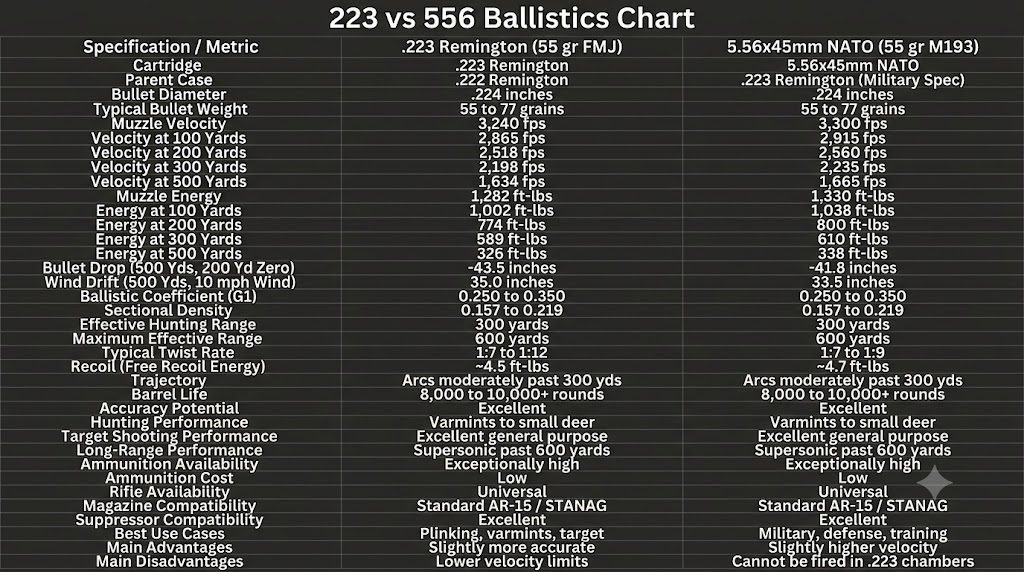
The comparison table above shows that when firing identical 55 grain bullets, the performance difference between these two cartridges is relatively minor. The 5.56 NATO holds a slight velocity advantage right out of the barrel because it is loaded with powder charges designed to generate higher pressures. This extra 60 to 100 feet per second of muzzle velocity translates into slightly more kinetic energy on target.
Because the 5.56 NATO is flying just a bit faster, it retains energy slightly better downrange and shoots just a fraction flatter than the .223 Remington. However, in real world shooting situations inside 300 yards, these ballistic differences are virtually indistinguishable to the average shooter. Both cartridges will strike the exact same target with almost identical holds.
The most important takeaway from this data is not the minor ballistic gap, but the chamber pressure reality. The 5.56 NATO requires a rifle chamber designed to handle higher pressure spikes. While the .223 Remington is technically a bit slower, it is often favored by precision shooters because commercial .223 match ammunition is manufactured with stricter tolerances than bulk military 5.56 ammunition, leading to tighter groups on paper.
Detailed Comparison Sections
Understanding the Comparison Chart
To fully grasp the dynamics between the .223 Remington and the 5.56 NATO, you must look at their intended purposes. The .223 Remington was standardized for the civilian market, focusing on safety and accuracy across a wide variety of bolt action and semi-automatic rifles. The 5.56 NATO was adopted by military forces worldwide, focusing on reliable cycling in fully automatic weapons and maximum terminal velocity.
How to Read the Ballistics Chart
When reviewing the 223 vs 556 ballistics chart, focus on velocity, energy, and trajectory. Velocity dictates how quickly the bullet covers distance. Kinetic energy shows the raw hitting power upon impact. Trajectory reveals how much the bullet drops over distance. Since both cartridges shoot identical projectiles, speed is the only variable changing the math.
Velocity Comparison
Because of its higher pressure loading, the 5.56 NATO is faster. A standard 55 grain M193 5.56 NATO round exits a 20 inch barrel at approximately 3,300 fps. A commercial 55 grain .223 Remington round typically leaves the same barrel at 3,240 fps. This extra speed helps the 5.56 NATO stay supersonic just a few yards further than the .223 Remington, but the difference is rarely noticeable unless shooting at extreme distances.
Energy Comparison
Kinetic energy is a product of mass and velocity. Since the mass is identical, the faster 5.56 NATO generates slightly more energy. At the muzzle, the 5.56 produces roughly 1,330 foot-pounds of energy compared to the 1,282 foot-pounds of the .223 Remington. Out at 500 yards, the 5.56 NATO retains 338 ft-lbs while the .223 retains 326 ft-lbs. Both rounds lack the kinetic energy necessary for reliable expansion on big game at that distance.
Trajectory Comparison
A faster bullet is a flatter bullet. Because the 5.56 NATO gets to the target quicker, gravity has less time to affect its flight path.
Bullet Drop Comparison
If you zero both rifles at 200 yards, the trajectory is practically identical inside 300 yards. At 500 yards, the slightly faster 5.56 NATO will drop about 41.8 inches, while the .223 Remington drops roughly 43.5 inches. This two inch difference is smaller than the typical accuracy potential of bulk training ammunition, meaning they shoot essentially the same arc.
Wind Drift Comparison
Wind drift is determined by velocity and ballistic coefficient. With identical bullets, the faster 5.56 NATO spends less time in the air, meaning the wind has less time to push it off course. In a 10 mph crosswind at 500 yards, the 5.56 NATO drifts 33.5 inches, while the .223 Remington drifts 35 inches. Again, the difference is incredibly minor.
Ballistic Coefficient Comparison
Ballistic Coefficient (BC) measures aerodynamic efficiency. Because both cartridges utilize the exact same .224 caliber projectiles, their BC ratings are identical when loaded with the same bullet style. Standard 55 grain full metal jacket bullets sit around a 0.250 BC, while heavier 77 grain match bullets push up near a 0.350 BC for both cartridges.
Accuracy Comparison
In a vacuum, the .223 Remington is generally considered more accurate. This is not due to ballistics, but rather manufacturing standards. Civilian .223 Remington match ammunition is loaded to incredibly tight tolerances. Bulk 5.56 NATO ammunition is mass produced for military function, meaning slightly larger variances in powder charges and bullet concentricity. If you want to shoot tiny groups, premium .223 Remington ammunition is usually the better choice.
Effective Range Comparison
Both cartridges share the exact same effective range. For target shooting, they perform beautifully out to 600 yards before wind drift becomes exceptionally difficult to manage. For hunting applications on varmints and small predators, they both deliver reliable terminal performance out to 300 yards.
Hunting Performance Comparison
For predator control and varmint hunting, both cartridges are completely interchangeable in a 5.56 or .223 Wylde chamber. There are dozens of excellent soft point and polymer tipped hunting loads available in both designations. They offer identical penetration and expansion profiles on coyotes, foxes, and groundhogs.
Target Shooting Comparison
If you are running a carbine course or shooting steel plates inside 300 yards, you will not notice a difference between the two rounds. The recoil, sound, and impact points are effectively identical. For high volume target shooting, your choice should be based purely on which bulk ammunition you can find for the lowest price.
Long-Range Performance Comparison
Both cartridges perform admirably at extended ranges when loaded with heavy 69 grain or 77 grain match bullets. The 5.56 NATO will give you a tiny velocity advantage that helps beat the wind slightly better, but high quality .223 Remington match ammunition will often provide more consistent velocities shot to shot, reducing vertical stringing at 600 yards.
Recoil Comparison
Both rounds offer virtually zero felt recoil. The .223 Remington produces about 4.5 foot-pounds of free recoil energy, and the slightly hotter 5.56 NATO produces roughly 4.7 foot-pounds. This difference is entirely imperceptible to the human shoulder. Both rounds allow shooters of all sizes to comfortably train for hours.
Barrel Life Comparison
Because they use the same bullets and similar powder charges, barrel life is essentially identical. Whether you shoot strictly .223 Remington or strictly 5.56 NATO, a quality AR-15 barrel will easily last 8,000 to 10,000 rounds before accuracy begins to severely degrade.
Ammunition Cost Comparison
Ammunition costs for both cartridges fluctuate based on military demand and global supply chains. Generally, bulk 5.56 NATO (like M193 and M855) and bulk .223 Remington (like 55 grain FMJ) are priced exactly the same. They are two of the most affordable centerfire rifle rounds on the planet.
Ammunition Availability
You will never have an issue finding either of these cartridges. They dominate the shelves of every gun shop, sporting goods store, and online retailer. Because they share the AR-15 platform, manufacturers prioritize producing massive quantities of both rounds year round.
Rifle Compatibility
This is the most critical difference. A rifle chambered in 5.56 NATO is designed with a longer “leade” or throat to handle higher pressure spikes. You can safely fire .223 Remington in a 5.56 NATO chamber. However, a rifle specifically chambered for .223 Remington has a tighter, shorter throat. Firing a high pressure 5.56 NATO round in a dedicated .223 Remington chamber can cause dangerous overpressure issues and should be avoided.
Pros and Cons of .223 Remington
Pros:
- Can be safely fired in 5.56 and .223 Wylde chambers.
- Match grade ammunition offers supreme accuracy.
- Slightly less chamber pressure.
Cons:
- Marginally lower velocity and energy.
- Dedicated .223 rifles cannot safely shoot 5.56 NATO bulk ammo.
Pros and Cons of 5.56 NATO
Pros:
- Slightly higher velocity and flatter trajectory.
- Military surplus ammunition is widely available.
- Rifles chambered in 5.56 can safely shoot both calibers.
Cons:
- Cannot be safely fired in a dedicated .223 Remington chamber.
- Bulk military ammo is slightly less accurate than commercial match ammo.
Which Cartridge Is Better for Beginners?
Both cartridges are perfect for beginners due to their low recoil and cheap ammunition. The smartest move for a beginner is to purchase a rifle chambered in 5.56 NATO or .223 Wylde. This allows the new shooter to safely buy and practice with whichever ammunition happens to be on sale that day.
Which Cartridge Is Better for Hunting?
For hunting, you should focus on bullet design rather than the cartridge stamp. A .223 Remington loaded with a high quality expanding hunting bullet will perform infinitely better on a coyote than a 5.56 NATO loaded with full metal jacket military ball ammunition. Pick a quality hunting bullet, and either cartridge will perform flawlessly.
Which Cartridge Is Better for Long-Range Shooting?
If you are shooting for pure accuracy at 600 yards, heavy match grade .223 Remington ammunition is typically preferred by precision shooters due to its consistent powder charges and tight manufacturing tolerances. The slight velocity loss is easily made up for by the predictability of the round.
Which Cartridge Should You Choose?
You do not necessarily have to choose one over the other. The best practice is to buy a rifle chambered in 5.56 NATO or .223 Wylde. This specific chambering gives you the ultimate versatility to shoot hot military 5.56 NATO surplus when you want to train on a budget, and highly accurate .223 Remington match ammo when you want to shoot for precision.
Verdict
When reviewing the 223 vs 556 ballistics chart, the ballistic differences are practically invisible to the average shooter. The 5.56 NATO provides a tiny edge in speed and energy, while the .223 Remington often provides a slight edge in pure accuracy. The true deciding factor between these two iconic rounds comes down to rifle compatibility and safety. The .223 Remington is the safest ammunition to buy because it functions flawlessly in every AR-15 chamber style. However, owning a rifle chambered in 5.56 NATO is the smartest hardware choice, as it allows you to utilize every piece of .224 caliber ammunition you find on the shelf. Treat them as interchangeable tools for a 5.56 chambered rifle, and enjoy the most versatile rifle platform in the world.
FAQs
Can I shoot 5.56 in a .223 rifle?
No. You should not fire 5.56 NATO ammunition in a rifle specifically stamped and chambered for .223 Remington. The 5.56 NATO generates higher pressures and requires a longer chamber throat. Firing it in a tight .223 chamber can cause dangerous pressure spikes.
Can I shoot .223 in a 5.56 rifle?
Yes. A rifle chambered in 5.56 NATO is built to handle higher pressures and has a looser chamber tolerance. It will safely and reliably fire standard commercial .223 Remington ammunition.
What is a .223 Wylde chamber?
A .223 Wylde is a hybrid rifle chamber designed to safely fire both high pressure 5.56 NATO ammunition and standard .223 Remington ammunition without sacrificing the target accuracy typically lost in looser 5.56 military chambers.
Is 5.56 ammo more powerful than .223?
Yes, but only slightly. The 5.56 NATO is loaded with slightly more powder and generates higher chamber pressures, resulting in roughly 60 to 100 feet per second more muzzle velocity and slightly more kinetic energy.
Which is more accurate, .223 or 5.56?
Generally, .223 Remington ammunition is considered more accurate because it is heavily produced for the civilian precision and varmint hunting markets. Bulk 5.56 NATO is built for military machine guns and combat rifles where pure accuracy takes a back seat to absolute feeding reliability.