The 280 Ackley Improved (280 AI) Ballistics Chart is a highly comprehensive reference guide that details the velocity, kinetic energy, trajectory curve, and wind drift of this incredibly efficient cartridge over various distances. By studying this specific chart, you can visualize exactly how your high-ballistic-coefficient 7mm bullet will behave from the moment it leaves your barrel until it strikes a target hundreds of yards downrange. This critical data allows you to accurately predict bullet drop, compensate for wind deflection, and verify that your projectile retains enough energy for an ethical harvest on tough big game animals across open terrain.
Shooters, hunters, reloaders, and precision rifle enthusiasts use a 280 Ackley Improved Ballistics Chart to unlock the full potential of what many consider to be the ultimate standard-action hunting cartridge. Originally designed as a wildcat by the legendary gunsmith P.O. Ackley, the cartridge was standardized by SAAMI in 2007 thanks to Nosler. By taking a standard .280 Remington case, removing the body taper, and blowing the shoulder out to a sharp 40-degree angle, Ackley created a cartridge that rivals the legendary 7mm Remington Magnum while burning less powder, generating less recoil, and fitting perfectly on a standard .30-06 bolt face. By analyzing the numbers, a dedicated backcountry hunter can confidently take a challenging shot on a bull elk at six hundred yards. In this comprehensive guide, you will learn how to interpret ballistics data, choose the absolute best bullet weight for your specific needs, determine the ideal zero distance, and see exactly how this highly efficient cartridge performs compared to other popular calibers.
280 Ackley Improved Ballistics Chart
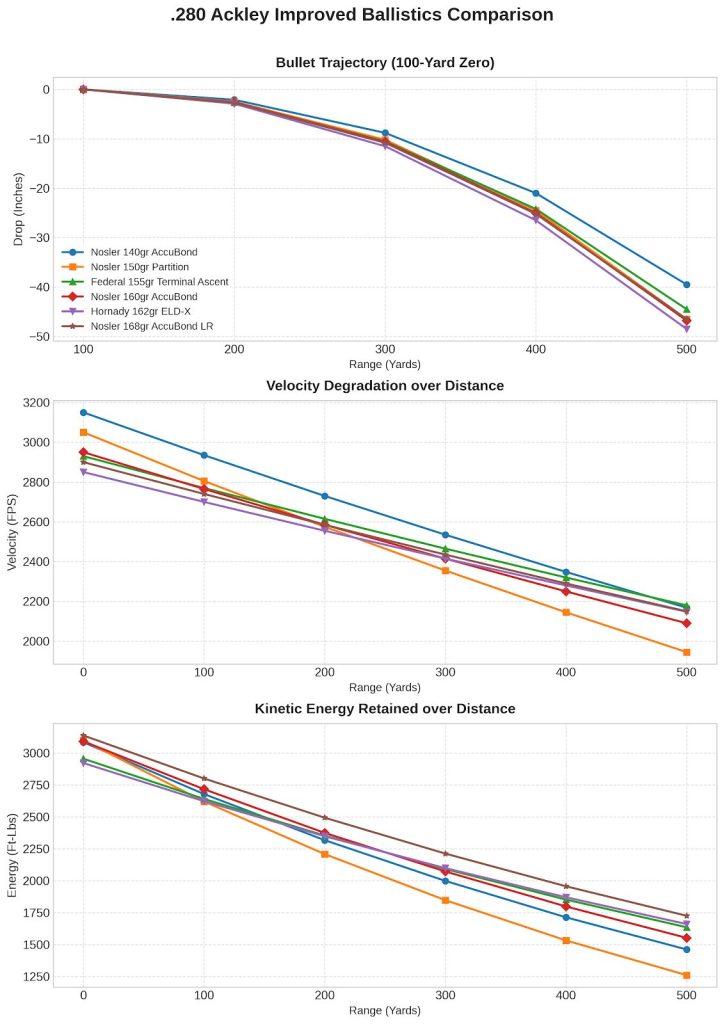
Below is a detailed ballistics table featuring popular factory-loaded ammunition available for the 280 Ackley Improved. Because this cartridge bridges the gap between wildcat and mainstream, the options include flagship loads from Nosler, Hornady, and Federal. The data represents a standard 24-inch test barrel and assumes a 100-yard zero under standard sea-level atmospheric conditions.
| Bullet Weight | Bullet Type | Manufacturer | Muzzle Velocity | Velocity At 100 Yards | Velocity At 200 Yards | Velocity At 300 Yards | Velocity At 400 Yards | Velocity At 500 Yards | Muzzle Energy | Energy At 100 Yards | Energy At 200 Yards | Energy At 300 Yards | Energy At 400 Yards | Energy At 500 Yards | Trajectory At 100 Yards | Trajectory At 200 Yards | Trajectory At 300 Yards | Trajectory At 400 Yards | Trajectory At 500 Yards | Ballistic Coefficient | Sectional Density |
| 140 Grain | AccuBond | Nosler | 3150 fps | 2935 fps | 2730 fps | 2535 fps | 2348 fps | 2168 fps | 3084 ft lbs | 2678 ft lbs | 2317 ft lbs | 1998 ft lbs | 1713 ft lbs | 1461 ft lbs | 0 inches | 2.1 inches drop | 8.8 inches drop | 21.0 inches drop | 39.5 inches drop | 0.485 | 0.248 |
| 150 Grain | Partition | Nosler | 3050 fps | 2805 fps | 2575 fps | 2355 fps | 2145 fps | 1945 fps | 3098 ft lbs | 2620 ft lbs | 2208 ft lbs | 1847 ft lbs | 1532 ft lbs | 1260 ft lbs | 0 inches | 2.5 inches drop | 10.2 inches drop | 24.5 inches drop | 46.5 inches drop | 0.456 | 0.266 |
| 155 Grain | Terminal Ascent | Federal Premium | 2930 fps | 2770 fps | 2615 fps | 2465 fps | 2320 fps | 2180 fps | 2955 ft lbs | 2640 ft lbs | 2353 ft lbs | 2091 ft lbs | 1852 ft lbs | 1635 ft lbs | 0 inches | 2.6 inches drop | 10.5 inches drop | 24.2 inches drop | 44.5 inches drop | 0.586 | 0.275 |
| 160 Grain | AccuBond | Nosler | 2950 fps | 2765 fps | 2585 fps | 2415 fps | 2250 fps | 2090 fps | 3091 ft lbs | 2716 ft lbs | 2374 ft lbs | 2072 ft lbs | 1798 ft lbs | 1552 ft lbs | 0 inches | 2.6 inches drop | 10.6 inches drop | 25.0 inches drop | 46.8 inches drop | 0.531 | 0.283 |
| 162 Grain | ELD-X | Hornady | 2850 fps | 2700 fps | 2555 fps | 2415 fps | 2280 fps | 2148 fps | 2921 ft lbs | 2622 ft lbs | 2348 ft lbs | 2098 ft lbs | 1870 ft lbs | 1660 ft lbs | 0 inches | 2.9 inches drop | 11.5 inches drop | 26.5 inches drop | 48.5 inches drop | 0.630 | 0.287 |
| 168 Grain | AccuBond LR | Nosler | 2900 fps | 2740 fps | 2585 fps | 2435 fps | 2290 fps | 2150 fps | 3137 ft lbs | 2800 ft lbs | 2493 ft lbs | 2212 ft lbs | 1956 ft lbs | 1725 ft lbs | 0 inches | 2.7 inches drop | 10.8 inches drop | 25.2 inches drop | 46.5 inches drop | 0.598 | 0.298 |
Understanding The Chart
A ballistics chart can look overwhelming at first glance due to the sheer volume of data presented. Breaking down each individual column reveals key information about how a specific load performs in the field.
Muzzle Velocity
Muzzle velocity is the speed at which the bullet exits the barrel of the firearm, measured in feet per second (fps). The 280 Ackley Improved achieves exceptionally high muzzle velocities by utilizing its 40-degree shoulder and blown-out body, which increases case capacity by roughly 5% over the standard .280 Remington. This allows it to push highly aerodynamic 7mm projectiles at speeds very closely approaching the 7mm Remington Magnum, doing so with incredibly efficient powder burns.
Retained Velocity
Retained velocity refers to the speed of the bullet at specific distances downrange, such as 100 or 500 yards. Air resistance constantly slows the bullet down as it travels through the atmosphere. Retained velocity is critical for hunters because most expanding hunting bullets require a minimum velocity threshold (typically around 1,800 fps) to expand reliably upon impact. Thanks to the incredibly high Ballistic Coefficients of 7mm bullets, the 280 AI retains lethal velocity far past extended hunting distances.
Kinetic Energy
Kinetic energy is the amount of destructive physical force the bullet carries, measured in foot-pounds (ft-lbs). It is calculated using the weight of the bullet and its velocity at any given distance. Hunters analyze this metric on any 280 AI Energy Chart to verify that the load delivers sufficient power for an ethical harvest on big game. Standard guidelines recommend at least 1,000 ft-lbs of energy for deer-sized game and 1,500 ft-lbs for elk—thresholds this cartridge easily surpasses at 500 yards with heavy bullets.
Trajectory
Trajectory indicates the physical path the bullet takes as it flies through the air, factoring in the constant downward pull of gravity. The trajectory chart displays bullet drop in inches at various yardages relative to a 100-yard zero line of sight. By knowing the exact trajectory curve, shooters can accurately adjust their aim or dial their scope turrets. The high velocity combined with sleek bullets gives the 280 AI a remarkably flat trajectory, minimizing holdover errors at medium to long ranges.
Ballistic Coefficient
The Ballistic Coefficient (BC) is a numerical value that represents how efficiently a bullet cuts through the air. A higher number indicates a more aerodynamic bullet that retains velocity and energy better over long distances. High BC bullets also resist lateral displacement from crosswinds much better than lower-rated projectiles. The .284-inch (7mm) bore diameter is legendary for offering some of the highest BC projectiles relative to bullet weight on the market today.
Sectional Density
Sectional density (SD) is the ratio of a bullet weight compared directly to its diameter. This metric indicates potential penetration depth into a target. Higher sectional density values generally correlate with deeper penetration. Heavy 7mm bullets weighing 160 to 175 grains offer extremely high sectional density values (0.283 to 0.310), allowing them to punch through thick hide and heavy bone on tough big game animals like elk and moose.
Common 280 Ackley Improved Bullet Weights
The performance characteristics of the 280 Ackley Improved shift noticeably based on bullet weight selection and construction, making it one of the most versatile big game cartridges in existence.
140 Grain
Bullet weights in the 140-grain range offer the highest muzzle velocities for the cartridge, often exceeding 3,150 fps. These lightweight, ultra-fast projectiles deliver laser-flat trajectories out to 400 yards, making them ideal choices for open-country hunting of medium game like antelope, mule deer, and whitetails. They provide devastating hydrostatic shock upon impact.
150 to 155 Grain
The 150 to 155-grain category includes highly advanced bonded and monolithic designs like the Federal Terminal Ascent. These weights strike a perfect “do-it-all” balance between high velocity, heavy bullet integrity, and deep penetration. They shoot incredibly flat while retaining enough mass to cleanly take larger game like elk at reasonable distances.
160 to 168 Grain
The 160 to 168-grain range represents the true sweet spot for the 280 Ackley Improved. Featuring high Ballistic Coefficients, these heavy 7mm projectiles resist wind drift and retain momentum beautifully downrange. Loaded to velocities around 2,850 to 2,950 fps, they deliver devastating impact force at long distances, making them optimal for bull elk, moose, and cross-canyon mountain hunting.
175 Grain+
The 175-grain and heavier bullets are reserved for extreme long-range precision and the largest heavy-boned game. These massive, sleek bullets require fast twist rates to stabilize properly but reward the shooter with maximum wind resistance and extreme energy retention at 1,000 yards and beyond.
Effective Hunting Range
The 280 Ackley Improved’s effective range is among the most impressive of any standard-action hunting cartridge.
Whitetail Deer and Antelope
For deer and antelope, the 280 AI is incredibly effective out to 800 yards in the hands of a highly skilled marksman. With proper expanding ammunition, it maintains a flat flight path, massive kinetic energy, and velocity levels that guarantee rapid ethical expansion.
Elk and Moose
Elk and moose require heavy energy delivery and deep bone-crushing penetration. The 280 AI retains over 1,500 ft-lbs of kinetic energy past 500 yards with heavy 160-grain to 168-grain projectiles, making it a premier open-country and lightweight mountain rifle cartridge for massive game.
Black Bear
Black bears feature dense muscle tissue and thick fat layers that require reliable projectile expansion and structural integrity. Heavy bonded or solid copper 160-grain bullets fired from the 280 AI easily penetrate to vital organs across deep canyons or heavy timber clearings.
Long-Range Target Shooting
For steel target shooting and precision applications, high-BC match loads cut through crosswinds efficiently. The 280 AI remains supersonic well past 1,200 yards, making it an excellent, low-recoil alternative to large magnums for extreme long-range target engagements.
Factors That Affect 280 AI Ballistics
Ballistics figures are heavily influenced by physical, mechanical, and environmental variables.
Barrel Length
Barrel length directly influences final velocity. To fully realize the powder capacity advantage of the 280 Ackley Improved, a 24-inch or 26-inch barrel is highly recommended. Shortening the barrel to 20 or 22 inches will cause a noticeable drop in velocity (roughly 25 to 30 fps per inch), diminishing its ballistic advantage over the standard .280 Remington.
Case Design & Fire-Forming
The defining characteristic of this cartridge is its 40-degree shoulder and reduced body taper. This design not only increases powder capacity but drastically reduces case stretching and brass flow. Handloaders love the 280 AI because the brass lasts for many reloads with minimal trimming required. Additionally, you can safely chamber and fire standard .280 Remington factory ammunition in a 280 AI rifle to safely “fire-form” the brass to the improved chamber dimensions, though you will experience a slight loss in velocity during the fire-forming process.
Altitude and Air Density
Higher elevations feature thinner, less dense air, reducing atmospheric drag on the bullet. Shooting the 280 AI at high mountain elevations during a sheep or elk hunt results in a flatter trajectory, less wind drift, and higher retained energy downrange compared to sea-level performance.
Twist Rate
To stabilize long, highly aerodynamic 168-grain to 175-grain 7mm projectiles, rifles chambered in 280 Ackley Improved require fast barrel twist rates, typically 1 in 9 inches or 1 in 8.5 inches.
Best Zero Distance
Selecting the optimal zero distance depends on your scope setup and field application.
100 Yard Zero
A 100-yard zero is the preferred baseline for precision marksmen and long-range hunters who utilize dialable optic turrets or modern ballistic reticles. It establishes a clean mathematical baseline where all turret adjustments for extended distances are dialed upward.
200 Yard Zero
A 200-yard zero is highly recommended for big-game hunters using a Maximum Point-Blank Range (MPBR) strategy. With a fast-moving 140-grain to 160-grain load zeroed at 200 yards, the bullet impacts roughly 1.5 to 2 inches high at 100 yards and drops only a few inches at 250 yards, enabling a dead-center hold on a deer or elk’s vital zone out past 300 yards without ever needing to touch the scope turrets.
280 Ackley Improved Ballistics Compared To Other Cartridges
Below is a comparison table showcasing how 280 AI loads evaluate against established hunting and magnum cartridges at 500 yards under standard sea-level conditions.
| Cartridge | Muzzle Velocity | Muzzle Energy | Trajectory At 500 Yards | Recoil | Action Size | Bolt Face |
| 280 Ackley Improved (160gr) | 2950 fps | 3091 ft lbs | 46.8 inches drop | Moderate | Standard Long | Standard (.473″) |
| 280 Remington (160gr) | 2800 fps | 2785 ft lbs | 52.5 inches drop | Moderate | Standard Long | Standard (.473″) |
| 7mm Remington Magnum (160gr) | 3000 fps | 3197 ft lbs | 44.5 inches drop | Mod-Heavy | Standard Long | Magnum (.532″) |
| 28 Nosler (160gr) | 3300 fps | 3868 ft lbs | 36.8 inches drop | Heavy | Standard Long | Magnum (.532″) |
| 30-06 Springfield (180gr) | 2700 fps | 2913 ft lbs | 58.5 inches drop | Moderate | Standard Long | Standard (.473″) |
The genius of the 280 Ackley Improved is completely apparent when compared to the 7mm Remington Magnum. The 280 AI shoots within 50 to 75 fps of the 7mm Rem Mag, but does so burning less powder, generating noticeably less recoil, and utilizing a standard .30-06 bolt face. Because it doesn’t use a fat magnum casing, rifles chambered in 280 AI can typically hold one extra round in the internal magazine compared to belted magnums.
Frequently Asked Questions
What is a 280 Ackley Improved Ballistics Chart?
It is a data reference table outlining velocity, kinetic energy, trajectory drop, and wind drift metrics for the cartridge across various distances. It helps shooters calculate precise elevation drops, wind holds, and energy retention thresholds for ethical hunting and extreme long-range target shooting.
Can you shoot standard .280 Remington ammo in a .280 Ackley Improved?
Yes. One of the greatest advantages of the Ackley Improved design is that standard .280 Remington factory ammunition can be safely chambered and fired in a 280 AI rifle. The pressure of the shot “fire-forms” the brass outward to perfectly match the 40-degree shoulder of the improved chamber, leaving you with perfectly formed 280 AI brass for reloading.
How far is the 280 Ackley Improved effective on elk?
Loaded with heavy, premium 160-grain to 168-grain expanding hunting bullets, it carries over 1,500 foot-pounds of kinetic energy past 500 yards. In the hands of a highly experienced shooter, it is a highly capable and ethical elk cartridge at those extended distances across open terrain.
Does the 280 Ackley Improved burn out barrels quickly?
No. Compared to highly overbore magnums like the 28 Nosler or 7mm STW, the 280 AI boasts an incredibly efficient powder column. With proper heat management during range sessions, a 280 AI barrel will easily provide excellent hunting accuracy for 2,000 to 2,500 rounds or more.
Is the 280 AI better than the 7mm Remington Magnum?
It depends entirely on your priorities. The 7mm Rem Mag will always shoot slightly faster due to its larger case capacity. However, the 280 AI delivers 95% of the magnum’s performance with less powder, less recoil, longer barrel life, and the ability to hold an extra round in a standard internal magazine, making it the preferred choice for many custom lightweight mountain rifle builds.
Conclusion
Understanding a 280 Ackley Improved Ballistics Chart reveals exactly why this cartridge transitioned from a niche gunsmith’s wildcat into one of the most highly respected modern hunting rounds on the market. By combining the highly efficient 40-degree shoulder design with a standard long-action receiver and high-BC 7mm projectiles, the 280 AI delivers flat trajectories, heavy kinetic energy, and magnum-level performance without the traditional magnum penalties. Understanding its trajectory curvature, retained velocity, and energy transfer characteristics enables hunters and long-range precision shooters to extract maximum accuracy and devastating terminal performance across deep canyons and open mountain terrain.