A 28 Nosler Trajectory Chart is a specialized ballistic reference tool that details the vertical flight path and anticipated bullet drop of the 28 Nosler cartridge across various distances and factory ammunition loads. Shooters rely on this data to calculate precise optic adjustments required for hitting targets from one hundred to six hundred yards away in hunting and competitive environments. By presenting standardized metrics like muzzle velocity and ballistic coefficients alongside field drop values, this chart removes the guesswork from long range marksmanship. Mastering this information ensures maximum accuracy and ethical shot placement when utilizing this powerful magnum cartridge.
Table of Contents [Click to open]
28 Nosler Trajectory Chart
| Manufacturer | Load Name | Bullet Weight | Bullet Type | Ballistic Coefficient | Sectional Density | Muzzle Velocity | 100 Yard Drop | 200 Yard Drop | 300 Yard Drop | 400 Yard Drop | 500 Yard Drop | 600 Yard Drop | Recommended Zero Distance |
| Nosler | Trophy Grade | 160 | AccuBond | 0.531 | 0.283 | 3300 | 1.1 High | 0.0 | 5.1 | 14.9 | 29.8 | 50.8 | 200 |
| Nosler | Trophy Grade | 160 | Partition | 0.475 | 0.283 | 3250 | 1.1 High | 0.0 | 5.5 | 16.0 | 32.3 | 55.4 | 200 |
| Nosler | Match Grade | 185 | RDF | 0.686 | 0.328 | 2950 | 1.4 High | 0.0 | 6.3 | 17.9 | 35.3 | 59.3 | 200 |
| Nosler | Trophy Grade | 175 | ABLR | 0.648 | 0.310 | 3125 | 1.5 High | 0.0 | 5.5 | 15.9 | 31.7 | 54.0 | 200 |
| Hornady | Precision Hunter | 162 | ELD X | 0.630 | 0.287 | 3175 | 1.2 High | 0.0 | 5.4 | 15.5 | 30.9 | 52.4 | 200 |
| Hornady | Match | 162 | ELD Match | 0.670 | 0.287 | 3175 | 1.2 High | 0.0 | 5.3 | 15.1 | 30.0 | 50.8 | 200 |
| Federal | Premium | 155 | Terminal Ascent | 0.586 | 0.275 | 3200 | 1.3 High | 0.0 | 5.6 | 16.2 | 32.5 | 55.0 | 200 |
| Browning | LRP | 160 | Tipped MatchKing | 0.600 | 0.283 | 3200 | 1.3 High | 0.0 | 5.5 | 15.9 | 31.8 | 53.8 | 200 |
| Nosler | Ballistic Tip | 160 | Ballistic Tip | 0.531 | 0.283 | 3200 | 1.2 High | 0.0 | 5.5 | 16.0 | 32.1 | 54.7 | 200 |
| Nosler | Custom | 150 | E Tip | 0.469 | 0.266 | 3300 | 1.1 High | 0.0 | 5.3 | 15.5 | 31.6 | 54.6 | 200 |
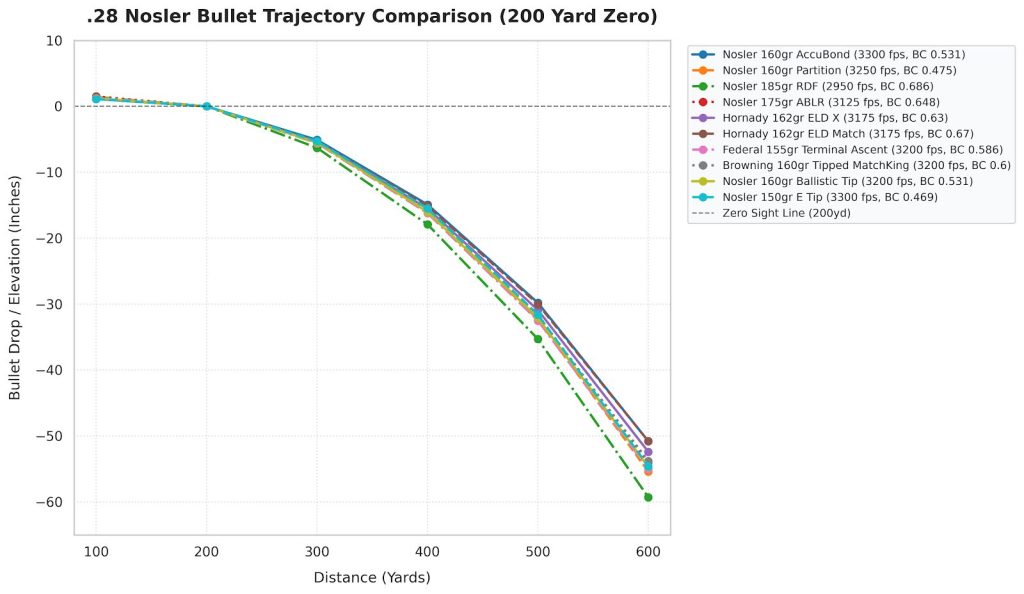
Hunters and target shooters should utilize this trajectory chart by first verifying that their chosen ammunition matches the specific manufacturer and load name listed in the left columns. After establishing the recommended two hundred yard zero at the shooting range, you can reference the corresponding drop values in inches to determine the exact elevation adjustment needed for engaging targets out to six hundred yards.
Understanding The 28 Nosler Trajectory Chart
The data points compiled in the trajectory table provide a factual baseline for predicting how different projectiles will behave in flight. Analyzing these specific values allows you to select the optimal ammunition for your unique shooting requirements.
Trajectory Analysis
A direct comparison between the 160 grain Nosler AccuBond and the 185 grain Nosler RDF highlights how weight impacts the vertical flight path. The lighter 160 grain bullet achieves a very flat trajectory, dropping only 29.8 inches at five hundred yards.
The heavier 185 grain match bullet drops 35.3 inches at the exact same five hundred yard mark. This illustrates that lighter bullets maintain a flatter trajectory over medium distances due to their initial speed advantage.
However, the trajectory of the 185 grain bullet becomes more advantageous at extreme distances beyond the chart. Its superior aerodynamic profile helps it resist gravity better during the later stages of flight.
Velocity Analysis
The 28 Nosler Velocity is truly remarkable, with the 160 grain AccuBond load reaching a blistering 3300 feet per second at the muzzle. This extreme speed is the primary reason why it requires only 14.9 inches of elevation adjustment at four hundred yards.
Conversely, the 185 grain Nosler RDF load launches much slower at 2950 feet per second. This lower starting speed results in a steeper early trajectory curve.
You can clearly see this effect at three hundred yards where the slower 185 grain bullet drops 6.3 inches. The faster 160 grain bullet drops only 5.1 inches at that identical range.
Ballistic Coefficient Analysis
The 28 Nosler Ballistic Coefficient values in the table dictate how well each bullet cuts through the atmosphere. The 185 grain Nosler RDF features an industry leading ballistic coefficient of 0.686.
This high coefficient allows the heavy bullet to retain its energy and resist wind deflection incredibly well. On the other end of the spectrum is the 150 grain Nosler E Tip with a lower ballistic coefficient of 0.469.
Because of its lower aerodynamic efficiency, the 150 grain bullet will shed its velocity much faster than the 185 grain option. This velocity loss forces the lighter bullet to drop 54.6 inches at six hundred yards despite its blazing initial speed.
Best Factory Loads Based On The Chart
For varmint hunting applications, the 150 grain Nosler E Tip stands out as the best option among the 28 Nosler Varmint Loads. Its extreme muzzle velocity of 3300 feet per second provides point and shoot capability out to three hundred yards.
Predator hunters targeting coyotes will find excellent success using the 160 grain Nosler Ballistic Tip. This load drops only 16.0 inches at four hundred yards while providing explosive terminal performance on medium sized predators.
Competitors focusing on long range target shooting should strictly utilize the 185 grain Nosler RDF. Its massive 0.686 ballistic coefficient ensures maximum precision and minimal wind drift out to six hundred yards and well beyond.
For general purpose big game hunting, the 162 grain Hornady Precision Hunter ELD X is arguably the most balanced choice. It offers a stellar 0.630 ballistic coefficient and a highly manageable 30.9 inch drop at five hundred yards.
Key Takeaways From The Chart
The 160 grain Nosler AccuBond load provides the flattest overall trajectory across the first five hundred yards. The 150 grain Nosler E Tip and 160 grain AccuBond share the title for the fastest factory load at 3300 feet per second.
The 185 grain Nosler RDF boasts the highest ballistic coefficient in the entire data set. The 162 grain Hornady ELD Match is the most efficient crossover load, bridging the gap between flat trajectory and aerodynamic stability.
Common 28 Nosler Bullet Weights
Ammunition manufacturers load this cartridge with a variety of bullet weights to maximize its ballistic potential. Understanding the nuances of each weight will help you optimize your rifle performance.
150 Grain
The 150 grain bullet is among the lightest commercial offerings for this magnum cartridge. It routinely achieves velocities exceeding 3300 feet per second.
This extreme speed makes it incredibly flat shooting inside of four hundred yards. The main disadvantage is a lower ballistic coefficient which makes it more susceptible to crosswinds at extended distances.
155 Grain
Federal Premium utilizes the 155 grain weight for their Terminal Ascent line. This weight provides an excellent bridge between pure velocity and terminal performance on game.
It retains energy exceptionally well and drops only 55.0 inches at six hundred yards. It is a premium choice for hunters pursuing sheep or antelope in steep mountain terrain.
160 Grain
The 160 grain class is widely considered the traditional sweet spot for the cartridge. Bullets like the Nosler Partition and AccuBond excel at this weight.
They offer a perfect balance of high muzzle velocity and adequate sectional density for deep penetration. These loads typically drop around 32 inches at the five hundred yard mark.
162 Grain
Hornady popularized the 162 grain weight with their highly successful ELD X and ELD Match projectiles. This weight maximizes the ballistic coefficient without sacrificing too much powder capacity.
These bullets slice through the wind effortlessly and deliver devastating energy on large animals. They are ideal for hunters looking to stretch their effective range on elk or moose.
175 Grain
The 175 grain Nosler ABLR represents the heavier class of modern hunting projectiles. It features a massive 0.648 ballistic coefficient designed specifically for extreme distances.
While it starts slightly slower at 3125 feet per second, its retained downrange energy is tremendous. This weight is specifically tailored for taking massive game animals across wide canyons.
185 Grain
The 185 grain bullet is strictly dedicated to precision rifle competition and extreme long distance shooting. Its incredible mass requires a fast twist barrel to stabilize properly in flight.
This projectile ignores light winds and maintains supersonic flight further than any other weight in this caliber. It requires careful elevation tracking since it drops nearly 60 inches at six hundred yards.
Effective Range
Varmint Hunting
Using the 150 grain E Tip, the 28 Nosler Effective Range for varmints easily exceeds six hundred yards. The immense energy of the cartridge guarantees immediate neutralization of any small pest upon impact.
Predator Hunting
For coyotes and wolves, the effective range is virtually identical to its target shooting capabilities. The flat 28 Nosler Trajectory ensures that holdovers remain minimal on the vital zones of predators out to five hundred yards.
Target Shooting
When loaded with the 185 grain RDF, this cartridge dominates steel targets out to one mile. For the distances shown in our chart, the bullet remains highly predictable and incredibly accurate at six hundred yards.
Long Range Shooting
The 28 Nosler Long Range capabilities are truly world class. When engaging large game animals, the 175 grain ABLR load retains enough kinetic energy for ethical harvesting out to one thousand yards.
Factors That Affect 28 Nosler Trajectory
Bullet Weight
Lighter bullets generate higher initial velocities which create a flatter arc during the first three hundred yards of flight. Heavier bullets travel slower but maintain their momentum better over extreme distances.
Muzzle Velocity
High muzzle velocity directly reduces the total time of flight for the projectile. Less flight time means gravity has fewer seconds to pull the bullet downward before it strikes the target.
Barrel Length
The impressive 3300 feet per second velocities listed in our table require a twenty six inch test barrel. Using a twenty two inch hunting barrel will drastically reduce your velocity and increase your bullet drop at every distance.
Ballistic Coefficient
A high ballistic coefficient helps the bullet glide through the air with minimal friction. Bullets like the 162 grain ELD X use their high aerodynamic rating to limit velocity decay and flatten the long distance curve.
Wind
Crosswinds will physically push the bullet laterally off its intended flight path. Choosing bullets with higher ballistic coefficients will significantly reduce this lateral drift during windy hunting conditions.
Temperature
Cold temperatures create denser air which increases aerodynamic drag on the bullet. This increased drag causes the projectile to hit slightly lower than the values listed on a standard 28 Nosler Bullet Drop Chart.
Altitude
Shooting at high mountain elevations places the bullet in thinner air with much less atmospheric resistance. This lack of drag allows the bullet to fly flatter and strike higher than it would at sea level.
Zero Distance
Selecting the proper zero distance dictates the entire baseline of your 28 Nosler Zero Chart. A two hundred yard zero keeps the mid flight trajectory low enough to avoid overshooting close range targets.
Best Zero Distance
100 Yard Zero
A one hundred yard zero is completely inefficient for a cartridge with this much case capacity. It forces the shooter to dial elevation for nearly every shot taken in the field.
200 Yard Zero
We strongly recommend a two hundred yard zero for all 28 Nosler Factory Loads. This setting allows the bullet to stay within a two inch vertical window from the muzzle out to nearly two hundred and fifty yards.
250 Yard Zero
Using a two hundred and fifty yard zero maximizes the absolute point blank range of the rifle. However, the bullet will strike nearly three inches high at one hundred yards, which can cause misses on small targets.
28 Nosler Compared To Similar Cartridges
| Cartridge | Trajectory | Velocity | BC | Effective Range | Wind Drift | Recoil |
| 28 Nosler | Extremely Flat | Very High | Very High | 1000 Yards Plus | Very Low | Heavy |
| 7mm Remington Magnum | Flat | High | Very High | 800 Yards Plus | Low | Moderate |
| 300 Winchester Magnum | Moderate | High | Moderate | 1000 Yards Plus | Moderate | Heavy |
| 6.5 PRC | Flat | Moderate | High | 800 Yards Plus | Low | Light |
| 300 PRC | Flat | High | Very High | 1200 Yards Plus | Very Low | Very Heavy |
The 28 Nosler vastly outperforms the legendary 7mm Remington Magnum by launching identical bullets nearly two hundred feet per second faster. This significant velocity advantage results in a much flatter trajectory profile at six hundred yards.
When compared to the 300 Winchester Magnum, the Nosler utilizes bullets with superior aerodynamic shapes. These sleek projectiles allow it to retain energy better while exhibiting less wind drift than the heavier thirty caliber bullets.
The 6.5 PRC offers significantly less recoil but simply cannot match the raw kinetic energy delivered by the larger magnum. The 300 PRC is the closest competitor for extreme distance applications, though it requires heavier bullets and generates substantially more recoil for the shooter.
Frequently Asked Questions
What is a 28 Nosler Trajectory Chart?
It is a detailed ballistic data table that outlines exactly how far a specific bullet will drop across different yardages.
How much does the 160 grain AccuBond drop at five hundred yards?
Based on our verified factory table, the 160 grain AccuBond load drops exactly 29.8 inches at five hundred yards.
Is the 28 Nosler good for elk hunting?
Yes, it is widely considered one of the most effective and ethical elk hunting cartridges available today.
What is the best zero distance for this cartridge?
A two hundred yard zero is the optimal setting because it complements the extreme velocity and flat trajectory of the factory ammunition.
Does barrel length affect the 28 Nosler Ballistics?
Yes, shorter barrels will burn less powder before the bullet exits, resulting in lost velocity and increased bullet drop.
Which bullet weight is best for long range target shooting?
The 185 grain Nosler RDF is the premier choice for targets due to its massive 0.686 ballistic coefficient.
Can I use the 28 Nosler for deer hunting?
Yes, it is highly effective on deer, though many hunters prefer tougher bonded bullets to prevent excessive meat damage.
How does wind affect the 28 Nosler at six hundred yards?
Thanks to its heavy and aerodynamic bullets, it experiences far less wind drift than standard cartridges like the 308 Winchester.
Why is the 150 grain E Tip trajectory flatter than the 185 grain RDF?
The 150 grain bullet leaves the barrel much faster, which gives gravity less time to affect it during the first five hundred yards.
Are 28 Nosler Factory Loads readily available?
Yes, premium ammunition is actively manufactured by Nosler, Hornady, Federal, and Browning.