A 30-30 Trajectory Chart is an essential ballistic reference guide that details the vertical descent of the venerable 30-30 Winchester cartridge across common engagement distances. By evaluating drop data for popular factory loads, this chart allows hunters to determine necessary holdover adjustments for shots ranging from 50 yards to 300 yards. This information is derived from verified muzzle velocities and ballistic coefficients, providing a standardized look at how this classic lever action cartridge performs in modern field conditions. Utilizing these figures ensures responsible shot placement and improves accuracy for hunters relying on this traditional medium game caliber.
Table of Contents [Click to open]
30-30 Trajectory Chart
| Manufacturer | Load Name | Weight (gr) | Type | BC | MV (fps) | 50y Drop | 100y Drop | 150y Drop | 200y Drop | 250y Drop | 300y Drop | Zero (y) |
| Hornady | LEVERevolution | 160 | FTX | 0.330 | 2400 | +0.7 | 0.0 | -3.5 | -10.4 | -21.1 | -36.5 | 100 |
| Federal | Power-Shok | 150 | FN | 0.184 | 2390 | +0.9 | 0.0 | -5.2 | -15.9 | -33.4 | -60.8 | 100 |
| Winchester | Super-X | 150 | PP | 0.180 | 2390 | +0.9 | 0.0 | -5.3 | -16.2 | -34.1 | -62.1 | 100 |
| Remington | Core-Lokt | 150 | PSP | 0.184 | 2390 | +0.9 | 0.0 | -5.2 | -15.9 | -33.4 | -60.8 | 100 |
| Winchester | Super-X | 170 | PP | 0.203 | 2200 | +1.1 | 0.0 | -6.2 | -18.9 | -39.3 | -70.9 | 100 |
| Federal | Power-Shok | 170 | FN | 0.203 | 2200 | +1.1 | 0.0 | -6.2 | -18.9 | -39.3 | -70.9 | 100 |
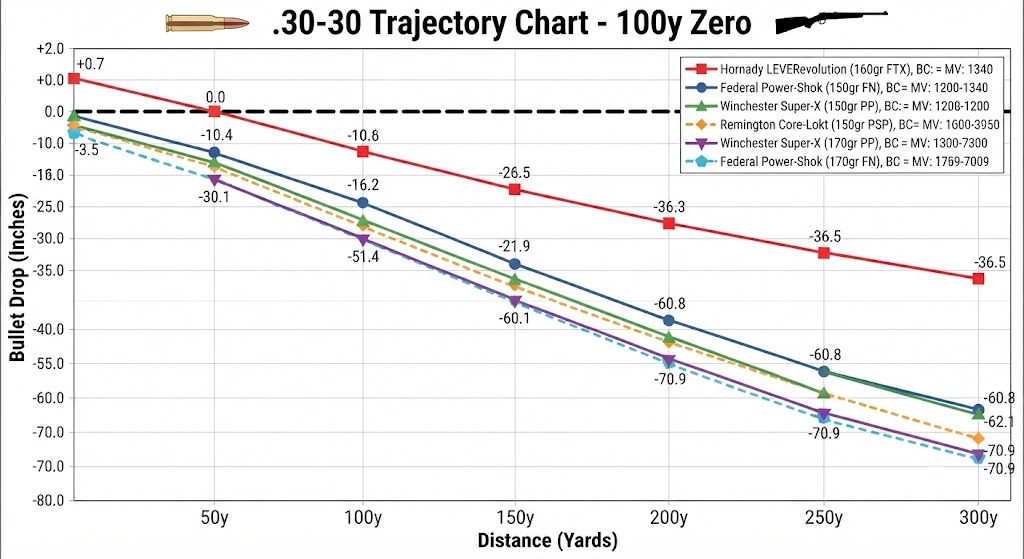
To use this trajectory chart effectively, first identify the specific bullet weight and load type you are using. With a 100 yard zero established, the chart shows the vertical deviation of the bullet at various intervals. For instance, the Hornady 160 grain FTX load drops only 10.4 inches at 200 yards, whereas the heavier 170 grain loads drop 18.9 inches at the same distance, demonstrating the performance benefits of modern aerodynamic bullet designs in this traditional platform.
Understanding The 30-30 Trajectory Chart
The data provided in the table reflects the realistic performance of the 30-30 Winchester when fired from standard rifle barrel lengths. These figures are the source of truth for your field calculations.
Trajectory Analysis
The trajectory of the 30-30 is limited by the flat nose bullet designs traditionally required for tubular magazines. The 170 grain Federal Power-Shok drops 70.9 inches at 300 yards, which is significantly deeper than the 36.5 inch drop of the Hornady FTX. This highlights how bullet profile significantly dictates effective range for this specific cartridge.
Velocity Analysis
Muzzle velocity for the 30-30 typically hovers near 2200 to 2400 fps depending on the bullet weight. The Hornady LEVERevolution reaches 2400 fps, which is the fastest velocity in our chart, contributing directly to its ability to maintain a flatter trajectory out to 200 yards. Slower loads like the 170 grain options at 2200 fps exhibit a steeper drop curve as they lose velocity downrange.
Ballistic Coefficient Analysis
Ballistic coefficient is a critical differentiator for 30-30 loads. The 160 grain FTX features a BC of 0.330, allowing it to retain velocity far better than the 0.180 BC of the 150 grain Winchester Super-X. Because the FTX retains velocity, it shows only 36.5 inches of drop at 300 yards, compared to the 62.1 inches of drop seen with the lower BC Winchester load.
Best Factory Loads Based On The Chart
For general deer hunting at ranges up to 200 yards, the Hornady LEVERevolution 160 grain FTX is the superior factory load due to its flatter trajectory and efficient energy retention. If you prefer traditional heavy-for-caliber performance for brush hunting, the 170 grain Federal or Winchester Power-Shok options are excellent, provided you keep your engagement distance within 150 yards. The 150 grain loads represent a balanced option for shooters who want a standard velocity profile at a lower cost for practice and light hunting.
Key Takeaways From The Chart
The Hornady 160 grain FTX is the flattest shooting factory load listed, making it the most capable choice for extended ranges. The 170 grain bullets produce the most vertical drop, which is the trade-off for their increased sectional density. The 100 yard zero is the most logical setting for the 30-30, as it keeps the bullet within the vital zone of deer sized game out to roughly 150 yards without requiring complex adjustments.
Common 30-30 Bullet Weights
150 Grain
The 150 grain bullet is a standard weight that offers high velocity for the 30-30 platform. It produces a relatively flat arc for this caliber and is well-suited for deer hunting in varied terrain. Its disadvantage is that it can lose energy quickly compared to heavier options when engaging at distances near 200 yards.
160 Grain
This weight is almost exclusively associated with modern polymer tipped ammunition designed to enhance ballistic performance. It offers a unique combination of high velocity and high ballistic coefficient, allowing the 30-30 to extend its effective range beyond traditional limits.
170 Grain
The 170 grain bullet is the traditional choice for the 30-30 and is renowned for its deep penetration on game. It is the preferred weight for hunters who prioritize terminal performance and large caliber impact over long distance trajectory. It is best used for shots under 150 yards.
Effective Range
Deer Hunting
The effective range for the 30-30 on deer is generally accepted as 150 yards for traditional loads and 200 yards for modern, high ballistic coefficient loads. The drop data shows that keeping shots within these limits ensures sufficient energy remains for an ethical harvest.
Brush Hunting
The 30-30 shines in thick brush where distances are short. The effective range is effectively zero to 100 yards, where the bullet’s heavy impact and the rifle’s quick handling are significant advantages.
Target Shooting
The 30-30 is a capable target round at ranges up to 200 yards. Beyond this distance, the amount of holdover required becomes challenging without specialized optics, as the drop values become quite substantial.
Factors That Affect 30-30 Trajectory
Bullet Weight
Heavier 170 grain bullets are slower and create more vertical drop. The table shows a clear difference in performance between the 150 and 170 grain bullets, with the heavier projectiles requiring more compensation at 200 yards.
Muzzle Velocity
Velocity is the limiting factor for the 30-30. Because the cartridge operates at lower pressures than modern bolt action rounds, it cannot push bullets to the high speeds necessary to flatten the trajectory.
Ballistic Coefficient
Due to the flat-nose or round-nose designs, 30-30 bullets often have low BCs. This causes them to slow down rapidly. Choosing bullets with higher BCs, like the FTX, is the best way to improve long distance performance.
Wind
The 30-30 is highly sensitive to wind drift at distances over 150 yards. Because the bullets travel relatively slowly, they spend more time in the air, allowing crosswinds more opportunity to push the projectile off target.
Zero Distance
The 100 yard zero is standard for this caliber. Moving the zero to 200 yards would cause the bullet to shoot high at close range, which could lead to misses on small target areas.
Best Zero Distance
100 Yard Zero
This is the universally accepted zero for the 30-30. It allows the hunter to hold dead-on for targets out to 150 yards, which covers the vast majority of hunting encounters for this cartridge.
150 Yard Zero
A 150 yard zero extends the range slightly but results in a higher mid range arc. This is only recommended if you are consistently shooting at targets past 150 yards and understand the vertical impact on closer targets.
30-30 Compared To Similar Cartridges
| Cartridge | Trajectory | Velocity | BC | Effective Range | Wind Drift | Recoil |
| 30-30 Win | Moderate | Moderate | Low | 150y | Moderate | Low |
| 308 Win | Flat | High | High | 400y | Low | Moderate |
| 35 Rem | Moderate | Low | Low | 150y | Moderate | Low |
| 44 Mag | Steep | Low | Low | 100y | High | Low |
The 30-30 remains a classic for a reason, offering manageable recoil and sufficient power for deer at moderate ranges. When compared to the 308 Winchester, it is significantly less capable at long distances but is much easier to shoot in a lightweight lever action rifle. It performs similarly to the 35 Remington, though the 30-30 enjoys much better ammunition availability.
Frequently Asked Questions
What is the typical effective range of a 30-30?
The effective range is generally 150 yards for traditional bullets, extending to 200 yards with modern, high-BC ammunition.
Can I shoot my 30-30 at 300 yards?
You can, but the bullet drop is extreme—over 36 inches for the best load—making it impractical for ethical hunting.
Why does the 30-30 have so much bullet drop?
The cartridge is limited by low muzzle velocity and the requirement to use flat-nosed bullets, which are inherently un-aerodynamic.
Is the 30-30 a good deer rifle?
Yes, it has harvested more deer in North America than almost any other caliber due to its effectiveness at medium and close ranges.
What zero distance is best for hunting?
A 100 yard zero is the best all-around setting for the 30-30.
Are there loads for the 30-30 that shoot flatter?
Yes, polymer-tipped loads like the Hornady LEVERevolution offer significantly flatter trajectories than traditional flat-nose bullets.
Does barrel length change 30-30 ballistics?
Yes, a shorter carbine-length barrel will produce lower muzzle velocity compared to a full-length rifle barrel.
Is the 30-30 good for long range?
No, the 30-30 is not a long range cartridge and is best used for targets within 200 yards.
What bullet weight is best for 30-30?
150 grains for general use and 170 grains for deep penetration on larger game.
Can I use Spitzer bullets in my 30-30?
Generally no, because most 30-30s have tubular magazines that can cause spitzer bullets to detonate under recoil. Always use flat or round-nosed bullets unless the manufacturer specifies otherwise for your rifle.