The 277 Fury Ballistics Chart is a comprehensive reference guide that details the velocity, kinetic energy, and trajectory curve of the 277 SIG Fury cartridge over various distances. By studying this chart, you can visualize exactly how your specific bullet will behave from the moment it leaves your barrel until it strikes a target hundreds of yards downrange. This critical data allows you to accurately predict bullet drop, compensate for wind drift, and verify that your projectile retains enough energy for an ethical kill on big game animals across open terrain.
Shooters, hunters, reloaders, and tactical enthusiasts use a 277 Fury Ballistics Chart to understand the capabilities of this hybrid case rifle cartridge. Officially adopted by the United States Army as the 6.8x51mm Common Cartridge for the Next Generation Squad Weapon (NGSW) system, the commercial 277 SIG Fury utilizes a revolutionary three piece hybrid case featuring a steel head attached to a brass body. This structural innovation allows the cartridge to withstand operating chamber pressures reaching an unprecedented 80,000 psi. By analyzing the numbers, a hunter can see how this high pressure cartridge launches heavy, highly aerodynamic bullets at speeds previously only obtainable with massive magnum calibers from long actions. In this comprehensive guide, you will learn how to analyze ballistics data, choose the absolute best bullet weight for your specific needs, determine the ideal zero distance, and see how this modern cartridge performs compared to other options.
277 Fury Ballistics Chart
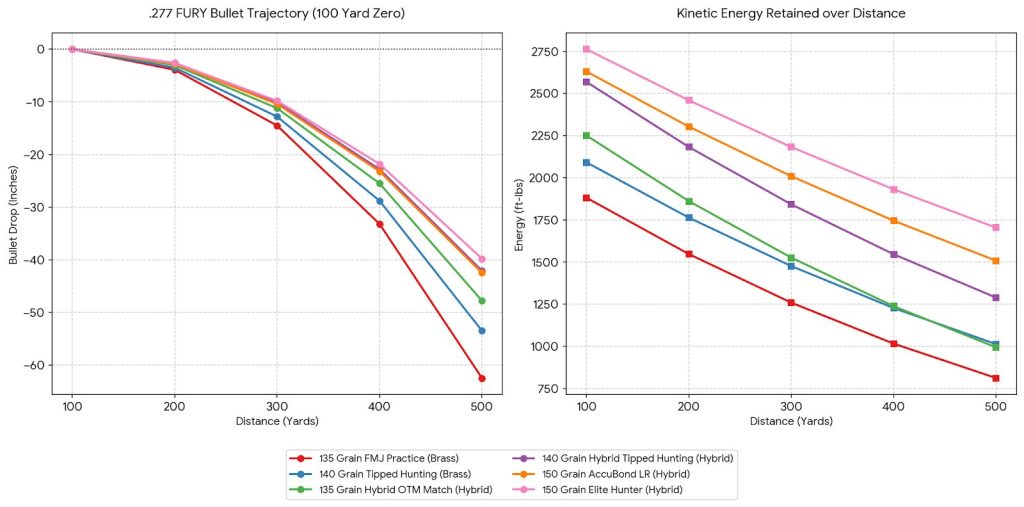
Below is a detailed ballistics table featuring representative factory loaded ammunition for the 277 Fury, including both maximum chamber pressure hybrid cased loads (operating up to 80,000 psi) and traditional brass cased loads (operating at standard 65,000 psi SAAMI limits). The data represents a standard twenty four inch test barrel and assumes a one hundred yard zero under standard sea level atmospheric conditions.
| Bullet Weight | Bullet Type | Case Type | Muzzle Velocity | Velocity At 100 Yards | Velocity At 200 Yards | Velocity At 300 Yards | Velocity At 400 Yards | Velocity At 500 Yards | Muzzle Energy | Energy At 100 Yards | Energy At 200 Yards | Energy At 300 Yards | Energy At 400 Yards | Energy At 500 Yards | Trajectory At 100 Yards | Trajectory At 200 Yards | Trajectory At 300 Yards | Trajectory At 400 Yards | Trajectory At 500 Yards | Ballistic Coefficient | Sectional Density |
| 135 Grain | FMJ Practice | All Brass | 2750 fps | 2505 fps | 2272 fps | 2050 fps | 1841 fps | 1646 fps | 2267 ft lbs | 1881 ft lbs | 1547 ft lbs | 1259 ft lbs | 1016 ft lbs | 812 ft lbs | 0 inches | 3.9 inches drop | 14.5 inches drop | 33.2 inches drop | 62.5 inches drop | 0.350 | 0.251 |
| 140 Grain | Tipped Hunting | All Brass | 2820 fps | 2595 fps | 2382 fps | 2180 fps | 1988 fps | 1807 fps | 2470 ft lbs | 2091 ft lbs | 1763 ft lbs | 1476 ft lbs | 1227 ft lbs | 1013 ft lbs | 0 inches | 3.5 inches drop | 12.8 inches drop | 28.8 inches drop | 53.5 inches drop | 0.415 | 0.261 |
| 135 Grain | Hybrid OTM Match | Hybrid (Steel/Brass) | 3000 fps | 2740 fps | 2492 fps | 2256 fps | 2032 fps | 1821 fps | 2698 ft lbs | 2250 ft lbs | 1861 ft lbs | 1526 ft lbs | 1238 ft lbs | 994 ft lbs | 0 inches | 3.0 inches drop | 11.2 inches drop | 25.5 inches drop | 47.8 inches drop | 0.370 | 0.251 |
| 140 Grain | Hybrid Tipped Hunting | Hybrid (Steel/Brass) | 3110 fps | 2875 fps | 2650 fps | 2435 fps | 2231 fps | 2037 fps | 3007 ft lbs | 2568 ft lbs | 2182 ft lbs | 1842 ft lbs | 1546 ft lbs | 1289 ft lbs | 0 inches | 2.6 inches drop | 10.1 inches drop | 22.8 inches drop | 42.1 inches drop | 0.420 | 0.261 |
| 150 Grain | AccuBond LR | Hybrid (Steel/Brass) | 3000 fps | 2810 fps | 2630 fps | 2456 fps | 2289 fps | 2128 fps | 2998 ft lbs | 2630 ft lbs | 2303 ft lbs | 2009 ft lbs | 1745 ft lbs | 1508 ft lbs | 0 inches | 2.8 inches drop | 10.4 inches drop | 23.2 inches drop | 42.5 inches drop | 0.500 | 0.279 |
| 150 Grain | Elite Hunter | Hybrid (Steel/Brass) | 3050 fps | 2880 fps | 2717 fps | 2560 fps | 2408 fps | 2262 fps | 3099 ft lbs | 2762 ft lbs | 2459 ft lbs | 2182 ft lbs | 1931 ft lbs | 1704 ft lbs | 0 inches | 2.6 inches drop | 9.8 inches drop | 21.8 inches drop | 39.8 inches drop | 0.550 | 0.279 |
Understanding The Chart
A ballistics chart can look overwhelming at first glance due to the volume of data presented. Breaking down each individual column reveals key information about how a specific load performs in the field.
Muzzle Velocity
Muzzle velocity is the speed at which the bullet exits the barrel of the firearm, measured in feet per second. In the 277 Fury, muzzle velocity is heavily dictated by case design. Traditional all brass cases are limited to standard SAAMI operating pressures (around 65,000 psi), yielding standard velocities. High pressure hybrid cases featuring a steel base allow the cartridge to operate safely at 80,000 psi, producing muzzle velocities over 3,000 fps with heavy projectiles from short to medium barrel lengths.
Retained Velocity
Retained velocity refers to the speed of the bullet at specific distances downrange, such as one hundred or five hundred yards. Air resistance constantly slows the bullet down as it travels through the atmosphere. Retained velocity is critical for hunters because expanding hunting bullets require a minimum velocity to open reliably upon impact. Thanks to high starting speeds and streamlined bullet profiles, high pressure 277 Fury loads maintain bullet expansion speeds well past extended hunting ranges.
Kinetic Energy
Kinetic energy is the amount of destructive physical force the bullet carries, measured in foot pounds. It is calculated using the weight of the bullet and its velocity at any given distance. Hunters analyze this metric on any 277 Fury Energy Chart to verify that the load delivers sufficient power for an ethical harvest on big game. Standard guidelines recommend at least 1,000 foot pounds of energy for deer sized game and 1,500 foot pounds for elk.
Trajectory
Trajectory indicates the physical path the bullet takes as it flies through the air, factoring in the constant downward pull of gravity. The 277 Fury Trajectory Chart displays bullet drop in inches at various yardages relative to a one hundred yard zero line of sight. Higher velocity hybrid loads deliver flat trajectories, minimizing the needed compensation for elevation at distance.
Ballistic Coefficient
The Ballistic Coefficient is a numerical value that represents how efficiently a bullet cuts through the air. A higher number indicates a more aerodynamic bullet that retains velocity and energy better over long distances. High Ballistic Coefficient bullets also resist lateral displacement from crosswinds much better than lower rated projectiles.
Sectional Density
Sectional density is the ratio of a bullet weight compared directly to its diameter. This metric indicates potential penetration depth into a target. Higher sectional density values generally correlate with deeper penetration. Because the 277 Fury uses .277 inch diameter bullets, weights ranging from 140 to 150 grains offer solid sectional density values for penetrating thick hide and muscle on tough big game.
Common 277 Fury Bullet Weights
The performance characteristics of the 277 Fury shift noticeably based on bullet selection and case construction.
135 Grain
The 135 grain bullet weight is commonly utilized for full metal jacket practice and range target loads. In traditional all brass construction, it functions as an accessible practice round. When loaded into a hybrid case, it achieves exceptionally high muzzle velocities, making it suitable for target engagements where flat trajectories and minimal flight time are desired.
140 Grain
The 140 grain bullet is an optimal choice for general big game and deer hunting. In standard brass loadings, it offers ballistics similar to a traditional .270 Winchester. However, when loaded in high pressure hybrid cases, it achieves velocities that mirror or surpass magnum cartridges. This weight delivers flat trajectories and controlled expansion on medium to large game.
150 Grain
The 150 grain bullet represents the heavy end of the spectrum for the .277 inch bore diameter. These long, aerodynamic projectiles feature high Ballistic Coefficients. Pushed by the high pressure hybrid case at velocities near 3,000 fps, 150 grain bullets retain momentum and kinetic energy extremely well at long range, making them ideal for pursuing heavy game such as elk or bull moose across open valleys.
Effective Hunting Range
The 277 Fury Effective Range varies based on whether standard all brass or high pressure hybrid ammunition is selected.
Whitetail Deer
For whitetail deer, high pressure hybrid loads in the 140 to 150 grain range are effective out past six hundred yards. Deer require roughly 1,000 foot pounds of kinetic energy for an ethical kill, a threshold that high pressure 277 Fury loads retain easily beyond typical practical hunting distances.
Elk
Elk require heavy energy delivery and deep bone crushing penetration. Hunters generally look for a minimum of 1,500 foot pounds of impact force. Pushing a 150 grain bullet at 3,000 fps allows the hybrid cased 277 Fury to retain over 1,500 foot pounds of kinetic energy past five hundred yards, making it a powerful mountain rifle option for elk.
Black Bear
Black bears feature dense muscle tissue and thick fat layers that require reliable projectile expansion and heavy penetration. Premium bonded or solid copper 140 to 150 grain bullets fired from the 277 Fury easily penetrate to vital organs on big bears out past four hundred yards.
Wild Hogs
Wild hogs possess a dense cartilage shoulder shield that demands deep structural penetration. High pressure 140 grain monolithic or heavy jacketed hunting bullets out of the 277 Fury pass through shoulder shields effortlessly, anchoring boars quickly across agricultural fields.
Coyotes and Predators
While the 277 Fury provides far more power than necessary for small predators, its ultra flat trajectory with hybrid cased 135 to 140 grain loads makes long distance hits straightforward across windy open plains.
Target and Long Range Shooting
For steel target shooting, high pressure match loads featuring 135 to 150 grain bullets cut through crosswinds efficiently. The primary advantage of the 277 Fury in target shooting is achieving magnum caliber trajectories out of a short action platform without needing a long magnum receiver or long barrel.
Factors That Affect 277 Fury Ballistics
Ballistics figures are influenced by physical, mechanical, and environmental variables.
Case Construction (Brass vs. Hybrid)
Case construction is the most distinct variable affecting 277 Fury ballistics. Traditional all brass construction limits chamber pressure to standard limits (65,000 psi), resulting in standard velocity figures. The steel base hybrid case safely contains pressures up to 80,000 psi, yielding a 200 to 300 fps increase in muzzle velocity with identical barrel lengths.
Barrel Length
Barrel length directly influences final velocity. The high pressure hybrid design was engineered to achieve maximum powder burn and velocity out of shorter military barrels (such as 13 or 16 inch barrels). While standard 24 inch test barrels show peak advertised velocities, short carbine barrels retain high performance due to the extreme operating pressure.
Altitude
Higher elevations feature thinner, less dense air, reducing atmospheric drag on the bullet. Shooting the 277 Fury at high mountain elevations results in a flatter trajectory and higher retained energy downrange compared to sea level performance.
Temperature
Cold atmospheric temperatures create denser air, increasing bullet drag. Additionally, cold ambient conditions can reduce gunpowder burn rates, lowering muzzle velocity. Selecting temperature stable powders minimizes point of impact shifts in freezing conditions.
Wind
Crosswinds deflect projectiles laterally off their path. High velocity, high Ballistic Coefficient projectiles like the 150 grain 277 Fury minimize time of flight and drift less in variable crosswinds.
Twist Rate
To stabilize long, heavy for caliber 140 to 150 grain .277 projectiles, rifles chambered in 277 Fury require fast barrel twist rates, typically 1 in 7 inches or 1 in 8 inches. Slow twist rates will fail to stabilize these aerodynamic bullets properly.
Best Zero Distance
Selecting the optimal zero distance depends on scope setup and field application.
100 Yard Zero
A 100 yard zero is the preferred baseline for precision marksmen and hunters who utilize dialable optic turrets or ballistic reticles. It establishes a clean mathematical baseline where all turret adjustments for distance are dialed upward.
200 Yard Zero
A 200 yard zero is recommended for big game hunters using a maximum point blank range strategy. With a high pressure 140 grain load zeroed at 200 yards, the bullet impacts roughly 1.5 to 2 inches high at 100 yards and drops only a few inches at 250 yards, enabling a dead center hold on a deer’s vital zone from point blank out past 250 yards without turret adjustments.
277 Fury Ballistics Compared To Other Cartridges
Below is a comparison table showcasing how high pressure hybrid 277 Fury loads evaluate against established hunting and military cartridges at 500 yards under standard sea level conditions.
| Cartridge | Muzzle Velocity | Muzzle Energy | Trajectory At 500 Yards | Recoil | Effective Range | Receiver Size | Operating Pressure |
| 277 Fury (Hybrid Case) | 3050 fps | 3099 ft lbs | 39.8 inches drop | Heavy | 1000 Yards | Short Action | 80,000 psi |
| 270 Winchester | 3060 fps | 2702 ft lbs | 42.8 inches drop | Moderate | 800 Yards | Long Action | 65,000 psi |
| 6.5 Creedmoor | 2700 fps | 2280 ft lbs | 54.0 inches drop | Light | 1000 Yards | Short Action | 62,000 psi |
| 6.8 Western | 2970 fps | 3226 ft lbs | 44.5 inches drop | Heavy | 1000 Yards | Short Action | 65,000 psi |
| 308 Winchester | 2820 fps | 2648 ft lbs | 52.5 inches drop | Moderate | 800 Yards | Short Action | 62,000 psi |
| 300 Winchester Magnum | 2960 fps | 3500 ft lbs | 46.0 inches drop | Very Heavy | 1200 Yards | Long Action | 64,000 psi |
The primary distinction of the 277 Fury is its ability to deliver velocity and kinetic energy comparable to long action magnum rounds (like the .270 Winchester or .300 Winchester Magnum) while using a short action .308 sized receiver platform, accomplished by raising maximum allowable chamber pressure to 80,000 psi via hybrid case technology.
Frequently Asked Questions
What is a 277 Fury Ballistics Chart?
It is a data reference table outlining velocity, kinetic energy, and drop for the 277 SIG Fury cartridge over distance. It helps shooters calculate elevation drops, wind holds, and energy retention for ethical hunting or target shooting.
What is the operating pressure of the 277 Fury?
The commercial SAAMI specification allows maximum operating pressures up to 80,000 psi for hybrid case loadings. Traditional all brass loads operate at standard pressure limits around 65,000 psi.
Can you fire hybrid 80,000 psi ammo in standard rifles?
No. High pressure 80,000 psi hybrid cased ammunition must only be fired in firearms specifically built and proofed by the manufacturer to handle 80,000 psi chamber pressures.
How far is the 277 Fury effective on big game?
With high pressure hybrid loads, it carries over 1,500 foot pounds of kinetic energy past 500 yards, making it effective for elk and large game up to and beyond that distance.
What is the difference between 277 Fury and 6.8x51mm?
The 277 SIG Fury is the commercial, SAAMI standardized name for the cartridge, while 6.8x51mm is the military designation utilized in the US Army Next Generation Squad Weapon program.
Conclusion
A 277 Fury Ballistics Chart reveals the performance gains made possible by high pressure hybrid casing technology. By safely operating up to 80,000 psi, the 277 Fury launches heavy .277 caliber projectiles at magnum velocities from short action rifles and shorter barrel lengths. Understanding the trajectory, velocity retention, and kinetic energy delivered by both standard brass and hybrid loads enables hunters and long range shooters to select the proper setup for their field requirements.