The main difference between the .270 Winchester and the .308 Winchester is that the .270 Winchester fires a lighter bullet at much higher velocities to provide a laser flat trajectory across open terrain, while the .308 Winchester delivers a highly efficient, versatile, and economical short action profile ideal for everything from target shooting to hunting in dense woods. The .270 Winchester was designed specifically to maximize the long action powder capacity of the legendary .30-06 Springfield case, giving hunters the ability to reach out and touch game at distances previously thought impossible. The .308 Winchester takes a completely different path, utilizing a shorter case and less powder to achieve excellent ballistics with phenomenal barrel life. Choosing between these two iconic centerfire rifle cartridges comes down to understanding exactly how their distinct case designs and bullet weights translate to real world performance.
270 vs 308 Ballistics Chart
| Specification / Metric | .270 Winchester (130 gr SST) | .308 Winchester (150 gr SST) |
| Cartridge | .270 Winchester | .308 Winchester |
| Parent Case | .30-06 Springfield | .300 Savage |
| Bullet Diameter | .277 inches | .308 inches |
| Typical Bullet Weight | 130 to 150 grains | 150 to 180 grains |
| Muzzle Velocity | 3,060 fps | 2,820 fps |
| Velocity at 100 Yards | 2,840 fps | 2,590 fps |
| Velocity at 200 Yards | 2,630 fps | 2,370 fps |
| Velocity at 300 Yards | 2,430 fps | 2,165 fps |
| Velocity at 500 Yards | 2,060 fps | 1,780 fps |
| Muzzle Energy | 2,702 ft-lbs | 2,648 ft-lbs |
| Energy at 100 Yards | 2,328 ft-lbs | 2,234 ft-lbs |
| Energy at 200 Yards | 1,996 ft-lbs | 1,870 ft-lbs |
| Energy at 300 Yards | 1,704 ft-lbs | 1,560 ft-lbs |
| Energy at 500 Yards | 1,225 ft-lbs | 1,055 ft-lbs |
| Bullet Drop (500 Yds, 200 Yd Zero) | -36.5 inches | -45.5 inches |
| Wind Drift (500 Yds, 10 mph Wind) | 18.5 inches | 24.5 inches |
| Ballistic Coefficient (G1) | 0.460 | 0.415 |
| Sectional Density | 0.242 | 0.226 |
| Effective Hunting Range | 500 yards (medium game) | 400 yards (medium game) |
| Maximum Effective Range | 800 yards | 800 yards |
| Typical Twist Rate | 1:10 | 1:10 to 1:12 |
| Recoil (Free Recoil Energy) | ~16.5 ft-lbs | ~16.5 ft-lbs |
| Trajectory | Exceptionally flat | Moderate arc past 300 yds |
| Barrel Life | 3,000 to 4,000 rounds | 8,000 to 10,000 rounds |
| Accuracy Potential | Excellent for hunting | Superb for precision target |
| Hunting Performance | Mule deer, antelope, sheep | Whitetail deer, feral hogs |
| Target Shooting Performance | Good for long range hunting | The gold standard inside 800 yds |
| Long-Range Performance | Supersonic past 1,000 yards | Supersonic past 800 yards |
| Ammunition Availability | Very High | Universal |
| Ammunition Cost | Moderate | Low to moderate |
| Rifle Availability | Common in long actions | Universal in short actions |
| Magazine Compatibility | Standard long action | Standard short action / AR-10 |
| Suppressor Compatibility | Excellent | Excellent |
| Best Use Cases | Open plains hunting | Tactical training, deer hunting |
| Main Advantages | Flat trajectory, high velocity | Ammo cost, short action |
| Main Disadvantages | Long action limits rifle choices | Steep drop past 400 yards |
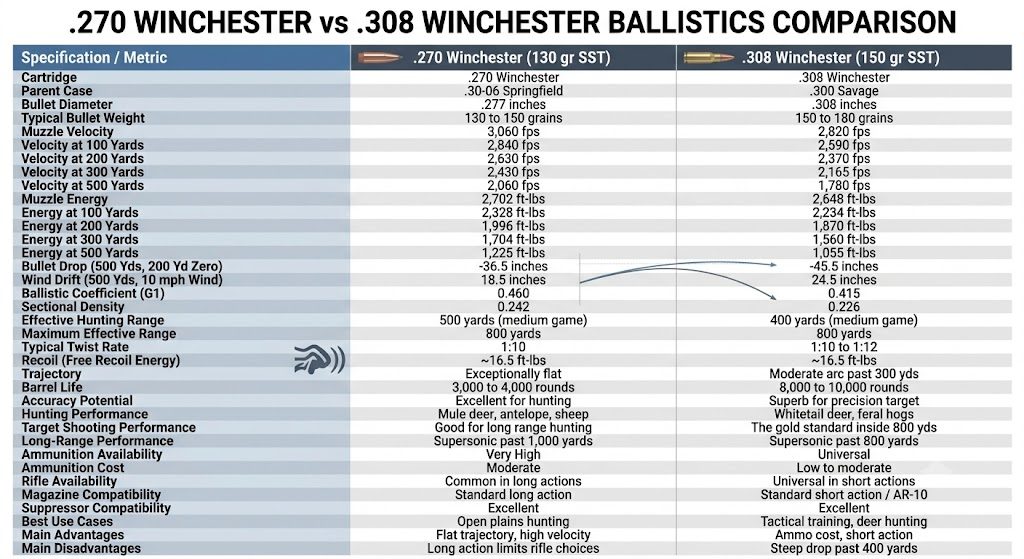
The comparison table above clearly illustrates how pushing a lighter bullet with more gunpowder creates a distinct long range advantage. The .270 Winchester leaves the muzzle with a significant speed advantage over the .308 Winchester. Because it starts faster and utilizes highly aerodynamic bullets, the .270 Winchester maintains that speed all the way downrange. This results in the .270 retaining much more kinetic energy at extended distances than the .308 Winchester.
This speed advantage directly translates to a flatter trajectory. A shooter using the .270 Winchester will experience noticeably less bullet drop and wind drift at 500 yards compared to a shooter using the .308 Winchester. This forgiving flight path makes the .270 the undisputed champion for hunting in open country where ranging targets perfectly can be difficult.
However, the .308 Winchester provides massive practical advantages for everyday shooters. It fits into much smaller and lighter short action rifles. It is universally considered the ultimate general purpose cartridge because the ammunition is incredibly cheap, it produces very mild recoil, and the barrels last almost forever. The .270 Winchester is a specialized open country hunting tool, while the .308 Winchester is the ultimate do everything utility cartridge.
Detailed Comparison Sections
Understanding the Comparison Chart
To fully grasp the capabilities of these two cartridges, you must understand their case lengths. The .270 Winchester requires a long action rifle receiver. This allows for a massive amount of gunpowder but creates a heavier rifle with a longer bolt throw. The .308 Winchester was engineered specifically to be a short action cartridge. It achieves excellent ballistics using a smaller powder charge, allowing it to fit into highly compact and fast cycling rifles.
How to Read the Ballistics Chart
When reading this ballistics chart, focus heavily on retained energy, bullet drop, and barrel life. Retained energy guarantees the bullet will have enough force to ethically harvest an animal at distance. Bullet drop dictates how much you will need to adjust your scope to make a precise hit. Barrel life reveals the hidden mechanical cost of high velocity ammunition.
Velocity Comparison
The .270 Winchester is the clear winner in pure speed. Firing a typical 130 grain bullet, it leaves the barrel at roughly 3,060 feet per second. The .308 Winchester fires a heavier 150 grain bullet that tops out around 2,820 feet per second. That initial speed gap allows the .270 Winchester to reach distant targets faster, giving gravity less time to pull the bullet into the dirt.
Energy Comparison
At the muzzle, both cartridges generate very similar kinetic energy, hovering right around 2,650 to 2,700 foot pounds. The difference becomes glaring as the distance increases. The sleek, aerodynamic bullets of the .270 Winchester cut through the air more efficiently, allowing it to retain its energy much better. At 500 yards, the .270 Winchester retains 1,225 foot pounds of energy, easily surpassing the 1,055 foot pounds of the .308 Winchester.
Trajectory Comparison
A flat trajectory takes the guesswork out of field shooting. Because the .270 Winchester is traveling significantly faster, it offers a much more forgiving flight path.
Bullet Drop Comparison
If you zero both rifles at 200 yards, you will notice a major difference at extreme ranges. At 500 yards, the fast .270 Winchester drops only 36.5 inches. The slower .308 Winchester drops roughly 45.5 inches. If you misjudge the distance to a target by 50 yards in the field, the flat path of the .270 Winchester makes it much more likely you will still hit the vital zone.
Wind Drift Comparison
Wind pushes slow bullets off course quickly. The .270 Winchester slices through the wind beautifully, drifting only 18.5 inches in a 10 mph crosswind at 500 yards. The .308 Winchester struggles more in the wind, drifting nearly 24.5 inches under the exact same conditions.
Ballistic Coefficient Comparison
Ballistic Coefficient measures how efficiently a bullet glides through the air. The long, sleek 130 grain bullets of the .270 Winchester boast excellent BC ratings around 0.460. The standard 150 grain .308 Winchester bullet is relatively short and blunt by comparison, yielding a BC of roughly 0.415. This is precisely why the .308 bleeds velocity faster than the .270.
Accuracy Potential
Both cartridges are mechanically capable of extreme precision. The .308 Winchester has the strongest global reputation for precision target shooting simply because match grade target ammunition is mass produced worldwide. In a practical hunting scenario, all modern factory rifles chambered in either cartridge will easily shoot one inch groups at 100 yards.
Effective Range Comparison
For competitive target shooting on steel plates, the .270 Winchester can easily stretch to 1,000 yards. The standard .308 Winchester begins to struggle heavily with wind and drop past 800 yards. For practical hunting, the .270 Winchester is highly effective out to 500 yards. The .308 Winchester is best utilized inside 400 yards to ensure proper bullet expansion on medium game.
Hunting Performance Comparison
If you are strictly hunting whitetail deer or wild hogs in dense woods, the .308 Winchester is perfect and highly effective. If you are hunting mule deer, sheep, or antelope across wide open plains or deep canyons, the flat trajectory of the .270 Winchester is vastly superior. Both provide plenty of stopping power for medium game.
Target Shooting Comparison
The .308 Winchester is the absolute best choice for high volume target shooting. The ammunition is incredibly cheap, the recoil is mild enough to shoot all day, and the short action receiver allows for faster bolt cycling. The .270 Winchester heats up rifle barrels very quickly and costs significantly more to shoot per round.
Long-Range Performance Comparison
The .270 Winchester performs beautifully at long range but is rarely used for competitive target shooting due to a lack of heavy match grade bullets on the commercial market. The .308 Winchester dominates the short to medium range tactical matches but will eventually drop into the subsonic zone much sooner than the hyper velocity .270 Winchester.
Recoil Comparison
Felt recoil determines how easily a shooter can spot their own impacts through a rifle scope. On paper, both cartridges generate roughly 16.5 foot pounds of free recoil energy in identically weighted rifles. However, they feel different to the shooter. The .270 Winchester has a sharper, snappier recoil impulse due to its high velocity. The .308 Winchester delivers a slower, more comfortable push.
Barrel Life Comparison
Burning massive amounts of gunpowder degrades rifle barrels. The .308 Winchester is incredibly efficient and gentle on barrels, often lasting 8,000 to 10,000 rounds before precision accuracy fades. The high velocity .270 Winchester acts like a cutting torch in the throat of the barrel, typically limiting peak precision life to roughly 3,000 to 4,000 rounds.
Ammunition Cost Comparison
The .308 Winchester is the undisputed champion of economy. Because it is a global military and law enforcement standard, factories produce practice ammunition by the millions, keeping costs extremely low. The .270 Winchester is strictly a civilian hunting cartridge. Practice ammunition is widely available, but it costs noticeably more than bulk .308 Winchester.
Ammunition Availability
You will never have an issue finding ammunition for either of these cartridges. They are two of the top selling centerfire rifle calibers in North America. Every hardware store, sporting goods retailer, and local gun shop will have multiple shelves dedicated to both the .270 Winchester and the .308 Winchester.
Rifle Compatibility
The .308 Winchester holds a distinct advantage in firearm selection. Because it is a short action cartridge, it can be chambered in highly compact, lightweight bolt action rifles and fits perfectly into the semi automatic AR-10 platform. The .270 Winchester requires a standard long action receiver, meaning the rifles are generally heavier and require a longer bolt throw to load a new round.
Pros and Cons of .270 Winchester
Pros:
- Laser flat trajectory out to 500 yards.
- Excellent wind bucking capabilities.
- Very manageable recoil for a high speed cartridge.
- The ultimate open country deer hunting tool.
Cons:
- Requires a heavier long action rifle.
- Shorter barrel life due to extreme velocities.
Pros and Cons of .308 Winchester
Pros:
- Incredibly cheap and abundant practice ammunition.
- Fits into lightweight short action rifles and AR-10s.
- Exceptional barrel life.
- Mild recoil suitable for all adult shooters.
Cons:
- Steep bullet drop past 400 yards.
- More susceptible to heavy wind drift at distance.
Which Cartridge Is Better for Beginners?
The .308 Winchester is the absolute best centerfire rifle cartridge for beginners. The recoil is very forgiving, allowing new shooters to learn solid fundamentals without fear of the rifle kicking them. Additionally, the availability of incredibly cheap practice ammunition means a beginner can afford to shoot hundreds of rounds to build their confidence.
Which Cartridge Is Better for Hunting?
This depends entirely on the terrain you plan to hunt. If you are hunting antelope or mule deer in open canyons where shots can exceed 300 yards, the .270 Winchester takes the crown due to its flat trajectory. If you just want an everyday deer rifle for the thick woods behind your house, the .308 Winchester is a perfect, compact, and economical choice.
Which Cartridge Is Better for Long-Range Shooting?
For competitive target shooting, the .308 Winchester is the most popular due to the massive availability of precision match rifles and cheap ammunition. However, if you are looking for pure long range ballistic performance in the wind, the .270 Winchester will hit targets at 1,000 yards with much less drop.
Which Cartridge Should You Choose?
Choose the .270 Winchester if you hunt deer or sheep across wide open spaces and hate calculating complex scope holdovers. Choose the .308 Winchester if you want a highly versatile, affordable, and mild shooting rifle for target practice and everyday medium game hunting.
Verdict
The .270 Winchester and the .308 Winchester are two absolute pillars of the shooting sports, but they represent completely different engineering philosophies. The .270 Winchester is a specialized scalpel, offering blistering speed and a flat trajectory for precision hunting in open country where distance estimation is difficult. It sacrifices barrel life and economy to achieve this laser flat performance. The .308 Winchester is the ultimate general purpose tool. It perfectly balances economy, barrel life, and stopping power into a compact short action package that anyone can enjoy shooting. Assess your budget, your target game, and the terrain you intend to conquer to easily determine which of these legends belongs in your hands.
FAQs
Is the .270 more powerful than the .308?
At the muzzle, they generate very similar amounts of energy. However, as the bullet travels downrange, the .270 Winchester retains its energy much better due to its higher velocity and aerodynamic efficiency. At 500 yards, the .270 is significantly more powerful than the .308.
Can you use a .308 for elk hunting?
Yes, the .308 Winchester is capable of killing an elk. However, it requires precise shot placement and high quality, deep penetrating bullets. Hunters using a .308 should generally limit their shots on elk to 300 yards or less to ensure the bullet retains enough energy for a humane harvest.
Why is the .270 so popular for deer hunting?
The .270 Winchester became legendary thanks to gun writers like Jack O’Connor who praised its flat trajectory. It allows hunters to essentially aim dead center on a deer from zero to 300 yards and guarantee a vital hit without adjusting their scope, making it incredibly reliable in the field.
Can I shoot .308 in a .270 rifle?
Absolutely not. The .308 Winchester is a completely different cartridge with a wider bullet diameter. Attempting to chamber and fire the wrong ammunition will cause a catastrophic and highly dangerous malfunction that could destroy the firearm and severely injure the shooter.
Which cartridge kicks harder, .270 or .308?
In rifles of the exact same weight, they generate almost identical amounts of recoil energy. However, the .270 Winchester feels sharper and faster on the shoulder because of its high velocity, while the .308 Winchester feels like a slower, softer push.