The main difference between the cartridges is that the .338 Lapua Magnum is a legendary military sniper cartridge designed to launch massive high-BC bullets at extreme velocities from long-action systems, whereas the 338 Norma Magnum is a modern, optimized cartridge engineered with a shorter, more efficient powder column to fit into standard repeating magazines while delivering near-identical extreme long-range ballistics with less barrel wear.
Both cartridges represent the absolute pinnacle of anti-personnel and long-range precision performance in the .338-caliber class. The .338 Lapua Magnum was developed in the late 1980s for military snipers requiring a cartridge capable of defeating body armor at 1,000 meters and beyond. It achieved legendary status globally, becoming a standard military sniper round. The 338 Norma Magnum was developed in 2009 by Norma in collaboration with Jimmie Sloan. It was specifically designed to solve physical limitations of the Lapua case: the Lapua is exceptionally long, which often forced military rifle builders to seat ultra-long, high-BC match bullets deeply into the powder column to fit inside standard magazine boxes, stealing valuable powder space. The 338 Norma Magnum shortened and widened the case, creating a superior powder combustion chamber that accommodates modern long bullets perfectly.
338 Norma Magnum Vs 338 Lapua Comparison
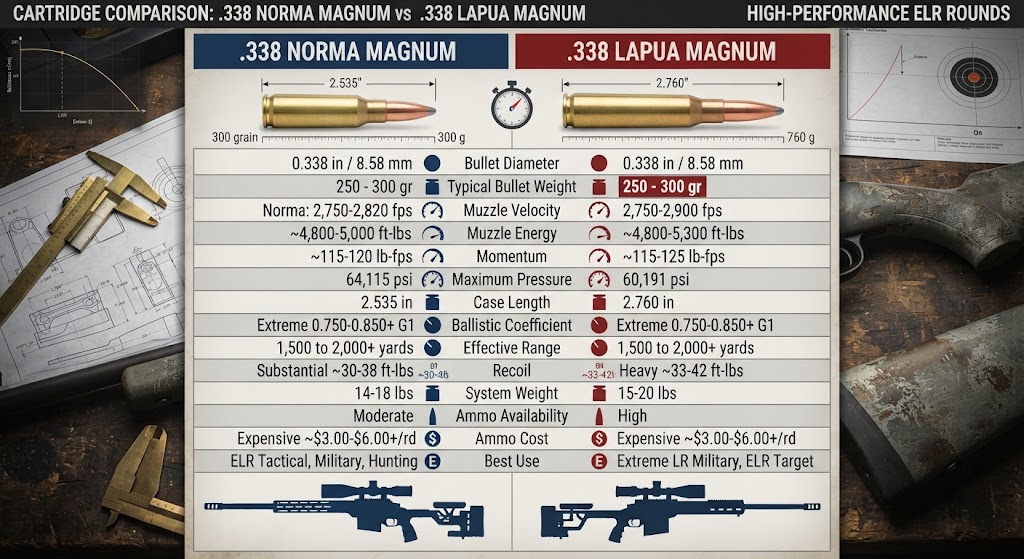
| Feature | 338 Norma Magnum | .338 Lapua |
| Bullet Diameter | 0.338 inches (8.58 mm) | 0.338 inches (8.58 mm) |
| Typical Bullet Weight | 250 gr to 300 gr (typically 300 gr) | 250 gr to 300 gr (typically 300 gr) |
| Muzzle Velocity | 2,750 to 2,820 fps (27-inch barrel) | 2,750 to 2,900 fps (27 to 30-inch barrel) |
| Muzzle Energy | ~4,800 to 5,000 ft-lbs | ~4,800 to 5,300 ft-lbs |
| Momentum | ~115 to ~120 lb-fps | ~115 to ~125 lb-fps |
| Maximum Pressure | 64,115 psi (CIP) / 63,000 psi (SAAMI) | 60,191 psi (CIP) / 47,000 CUP (SAAMI) |
| Case Length | 2.535 inches (64.4 mm) | 2.760 inches (70.1 mm) |
| Ballistic Coefficient | Extreme (0.750 to 0.850+ G1) | Extreme (0.750 to 0.850+ G1) |
| Effective Range | 1,500 to 2,000+ yards | 1,500 to 2,000+ yards |
| Recoil | Substantial (~30 to 38 ft-lbs in a heavy rifle) | Heavy (~33 to 42 ft-lbs in a heavy rifle) |
| System Weight | 14 to 18 lbs (Precision tactical rifle) | 15 to 20 lbs (Heavy sniper rifle) |
| Ammo Availability | Moderate (Growing military and civilian adoption) | High (Global military sniper standard) |
| Ammo Cost | Expensive ($3.00 to $6.00+/rd) | Expensive ($3.00 to $6.00+/rd) |
| Best Use | ELR tactical shooting, military sniper, heavy hunting | Extreme long-range military sniper, ELR target |
The table above highlights the core structural difference: case geometry. The .338 Lapua Magnum utilizes a long, tapered case (70.1 mm) derived from a scaled-up .416 Rigby parent case. The 338 Norma Magnum utilizes a shorter, fatter case (64.4 mm) with a sharper shoulder angle. Because the Norma case is shorter, it allows modern, ultra-long 300-grain high-BC match bullets to be seated out at their optimal overall length without interfering with magazine internal dimensions or crushing the powder column. This design efficiency allows the Norma to match the Lapua’s velocity using slightly less powder.
338 Norma Magnum Vs 338 Lapua Ballistics
To objectively evaluate the ballistic capabilities, we must examine match-grade factory ammunition fired from professional long-range precision rifles equipped with match barrels.
- Load A (338 Norma Magnum Match): Norma 300-grain Sierra MatchKing. Tested from a 27-inch barrel. Muzzle velocity is 2,770 feet per second. Muzzle energy is 5,115 foot-pounds. Ballistic Coefficient (G1) is 0.768.
- Load B (338 Norma Magnum High-BC): Hornady 300-grain A-TIP Match. Tested from a 27-inch barrel. Muzzle velocity is 2,750 feet per second. Muzzle energy is 5,042 foot-pounds. Ballistic Coefficient (G1) is 0.840.
- Load C (.338 Lapua Military Standard): Lapua 250-grain Scenar. Tested from a 27-inch barrel. Muzzle velocity is 2,950 feet per second. Muzzle energy is 4,828 foot-pounds. Ballistic Coefficient (G1) is 0.750.
- Load D (.338 Lapua Heavy Match): Berger 300-grain Hybrid OTM. Tested from a 30-inch barrel. Muzzle velocity is 2,800 feet per second. Muzzle energy is 5,222 foot-pounds. Ballistic Coefficient (G1) is 0.818.
338 Norma Magnum Vs 338 Lapua Velocity
Both cartridges push massive 300-grain projectiles at blistering velocities hovering around 2,750 to 2,850 feet per second.
When comparing raw muzzle velocity, the .338 Lapua Magnum holds a slight historical edge because its slightly larger case capacity allows it to pack marginally more slow-burning powder behind the bullet, yielding an extra 50 to 100 fps in select long-barreled configurations.
However, because the 338 Norma Magnum allows for optimized bullet seating depths (keeping the bullet’s bearing surface out of the powder cavity), it achieves virtually identical velocities in real-world tactical rifles while operating at optimized pressure limits. Downrange, their speeds converge entirely.
338 Norma Magnum Vs 338 Lapua Muzzle Energy
Muzzle energy represents the raw kinetic work capacity of a projectile.
Both cartridges generate colossal muzzle energy, generally ranging between 4,800 and 5,300 foot-pounds depending on the specific load. This is roughly double the energy of a standard .308 Winchester, delivering massive stopping power capable of breaking through heavy barrier materials and neutralizing targets at extreme distances. In practical terms, their muzzle energy outputs are functionally tied.
338 Norma Magnum Vs 338 Lapua Momentum
Momentum calculates mass in motion, dictating a projectile’s ability to drive through heavy structural barriers and wind resistance.
Because both cartridges utilize identical 300-grain match bullets traveling at nearly identical speeds (~2,800 fps), their momentum profiles are completely identical, yielding approximately 115 to 122 pound-feet per second of linear momentum. Both deliver devastating, freight-train momentum downrange.
338 Norma Magnum Vs 338 Lapua Trajectory
Understanding external ballistics highlights why both rounds are favored by elite military snipers. The calculations below assume a high-profile ELR optic height of 2.5 inches above the bore and a 200-yard zero using match 300-grain bullets.
| Distance | 338 Norma Magnum (300 gr at 2,770 fps) Drop | .338 Lapua (300 gr at 2,800 fps) Drop |
| Muzzle | -2.5 inches | -2.5 inches |
| 200 Yards | 0.0 inches (Zero) | 0.0 inches (Zero) |
| 500 Yards | -32.5 inches | -31.8 inches |
| 1000 Yards | -165.0 inches | -162.0 inches |
| 1500 Yards | -460.0 inches | -452.0 inches |
| 2000 Yards | -980.0 inches | -965.0 inches |
The trajectory data confirms that their drop curves are virtually indistinguishable. Because both rounds launch ultra-aerodynamic, high-BC 300-grain bullets at comparable speeds, they cut through the atmosphere with immense efficiency, maintaining supersonic stability well past 1,500 yards and remaining lethal out to 2,000+ yards.
338 Norma Magnum Vs 338 Lapua Recoil
Recoil management for both cartridges requires heavy rifle platforms and efficient muzzle brakes.
The .338 Lapua Magnum produces heavy, punishing recoil, generating roughly 33 to 42 foot-pounds of free recoil energy depending on the rifle’s weight.
The 338 Norma Magnum produces slightly more manageable recoil (roughly 30 to 38 ft-lbs) due to its more efficient powder column and optimized case geometry, which helps mitigate harsh gas spikes. Both, however, require proper shooting form to manage over long strings of fire.
338 Norma Magnum Vs 338 Lapua Penetration & Barrier Performance
When loaded with solid-machined match or armor-piercing bullets, both cartridges offer legendary barrier penetration. They maintain high retained energy and momentum at 1,000+ meters, allowing them to defeat heavy winter gear, vehicle doors, and light cover with absolute consistency.
338 Norma Magnum Vs 338 Lapua Self Defense & Concealed Carry
Neither cartridge is remotely suitable for civilian self-defense, home defense, or concealed carry. Both are specialized military sniper and extreme long-range target calibers requiring massive rifle platforms.
Which Has More Stopping Power: 338 Norma Magnum Vs 338 Lapua?
Their stopping power is functionally identical. Both deliver over 5,000 foot-pounds of energy using identical 300-grain heavy match bullets, offering devastating terminal performance on targets at extreme distances.
Which Is More Powerful: 338 Norma Magnum Vs 338 Lapua?
The .338 Lapua holds a microscopic advantage in raw powder capacity and muzzle velocity, making it fractionally more powerful on paper, though the difference is imperceptible in real-world tactical applications.
338 Norma Magnum Pros And Cons
Pros
- Optimized case geometry allows ultra-long 300-grain match bullets to seat perfectly without crowding powder space
- Shorter overall length fits into standard repeating magazine systems more efficiently
- Selected by USSOCOM for the Advanced Sniper Rifle (ASR) program, proving its modern military viability
- Slightly more efficient powder burn and reduced throat erosion compared to older designs
Cons
- Ammunition and brass are expensive and less universally available than .338 Lapua
- Limited commercial rifle platform availability compared to the massive Lapua market
338 Lapua Pros And Cons
Pros
- Legendary, combat-proven military pedigree with decades of worldwide sniper service
- Massive commercial and military ecosystem ensuring widespread rifle and ammunition availability
- Exceptional extreme long-range accuracy and energy retention
- Enormous selection of factory match ammunition and reloading components
Cons
- Long case length often forces deep bullet seating into the powder column in standard magazines
- Heavier, longer actions required compared to optimized modern short-magnum geometries
Final Comparison
| Category | Winner | Reason |
| Velocity | .338 Lapua | Slightly larger powder capacity achieves a fractional muzzle speed advantage |
| Muzzle Energy | .338 Lapua | Generates slightly higher kinetic energy outputs in long-barreled configurations |
| Momentum | Tie | Identical 300-grain bullet weights at matching speeds yield equivalent momentum |
| Penetration | Tie | Both drive heavy, high-sectional-density bullets deep through barriers |
| Expansion | Tie | Match bullets perform identically across extreme long-range flight paths |
| Trajectory | Tie | Drop curves are virtually indistinguishable out past 1,500 yards |
| Recoil Control | 338 Norma Magnum | Optimized powder combustion yields slightly more manageable felt recoil |
| Effective Range | Tie | Both easily reach out past 1,500 to 2,000+ yards |
| Self Defense | Neither | Both are specialized extreme long-range military and target calibers |
| Concealed Carry | Neither | Both require heavy, multi-pound tactical rifle systems |
| Ammo Cost | Tie | Both are ultra-premium extreme long-range cartridges carrying high price tags |
| Ammo Availability | .338 Lapua | Decades of global military adoption guarantee much wider commercial availability |
| Overall Performance | Tie | Ballistically identical; choice comes down to rifle platform and magazine design preferences |
338 Norma Magnum Vs 338 Lapua: Which Should You Choose?
Selecting between the 338 Norma Magnum and the 338 Lapua is a choice between modern optimized cartridge engineering and proven military legacy.
Choose the 338 Norma Magnum if you are building a modern custom ELR rifle or value the optimized case design that allows long 300-grain bullets to seat correctly without crowding powder capacity, mirroring its adoption by elite military programs like USSOCOM’s ASR.
Choose the 338 Lapua if you want the undisputed global standard of extreme long-range cartridges, backed by decades of military sniper history, ubiquitous factory match ammunition, and an enormous selection of ready-to-buy rifle platforms.
FAQs
Is 338 Norma Magnum More Powerful Than 338 Lapua?
No, the .338 Lapua is fractionally more powerful on paper due to its slightly larger powder capacity, though their real-world ballistic performance and energy outputs are virtually identical.
Which Has More Range?
They have identical effective ranges. Both cartridges are fully capable of engaging targets accurately past 1,500 to 2,000 yards when paired with high-BC 300-grain match bullets.
Can A 338 Lapua Rifle Shoot 338 Norma Magnum Ammunition?
No. They are completely different cartridges with incompatible case dimensions. Attempting to chamber one in the other is physically impossible.
Why Was 338 Norma Magnum Created If 338 Lapua Already Existed?
The 338 Norma Magnum was created to fix a structural flaw in the Lapua case: its excessive length forced heavy, high-BC bullets to be seated so deeply into the case that they reduced powder volume and created magazine length issues in tactical rifles.
Which Has More Recoil?
The .338 Lapua produces slightly heavier recoil due to its larger powder charge, though both generate punishing shoulder energy that requires heavy muzzle brakes and rifle chassis systems.
Which Should You Choose?
Choose the 338 Norma Magnum for modern optimized case design and SOCOM-inspired tactical builds. Choose the 338 Lapua for global military pedigree and widespread ammunition availability.