The .25-06 Remington is a highly regarded cartridge known for its blistering flat trajectory, manageable recoil, and excellent long-range performance on medium game. To help hunters and precision shooters make informed decisions, we have compiled a single, comprehensive database of factory-loaded ammunition directly from official manufacturer specifications.
Table of Contents [Click to minimize]
25-06 Ballistics: Bullet Drop & Trajectory Chart
| Manufacturer | Product Name | Wt (gr) | Velocity (fps) | Energy (ft-lbs) | BC | Zero | 100 Yds (in) | 200 Yds (in) | 300 Yds (in) | 400 Yds (in) | 500 Yds (in) |
| Hornady | Precision Hunter ELD-X | 110 | 3140 | 2408 | .465 | 200 Yds | +1.3 | 0.0 | -6.0 | -17.3 | -35.2 |
| Hornady | Superformance SST | 117 | 3110 | 2513 | .390 | 200 Yds | +1.4 | 0.0 | -6.4 | -18.9 | -38.6 |
| Federal | Premium Barnes TSX | 100 | 3210 | Not Pub. | .336 | 100 Yds | 0.0 | -2.6 | -10.2 | Not Pub. | Not Pub. |
| Federal | Power-Shok | 117 | 3030 | Not Pub. | .361 | 100 Yds | 0.0 | -3.1 | -11.6 | Not Pub. | Not Pub. |
| Federal | Fusion SP | 120 | 2980 | Not Pub. | .468 | 100 Yds | 0.0 | -3.0 | -11.2 | Not Pub. | Not Pub. |
| Remington | Core-Lokt | 120 | 2990 | Not Pub. | .362 | 100 Yds | 0.0 | -3.2 | -12.0 | Not Pub. | Not Pub. |
| Remington | Core-Lokt (Long Range) | 120 | Not Pub. | Not Pub. | Not Pub. | 200 Yds | Not Pub. | 0.0 | -7.2 | -21.3 | -43.8 |
| PPU | Standard HP | 90 | 3398 | 2351 | .261 | 100 Yds | 0.0 | Not Pub. | -12.8 | Not Pub. | Not Pub. |
| PPU | Standard PSP | 100 | 3230 | 2316 | .290 | 100 Yds | 0.0 | Not Pub. | -10.6 | Not Pub. | Not Pub. |
| Barnes | VOR-TX TTSX BT | 100 | 3225 | 2310 | .357 | 200 Yds | +1.3 | 0.0 | Not Pub. | Not Pub. | Not Pub. |
| Winchester | Ballistic Silvertip | 85 | Not Pub. | Not Pub. | Not Pub. | Not Pub. | Not Pub. | Not Pub. | Not Pub. | Not Pub. | Not Pub. |
| Winchester | Ballistic Silvertip | 115 | 3060 | 2392 | Not Pub. | Not Pub. | Not Pub. | Not Pub. | Not Pub. | Not Pub. | Not Pub. |
| Winchester | Deer Season XP | 117 | 3100 | Not Pub. | .391 | Not Pub. | Not Pub. | Not Pub. | Not Pub. | Not Pub. | Not Pub. |
| Nosler | Trophy Grade Partition | 100 | Not Pub. | Not Pub. | Not Pub. | 100 Yds | 0.0 | Not Pub. | Not Pub. | Not Pub. | Not Pub. |
| Nosler | Ballistic Tip Hunting | 115 | Not Pub. | Not Pub. | Not Pub. | 100 Yds | 0.0 | Not Pub. | Not Pub. | Not Pub. | Not Pub. |
| Fiocchi | Field Dynamics | 117 | 2975 | Not Pub. | .391 | Not Pub. | Not Pub. | Not Pub. | Not Pub. | Not Pub. | Not Pub. |
| HSM | Varmint | 75 | Not Pub. | Not Pub. | Not Pub. | Not Pub. | Not Pub. | Not Pub. | Not Pub. | Not Pub. | Not Pub. |
| HSM | Lead Free | 100 | Not Pub. | Not Pub. | Not Pub. | Not Pub. | Not Pub. | Not Pub. | Not Pub. | Not Pub. | Not Pub. |
| HSM | Trophy Gold | 115 | Not Pub. | Not Pub. | Not Pub. | Not Pub. | Not Pub. | Not Pub. | Not Pub. | Not Pub. | Not Pub. |
| HSM | Game King | 117 | Not Pub. | Not Pub. | Not Pub. | Not Pub. | Not Pub. | Not Pub. | Not Pub. | Not Pub. | Not Pub. |
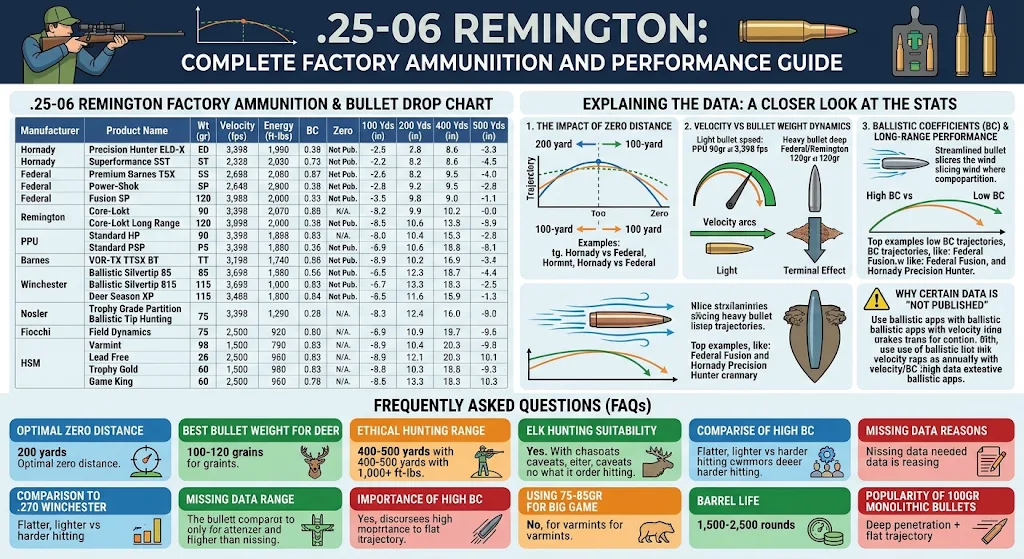
Explaining the Data: A Closer Look at the Stats
The Impact of Zero Distance on Trajectory
A major takeaway from the chart is how much zero distance dictates bullet drop. Manufacturers like Hornady and Barnes test their ammunition using a 200-yard zero. As seen with the Hornady 110-grain ELD-X, a 200-yard zero causes the bullet to strike just 1.3 inches high at 100 yards, allowing it to drop only 6.0 inches at 300 yards. Conversely, loads zeroed at 100 yards—such as the Federal 120-grain Fusion or Remington 120-grain Core-Lokt—show immediate drops of around 3.0 to 3.2 inches by the 200-yard mark, and dive 11 to 12 inches by 300 yards.
Velocity vs. Bullet Weight Dynamics
The .25-06 is beloved for its blistering speeds, but those speeds vary heavily by bullet weight. Lighter rounds like the PPU 90-grain Hollow Point rocket out of the muzzle at 3,398 fps. When stepping up to heavier brush-busting weights like the 120-grain Federal Fusion or Remington Core-Lokt, muzzle velocities slow down to the 2,980–2,990 fps range. This trade-off means lighter bullets shoot incredibly flat at short-to-medium distances, while heavier bullets rely on their mass to deliver deeper penetration.
Ballistic Coefficients (BC) and Long-Range Performance
For shooters looking to stretch the .25-06 past 300 yards, Ballistic Coefficient (BC) is the most critical stat on the chart. The Federal Fusion 120-grain (.468 BC) and Hornady Precision Hunter 110-grain ELD-X (.465 BC) represent the most aerodynamically efficient bullets on the list. These high-BC bullets slice through the wind more effectively and retain downrange energy much better than older, flat-base designs like the PPU 90-grain (.261 BC), which sheds velocity rapidly despite its high starting speed.
Why Certain Data is “Not Published”
This chart strictly utilizes manufacturer-published data. Many fields are marked as “Not Pub.” because modern ammunition companies (like Winchester, Nosler, and HSM) increasingly omit full trajectory and energy tables from their packaging and websites. Because actual bullet drop depends heavily on a shooter’s specific barrel length, elevation, and atmospheric conditions, manufacturers now prefer shooters plug the provided muzzle velocity and BC into a ballistics calculator app rather than relying on generic printed charts.
Frequently Asked Questions (FAQs)
1. What is the best zero distance for a .25-06 Remington?
Because of its inherently flat trajectory, a 200-yard zero is generally considered optimal. It keeps the bullet within 1.5 inches of the line of sight at 100 yards, meaning a shooter can hold dead-on for the vital zones of medium game from 0 to 250 yards without adjusting their aim.
2. What bullet weight is best for deer hunting with a .25-06?
For whitetail and mule deer, bullet weights between 100 and 120 grains are ideal. 117-grain and 120-grain soft points carry excellent kinetic energy, while 100-grain monolithic bullets (like the Barnes TTSX) offer devastating terminal performance at higher velocities.
3. How far can I ethically hunt medium game with the .25-06 Remington?
The ethical hunting range depends on the bullet retaining at least 1,000 ft-lbs of kinetic energy upon impact. With modern, aerodynamically efficient bullets like the Hornady ELD-X, the .25-06 carries this necessary energy out to approximately 400 to 500 yards under optimal conditions.
4. Is the .25-06 Remington suitable for elk hunting?
While it is on the lighter side for elk, it can be successful if you use heavy, premium controlled-expansion bullets (like 117-grain or 120-grain Partitions or copper monolithics) and strictly limit your shots to broadside angles at reasonable distances.
5. How does the .25-06 compare to the .270 Winchester?
Both cartridges are based on the .30-06 Springfield case. The .25-06 shoots lighter bullets (75–120 grains) faster and flatter, making it excellent for deer, antelope, and varmints. The .270 Winchester shoots heavier bullets (130–150 grains) and hits harder, making it a slightly better all-around choice if larger game like elk is regularly on the menu.
6. Why do some manufacturers have so much missing data in the chart?
Companies like Winchester and Nosler no longer print full ballistic tables on their retail sites because factors like barrel length, twist rate, and altitude drastically change real-world bullet drop. They provide the BC and velocity so shooters can calculate localized drops themselves.
7. Does a higher Ballistic Coefficient (BC) matter for hunting?
Yes, especially at extended ranges. A higher BC means the bullet is more aerodynamic. It retains its velocity and kinetic energy better over long distances and suffers less wind drift, leading to more ethical and accurate long-range shots.
8. Can I use 75-grain or 85-grain bullets for big game?
No. Bullets under 90 grains in the .25-06 are almost exclusively highly frangible varmint bullets (like the HSM 75-grain V-Max). They are designed to expand rapidly on thin-skinned pests like coyotes and prairie dogs and will not penetrate deep enough for ethical kills on deer.
9. What is the typical barrel life of a .25-06 Remington?
Because it pushes small bullets at very high velocities with a large powder charge (an “overbore” cartridge), barrel life is shorter than mild cartridges like the .308 Winchester. Most shooters see peak accuracy degrade around 1,500 to 2,500 rounds depending on how fast they fire and let the barrel heat up.
10. Why are 100-grain monolithic bullets (like the Barnes TSX) so popular?
Monolithic (solid copper) bullets don’t have a lead core to separate from a jacket. Because they retain nearly 100% of their weight upon impact, a 100-grain copper bullet penetrates just as deeply as a traditional 120-grain lead-core bullet, while benefiting from the flatter trajectory of a lighter weight.