A PowerBelt ballistic chart provides critical data for muzzleloader hunters looking to understand the downrange performance of their firearm. By reviewing specific load configurations, shooters can accurately predict bullet drop and velocity retention to ensure ethical and precise shots at varied distances.
Table of Contents [Click to minimize]
PowerBelt Ballistic Chart
| PowerBelt Bullet | Caliber | Bullet Weight | Projectile Type | Propellant and Published Charge | Test Barrel Length | Muzzle Velocity | Velocity at 50 Yards | Velocity at 100 Yards | Velocity at 150 Yards | Velocity at 200 Yards | Velocity at 250 Yards | Muzzle Energy | Energy at 50 Yards | Energy at 100 Yards | Energy at 150 Yards | Energy at 200 Yards | Energy at 250 Yards | Ballistic Coefficient |
| PowerBelt ELR | .45 Cal | 285 gr | AeroTip | Blackhorn 209 (112 gr weight) | Not verified | 2430 fps | Not verified | Not verified | Not verified | Not verified | Not verified | Not verified | Not verified | Not verified | Not verified | Not verified | Not verified | .333 |
| PowerBelt ELR | .50 Cal | 270 gr | AeroTip | Blackhorn 209 (170 gr volume) | Not verified | 2590 fps | Not verified | Not verified | Not verified | Not verified | Not verified | Not verified | Not verified | Not verified | Not verified | Not verified | Not verified | Not verified |
| PowerBelt AeroTip | .50 Cal | 295 gr | AeroTip Copper | Pyrodex (100 gr volume) | 26 inches | Not verified | Not verified | Not verified | Not verified | Not verified | Not verified | Not verified | 1200 ft-lbs (at 75 yards) | 1100 ft-lbs | <1000 ft-lbs | Not verified | Not verified | Modeled estimate: 0.150 to 0.200 |
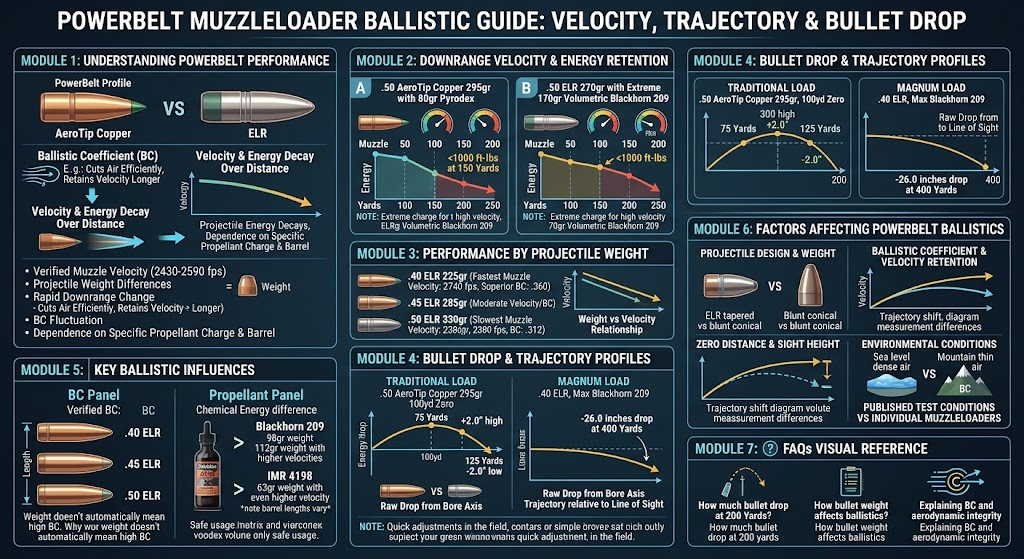
Understanding the PowerBelt Velocity and Energy Chart
- The verified muzzle velocity range of the listed loads spans from 2430 fps to 2590 fps when utilizing super magnum charges of Blackhorn 209.
- Differences between the selected projectile weights and designs include the highly elongated profile of the ELR bullet compared to the traditional AeroTip Copper design.
- Velocity and energy change rapidly with distance. The .50 caliber 295 grain AeroTip Copper retains approximately 1100 ft-lbs of energy at 100 yards but drops below 1000 ft-lbs by 150 yards.
- Ballistic coefficient varies considerably between the listed projectiles. The .45 caliber 285 grain ELR features a verified .333 BC, whereas older conical designs feature significantly lower aerodynamic ratings.
- The published figures depend heavily on the specific propellant, charge, and barrel configuration. For example, the 270 grain ELR requires an exceptional 170 grain volumetric charge of Blackhorn 209 to achieve 2590 fps.
PowerBelt Ballistics by Bullet Weight
| PowerBelt Bullet Model | Caliber | Bullet Weight | Projectile Design | Published Muzzle Velocity | Published Muzzle Energy | Ballistic Coefficient | Test Conditions |
| ELR | .40 Cal | 225 gr | AeroTip | 2740 fps | Not verified | .360 | CVA Paramount, Max Blackhorn 209 |
| ELR | .45 Cal | 285 gr | AeroTip | 2560 fps | Not verified | .333 | CVA Paramount, Max Blackhorn 209 |
| ELR | .50 Cal | 330 gr | AeroTip | 2380 fps | Not verified | .312 | CVA Paramount, Max Blackhorn 209 |
Comparing Bullet Weight Performance
- Velocity drops noticeably as bullet weight increases. The 225 grain .40 caliber projectile launches at 2740 fps, while the heavier 330 grain .50 caliber bullet slows to 2380 fps under the same maximum propellant conditions.
- Energy output changes dynamically depending on mass and speed, though specific published energy charts are not officially verified for these exact configurations.
- Ballistic coefficient fluctuates with projectile length and weight. The specialized .40 caliber 225 grain bullet offers a superior .360 BC due to its extremely tapered aerodynamic shape.
PowerBelt Bullet Drop Chart
| Distance | Bullet Drop or Trajectory | Remaining Velocity | Remaining Energy | PowerBelt Bullet and Weight | Zero Distance and Test Assumptions |
| 50 Yards | Modeled estimate: +2.0 inches | Not verified | Not verified | PowerBelt AeroTip Copper 295 gr | 100 Yard Zero, 80 gr Pyrodex |
| 100 Yards | 0.0 inches (Zero) | Not verified | Not verified | PowerBelt AeroTip Copper 295 gr | 100 Yard Zero, 80 gr Pyrodex |
| 125 Yards | Modeled estimate: -2.0 inches | Not verified | Not verified | PowerBelt AeroTip Copper 295 gr | 100 Yard Zero, 80 gr Pyrodex |
| 400 Yards | -26.0 inches | Not verified | Not verified | PowerBelt ELR .40 Cal | Modeled estimate: Zero distance not verified, Max Blackhorn 209 |
Analyzing the Bullet Drop Data
- Actual trajectory values highlight that a standard PowerBelt 295 grain bullet fired with 80 grains of Pyrodex will drop approximately two inches low by 125 yards with a 100 yard zero.
- When fueled by a super magnum charge of Blackhorn 209, the high velocity .40 caliber ELR bullet achieves an impressively flat trajectory with only 26 inches of drop at 400 yards.
- Muzzleloader manufacturers publish trajectory metrics based on line of sight rather than raw drop from the bore axis to help hunters make quick optical adjustments in the field.
PowerBelt Trajectory Chart by Zero Distance
| PowerBelt Bullet | Bullet Weight | Propellant and Charge | Zero Distance | Distance | Published Trajectory or Sight Reference |
| AeroTip Copper | 295 gr | 80 gr Pyrodex | 100 Yards | 75 Yards | Modeled estimate: +2.0 inches |
| AeroTip Copper | 295 gr | 80 gr Pyrodex | 100 Yards | 100 Yards | 0.0 inches (Dead on) |
| AeroTip Copper | 295 gr | 80 gr Pyrodex | 100 Yards | 125 Yards | Modeled estimate: -2.0 inches |
How Zero Distance Alters Trajectory
- Using a 100 yard zero distance forces the bullet to hit two inches high at 75 yards when firing standard 80 grain Pyrodex loads.
- Shifting the zero distance directly modifies the apex of the bullet flight path, dictating how far a hunter can shoot without adjusting their aim.
- Trajectory figures prove that standard muzzleloader velocities decay quickly, creating steep drop-offs just past the 125 yard mark.
PowerBelt Ballistics by Propellant
| Propellant | PowerBelt Bullet | Bullet Weight | Published Charge | Barrel Length | Muzzle Velocity | Published Energy | Source Chart Conditions |
| Blackhorn 209 | ELR .45 Cal | 285 gr | 98 gr by weight | Not verified | 2293 fps | Not verified | CVA Endura Manual |
| Blackhorn 209 | ELR .45 Cal | 285 gr | 112 gr by weight | Not verified | 2430 fps | Not verified | CVA Endura Manual |
| IMR 4198 | ELR .45 Cal | 285 gr | 63 gr by weight | Not verified | 2530 fps | Not verified | CVA Endura Manual |
| Pyrodex | AeroTip Copper | 295 gr | 100 gr by volume | 26 inches | Not verified | Not verified | Published test data |
Evaluating Propellant Impact on Performance
- Verified results demonstrate that a 112 grain by weight charge of Blackhorn 209 pushes a 285 grain ELR bullet to a fast 2430 fps.
- Propellant charges are not interchangeable. Measuring 112 grains of Blackhorn 209 by weight is a completely different procedure than measuring 100 grains of Pyrodex by volume.
- The comparison reveals limitations because the specific barrel length used for the Blackhorn 209 tests was not disclosed, unlike the 26 inch barrel specified for the Pyrodex test.
PowerBelt Ballistic Coefficient Chart
| PowerBelt Bullet Model | Caliber | Bullet Weight | Projectile Design | Published Ballistic Coefficient | Source Notes |
| ELR | .40 Cal | 225 gr | AeroTip | .360 | BPI Outdoors verified data |
| ELR | .45 Cal | 285 gr | AeroTip | .333 | BPI Outdoors verified data |
| ELR | .50 Cal | 330 gr | AeroTip | .312 | BPI Outdoors verified data |
| AeroTip Copper | .50 Cal | 295 gr | AeroTip | Modeled estimate: 0.150 to 0.200 | Atlas Ballistics generalized data |
Understanding Ballistic Coefficient and Velocity Retention
- The ballistic coefficient varies substantially across projectile designs, with the elongated .40 caliber ELR bullet offering an exceptional .360 BC.
- Weight alone does not guarantee a high BC. The heavy .50 caliber 330 grain bullet generates a .312 BC, which is lower than the lighter .45 caliber option.
- A high ballistic coefficient directly influences how efficiently a bullet retains velocity during flight, resulting in a flatter trajectory over long distances.
Factors That Affect PowerBelt Ballistics
PowerBelt projectile design and weight drastically shape downrange ballistics. The aggressively tapered profile of the modern ELR series cuts through the air more efficiently than older, blunt bullet shapes. When shooters select a heavier bullet like the 330 grain variant, the increased mass carries more momentum but typically starts at a slower muzzle velocity compared to a lighter 225 grain bullet.
Propellant type and published charge serve as the engine for any ballistic chart. Measuring black powder substitutes like Blackhorn 209 by weight versus volume produces entirely different pressure spikes and velocity results. Shooters must match the specific chemical energy of their chosen powder to the exact manufacturer recommendations to safely achieve the listed velocities.
Barrel length and muzzle velocity share a direct relationship in muzzleloading performance. A longer 26 inch barrel provides more time for the burning propellant gases to expand and accelerate the bullet, translating to higher initial speeds. If a shooter uses a shorter barrel, the actual muzzle velocity will fall below the published figures found in the factory charts.
Ballistic coefficient and velocity retention dictate how well a bullet performs at extended hunting ranges. The polycarbonate tip and elongated structure of the ELR models increase the ballistic coefficient, which heavily reduces air drag. This aerodynamic efficiency preserves supersonic flight longer, yielding a flatter trajectory and significantly more retained terminal energy upon impact.
Zero distance and sight height determine the practical curve of the bullet relative to the optical line of sight. By sighting in at 100 yards, the shooter forces the barrel slightly upward to compensate for the pull of gravity. Any adjustments to the scope ring height or the selected zero distance will completely alter the physical holdover values required at 150 or 200 yards.
Environmental conditions such as temperature, altitude, and humidity continually manipulate bullet flight. Denser air at sea level slows projectiles much faster than thin mountain air, which effectively lowers the ballistic coefficient in practical real world scenarios. These atmospheric variables mean that no single factory chart can perfectly represent every hunting environment.
Differences between published test conditions and individual muzzleloaders represent the final major variable. Manufacturers frequently test loads utilizing tightly controlled indoor facilities and maximum safe powder charges to display optimal performance numbers. A civilian hunter firing a standard inline rifle with moderate powder charges will experience steeper bullet drop and reduced energy compared to the official testing data.
Frequently Asked Questions
What is a PowerBelt ballistic chart?
A PowerBelt ballistic chart is a structured data table that tracks the velocity, energy, and trajectory of a specific muzzleloader bullet across various distances.
Where can you find official PowerBelt ballistic charts?
Official charts are published by BPI Outdoors, the parent company of PowerBelt Bullets, and are often included in the operational manuals for CVA muzzleloaders.
How much does a PowerBelt bullet drop at 100 yards?
If a muzzleloader firing a 295 grain PowerBelt AeroTip Copper with 80 grains of Pyrodex is explicitly zeroed at 100 yards, the bullet drop at 100 yards is exactly zero inches.
How much does a PowerBelt bullet drop at 200 yards?
At 200 yards, a traditional 295 grain PowerBelt drops heavily. Conversely, a .40 caliber ELR bullet pushed by a maximum charge of Blackhorn 209 drops only 26 inches all the way out to 400 yards, meaning the drop at 200 yards is exceptionally flat. Actual drop depends completely on the propellant charge and zero distance.
What is the muzzle velocity of a .50-caliber PowerBelt bullet?
A .50 caliber 270 grain PowerBelt ELR bullet achieves a published muzzle velocity of 2590 fps when fired with a 170 grain volumetric charge of Blackhorn 209.
How does PowerBelt bullet weight affect ballistics?
Heavier bullets launch at slower muzzle velocities but carry greater momentum downrange. For example, a .40 caliber 225 grain ELR reaches 2740 fps, while the heavier .50 caliber 330 grain version slows to 2380 fps using similar maximum powder charges.
What is the difference between PowerBelt AeroTip and hollow-point bullets?
The AeroTip incorporates a polycarbonate tip that preserves aerodynamic integrity and ensures deep penetration, while the traditional hollow point cavity maximizes rapid internal expansion for immediate energy transfer.
How does propellant affect PowerBelt ballistic performance?
Different propellants generate varied pressures and burn rates. Blackhorn 209 consistently yields higher velocities per volume equivalent than standard Pyrodex, heavily altering the entire trajectory curve of the bullet.
What is the ballistic coefficient of a PowerBelt bullet?
The ballistic coefficient depends entirely on the exact bullet model. The .45 caliber 285 grain PowerBelt ELR has a verified BC of .333, while the .40 caliber 225 grain version features an even higher .360 BC.
Why do PowerBelt trajectory charts use different zero distances?
Trajectory charts utilize different zero distances because a 50 yard zero is optimized for close range timber hunting, whereas a 100 yard or 150 yard zero accommodates the flatter flight path of magnum powder charges used in open terrain.