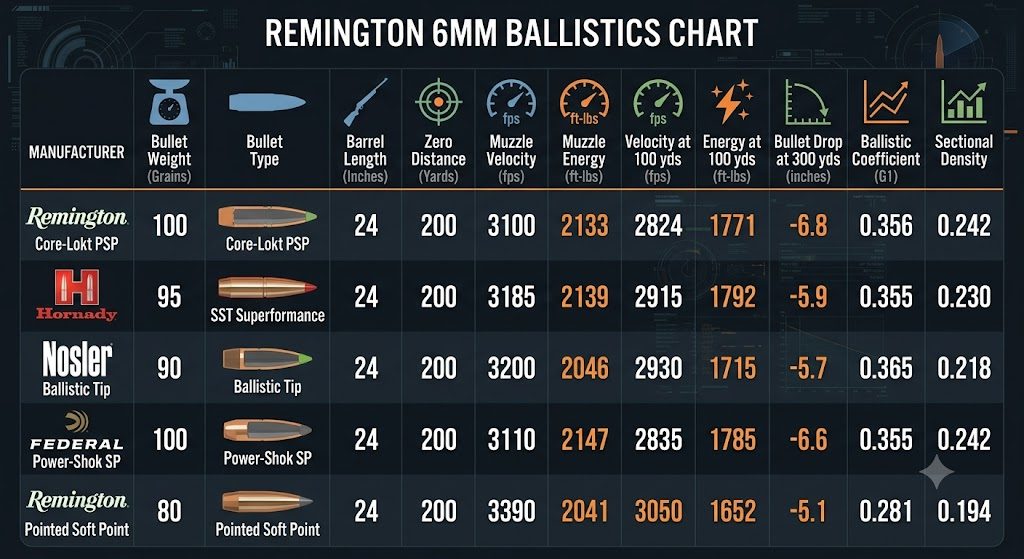
The remington 6mm ballistics chart provides a comprehensive breakdown of the velocity, kinetic energy, and trajectory for the 6mm Remington cartridge. Originally introduced as the .244 Remington, this extremely flat-shooting caliber is optimized for both long-range varmint control and medium-game hunting. The data below directly answers how this cartridge performs across various distances, illustrating its high muzzle velocity and efficient downrange energy retention. Readers will find a detailed comparison of popular factory loads, revealing how specific variables like bullet weight, barrel length, and projectile design influence overall accuracy. By consulting this data, shooters can easily identify the best ammunition for their specific rifle and chosen field application.
Remington 6mm Ballistics Chart
| Manufacturer | Bullet Weight (Grains) | Bullet Type | Barrel Length (Inches) | Zero Distance (Yards) | Muzzle Velocity (fps) | Muzzle Energy (ft-lbs) | Velocity at 100 yds (fps) | Energy at 100 yds (ft-lbs) | Bullet Drop at 300 yds (inches) | Ballistic Coefficient (G1) | Sectional Density |
| Remington | 100 | Core-Lokt PSP | 24 | 200 | 3100 | 2133 | 2824 | 1771 | -6.8 | 0.356 | 0.242 |
| Hornady | 95 | SST Superformance | 24 | 200 | 3185 | 2139 | 2915 | 1792 | -5.9 | 0.355 | 0.230 |
| Nosler | 90 | Ballistic Tip | 24 | 200 | 3200 | 2046 | 2930 | 1715 | -5.7 | 0.365 | 0.218 |
| Federal | 100 | Power-Shok SP | 24 | 200 | 3110 | 2147 | 2835 | 1785 | -6.6 | 0.355 | 0.242 |
| Remington | 80 | Pointed Soft Point | 24 | 200 | 3390 | 2041 | 3050 | 1652 | -5.1 | 0.281 | 0.194 |
Understanding the Chart
Manufacturer
The manufacturer is the brand responsible for loading the ammunition. This column matters because different companies use highly specific proprietary components, including unique powders, brass, and primers. Interpreting this data involves selecting a brand that aligns with your shooting goals; for example, Nosler often loads premium polymer-tipped projectiles, while Remington is famous for its classic Core-Lokt hunting rounds. In real-world applications, sticking to a manufacturer that your specific rifle shoots accurately is vital for consistent groups. A common misconception is that any two brands loading the same bullet weight will hit exactly the same spot on a target, which ignores the varying pressure curves of different powder charges.
Bullet Weight (Grains)
Bullet weight is measured in grains, which is a traditional firearms unit where 437.5 grains equal one ounce. This metric is important because it dictates the balance between the speed of the projectile and its ability to retain energy downrange. You interpret this column by noting that lighter bullets travel faster, while heavier bullets resist wind drift better and penetrate deeper. A practical example in the field is choosing an 80-grain bullet for explosive expansion on coyotes, whereas a 100-grain bullet is the standard choice for harvesting whitetail deer. Shooters often make the mistake of choosing the heaviest bullet available for every situation, unnecessarily sacrificing the flat trajectory that makes the 6mm Remington so effective.
Bullet Type
Bullet type refers to the physical construction and nose profile of the projectile. This specification is critical because it determines exactly what the bullet will do after it strikes a target. To interpret this column, look at the acronyms: PSP stands for Pointed Soft Point (which expands reliably on game), and SST designates a Super Shock Tip (designed for rapid, dramatic expansion). In real-world hunting, using a properly constructed hunting bullet ensures a quick and ethical kill by transferring maximum kinetic energy into the animal. A frequent mistake is using standard full metal jacket target ammunition for hunting, which typically results in narrow wound channels and lost game.
Barrel Length (Inches)
Barrel length denotes the distance from the chamber to the muzzle where the bullet accelerates under expanding gas pressure. This metric matters heavily because the 6mm Remington requires a sufficiently long barrel to burn its large powder charge efficiently. Interpreting this column requires understanding that the velocities listed in the table were achieved using standard 24-inch test barrels. If you take a rifle with an 18-inch barrel into the field, your actual velocity will drop by approximately 150 to 200 feet per second, altering your bullet drop at long distances. A common misconception is that ammunition box velocities are guaranteed out of any firearm, regardless of the physical length of the gun’s barrel.
Zero Distance (Yards)
Zero distance is the specific range where the rifle’s optic is adjusted so the bullet perfectly impacts the center of the crosshairs. This baseline is essential because a bullet travels in an arc, and the zero distance dictates all downrange holdover calculations. You can interpret this column by understanding that a 200-yard zero is optimal for the 6mm Remington, as the bullet will only rise a couple of inches at 100 yards before dropping gently at 300 yards. In practical hunting scenarios, this allows the shooter to aim dead-center on a deer’s vital zone anywhere from 50 to 250 yards without doing complex math. Novice shooters often make the mistake of zeroing this caliber at 100 yards, essentially wasting the cartridge’s inherently flat-shooting capability.
Muzzle Velocity (fps)
Muzzle velocity is the exact speed of the bullet in feet per second as it clears the end of the rifle barrel. This data point is vital because high velocity minimizes the time it takes for the bullet to reach the target, thereby reducing the effects of gravity and wind. Interpreting this figure involves recognizing that the 6mm Remington is a remarkably fast cartridge, often exceeding 3,100 fps with standard hunting loads. In real-world use, this blazing speed makes hitting moving targets like coyotes much easier because the shooter requires less forward lead. A major misconception is that faster always means better; if a bullet is pushed too fast for its specific jacket design, it can disintegrate upon impact rather than penetrating cleanly.
Muzzle Energy (ft-lbs)
Muzzle energy measures the total kinetic power of the bullet as it leaves the firearm, expressed in foot-pounds. This column is critical for understanding the maximum destructive potential and stopping power of the chosen ammunition. To interpret this metric, you must look at the mathematical product of both the bullet’s weight and its velocity. In practical field terms, generating over 2,100 foot-pounds of muzzle energy makes the 6mm Remington a highly capable deer cartridge that easily punches above its weight class. A common mistake is comparing muzzle energy numbers directly to larger calibers without considering how the bullet’s physical diameter affects the transfer of that energy.
Velocity at 100 yds (fps)
Velocity at 100 yards indicates how fast the bullet is traveling after it has overcome a football field’s length of atmospheric drag. This metric is important because it proves how aerodynamically efficient the projectile is in sustained flight. Interpreting this value allows you to verify that the bullet is still traveling fast enough to initiate mechanical expansion upon striking an animal. In the real world, premium polymer-tipped bullets will shed less velocity over 100 yards compared to older, round-nose bullet designs. Shooters frequently make the mistake of ignoring downrange velocity entirely, assuming that a high muzzle velocity guarantees good performance at every distance.
Energy at 100 yds (ft-lbs)
Energy at 100 yards reflects the remaining stopping power of the cartridge at a very common hunting distance. This data matters because terminal ballistics depend on the kinetic energy actually delivered to the target, not the energy left behind at the muzzle. You should interpret this column to ensure your selected load maintains enough force for your specific hunting requirements. For real-world applications, maintaining over 1,700 foot-pounds of energy at 100 yards gives the hunter immense confidence when taking a broadside shot on a large buck. A common misconception is that a cartridge “loses” its effectiveness quickly; however, a streamlined 6mm bullet retains its lethal energy far better than many heavier, slower alternatives.
Bullet Drop at 300 yds (inches)
Bullet drop at 300 yards measures exactly how many inches the projectile falls below your line of sight due to gravity at that range. This metric is indispensable for taking ethical, precise shots at medium to long distances. To interpret this data, you combine it with your 200-yard zero; for instance, a drop of 6.8 inches means you must aim roughly seven inches higher than your desired point of impact. In the field, knowing this exact drop allows a hunter to confidently place a shot in the vital zone without guessing or hesitating. Beginners commonly make the mistake of aiming directly at the center of the target at 300 yards, which guarantees a low strike or a complete miss.
Ballistic Coefficient (G1)
The Ballistic Coefficient (BC) is a standardized numerical rating that evaluates how well a bullet cuts through the air. This column is immensely important for long-range shooters because a higher BC translates to less wind deflection and a flatter overall trajectory. You can interpret this metric by comparing values; a BC of 0.365 will slice through a crosswind much more effectively than a BC of 0.281. In practical scenarios, choosing a bullet with a high ballistic coefficient takes the guesswork out of shooting on windy days across open plains or agricultural fields. A frequent misconception is that all 100-grain bullets have the same BC, ignoring the fact that a boat-tail profile drastically improves a bullet’s aerodynamic efficiency compared to a flat-base design.
Sectional Density
Sectional density is a mathematical ratio comparing the bullet’s overall weight to its physical diameter. This value is critical for hunters because it directly correlates to how deeply the bullet will penetrate through thick hide, muscle, and bone. Interpreting this column is simple: higher sectional density numbers indicate superior penetration capabilities. In real-world hunting, the 6mm Remington shines because a 100-grain .243 caliber bullet has a relatively high sectional density (0.242), allowing it to drive deep into the vitals of medium game. Shooters often make the mistake of ignoring sectional density altogether, focusing solely on velocity, which can result in shallow surface wounds if the bullet lacks the proper weight-to-diameter ratio to penetrate deeply.