The main difference between .223 Wylde and .223 Remington is that .223 Wylde is a specialized hybrid rifle chamber designed to safely fire both high pressure 5.56 NATO ammunition and standard .223 Remington ammunition with match grade accuracy, whereas the standard .223 Remington chamber is strictly rated only for lower pressure .223 Remington cartridges and can experience dangerous pressure spikes if a 5.56 NATO round is fired through it.
.223 Wylde vs .223 Remington Comparison Table
Before diving into the ballistic data, it is critical to understand that .223 Wylde is not a type of ammunition you can buy at a store. It is a set of internal barrel dimensions. The table below compares the physical chamber specifications and the ballistic potential they unlock when safely firing their respective maximum pressure loads.
| Specification | .223 Wylde Chamber | .223 Remington Chamber |
| Classification | Hybrid Rifle Chamber | Standard Rifle Chamber |
| Safe Ammo Compatibility | .223 Remington and 5.56 NATO | ONLY .223 Remington |
| Maximum Safe Pressure | 62,366 psi (NATO Specification) | 55,000 psi (SAAMI Specification) |
| Freebore Diameter | 0.2240 inches | 0.2240 inches |
| Leade Angle / Throat Length | Longer (Mitigates 5.56 pressure spikes) | Shorter (Optimized for .223 bullets) |
| Max Velocity Potential | 3,260 fps (Using 55gr 5.56 NATO) | 3,240 fps (Using 55gr .223 Rem) |
| Max Energy Potential | 1,331 ft-lbs (Using 62gr 5.56 NATO) | 1,282 ft-lbs (Using 55gr .223 Rem) |
| Effective Range | 500 to 600 yds | 400 to 500 yds |
| Trajectory | Extremely Flat (Using NATO loads) | Very Flat |
| Bullet Drop (300 yds) | Approx. 11.3 inches | Approx. 12.5 inches |
| Wind Drift | Moderate | Moderate to High |
| Recoil | Very Mild (approx. 4 to 5 ft-lbs) | Very Mild (approx. 4 ft-lbs) |
| Barrel Length Performance | Excels in 16 to 20 inch barrels | Excels in 20 to 24 inch bolt actions |
| Suppressor Performance | Moderate (Remains supersonic) | Moderate (Remains supersonic) |
| Short Barrel Performance | Good (If using 5.56 NATO pressures) | Poor (Massive velocity loss) |
| Long Range Performance | Excellent (Can fire heavy 77gr Mk262) | Good (Limited by pressure) |
| Accuracy Potential | Sub MOA | Sub MOA |
| Penetration | Excellent (Can fire 62gr M855 steel core) | Moderate (Varmint and soft points) |
| Expansion | High (Fragmentation based) | Very High (Varmint expansion) |
| Hunting Performance | Good (Coyotes, Hogs, small Deer) | Excellent (Varmints, Prairie Dogs) |
| Home Defense | Elite (Using 5.56 fragmentation loads) | Good (Soft points prevent over penetration) |
| Tactical Use | Elite for AR-15 platforms | Not Recommended |
| AR-15 Compatibility | Native (The modern AR-15 standard) | Native but restrictive |
| Magazine Compatibility | Standard AR-15 PMAGs | Standard AR-15 PMAGs |
| Ammunition Cost | Low (Surplus 5.56 is cheap) | Moderate (Commercial .223 is slightly higher) |
| Ammo Availability | Unlimited | Excellent |
| Best Uses | Custom AR-15 builds, 3 Gun competition | Precision bolt action varmint hunting |
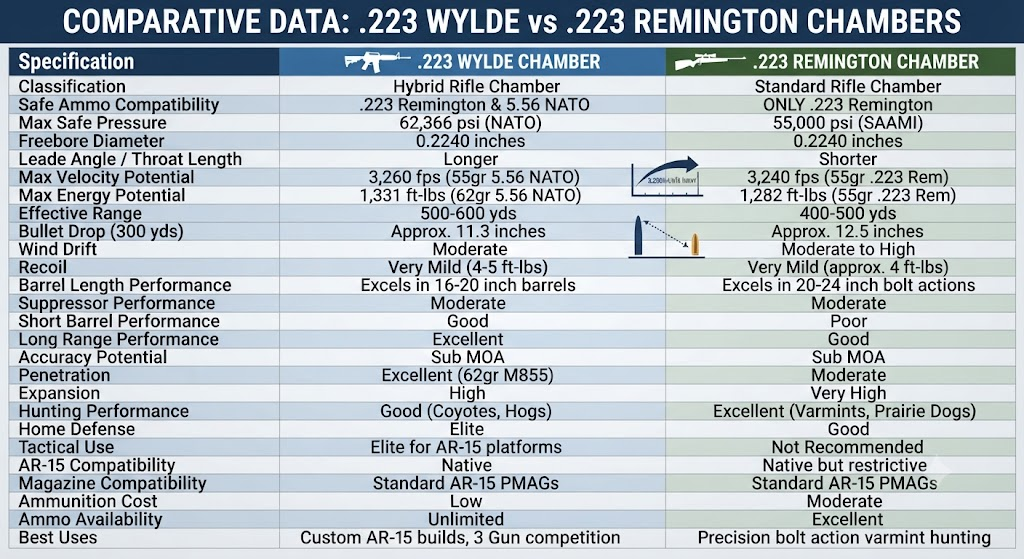
Understanding the Chamber Differences
To fully grasp this comparison, we must address the most common point of confusion in the firearms world. The .223 Remington and the 5.56 NATO cartridges look physically identical on the outside. However, the military 5.56 NATO cartridge is loaded with thicker brass and a hotter powder charge, generating up to 62,366 psi of pressure. The commercial .223 Remington cartridge is loaded to a maximum of 55,000 psi.
If you fire a 55,000 psi .223 Remington cartridge inside a 5.56 NATO chamber, it is perfectly safe, but accuracy suffers because the military chamber is slightly oversized. If you fire a 62,366 psi 5.56 NATO cartridge inside a tight .223 Remington chamber, the bullet jams into the rifling too quickly, causing a catastrophic pressure spike that can blow up your rifle.
Bill Wylde solved this problem. He designed the .223 Wylde chamber with the exact same tight .2240 inch freebore diameter as the match grade .223 Remington chamber to ensure pinpoint accuracy, but he lengthened the throat (the unrifled area ahead of the bullet) to give the high pressure 5.56 NATO cartridge enough room to safely expand before hitting the rifling. Therefore, comparing these two requires comparing the maximum ballistic potential of the ammunition they can safely fire.
Ammunition Compatibility Comparison
This is the primary reason the .223 Wylde exists.
A rifle with a barrel stamped “.223 Remington” is strictly limited to commercial .223 Remington ammunition. You cannot buy cheap military surplus M193 or M855 Green Tip ammunition, nor can you use high pressure military defensive loads.
A rifle with a barrel stamped “.223 Wylde” safely digests every single 5.56 NATO round on the market, as well as every single .223 Remington round on the market, without sacrificing accuracy for either.
Winner: .223 Wylde
The Wylde chamber offers 100 percent ammunition compatibility across both calibers.
Chamber Pressure Comparison
The pressure threshold dictates the absolute speed limit of the bullet.
The .223 Remington chamber is certified by SAAMI (Sporting Arms and Ammunition Manufacturers Institute) to handle a maximum of 55,000 psi. Ammunition manufacturers purposefully under load .223 Remington ammunition to ensure it stays well below this limit to protect older bolt action rifles.
The .223 Wylde chamber is engineered to withstand the NATO specification of 62,366 psi. This extra 7,300 psi is the engine that drives heavier bullets faster, extending the lethal range of the AR-15 platform.
Winner: .223 Wylde
Higher pressure tolerances safely unlock superior external ballistics.
Velocity Comparison
Because the .223 Wylde chamber can safely fire high pressure 5.56 NATO ammunition, it boasts a higher velocity ceiling than a strictly commercial .223 Remington chamber.
Muzzle Velocity Data (16 inch barrel):
- .223 Wylde (Using 5.56 NATO 55gr M193): 3,240 fps
- .223 Remington (Using .223 Rem 55gr V-MAX): 3,080 fps
By utilizing the 5.56 NATO cartridge, the .223 Wylde chamber pushes identical 55 grain bullet weights nearly 160 feet per second faster than standard commercial .223 Remington loads. This extra speed flattens the trajectory and ensures reliable bullet fragmentation at longer distances.
Winner: .223 Wylde
Access to 5.56 NATO pressures yields higher muzzle velocities.
Muzzle Energy Comparison
Muzzle energy dictates how much kinetic force the bullet strikes with.
Muzzle Energy Data (16 inch barrel):
- .223 Wylde (Using 5.56 NATO 62gr M855): 1,331 ft-lbs
- .223 Remington (Using .223 Rem 55gr FMJ): 1,180 ft-lbs
The ability to safely fire the heavier 62 grain 5.56 NATO ammunition gives the .223 Wylde chamber a distinct energy advantage. While both are highly lethal, the extra 150 foot pounds of energy provided by the NATO loading translates to deeper penetration and more violent terminal ballistics on medium sized game and defensive targets.
Winner: .223 Wylde
Accuracy Comparison
This category is where the traditional debate lies.
For decades, precision bolt action shooters swore by the .223 Remington chamber because its short throat engaged the bullet into the rifling immediately, resulting in incredible sub MOA accuracy. Military 5.56 NATO chambers were notoriously loose and inaccurate (often printing 2 to 3 MOA groups) because they were designed for reliability in muddy combat conditions, not precision paper punching.
The .223 Wylde chamber provides the exact same tight .2240 inch freebore diameter as the .223 Remington. When firing high quality match grade ammunition (like Federal Gold Medal Match), a .223 Wylde barrel is mathematically and practically just as accurate as a dedicated .223 Remington barrel. Both will easily shoot sub MOA groups under half an inch at 100 yards.
Winner: Tie
The .223 Wylde successfully replicates .223 Remington match grade accuracy.
Trajectory Comparison
A flatter trajectory makes hitting targets at unknown distances easier because the shooter has to make fewer holdover adjustments.
Because the .223 Wylde can utilize high velocity 5.56 NATO ammunition, it shoots noticeably flatter than standard pressure .223 Remington ammunition. The military 55 grain M193 load cuts through the air faster, giving gravity less time to pull the projectile downward.
Winner: .223 Wylde
Bullet Drop Comparison
Let us look at the actual drop data in inches assuming a standard 100 yard zero out of a 16 inch barrel.
| Distance | .223 Remington (55gr V-MAX) | .223 Wylde (using 5.56 NATO 55gr M193) |
| 100 Yards | 0 inches | 0 inches |
| 200 Yards | -3.6 inches | -2.8 inches |
| 300 Yards | -13.5 inches | -11.3 inches |
| 400 Yards | -31.8 inches | -27.4 inches |
| 500 Yards | -61.5 inches | -54.0 inches |
At 300 yards, the high pressure 5.56 NATO round fired from the .223 Wylde drops roughly two inches less than the commercial .223 Remington round. At 500 yards, the difference expands to over seven inches. This provides the .223 Wylde shooter with a much larger margin of error.
Winner: .223 Wylde
Wind Drift Comparison
Wind drift is dictated by a bullet’s ballistic coefficient and its time in flight.
The ultimate long range load for the AR-15 platform is the military Mk262, a 5.56 NATO cartridge loaded with a heavy 77 grain Sierra MatchKing bullet. Because this is a high pressure 5.56 NATO load, it is unsafe to fire in a standard .223 Remington chamber.
The .223 Wylde safely fires this heavy 77 grain projectile. Because the 77 grain bullet is aerodynamically superior and retains its velocity longer, it completely dominates standard 55 grain .223 Remington loads in heavy crosswinds at 300 to 500 yards.
Winner: .223 Wylde
Recoil Comparison
Recoil in an AR-15 platform is famously soft for both chamberings.
Firing standard pressure .223 Remington ammunition generates roughly 4 foot pounds of free recoil. Firing high pressure 5.56 NATO ammunition through a .223 Wylde generates slightly more recoil, usually around 4.5 to 5 foot pounds.
Both are practically non existent and highly suitable for beginners, but the commercial .223 Remington is technically slightly softer shooting due to the reduced powder charge.
Winner: .223 Remington
Stopping Power Comparison
Stopping power relies on terminal ballistics, specifically how efficiently a bullet dumps its energy into the target.
When 5.56 NATO (M193) hits soft tissue at velocities over 2,500 fps, the bullet yaws and violently fragments, destroying surrounding tissue and creating massive temporary wound cavities. The .223 Wylde safely drives these military loads to the extreme velocities required for reliable fragmentation.
Standard .223 Remington soft points expand beautifully and offer excellent stopping power, but they lack the devastating high speed fragmentation characteristics of true military spec ammunition.
Winner: .223 Wylde
Penetration Comparison
Penetration matters when dealing with barriers like auto glass, heavy clothing, or bone.
The .223 Remington chamber is largely restricted to lead core varmint bullets and standard full metal jackets.
The .223 Wylde chamber safely fires the 5.56 NATO M855 Green Tip. This 62 grain cartridge features a mild steel penetrator inside the nose, specifically designed to pierce light barriers and standard steel helmets at a distance. The ability to utilize armor penetrating military ammunition gives the Wylde chamber a massive tactical advantage.
Winner: .223 Wylde
Expansion Comparison
To test expansion, the industry uses calibrated 10 percent ordinance gel.
If you fire premium defensive ammunition (like the 62 grain Federal Fusion or 73 grain Hornady Critical Defense) out of either chamber, the bullet will expand beautifully to nearly half an inch in diameter. Because the .223 Wylde can shoot every single .223 Remington defensive round on the market with equal precision, it matches the .223 Remington perfectly in this category.
Winner: Tie
Effective Range Comparison
The effective range is the distance at which a bullet still carries enough velocity to reliably fragment or expand.
Because standard .223 Remington loads start at lower velocities, they drop below the 2,000 fps fragmentation threshold much sooner. Out of a 16 inch barrel, a standard .223 Remington load loses reliable terminal performance around 200 yards.
The .223 Wylde, firing hotter 5.56 NATO ammunition, keeps the bullet supersonic longer and maintains fragmentation velocities out to 250 or 300 yards. For target shooting, a Wylde chamber firing 77 grain Mk262 ammunition is highly effective out to 600 yards.
Winner: .223 Wylde
Suppressor Performance Comparison
Suppressors reduce the muzzle blast of a firearm, but neither of these cartridges can be effectively silenced.
Both the .223 Remington and 5.56 NATO cartridges fire lightweight bullets at velocities over 3,000 fps. It is impossible to load a 55 grain bullet to subsonic speeds (below 1,125 fps) without turning it into a glorified .22 Long Rifle. Therefore, every round fired from either chamber will produce a loud supersonic crack as it breaks the sound barrier. You will still need ear protection in closed spaces.
Winner: Tie
Short Barrel Performance Comparison
When you chop an AR-15 barrel down to 10.5 inches, you lose a massive amount of velocity.
Because the .223 Remington operates at lower pressures, firing it out of a 10.5 inch barrel often results in muzzle velocities dipping below 2,400 fps. This neuters the cartridge, making it incapable of reliable fragmentation.
The .223 Wylde chamber firing 5.56 NATO ammunition mitigates this velocity loss slightly because of the hotter powder charge. While it still suffers in a short barrel, the NATO pressure keeps the velocity just high enough to remain lethal at close CQB distances.
Winner: .223 Wylde
16 inch vs 10.5 inch Barrel Performance
For both chamberings, the 16 inch barrel is the undisputed sweet spot.
A 16 inch barrel maximizes the powder burn rate, ensuring velocities over 3,000 fps without generating the massive concussive fireball associated with short barreled rifles. If you are building an AR-15, a 16 inch .223 Wylde barrel offers the absolute best balance of maneuverability, velocity, and ammunition compatibility.
Winner: Tie
Home Defense Comparison
Inside the home, engagements are typically 3 to 10 yards. Over penetration is the biggest concern.
A dedicated .223 Remington rifle loaded with lightweight 40 grain or 55 grain polymer tipped varmint rounds (like the V-MAX) is excellent for home defense because the bullets explode violently upon hitting drywall, reducing the risk to family members in the next room.
However, a .223 Wylde rifle can shoot those exact same varmint rounds flawlessly. Furthermore, the Wylde chamber allows you to switch to heavy 77 grain military OTM (Open Tip Match) loads which are widely considered the gold standard for urban defensive engagements.
Winner: .223 Wylde
Hunting Comparison
Both chambers have distinct roles in the hunting woods.
For prairie dogs and coyotes, the dedicated .223 Remington chamber in a heavy bolt action rifle is legendary. The tight tolerances combined with lightweight, explosive bullets make it a devastating varmint rig out to 400 yards.
For feral hogs and small white tailed deer, the .223 Wylde in an AR-15 platform is superior. It allows the hunter to utilize heavy, high pressure 5.56 NATO bonded soft points (like the 64 grain Winchester Ranger) which punch deeper through thick shoulder bone and cartilage than standard commercial .223 Remington loads.
Winner: Tie (Depends entirely on the game animal)
Tactical and Duty Use Comparison
In military and law enforcement applications, reliability and terminal ballistics dictate the gear.
Law enforcement agencies and tactical teams exclusively use 5.56 NATO ammunition because of its superior barrier penetration and high velocity fragmentation. A rifle chambered strictly in .223 Remington is a massive liability on duty because it cannot safely fire standard issue military patrol ammunition.
The .223 Wylde chamber bridges the gap, offering SWAT snipers match grade accuracy while retaining the ability to safely fire standard issue 5.56 NATO duty rounds if their primary match ammunition runs out during an extended firefight.
Winner: .223 Wylde
AR-15 Compatibility
The .223 Wylde was explicitly designed for the AR-15 platform.
Today, nearly every premium AR-15 barrel manufacturer defaults to the .223 Wylde chamber. It has practically rendered the dedicated .223 Remington AR-15 barrel obsolete. If you are building an AR-15, installing a Wylde barrel requires no proprietary parts. It uses the standard upper receiver, standard bolt carrier group, and standard gas system.
Winner: .223 Wylde
Magazine Compatibility
Because the physical external dimensions of the .223 Remington and 5.56 NATO cartridges are absolutely identical, magazine compatibility is flawless.
Whether your barrel is stamped .223 Remington, 5.56 NATO, or .223 Wylde, standard 30 round Magpul PMAGs and USGI aluminum magazines will feed the ammunition perfectly.
Winner: Tie
Ammo Cost Comparison
To become proficient with a rifle, you must shoot it frequently.
If your rifle is chambered only in .223 Remington, you are forced to buy commercial brass cased ammunition, which typically costs around 50 to 60 cents per round.
If your rifle is chambered in .223 Wylde, you can safely buy massive bulk crates of military surplus 5.56 NATO M193 or green tip penetrator ammunition, which often drops the price to 35 to 45 cents per round. This price difference adds up rapidly for high volume shooters.
Winner: .223 Wylde
Ammo Availability Comparison
Walk into any hardware store, bait shop, or big box sporting goods store in America, and you will find .223 Remington on the shelf.
However, during times of national ammunition shortages or panic buying, commercial .223 Remington is often the first to vanish. Having a .223 Wylde chamber means you can buy whatever is left on the shelf, whether it is a box of commercial .223 soft points or a surplus military can of 5.56 NATO. Flexibility is the ultimate logistical advantage.
Winner: .223 Wylde
Reloading Comparison
For handloaders, both chambers offer deep ecosystems.
Reloading for a strict .223 Remington bolt action rifle allows the shooter to tune their powder charges and seating depth to microscopic tolerances, ensuring absolute pinpoint accuracy.
Reloading for a .223 Wylde chamber is equally rewarding, but the longer throat (leade angle) means reloaders can safely experiment with longer, heavier 77 grain to 80 grain bullets without dangerously spiking the chamber pressure.
Winner: Tie
Pros and Cons
.223 Wylde
Pros
- Safely fires both high pressure 5.56 NATO and standard .223 Remington.
- Retains match grade sub MOA accuracy.
- Unlocks higher velocity and energy potential.
- Allows you to shoot cheaper military surplus ammunition.
- The absolute best all purpose chamber for modern AR-15 builds.
Cons
- Not typically found in traditional bolt action hunting rifles.
- Can be slightly more expensive when buying aftermarket match barrels.
.223 Remington
Pros
- The gold standard for precision varmint hunting in bolt action rifles.
- Extremely mild recoil impulse.
- Ammunition is highly affordable and available everywhere.
- Massive ecosystem of reloading data.
Cons
- Highly dangerous if you accidentally fire a 5.56 NATO cartridge inside it.
- Limited to lower pressure commercial velocities.
- Restricts your ability to buy bulk military surplus ammunition.
Final Verdict
Choosing between a .223 Wylde chamber and a .223 Remington chamber is incredibly simple once you define your rifle platform.
- For AR-15 Builders:.223 Wylde. There is absolutely no logical reason to put a strict .223 Remington barrel on a modern AR-15. The Wylde chamber gives you 100 percent ammunition flexibility, military velocity, and match grade precision.
- For Bolt Action Varmint Hunters:.223 Remington. If you are buying a dedicated bolt action rifle for shooting prairie dogs at 400 yards, the traditional .223 Remington chamber is still the undisputed king of off the shelf precision.
- For Budget Conscious Shooters:.223 Wylde. The ability to shoot cheap bulk 5.56 NATO military surplus ammunition will save you hundreds of dollars in training costs over the lifespan of the barrel.
- For Home Defense:.223 Wylde. You gain the ability to shoot heavy, high velocity 5.56 NATO defensive loads that are specifically engineered to fragment reliably and stop threats immediately.
- For Beginners:.223 Wylde. It completely removes the anxiety of accidentally loading the wrong ammunition. If the box says .223 or 5.56, your Wylde barrel will shoot it safely and accurately.
FAQ
Is .223 Wylde better than 5.56 NATO?
For accuracy, yes. A standard 5.56 NATO chamber is slightly oversized to ensure the gun cycles when filled with mud or carbon buildup. The .223 Wylde chamber tightened those dimensions to match the .223 Remington, resulting in significantly better accuracy while still safely handling the 5.56 NATO pressures.
Can a .223 Wylde shoot 5.56 safely?
Yes. That is the exact reason Bill Wylde invented the chamber. It safely digests the highest pressure 5.56 NATO military loads without any risk of catastrophic failure or dangerous pressure spikes.
Will a .223 Wylde shoot .223 Remington accurately?
Absolutely. Because the freebore diameter of the .223 Wylde is identical to a match grade .223 Remington chamber (.2240 inches), it shoots commercial .223 Remington ammunition with stunning sub MOA precision.
Why do some rifles still use a strict .223 Remington chamber?
Many traditional bolt action hunting rifles are strictly chambered in .223 Remington because they are designed purely for commercial varmint hunting ammunition. Bolt action shooters rarely need to fire high pressure military 5.56 NATO ammunition, so manufacturers stick to the traditional SAAMI specification.
What happens if I shoot 5.56 NATO in a .223 Remington barrel?
Because 5.56 NATO operates at up to 62,366 psi and the .223 Remington is only rated for 55,000 psi, firing 5.56 NATO in a strict .223 barrel can cause popped primers, blown case heads, extraction failures, and in severe cases, a catastrophic explosion that can destroy the rifle and injure the shooter.
Is .223 Wylde a type of ammo?
No. You cannot buy a box of “.223 Wylde” ammunition at a gun store. It is purely a specification for how the inside of the rifle barrel is machined. A .223 Wylde rifle shoots standard .223 Remington and 5.56 NATO ammunition.
Does .223 Wylde have more recoil?
Not inherently. Recoil is determined by the ammunition you load into it. If you fire a standard .223 Remington cartridge out of a .223 Wylde barrel, the recoil is identical. If you load a hotter 5.56 NATO cartridge, you will feel slightly more recoil simply because the bullet is traveling faster.
Should I upgrade my 5.56 AR-15 barrel to a .223 Wylde?
If you are satisfied with your current rifle’s accuracy, there is no need to upgrade. However, if you are building a new AR-15 from scratch or want to shrink your shot groups from 2 inches down to 1 inch at 100 yards, a .223 Wylde match barrel is the best upgrade you can make.