The main difference between the .300 PRC and the .338 Lapua Magnum is their design philosophy and intended application: the .300 PRC is a modern, high-efficiency cartridge optimized for extreme-range precision using high-BC .30-caliber bullets, while the .338 Lapua Magnum is a heavier, more powerful platform engineered for devastating terminal performance and long-range engagement of larger targets. Although both are elite cartridges for long-distance work, the .300 PRC typically provides a flatter trajectory and significantly lower recoil, whereas the .338 Lapua delivers substantially more kinetic energy and heavier payloads at extreme ranges. Choosing between them depends on whether your priority is a more manageable, versatile precision system or a heavy-hitting magnum with maximum stopping power, making this 300 PRC vs 338 Lapua ballistics chart comparison vital for your long-range journey.
300 PRC vs 338 Lapua Ballistics Chart
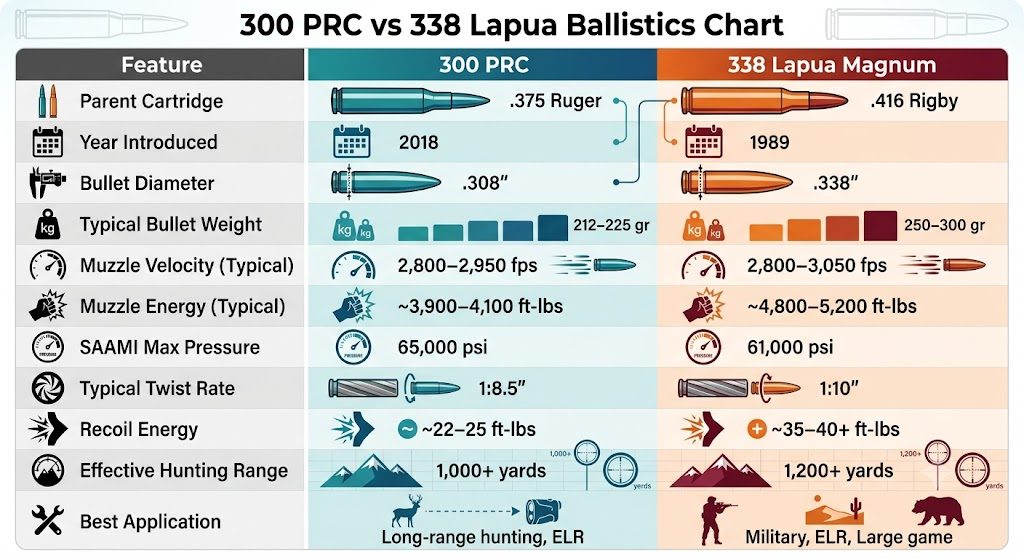
| Feature | .300 PRC | .338 Lapua Magnum |
| Parent Cartridge | .375 Ruger | .416 Rigby |
| Year Introduced | 2018 | 1989 |
| Bullet Diameter | .308″ | .338″ |
| Typical Bullet Weight | 212–225 gr | 250–300 gr |
| Muzzle Velocity (Typical) | 2,800–2,950 fps | 2,800–3,050 fps |
| Muzzle Energy (Typical) | ~3,900–4,100 ft-lbs | ~4,800–5,200 ft-lbs |
| SAAMI Max Pressure | 65,000 psi | 61,000 psi |
| Typical Twist Rate | 1:8.5″ | 1:10″ |
| Recoil Energy | ~22–25 ft-lbs | ~35–40+ ft-lbs |
| Effective Hunting Range | 1,000+ yards | 1,200+ yards |
| Best Application | Long-range hunting, ELR | Military, ELR, Large game |
Muzzle Velocity Comparison
The .300 PRC is engineered to launch heavy .30-caliber match bullets at high velocities, often achieving 2,900 fps with 225-grain projectiles. In contrast, the .338 Lapua Magnum pushes much heavier 250- to 300-grain bullets, often reaching similar velocity levels. While the .300 PRC maintains impressive speed due to its aerodynamic bullet design, the .338 Lapua relies on sheer mass and momentum to maintain its flight path at extreme distances compared with the .300 PRC.
Muzzle Energy Comparison
The .338 Lapua Magnum is a clear leader in raw power, generating massive muzzle energy that frequently exceeds 5,000 ft-lbs. On the other hand, the .300 PRC produces a highly respectable 4,000 ft-lbs, which is more than enough for long-range big-game hunting. The .338 Lapua delivers a more significant impact force compared to the .300 PRC, making it the preferred choice for applications where terminal kinetic energy is the absolute priority.
Downrange Energy Comparison
As the distance increases, the .338 Lapua maintains superior energy levels thanks to its heavier projectile weights. At 1,000 yards, the .338 Lapua often retains energy well into the 2,000+ ft-lbs range, whereas the .300 PRC, while still capable, experiences a more noticeable drop-off in total energy compared to the massive .338 projectile. However, both cartridges are designed to remain effective at ranges where most other hunting rounds fail.
Bullet Drop and Trajectory
The .300 PRC features an incredibly flat trajectory due to its optimized case design and high-BC bullets, often requiring less holdover than the .338 Lapua at mid-to-long ranges. In contrast, the .338 Lapua has a flatter flight path at extreme ranges (beyond 1,500 yards) because its heavier bullets are better at resisting wind and air resistance. While the .300 PRC is often easier to adjust for at typical long-range distances, the .338 Lapua is superior for extreme-long-range (ELR) precision.
Recoil Comparison
Recoil is the most significant differentiator for the average shooter. The .300 PRC is widely praised for its manageable recoil impulse, which is significantly lower—often 30% to 40% less—than that of the .338 Lapua. The .338 Lapua Magnum produces heavy, punishing recoil that can fatigue the shooter and make follow-up shots more difficult compared with the much smoother, faster recovery time of the .300 PRC.
Accuracy and Precision
Both cartridges are renowned for sub-MOA potential in the right hands and with high-quality components. The .300 PRC is often considered easier to shoot accurately for longer sessions because of the reduced recoil. However, the .338 Lapua has a long-standing reputation for military-grade precision at extreme distances, and it remains a gold standard for shooters who have mastered the recoil management required to shoot it well.
Which Is Better?
The “better” cartridge is defined by your commitment to the long-range discipline. The .300 PRC is generally better for the long-range hunter or precision shooter who wants extreme performance without the massive physical toll of the .338 Lapua. It offers a more efficient, cost-effective, and shooter-friendly package that is still highly lethal on North American game like elk and moose at long ranges.
The .338 Lapua Magnum is better for the shooter whose primary goal is extreme-long-range (ELR) work beyond 1,500 yards, or for those pursuing dangerous or very large game where the maximum possible terminal energy is required. If you can handle the intense recoil and the increased weight of the necessary rifle system, the .338 Lapua provides performance that few other shoulder-fired cartridges can match.
FAQ
Is the .300 PRC enough for elk?
Yes, the .300 PRC is exceptionally capable for elk and similar sized game at extreme distances, offering better terminal ballistics than the classic .300 Win Mag while maintaining a flatter trajectory.
Why is the .338 Lapua so expensive to shoot?
The .338 Lapua uses large, premium-grade projectiles and a significant amount of powder per charge, and the specialized actions required for the cartridge add to the overall cost of both the ammunition and the rifle.
Can I use a .300 PRC in a standard long-action rifle?
No, the .300 PRC has a long overall length and requires a dedicated long-range magnum action to function reliably and accommodate its specific case dimensions.
Does the .338 Lapua have more barrel wear than the .300 PRC?
Generally, yes. The larger powder capacity of the .338 Lapua, combined with the high pressures, tends to erode barrels faster than the highly efficient powder-to-bore ratio found in the .300 PRC.