Understanding 22 WMR (22 Magnum) ballistics requires looking at bullet weight, muzzle velocity, and the aerodynamic properties of different rimfire projectiles. Factors like barrel length, ballistic coefficient, and environmental conditions significantly alter how these cartridges perform at varying distances. The tables below outline the expected velocities, energies, and bullet paths for popular 22 WMR (22 Magnum) ammunition.
Table of Contents [Click to minimize]
22 WMR Ballistics Chart
| Bullet Weight | Bullet Type | Manufacturer and Load | Test Barrel Length | Muzzle Velocity (fps) | Velocity at 50 Yards (fps) | Velocity at 100 Yards (fps) | Velocity at 150 Yards (fps) | Velocity at 200 Yards (fps) | Muzzle Energy (ft-lbs) | Energy at 50 Yards (ft-lbs) | Energy at 100 Yards (ft-lbs) | Energy at 150 Yards (ft-lbs) | Energy at 200 Yards (ft-lbs) | Bullet Drop at 50 Yards (inches)* | Bullet Drop at 100 Yards (inches)* | Bullet Drop at 150 Yards (inches)* | Bullet Drop at 200 Yards (inches)* | Ballistic Coefficient |
| 30 grain | Polymer Tip | Hornady V-MAX | 24 inches | 2200 | 1754 | 1374 | 1109 (est) | Not verified | 322 | 205 | 126 | 82 (est) | Not verified | +0.9 | 0.0 | -5.8 (est) | -16.5 (est) | 0.095 |
| 40 grain | JHP | CCI Maxi-Mag | 24 inches | 1875 | 1563 | 1318 | 1133 (est) | Not verified | 312 | 217 | 154 | 114 (est) | Not verified | +1.0 | 0.0 | -6.5 (est) | -18.2 (est) | 0.114 |
| 50 grain | JHP | Federal Game-Shok | 24 inches | 1530 | 1320 | 1146 | 1025 (est) | Not verified | 260 | 193 | 146 | 116 (est) | Not verified | +1.8 | 0.0 | -8.5 (est) | -24.0 (est) | 0.145 |
*Bullet drop is modeled with a 100-yard zero and a 1.5-inch sight height. Values marked (est) are calculated trajectory estimates.
Analyzing the Ballistics Data
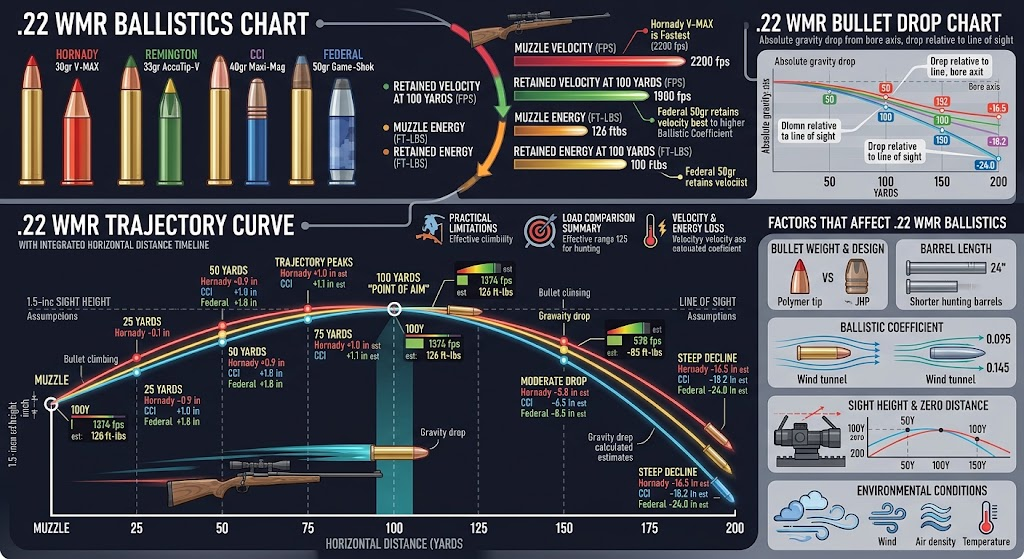
- The muzzle velocity range of the listed loads spans from a conservative 1530 fps to a high-speed 2200 fps.
- The 30-grain Hornady bullet leaves the muzzle 670 fps faster than the 50-grain Federal load.
- Velocity and energy drop rapidly as distance increases, with the 30-grain load losing nearly 40 percent of its velocity by 100 yards.
- The higher ballistic coefficient of the 50-grain bullet (0.145) helps it retain velocity better over distance, even though it starts much slower than the 30-grain option.
- Bullet drop changes drastically past 100 yards, with the 40-grain load dropping an estimated 6.5 inches at 150 yards and over 18 inches at 200 yards.
22 WMR Ammo Ballistics
| Manufacturer and Load | Bullet Weight | Bullet Type | Test Barrel Length | Muzzle Velocity (fps) | Velocity at 100 Yards (fps) | Muzzle Energy (ft-lbs) | Energy at 100 Yards (ft-lbs) | Ballistic Coefficient |
| Hornady V-MAX | 30 grain | Polymer Tip | 24 inches | 2200 | 1374 | 322 | 126 | 0.095 |
| Remington Magnum Rimfire | 33 grain | AccuTip-V | 24 inches | 2000 | 1344 | 293 | 132 | 0.084 |
| CCI Maxi-Mag | 40 grain | JHP | 24 inches | 1875 | 1318 | 312 | 154 | 0.114 |
| Federal Game-Shok | 50 grain | JHP | 24 inches | 1530 | 1146 | 260 | 146 | 0.145 |
Comparing Ammunition Loads
- The highest verified muzzle velocity in this group is 2200 fps from the 30-grain Hornady load, while the lowest is 1530 fps from the 50-grain Federal load.
- Lighter bullets like the 30-grain and 33-grain options use polymer tips to improve aerodynamics, whereas the 40-grain and 50-grain bullets rely on traditional jacketed hollow point designs.
- The 40-grain CCI load retains the most energy at 100 yards (154 ft-lbs) despite starting with less muzzle energy than the 30-grain Hornady load.
- All listed 22 WMR (22 Magnum) ammo ballistics rely on 24-inch test barrels, meaning real-world speeds in shorter hunting rifles will be lower.
22 WMR Trajectory Chart
| Distance (Yards) | Trajectory Relative to Line of Sight (Inches) | Remaining Velocity (fps) | Remaining Energy (ft-lbs) | Ammunition Load | Sight-In and Calculation Assumptions |
| 25 | -0.1 | 1968 | 258 | Hornady 30gr V-MAX | 100-yard zero, 1.5-inch sight height |
| 50 | +0.9 | 1754 | 205 | Hornady 30gr V-MAX | 100-yard zero, 1.5-inch sight height |
| 75 | +1.0 (est) | 1555 (est) | 161 (est) | Hornady 30gr V-MAX | 100-yard zero, 1.5-inch sight height |
| 100 | 0.0 | 1374 | 126 | Hornady 30gr V-MAX | 100-yard zero, 1.5-inch sight height |
| 125 | -2.1 (est) | 1230 (est) | 101 (est) | Hornady 30gr V-MAX | 100-yard zero, 1.5-inch sight height |
| 150 | -5.8 (est) | 1109 (est) | 82 (est) | Hornady 30gr V-MAX | 100-yard zero, 1.5-inch sight height |
| 200 | -16.5 (est) | Not verified | Not verified | Hornady 30gr V-MAX | 100-yard zero, 1.5-inch sight height |
Understanding the Trajectory Curve
- At 25 yards, the bullet is still 0.1 inches below the line of sight as it climbs to meet the crosshairs.
- The 22 WMR (22 Magnum) trajectory peaks around 75 yards, where the bullet travels approximately 1.0 inch above the line of sight.
- By 150 yards, the lightweight 30-grain bullet drops an estimated 5.8 inches below the crosshairs.
- At 200 yards, the modeled trajectory shows a steep decline, dropping 16.5 inches below the line of sight.
22 WMR Ballistics Bullet Drop Chart
| Distance (Yards) | Bullet Drop (Inches) | Remaining Velocity (fps) | Remaining Energy (ft-lbs) | Bullet Weight | Reference and Assumptions |
| 25 | 0.0 | 1714 | 261 | 40 grain | CCI Maxi-Mag JHP, 100-yard zero, 1.5-inch sight height |
| 50 | +1.0 | 1563 | 217 | 40 grain | CCI Maxi-Mag JHP, 100-yard zero, 1.5-inch sight height |
| 75 | +1.1 (est) | 1435 (est) | 183 (est) | 40 grain | CCI Maxi-Mag JHP, 100-yard zero, 1.5-inch sight height |
| 100 | 0.0 | 1318 | 154 | 40 grain | CCI Maxi-Mag JHP, 100-yard zero, 1.5-inch sight height |
| 125 | -2.4 (est) | 1218 (est) | 132 (est) | 40 grain | CCI Maxi-Mag JHP, 100-yard zero, 1.5-inch sight height |
| 150 | -6.5 (est) | 1133 (est) | 114 (est) | 40 grain | CCI Maxi-Mag JHP, 100-yard zero, 1.5-inch sight height |
| 200 | -18.2 (est) | Not verified | Not verified | 40 grain | CCI Maxi-Mag JHP, 100-yard zero, 1.5-inch sight height |
Evaluating Bullet Drop
- With a 100-yard zero, the 40-grain bullet impacts 1.0 inch high at 50 yards.
- At 100 yards, the 22 WMR (22 Magnum) ballistics bullet drop brings the projectile exactly to the point of aim with 154 ft-lbs of remaining energy.
- By 150 yards, the bullet drops an estimated 6.5 inches, requiring the shooter to aim noticeably higher than the target.
- At 200 yards, the estimated bullet drop plummets to 18.2 inches, demonstrating the practical limitations of the cartridge at extended ranges.
Factors That Affect 22 WMR Ballistics
Bullet weight and projectile design play a massive role in performance. A 30-grain bullet flies faster initially but loses momentum quickly, while a heavier 50-grain bullet starts slower but carries its energy further downrange. Polymer tips help streamline lighter bullets, while jacketed hollow points maximize expansion upon impact.
Barrel length directly impacts muzzle velocity. Ammunition manufacturers typically test 22 WMR (22 Magnum) in 24-inch barrels. If you fire the same ammunition from an 18-inch or 20-inch rifle barrel, you will likely see a reduction in muzzle velocity, which slightly alters the entire trajectory profile.
Ballistic coefficient measures a bullet’s ability to overcome air resistance. A higher ballistic coefficient means the bullet retains its velocity and energy better over distance. This is why a heavier 22 WMR (22 Magnum) bullet often hits harder at 100 yards than a lighter, faster bullet with poor aerodynamics.
Muzzle energy represents the raw power of the bullet as it leaves the barrel, but downrange energy determines effectiveness on the target. As the bullet loses speed, it loses energy exponentially. Choosing an efficient projectile ensures adequate energy reaches the target at typical hunting ranges.
Sight height and zero distance completely change how bullet drop is measured. A rifle zeroed at 50 yards will show a very different trajectory curve than a rifle zeroed at 100 yards. A higher optic mount also changes the angle at which the barrel points relative to the line of sight.
Wind, air density, temperature, and other environmental conditions influence the bullet’s flight path. High winds easily push the small, lightweight 22 WMR (22 Magnum) projectiles off target, and dense, cold air increases drag, causing the bullet to drop faster than it would in hot weather.
Differences between manufacturer test barrels and real-world rifles cause discrepancies between published data and actual performance. Factory test barrels are tightly toleranced to produce optimal numbers. Your specific rifle’s chamber, rifling, and barrel length will produce slightly different ballistics.
Frequently Asked Questions
What is the muzzle velocity of a 22 WMR (22 Magnum) bullet?
Muzzle velocity usually ranges from 1,530 fps for heavy 50-grain loads to 2,200 fps for light 30-grain loads when fired from a 24-inch test barrel.
What is a 22 WMR (22 Magnum) ballistics chart?
A 22 WMR (22 Magnum) ballistics chart is a data table showing the velocity, energy, and trajectory of a specific ammunition load as it travels away from the muzzle at marked distance intervals.
How far can a 22 WMR (22 Magnum) bullet travel?
While a 22 WMR (22 Magnum) bullet can physically travel over a mile if fired at an upward angle, its practical effective range for hunting and accurate target shooting is typically limited to 125 to 150 yards.
How much does a 22 WMR (22 Magnum) bullet drop at 100 yards?
If a rifle is zeroed at 100 yards, there is zero bullet drop at that distance. If zeroed at 50 yards, a standard 40-grain 22 WMR (22 Magnum) bullet will drop approximately 1.5 to 2.0 inches at 100 yards.
How much does a 22 WMR (22 Magnum) bullet drop at 200 yards?
When zeroed at 100 yards, a standard 40-grain 22 WMR (22 Magnum) bullet will drop an estimated 16 to 19 inches at 200 yards, depending on the exact load and barrel length.
What is the trajectory of a 22 WMR (22 Magnum) bullet?
The trajectory is a parabolic curve. When zeroed at 100 yards, the bullet climbs slightly above the line of sight peaking around 75 yards, crosses the crosshairs at 100 yards, and drops rapidly thereafter.
How does bullet weight affect 22 WMR (22 Magnum) ballistics?
Lighter bullets achieve higher initial velocities and flatter short-range trajectories, while heavier bullets start slower but retain more energy and resist wind deflection better at longer distances.
How much energy does 22 WMR (22 Magnum) retain at 100 yards?
Depending on the specific load, a 22 WMR (22 Magnum) bullet typically retains between 120 and 160 ft-lbs of energy at 100 yards.
Does barrel length affect 22 WMR (22 Magnum) velocity?
Yes. Manufacturer data is usually based on 24-inch barrels. Firing the cartridge from a shorter barrel typically results in lower velocities.
What factors affect 22 WMR (22 Magnum) bullet drop?
Bullet drop is primarily affected by the bullet’s starting velocity, its ballistic coefficient, the distance to the target, the rifle’s zero distance, the height of the sights, and environmental conditions like air density.