Looking for an accurate 220 swift ballistics chart to understand the blistering speed and flat trajectory of this classic varmint cartridge? You have found the right guide. We break down the authentic downrange velocity, kinetic energy, and bullet drop for the fastest commercial .22 caliber round ever produced. Whether you are hunting coyotes or targeting distant prairie dogs, this data will show you exactly how this historic cartridge performs in the field.
220 Swift Ballistics Chart
The following chart details the downrange performance of two popular factory loads: the Hornady Varmint Express 55 grain V-MAX and the Remington High Performance 50 grain Pointed Soft Point. The Hornady load utilizes a modern 200 yard zero, while the Remington data reflects their standard factory trajectory chart.
| Ammunition Load | Distance (Yards) | Velocity (fps) | Energy (ft-lbs) | Drop (Inches) | Drop (MOA) | Wind Drift 10mph (Inches) | Time of Flight (sec) |
| 55gr Hornady V-MAX | Muzzle | 3680 | 1654 | -1.5 | N/A | 0.0 | 0.000 |
| (Varmint Express) | 100 | 3253 | 1293 | +0.9 | -0.9 | 0.7 | 0.086 |
| G1 BC: 0.255 | 200 | 2868 | 1004 | 0.0 | 0.0 | 2.8 | 0.184 |
| 200 Yard Zero | 300 | 2514 | 772 | -5.1 | +1.6 | 6.8 | 0.296 |
| 400 | 2186 | 583 | -15.8 | +3.8 | 13.0 | 0.423 | |
| 500 | 1884 | 433 | -33.9 | +6.5 | 21.8 | 0.571 | |
| 50gr Remington PSP | Muzzle | 3780 | 1586 | -1.5 | N/A | 0.0 | 0.000 |
| (High Performance Rifle) | 100 | 3215 | 1147 | +1.0 | -1.0 | 1.0 | 0.086 |
| G1 BC: 0.175 | 200 | 2707 | 813 | -6.2 | +3.0 | 4.4 | 0.188 |
| Factory Trajectory | 300 | 2248 | 561 | -20.2 | +6.4 | 10.6 | 0.310 |
| 400 | 1836 | 374 | -47.0 | +11.2 | 20.6 | 0.458 | |
| 500 | 1478 | 242 | -92.5 | +17.7 | 35.3 | 0.640 |
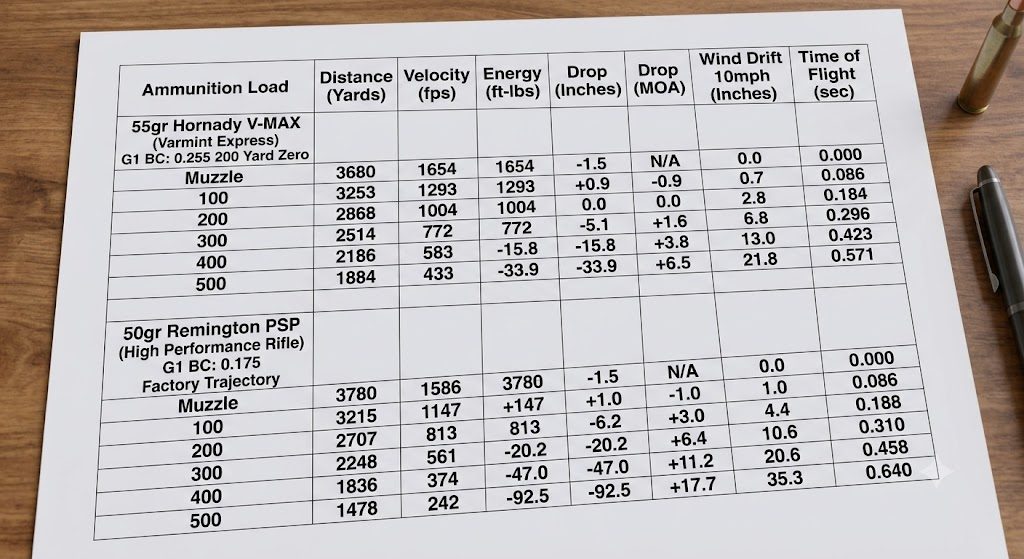
Ammunition Load
This column specifies the manufacturer, bullet weight, and projectile type. Bullet weight is measured in grains. The 55 grain V-MAX is a polymer tipped bullet designed for rapid fragmentation and high aerodynamic efficiency. The 50 grain Pointed Soft Point is a traditional cup and core bullet designed for rapid expansion on small game and predators.
Distance
Distance is measured in yards from the muzzle of the rifle to the target. The table provides data in 100 yard increments up to 500 yards. This covers the practical ethical hunting range for small game and predators with a .22 caliber centerfire rifle.
Velocity
Velocity is the speed of the bullet measured in feet per second (fps). This cartridge is famous for extreme speed. Both loads launch at roughly 3,700 fps. The Hornady load retains velocity much better at long range due to its streamlined polymer tip, staying supersonic well past 500 yards.
Energy
Energy measures the kinetic knockdown power of the bullet, calculated in foot pounds (ft-lbs). Muzzle energy is roughly 1,600 ft-lbs. While this is relatively low compared to big game magnums, it is exceptionally high for a varmint round. The massive transfer of energy upon impact causes explosive fragmentation on small targets like groundhogs and prairie dogs.
Drop in Inches
Bullet drop shows the physical height of the bullet relative to your line of sight. The negative 1.5 inches at the muzzle accounts for the standard height of a rifle scope above the bore. Because of the hyper velocity, the trajectory is incredibly flat. With a 200 yard zero, the Hornady bullet only drops 5.1 inches at 300 yards.
Drop in MOA
MOA stands for Minute of Angle. This statistic tells you exactly how much to adjust your rifle scope turrets for a precise shot at distance. If a target is 400 yards away using the Hornady load, you simply dial your elevation turret up 3.8 MOA to place the bullet exactly on your crosshairs.
Wind Drift
Wind drift measures how far a 10 mph full value crosswind will push the bullet laterally off target. Lightweight .22 caliber bullets are susceptible to wind push at long ranges. However, the extreme speed of this cartridge minimizes the time the wind has to act on the bullet. The more aerodynamic Hornady load drifts significantly less than the Remington load at 500 yards.
Time of Flight
Time of flight is the exact fraction of a second it takes the bullet to travel from the muzzle to the target. This statistic is critical for hunters who need to estimate lead on a moving coyote or fox. At 300 yards, the bullet reaches the target in under three tenths of a second.
Cartridge Overview
Introduced by Winchester in 1935, this cartridge made history as the first factory loaded rifle round to break the 4,000 fps barrier. It is based on the 6mm Lee Navy case necked down to accept .224 caliber bullets. For decades, it held the title of the fastest commercial cartridge in the world. It was considered a marvel of ballistic engineering and remains a favorite among dedicated varmint hunters who want maximum velocity and explosive terminal performance.
Varmint Hunting Performance
This cartridge is built specifically for predator and varmint hunting. The extreme velocity generates devastating hydrostatic shock. When a fragile, light bullet strikes a small animal at over 3,000 fps, it fragments violently. This makes it an ideal choice for coyotes, foxes, bobcats, and prairie dogs, ensuring instant ethical kills with minimal risk of ricochet.
Effective Range
The effective range on small game easily extends to 500 yards in calm conditions. The primary limiting factor is not energy, but wind drift. Because the bullets are very light, a strong crosswind will push them completely off a small target past 400 yards. In the hands of a skilled marksman who can read the wind, it is a highly capable long range varmint tool.
Comparison to the 22-250 Remington
These two cartridges are constant rivals. The .22-250 Remington is far more popular today because it fits in standard short actions and is gentler on barrels. However, the Swift case holds more powder and is marginally faster. When using identical bullet weights, the Swift generally achieves 100 to 150 fps more velocity. Both deliver virtually identical performance in the field, but the older Swift retains a cult following for its historical significance and pure speed.
Barrel Life and Twist Rates
A common criticism of this cartridge is accelerated barrel wear. Pushing large volumes of hot powder gas through a small bore at 4,000 fps erodes the throat of the barrel much faster than a standard cartridge. Most traditional rifles feature a 1 in 14 twist rate, which limits them to shooting light bullets in the 40 to 55 grain range. Modern custom rifles sometimes use faster twist rates to stabilize heavier, high BC bullets, making the cartridge even more effective at extreme distances.
Recoil Characteristics
One of the greatest advantages of this cartridge is the lack of recoil. Despite the massive muzzle blast and extreme speed, the light bullets generate very little rearward force. The recoil energy is typically less than 5 ft-lbs in a standard varmint rifle. This allows hunters to spot their own hits through the scope, making follow up shots incredibly fast and easy.
Best Factory Ammunition Options
Because it has been overshadowed by the .22-250, factory ammunition can sometimes be difficult to find on local store shelves. The best readily available factory loads include:
- Hornady Varmint Express 55gr V-MAX: The best overall choice for flat trajectory and rapid fragmentation.
- Remington High Performance 50gr PSP: A classic soft point load excellent for close range predators.
- Winchester Super-X 48gr Pointed Soft Point: A tribute to the original historical loading from 1935.
Frequently Asked Questions
Is this cartridge suitable for deer hunting?
While it has been used for deer by expert marksmen, it is generally considered unethical for medium game. The light, fragile bullets are designed to explode on impact and will not reliably penetrate the shoulder bone of a deer. It should be reserved strictly for predators and varmints.
Why did it lose popularity?
Early rifles suffered from rapid barrel throat erosion, earning the cartridge a reputation as a “barrel burner.” Additionally, the semi rimmed case design can occasionally cause feeding issues in modern box magazines. The introduction of the rimless, highly efficient .22-250 Remington largely made the Swift obsolete for the average shooter.
Can I reload this cartridge to save money?
Yes. Handloading is highly recommended for this caliber. Reloading allows you to bypass the high cost of rare factory ammunition and tune your loads for maximum accuracy. Because the case has a semi rimmed design, reloaders must pay close attention to case trimming and sizing to ensure reliable chambering.