The main difference between 22 LR and 556 is the ignition type and immense disparity in case capacity, resulting in drastically different ballistic performance. The 22 LR is a small rimfire cartridge designed for short-range plinking and small game, while the 556 is a high-pressure centerfire rifle cartridge designed originally for military combat. Because the 556 case holds vastly more gunpowder, it launches a heavier bullet at roughly three times the velocity of a standard 22 LR, generating over ten times the kinetic energy. This makes the 556 highly effective for medium game hunting and defensive applications out to 500 yards, whereas the 22 LR drops rapidly after 100 yards. Despite sharing similar bullet diameters, their extreme differences in recoil, muzzle blast, and ammunition cost mean they serve entirely separate shooting applications.
Table of Contents [Click to open]
22 LR vs 556
| Feature | 22 LR | 556 |
| Full Name | .22 Long Rifle | 5.56x45mm NATO |
| Cartridge Type | Rimfire | Centerfire |
| Bullet Weight | 30 to 40 grains | 55 to 77 grains |
| Bullet Diameter | 0.223 to 0.2255 inches | 0.224 inches |
| Case Length | 0.613 inches | 1.760 inches |
| Overall Cartridge Length | 1.000 inches | 2.260 inches |
| Typical Muzzle Velocity | 1,070 to 1,640 fps | 2,700 to 3,200 fps |
| Typical Muzzle Energy | 100 to 191 ft-lbs | 1,200 to 1,350 ft-lbs |
| Effective Range | 50 to 100 yards | 400 to 600 yards |
| Recoil | Extremely low | Low to moderate |
| Ammunition Cost | $0.06 to $0.12 per round | $0.40 to $0.65 per round (FMJ) |
| Common Uses | Plinking, training, small game | Military, self-defense, competition, hunting |
| Source | SAAMI / Federal Premium | NATO / Winchester |
The Main Difference Between 22 LR And 556
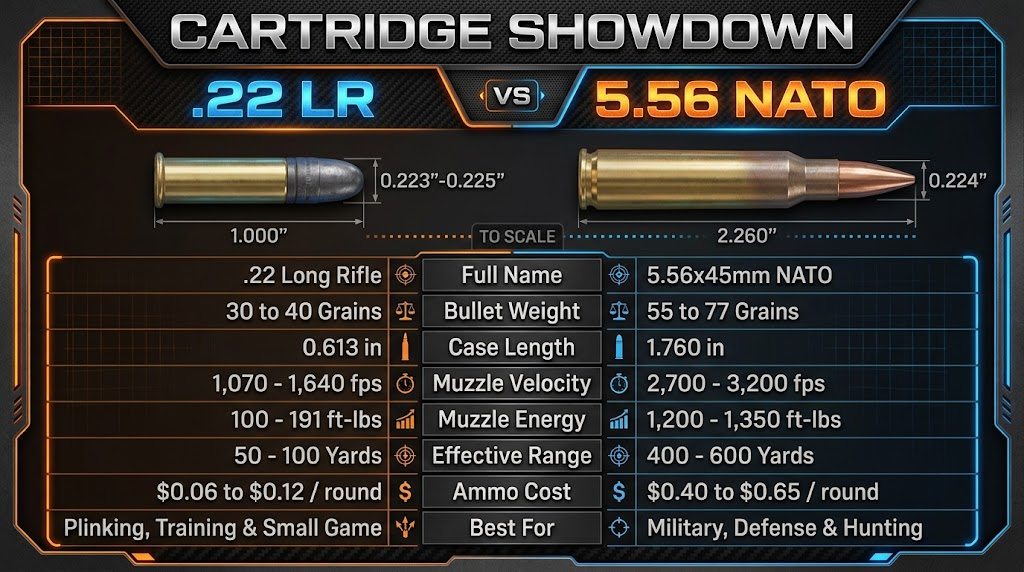
When comparing 22 LR vs 556, the most obvious difference is the sheer physical size and construction of the cartridges. The 22 LR utilizes a thin rimfire casing where the priming compound is spun into the rim. The 556 (officially the 5.56x45mm NATO) utilizes a thick, robust centerfire casing with a replaceable primer seated in the base. This thick brass case allows the 556 to safely contain explosive chamber pressures that would instantly vaporize a rimfire casing.
Because it operates at such high pressures and holds a massive powder charge, the 556 produces ballistics in a completely different class than the 22 LR. It pushes a heavier bullet to supersonic speeds exceeding 3,000 feet per second. This speed generates devastating kinetic energy upon impact, making the 556 a standard choice for infantry forces and law enforcement worldwide. The tradeoff for this extreme performance is significantly higher ammunition costs, a concussive muzzle blast, and heavier firearm platforms. The 22 LR remains the champion of low-cost, low-noise training, while the 556 is a serious centerfire rifle cartridge built for combat and medium game.
22 LR vs 556 Dimensions
Cartridge dimensions dictate the size of the firearm action and the amount of gunpowder the casing can hold. The only thing these two cartridges share is their bullet width, as both fire a .22-caliber class projectile.
According to Sporting Arms and Ammunition Manufacturers’ Institute (SAAMI) specifications, the 22 LR measures:
- Bullet diameter: 0.223 to 0.2255 inches
- Case length: 0.613 inches
- Rim diameter: 0.278 inches
- Case diameter: 0.226 inches
- Overall cartridge length: 1.000 inches
The 5.56x45mm NATO measures:
- Bullet diameter: 0.224 inches
- Case length: 1.760 inches (44.70 mm)
- Rim diameter: 0.378 inches
- Case base diameter: 0.377 inches
- Overall cartridge length: 2.260 inches (57.40 mm)
The 556 case is nearly three times longer and substantially wider than the 22 LR case. Do not let the similar bullet diameters confuse you, as the loaded cartridges look entirely different side by side.
22 LR vs 556 Velocity
Velocity dictates how flat a bullet flies and how much energy it carries to the target. The 556 is designed entirely around the concept of hyper-velocity, relying on extreme speed to cause massive tissue damage.
Comparing representative factory ammunition fired from standard test barrels:
- CCI Standard Velocity 22 LR (40-grain lead round nose): 1,070 fps.
- Federal AutoMatch 22 LR (40-grain lead round nose): 1,200 fps.
- Winchester M193 556 (55-grain full metal jacket): 3,165 fps.
- Federal M855 556 (62-grain green tip FMJ): 3,020 fps.
- Hornady Frontier 556 (75-grain boat tail hollow point): 2,750 fps.
The 556 easily achieves three times the muzzle velocity of standard 22 LR ammunition, all while pushing a projectile that is significantly heavier.
22 LR vs 556 Energy
Muzzle energy measures the striking force of the bullet. Energy is determined by a mathematical formula combining bullet weight and velocity. Because the 556 is heavier and drastically faster, it generates an entirely different tier of kinetic energy.
Representative muzzle energy figures based on manufacturer specifications:
- CCI Standard Velocity 22 LR (40-grain): 102 ft-lbs.
- Federal AutoMatch 22 LR (40-grain): 128 ft-lbs.
- Hornady Frontier 556 (75-grain): 1,259 ft-lbs.
- Federal M855 556 (62-grain): 1,256 ft-lbs.
- Winchester M193 556 (55-grain): 1,223 ft-lbs.
The 556 consistently produces over 1,200 foot-pounds of energy, which is roughly ten times the striking power of the 22 LR. This massive energy difference is why the 556 is appropriate for defense and hunting larger animals, whereas the 22 LR is restricted strictly to small game and targets.
22 LR vs 556 Range
When comparing 22 LR vs 556 range, it is crucial to separate practical effective range from maximum projectile travel. Maximum projectile travel for the 556 exceeds two miles when fired at an optimal upward angle, and the 22 LR can travel over a mile. Both absolutely require a safe backstop.
Effective range specifies the distance at which the bullet maintains accuracy and terminal performance. The 22 LR has a practical effective range of 50 to 100 yards on targets, with extreme bullet drop occurring rapidly past the 100-yard mark.
The 556 is a dedicated medium-range rifle cartridge. When fired from a standard 16-inch or 20-inch barrel, the 556 maintains a flat trajectory and supersonic speeds well past 500 yards. Military qualifications routinely require infantrymen to engage man-sized targets at 500 meters using 556 rifles.
22 LR vs 556 Accuracy
Accuracy depends heavily on the specific firearm platform, barrel quality, and ammunition grade.
In independent accuracy testing, a premium bolt-action 22 LR rifle firing specialized match-grade ammunition (such as Lapua Center-X) can shoot 5-shot groups measuring under 0.5 inches at 50 yards. The 22 LR dominates short-range precision benchrest competitions.
The 556 is natively highly accurate, especially when fired from modern AR-15 platforms or bolt-action rifles. With standard military-ball ammunition (M193 or M855), shooters can expect 1.5 to 2.5-inch groups at 100 yards. However, when loaded with heavy, match-grade bullets (like the 77-grain Sierra MatchKing), a quality 556 rifle will routinely print sub-1-inch groups at 100 yards and remain accurate out to 600 yards or further.
22 LR vs 556 Recoil
Recoil is dictated by the firearm’s weight and the energy of the cartridge being fired. There is a very noticeable practical difference between the two.
A 22 LR fired from a 6-pound rifle generates less than 0.2 foot-pounds of free recoil energy. This is essentially zero felt recoil, making it completely comfortable for any shooter.
A 556 fired from a standard 7-pound AR-15 generates approximately 4 to 5 foot-pounds of recoil energy. While the 556 is globally recognized as one of the mildest and easiest centerfire rifle cartridges to shoot, it still produces a firm push into the shoulder and a loud concussive blast that a 22 LR does not.
22 LR vs 556 Ammunition Cost
Ammunition cost heavily favors the 22 LR, which remains the cheapest factory ammunition in production. The 556 is one of the most affordable centerfire rifle cartridges available due to massive global production, but it still costs considerably more than rimfire.
As of September 2026, representative normal retail prices indicate:
- Federal AutoMatch 22 LR (40-grain, 325-round bulk box): $19.50 to $26.00 per box, equating to $0.06 to $0.08 per round.
- CCI Standard Velocity 22 LR (40-grain, 50-round box): $4.50 to $6.00 per box, equating to $0.09 to $0.12 per round.
- Winchester M193 556 (55-grain FMJ, 20-round box): $8.00 to $12.00 per box, equating to $0.40 to $0.60 per round.
- Federal Premium Match 556 (77-grain, 20-round box): $25.00 to $35.00 per box, equating to $1.25 to $1.75 per round.
Shooting standard 556 training ammunition costs roughly five to eight times as much as shooting 22 LR.
22 LR vs 556 For Hunting
The 22 LR is an ideal small game cartridge. Inside of 50 to 75 yards, a standard 40-grain solid bullet or a 36-grain hollow point will cleanly harvest squirrels and rabbits while preserving the edible meat.
The 556 is vastly overpowered for small game and will completely destroy the meat on a rabbit or squirrel. However, the 556 is a phenomenal cartridge for hunting predators and varmints, such as coyotes and wild hogs, at distances out to 300 yards. With proper expanding ammunition, the 556 is also widely and successfully used to harvest medium-sized game like whitetail deer, though hunters must check local regulations as some states mandate a minimum caliber larger than .224 for deer hunting.
22 LR vs 556 For Target Shooting
For casual plinking, fundamentals training, and short-range target shooting, the 22 LR is unmatched. The lack of recoil, low noise, and incredibly inexpensive ammunition allow shooters to practice all day on a very small budget.
The 556 is the standard for practical action shooting, tactical training, and 3-Gun competitions. The AR-15 platform chambered in 556 dominates these sports due to its low recoil, high magazine capacities, and excellent intermediate-range ballistics. Shooters who want to ring steel silhouettes at 300 to 500 yards will require the power and flat trajectory of the 556, as the 22 LR simply cannot compete at those distances.
22 LR vs 556 For Beginners
For brand new shooters, the 22 LR is universally the best possible introduction to rifles. The complete absence of recoil and the very mild report prevent inexperienced shooters from developing a flinch response. A beginner can dedicate hours to mastering sight alignment, breathing, and trigger control without physical fatigue.
The 556 is widely considered the best introductory centerfire rifle cartridge. Once a beginner has mastered the safety and fundamentals on a 22 LR, moving up to an AR-15 in 556 is the logical next step. The recoil is very manageable, though the loud muzzle blast often requires doubling up on ear protection (plugs and muffs) for new shooters firing at indoor ranges.
22 LR vs 556 Firearms
Firearms chambered in 22 LR encompass almost every action type imaginable, from bolt-action rifles and single-shot pistols to modern semi-automatic rifles. The Ruger 10/22 remains one of the most popular 22 LR firearms ever produced.
Firearms chambered in 556 are primarily semi-automatic rifles and bolt-action rifles. The AR-15 platform is intrinsically linked to the 5.56x45mm NATO cartridge and is the most popular rifle in the United States. Firearm manufacturers also produce high-quality bolt-action rifles in 556, which are highly favored by coyote hunters and precision shooters.
Can 22 LR And 556 Use The Same Gun?
Generally, no. Standard 22 LR and 556 cartridges cannot be safely fired from the same gun chamber. The chamber dimensions, bolt face sizes, and firing pin locations (rimfire vs centerfire) are completely incompatible.
However, there is a very popular exception specifically for the AR-15 platform. Manufacturers like CMMG produce dedicated 22 LR conversion kits for 556 rifles. A user can simply open their AR-15, remove the standard 556 bolt carrier group, and drop in the specialized 22 LR bolt carrier and magazine. Because the barrel bore diameters are practically identical (.223 vs .224 inches), the conversion kit allows the user to safely fire cheap 22 LR ammunition through their 556 barrel for training purposes.
22 LR vs 556 Ammunition Compatibility
Ammunition compatibility is strictly determined by the chamber size and ignition type.
- 22 LR is not interchangeable with 556.
- 556 is not interchangeable with 22 LR.
If a shooter attempts to load a 556 cartridge into a 22 LR firearm, it physically will not fit because the 556 is vastly longer and wider. If a shooter drops a tiny 22 LR cartridge into a 556 chamber, it will slip deep into the chamber or fall out of the barrel entirely. You can never fire rimfire ammunition in a centerfire chamber without a dedicated, manufacturer-designed conversion bolt.
Pros And Cons
22 LR Pros And Cons
Pros:
- Lowest ammunition cost enables high-volume, affordable training.
- Massive availability of firearms and ammunition globally.
- Virtually no recoil or concussive blast.
- Highly effective for small game hunting without meat destruction.Cons:
- Severely limited effective range and wind resistance.
- Lacks the kinetic energy for defensive applications or medium game.
556 Pros And Cons
Pros:
- Extreme velocity provides a flat trajectory out to 500 yards.
- Excellent kinetic energy for self-defense and varmint hunting.
- Vast availability of military surplus and commercial ammunition.
- Very light recoil for a centerfire rifle cartridge.Cons:
- Ammunition costs roughly five to eight times more than 22 LR.
- Produces a loud concussive muzzle blast, especially indoors.
- Destroys too much meat to be used for small game hunting.
Manufacturer Data vs Independent Testing
When reviewing 556 ballistics, readers must understand the difference between promotional military specifications and independent chronograph testing. Military specifications for 556 ammunition are typically recorded using standard 20-inch barrels, which provide maximum powder burn and velocity.
Independent chronograph testing provides a highly realistic baseline for civilian consumers, who primarily shoot AR-15s equipped with 16-inch or 14.5-inch barrels. When fired from these shorter barrels, the 556 will consistently lose 100 to 200 feet per second compared to the numbers printed on the box or in military manuals. This velocity loss slightly reduces terminal energy and increases bullet drop at longer ranges. When sources provide conflicting figures, controlled independent testing through the exact barrel length of the consumer’s chosen rifle is always the most practical data source.
FAQs
What is the main difference between 22 LR and 556?
The main difference is size and power. The 22 LR is a small, low-pressure rimfire cartridge for target practice. The 556 is a large, high-pressure centerfire cartridge designed for military combat, offering vastly more speed and energy.
Is 556 more powerful than 22 LR?
Yes. The 556 generates roughly ten times the kinetic energy of a standard 22 LR at the muzzle, making it vastly more powerful on impact.
Is 556 faster than 22 LR?
Yes. The 556 routinely achieves muzzle velocities exceeding 3,000 feet per second, whereas most standard 22 LR ammunition operates between 1,070 and 1,260 feet per second.
Which has more range, 22 LR or 556?
The 556 has a substantially longer effective range. While the 22 LR is effective inside of 100 yards, the 556 maintains supersonic velocity and lethal energy out to 500 yards and beyond.
Which is more accurate, 22 LR or 556?
Both are highly accurate within their respective ranges. The 22 LR is extremely precise inside 50 yards for benchrest shooting, while the 556 remains highly accurate out to 600 yards in the hands of a skilled marksman.
Which has less recoil?
The 22 LR has essentially zero recoil. The 556 produces a noticeable push into the shoulder and a loud blast, though it is considered very mild for a centerfire rifle.
Which is cheaper to shoot?
The 22 LR is considerably cheaper. It typically costs between 6 and 12 cents per round, while 556 training ammunition typically costs between 40 and 65 cents per round.
Is 556 better for hunting?
It depends on the game. For small animals like squirrels, the 22 LR is perfect. For medium game like wild hogs, coyotes, and deer, the 556 is vastly superior and legally required in many areas.
Can a 556 shoot 22 LR?
Only if you install a dedicated 22 LR conversion kit (like a CMMG drop-in bolt) into your 556 AR-15. You cannot fire a 22 LR cartridge through a standard 556 bolt.
Can a 22 LR shoot 556?
No. A 556 cartridge is far too large to fit into a 22 LR chamber, and a 22 LR firearm cannot withstand the extreme pressures of a 556 cartridge.
Are 22 LR and 556 interchangeable?
No. The standard ammunition is never interchangeable. You must only load the specific ammunition that is stamped on the barrel of your firearm unless utilizing a specific conversion bolt.
Which is better for beginners?
The 22 LR is the best choice for absolute beginners. The low noise, lack of recoil, and affordable ammunition allow a new shooter to learn fundamentals before stepping up to the louder 556 centerfire rifle.