The main difference between 22 LR and 22 Magnum is the case capacity, which gives the 22 Magnum significantly higher velocity and kinetic energy. While the 22 LR fires a similar .22-caliber projectile, its shorter case limits muzzle energy to roughly 100 to 190 foot-pounds compared to the 300-plus foot-pounds generated by the 22 Magnum. This translates to an extended effective range for the 22 Magnum, allowing hunters to reliably harvest varmints out to 150 yards. In contrast, the 22 LR shines inside of 100 yards, where its minimal recoil and exceptionally low cost per round make it the universal standard for high-volume target shooting. Both are highly popular rimfire cartridges, but their physical sizes dictate very different capabilities for hunting, plinking, and training.
22 LR vs 22 Magnum
| Feature | 22 LR | 22 Magnum |
| Full Name | .22 Long Rifle | .22 Winchester Magnum Rimfire (.22 WMR) |
| Cartridge Type | Rimfire | Rimfire |
| Bullet Weight | 30 to 40 grains | 30 to 50 grains |
| Bullet Diameter | 0.223 to 0.2255 inches | 0.224 inches |
| Case Length | 0.613 inches | 1.055 inches |
| Overall Cartridge Length | 1.000 inches | 1.350 inches |
| Typical Muzzle Velocity | 1,070 to 1,640 fps | 1,530 to 2,200 fps |
| Typical Muzzle Energy | 100 to 191 ft-lbs | 300 to 324 ft-lbs |
| Effective Range | 50 to 100 yards | 100 to 150 yards |
| Recoil | Extremely low | Low |
| Ammunition Cost | $0.06 to $0.12 per round | $0.20 to $0.40 per round |
| Common Uses | Plinking, training, small game, target shooting | Varmint hunting, predator hunting, longer-range target shooting |
| Source | SAAMI / Federal Premium | SAAMI / CCI Ammunition |
The Main Difference Between 22 LR And 22 Magnum
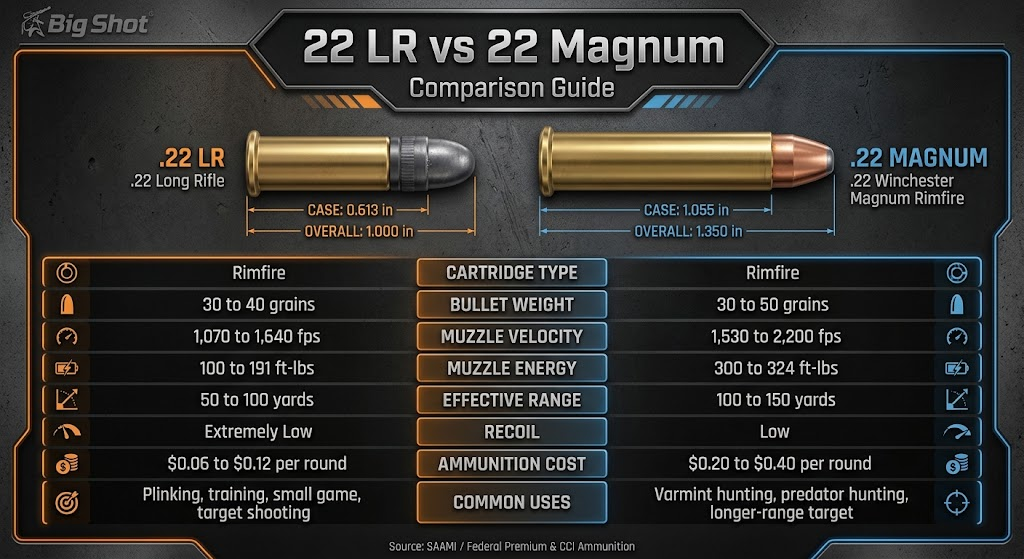
When comparing 22 LR vs 22 Magnum, the most obvious difference is the cartridge dimensions. The 22 Magnum case is significantly longer and slightly wider than the 22 LR case. This larger case capacity allows the 22 Magnum to hold more gunpowder. Because it holds more powder, the 22 Magnum pushes a similar bullet to a much higher velocity.
Higher velocity directly translates to greater kinetic energy, a flatter trajectory, and a longer practical range. While a 22 LR bullet begins to drop rapidly past 75 yards, a 22 Magnum bullet remains flat and carries lethal energy out to 125 or 150 yards. However, this increased performance comes with tradeoffs. The 22 Magnum produces a louder report, slightly more recoil, and requires firearms designed to handle higher pressures. Ammunition cost is also a major difference, as 22 LR is typically a fraction of the price of 22 Magnum. Therefore, the intended use dictates the better choice: 22 LR is ideal for target shooting and close-range small game, while 22 Magnum is superior for varmint hunting at extended distances.
22 LR vs 22 Magnum Dimensions
Cartridge dimensions dictate chamber compatibility and powder capacity. Although both cartridges fire a .22-caliber projectile, their cases are completely different. Similar bullet diameters do not make the cartridges interchangeable.
According to Sporting Arms and Ammunition Manufacturers’ Institute (SAAMI) specifications, the 22 LR measures:
- Bullet diameter: 0.223 to 0.2255 inches
- Case length: 0.613 inches
- Rim diameter: 0.278 inches
- Case diameter: 0.226 inches
- Overall cartridge length: 1.000 inches
The 22 Magnum (formally known as the .22 WMR) measures:
- Bullet diameter: 0.224 inches
- Case length: 1.055 inches
- Rim diameter: 0.294 inches
- Case diameter: 0.242 inches
- Overall cartridge length: 1.350 inches
The 22 Magnum case is nearly twice as long as the 22 LR case. Furthermore, the 22 Magnum case is physically wider (0.242 inches compared to 0.226 inches). A 22 Magnum cartridge will not fit into a standard 22 LR chamber.
22 LR vs 22 Magnum Velocity
Velocity dictates trajectory and energy. The 22 Magnum is inherently faster than the 22 LR because its longer case holds more powder. Typical 22 LR factory ammunition produces muzzle velocities between 1,070 and 1,640 feet per second (fps) when fired from a rifle barrel. The 22 Magnum produces between 1,530 and 2,200 fps.
To compare representative factory ammunition from an 18 to 20-inch rifle barrel:
- CCI Standard Velocity 22 LR (40-grain lead round nose): 1,070 fps.
- Federal AutoMatch 22 LR (40-grain lead round nose): 1,200 fps.
- CCI Maxi-Mag 22 WMR (40-grain total metal jacket): 1,875 fps.
- Hornady V-MAX 22 WMR (30-grain polymer tip): 2,200 fps.
Even when firing the exact same bullet weight of 40 grains, the 22 Magnum typically achieves over 600 fps more muzzle velocity than high-velocity 22 LR loads.
22 LR vs 22 Magnum Energy
Muzzle energy determines the striking power of the bullet, which is critical for hunting. Energy is calculated using bullet weight and velocity, and because the 22 Magnum is significantly faster, it generates much more energy. Do not use energy alone as a measure of overall effectiveness, as bullet construction also plays a major role in terminal performance.
Representative muzzle energy figures based on manufacturer specifications:
- CCI Standard Velocity 22 LR (40-grain): 102 ft-lbs.
- Federal AutoMatch 22 LR (40-grain): 128 ft-lbs.
- CCI Maxi-Mag 22 WMR (40-grain): 312 ft-lbs.
- Hornady V-MAX 22 WMR (30-grain): 322 ft-lbs.
The energy difference changes practical performance dramatically in the field. A 22 Magnum delivers roughly three times the kinetic energy of a standard 22 LR. At 100 yards, a 22 Magnum bullet often retains more energy than a 22 LR bullet produces at the muzzle. This makes the 22 Magnum far more effective for anchoring tough varmints like coyotes or woodchucks.
22 LR vs 22 Magnum Range
When comparing 22 LR vs 22 Magnum range, it is crucial to separate practical range, effective hunting range, and maximum projectile travel. Maximum projectile travel refers to the absolute distance the bullet can fly if fired at an upward angle. Both cartridges can travel over a mile under optimal conditions, so both require a safe backstop. Do not treat maximum projectile travel as an effective shooting range.
Effective range refers to the distance at which the bullet maintains enough velocity, energy, and accuracy to ethically harvest game. For the 22 LR, the effective hunting range is generally 50 to 75 yards on small game like squirrels and rabbits. Practical target shooting with a 22 LR extends to 100 yards, though specialized shooters stretch it further.
The 22 Magnum maintains useful velocity and energy much farther downrange. Because it starts out much faster, it drops less over distance. A hunter can zero a 22 Magnum at 100 yards and effectively hit varmints out to 150 yards without holding over significantly.
22 LR vs 22 Magnum Accuracy
Accuracy is influenced heavily by the specific firearm and the quality of the ammunition, rather than the cartridge name alone. Neither cartridge is universally more accurate than the other.
In independent accuracy testing, the 22 LR often produces smaller group sizes simply because manufacturers produce specialized, match-grade 22 LR ammunition (such as Eley Tenex or Lapua Center-X) for Olympic-style competition. A high-quality bolt-action 22 LR rifle firing premium match ammunition can consistently shoot 5-shot groups measuring under 0.5 inches at 50 yards.
The 22 Magnum is primarily manufactured as a hunting cartridge rather than a precision match cartridge. Documented testing typically shows 22 Magnum rifles producing 1.0 to 1.5-inch groups at 100 yards with factory ammunition. Rifle and ammunition quality will always have a greater effect on accuracy than the choice between 22 LR or 22 Magnum ballistics.
22 LR vs 22 Magnum Recoil
Both cartridges are famous for being gentle on the shoulder, but there is a practical recoil difference. Cartridge energy and firearm weight determine felt recoil.
When fired from a standard 6-pound rifle, a 22 LR generates roughly 0.2 foot-pounds of free recoil energy. A 22 Magnum generates roughly 0.6 foot-pounds. While the 22 Magnum mathematically produces three times the recoil of a 22 LR, the actual shooter perception remains incredibly low. Both cartridges generate less than one foot-pound of recoil in a rifle, making them comfortable for shooters of all sizes. In lightweight handguns, the 22 Magnum produces slightly more muzzle flip and a noticeably louder blast.
22 LR vs 22 Magnum Ammunition Cost
Ammunition cost heavily favors the 22 LR. It is consistently the most affordable ammunition on the market. Current ammunition prices dictate how often a shooter can comfortably afford to practice. Never confuse normal retail pricing with clearance or sale pricing.
As of September 2026, market data from aggregators like IronScout and GunPartPicker shows the following representative normal retail prices:
- Federal AutoMatch 22 LR (40-grain, 325-round box): $19.50 to $26.00 per box, averaging $0.06 to $0.08 per round.
- CCI Standard Velocity 22 LR (40-grain, 50-round box): $4.50 to $6.00 per box, averaging $0.09 to $0.12 per round.
- CCI Maxi-Mag 22 WMR (40-grain, 50-round box): $13.00 to $18.00 per box, averaging $0.26 to $0.36 per round.
- Hornady V-MAX 22 WMR (30-grain, 50-round box): $16.00 to $20.00 per box, averaging $0.32 to $0.40 per round.
Shooting a 22 Magnum typically costs three to four times as much as shooting a 22 LR.
22 LR vs 22 Magnum For Hunting
Hunting is where the differences in 22 LR vs 22 Magnum ballistics become highly practical. The 22 LR is an excellent small game cartridge for squirrels, rabbits, and grouse. At distances inside 50 yards, a standard 40-grain solid or 36-grain hollow point will anchor small game cleanly without destroying excessive meat.
The 22 Magnum offers a massive practical advantage over the 22 LR when hunting varmints and predators, such as coyotes, foxes, and prairie dogs. The higher velocity ensures that specialized polymer-tipped or jacketed hollow-point bullets expand reliably upon impact. Furthermore, the 22 Magnum allows the hunter to confidently take shots at 100 to 150 yards, a distance where the 22 LR lacks both the flat trajectory and the remaining energy to ensure a humane kill. Always check local regulations, as some jurisdictions restrict certain rimfire calibers for specific game species.
22 LR vs 22 Magnum For Target Shooting
For plinking, training, and general target shooting, the 22 LR is the undisputed winner. The combination of minimal recoil, quiet operation, and incredibly low ammunition cost makes it perfect for high-volume range days. Competitive target shooting disciplines, such as NRL22 or Rimfire Benchrest, are built entirely around the 22 LR cartridge due to the availability of extreme-precision ammunition.
The 22 Magnum is less suited to casual plinking simply because it is too expensive to shoot in high volumes. While it is certainly fun to shoot at steel plates at 100 yards, a shooter will burn through funds much faster with a 22 Magnum. Target shooters who want to routinely shoot past 150 yards usually step up to centerfire cartridges like the .223 Remington rather than relying on a 22 Magnum.
22 LR vs 22 Magnum For Beginners
For new shooters, the 22 LR is the best choice available. The absence of recoil and the very low noise level prevent beginners from developing a flinch. A new shooter can practice fundamental skills like sight alignment and trigger control for hours without fatigue or major expense. Furthermore, 22 LR rifles are ubiquitous, inexpensive, and available in every action type.
The 22 Magnum is also perfectly safe for beginners, as its recoil is still very low. However, the louder muzzle blast can be startling to a brand new shooter, and the higher cost of ammunition discourages the frequent practice required to build fundamental skills. A practical recommendation is to learn on a 22 LR and transition to a 22 Magnum later if the shooter specifically intends to hunt varmints.
22 LR vs 22 Magnum Firearms
Firearm manufacturers chamber thousands of different models for both cartridges. For the 22 LR, shooters can choose from bolt-action rifles, semi-automatic rifles, lever-action rifles, pump-action rifles, single-action revolvers, double-action revolvers, and semi-automatic pistols. Popular models like the Ruger 10/22 or the Smith & Wesson M&P 15-22 dominate the 22 LR market.
Firearms chambered in 22 Magnum include bolt-action rifles (like the Ruger American Rimfire or Savage 93), lever-action rifles (like the Henry Golden Boy), and various revolvers. There are fewer semi-automatic rifles and pistols chambered in 22 Magnum because the higher chamber pressures and longer cartridge length make reliable blowback operation more difficult to engineer.
Can 22 LR And 22 Magnum Use The Same Gun?
No, standard 22 LR and 22 Magnum cartridges cannot safely use the same gun. The chamber specifications are fundamentally different.
The only exception is a manufacturer-approved convertible firearm. Revolvers like the Ruger Single-Six or the Heritage Rough Rider are specifically sold as convertible packages. They come with one barrel but two separate cylinders. One cylinder is bored and chambered exclusively for 22 LR, while the second cylinder is bored and chambered exclusively for 22 Magnum. To switch calibers, the user must physically swap the cylinder. You still cannot load a 22 Magnum cartridge into the 22 LR cylinder, nor should you load a 22 LR into the 22 Magnum cylinder.
22 LR vs 22 Magnum Ammunition Compatibility
Ammunition compatibility is strictly determined by the firearm’s stamped chambering.
- .22 LR is not interchangeable with .22 WMR.
- .22 WMR is not interchangeable with .22 LR.
If you attempt to load a 22 Magnum into a standard 22 LR chamber, it will not fit because the case is too wide and too long. If you drop a 22 LR into a 22 Magnum chamber, it will fit loosely. Firing a 22 LR in a 22 Magnum chamber is extremely dangerous. The loose fit allows the thinner 22 LR brass case to rupture upon firing, which can vent hot gases and brass fragments back toward the shooter, potentially destroying the firearm and causing severe injury.
Pros And Cons
22 LR Pros And Cons
Pros:
- Lower ammunition cost makes high-volume practice affordable.
- Wide availability of both ammunition and firearms.
- Exceptionally low recoil and low noise.
- Extensive options for match-grade accuracy training.Cons:
- Limitations in velocity and kinetic energy.
- Limited effective range for hunting.
22 Magnum Pros And Cons
Pros:
- Higher velocity provides a flatter trajectory.
- Higher energy delivers better terminal performance on game.
- Greater practical range for varmint hunting.
- Fires heavier, sturdier jacketed bullets.Cons:
- Higher ammunition cost.
- Greater noise and slightly higher recoil than 22 LR.
- Fewer semi-automatic firearm options.
Manufacturer Data vs Independent Testing
When researching ballistics, it is important to understand where the numbers originate. Manufacturer specifications usually reflect perfect laboratory conditions. Ammunition companies test velocity using specialized 24-inch test barrels that yield higher speeds than a consumer’s standard 16 or 18-inch field rifle.
Independent chronograph testing provides a more realistic picture of what a cartridge will do in the real world. When reputable ballistics publications test factory ammunition, the velocities are routinely 50 to 100 fps slower than the numbers printed on the box. Similarly, ballistic calculator estimates use mathematical models based on standard atmospheric conditions, which can differ from user-submitted reports recorded at high altitudes or in extreme temperatures. When sources provide different figures, controlled independent testing from an actual firearm is generally the most practical metric for a consumer.
FAQs
What is the main difference between 22 LR and 22 Magnum?
The main difference is the physical size of the case. The 22 Magnum case is longer and wider, holding more gunpowder, which allows it to push a bullet much faster and hit with significantly more energy than the 22 LR.
Is 22 Magnum more powerful than 22 LR?
Yes. The 22 Magnum generates roughly three times the kinetic energy of a standard 22 LR at the muzzle, making it considerably more powerful.
Is 22 Magnum faster than 22 LR?
Yes. The 22 Magnum commonly achieves muzzle velocities between 1,800 and 2,200 feet per second, whereas most standard 22 LR ammunition stays between 1,070 and 1,260 feet per second.
Which has more range, 22 LR or 22 Magnum?
The 22 Magnum has a longer effective range. While the 22 LR is highly effective inside of 75 yards, the 22 Magnum maintains enough velocity and energy to hunt varmints out to 150 yards.
Which is more accurate, 22 LR or 22 Magnum?
Mechanically, both are very accurate. However, because highly specialized match-grade ammunition is widely manufactured for the 22 LR, it is generally used for extreme precision target shooting.
Which has less recoil?
The 22 LR has less recoil, although the recoil from both cartridges is so minimal that most shooters barely notice the difference in a full-sized rifle.
Which is cheaper to shoot?
The 22 LR is significantly cheaper. It typically costs between 6 and 12 cents per round, whereas the 22 Magnum typically costs between 25 and 40 cents per round.
Is 22 Magnum better for hunting?
It depends on the game. For small animals like squirrels where meat preservation is key, the 22 LR is excellent. For larger, tougher varmints like coyotes or prairie dogs at longer distances, the 22 Magnum is far better.
Can a 22 Magnum shoot 22 LR?
No. A 22 LR cartridge is narrower than a 22 Magnum chamber. Firing it will cause the brass case to bulge or rupture, which is extremely dangerous.
Can a 22 LR shoot 22 Magnum?
No. A 22 Magnum cartridge is too long and too wide to fit into a 22 LR chamber.
Are 22 LR and 22 Magnum interchangeable?
No. The ammunition is not interchangeable under any circumstances. You must only use the ammunition specifically stamped on the barrel of your firearm.
Which is better for beginners?
The 22 LR is the undisputed best choice for beginners. The low noise, absence of recoil, and cheap ammunition allow a new shooter to practice fundamental skills comfortably and affordably.