The main difference between 22 Long and 22 LR is the weight and length of the bullet they fire. While both cartridges share the exact same brass case length and case diameter, the 22 LR uses a heavier 40-grain projectile, whereas the 22 Long uses a lighter 29-grain projectile originally designed for the 22 Short.This difference gives the 22 LR significantly more kinetic energy, better accuracy at distance, and a slightly longer overall cartridge length.Today, the 22 LR is the most popular rimfire cartridge in the world, renowned for its low cost and versatility in both target shooting and small game hunting.In contrast, the 22 Long is largely obsolete, manufactured in very limited quantities primarily for shooters who own antique firearms chambered specifically for the older cartridge.
22 Long vs 22 LR
| Feature | 22 Long | 22 LR |
| Full Name | .22 Long | .22 Long Rifle |
| Cartridge Type | Rimfire | Rimfire |
| Bullet Weight | 29 grains | 30 to 40 grains |
| Bullet Diameter | 0.222 to 0.2255 inches | 0.223 to 0.2255 inches |
| Case Length | 0.613 inches | 0.613 inches |
| Overall Cartridge Length | 0.888 inches | 1.000 inches |
| Typical Muzzle Velocity | 1,040 to 1,240 fps | 1,070 to 1,640 fps |
| Typical Muzzle Energy | 70 to 95 ft-lbs | 100 to 191 ft-lbs |
| Effective Range | 50 to 75 yards | 50 to 100 yards |
| Recoil | Extremely low | Extremely low |
| Ammunition Cost | $0.15 to $0.30 per round | $0.06 to $0.12 per round |
| Common Uses | Antique firearms, quiet pest control | Plinking, training, small game, competition |
| Source | SAAMI / CCI Ammunition | SAAMI / Federal Premium |
The Main Difference Between 22 Long And 22 LR
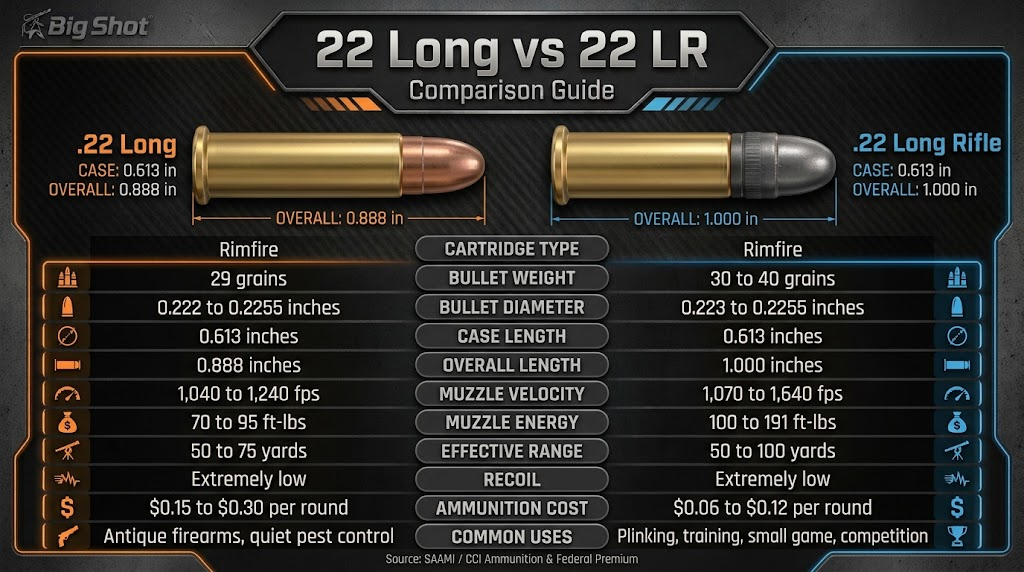
When comparing 22 Long vs 22 LR, the most defining difference is the projectile. The 22 Long was developed first, and it paired a .22 caliber case with a light 29-grain bullet originally borrowed from the older 22 Short.The 22 Long Rifle (22 LR) was later created by taking that exact same 22 Long brass case and seating a heavier, longer 40-grain bullet into it.
Because the 22 LR uses a heavier bullet, it generates much greater kinetic energy and maintains better stability over longer distances. The 22 LR quickly rendered the 22 Long obsolete for most practical applications. Today, the 22 LR is universally available and heavily supported by the firearms industry. The 22 Long is kept alive primarily by niche ammunition manufacturers to support antique rifles that were manufactured before the 22 LR became the global standard.
22 Long vs 22 LR Dimensions
Cartridge dimensions are virtually identical until you measure the overall length. The brass cases are exactly the same size, but the difference in bullet shape changes the final profile.
According to Sporting Arms and Ammunition Manufacturers’ Institute (SAAMI) specifications, the 22 LR measures:
- Bullet diameter: 0.223 to 0.2255 inches
- Case length: 0.613 inches
- Rim diameter: 0.278 inches
- Case diameter: 0.226 inches
- Overall cartridge length: 1.000 inches
The 22 Long shares the same case dimensions but differs in overall length:
- Bullet diameter: 0.222 to 0.2255 inches
- Case length: 0.613 inches
- Rim diameter: 0.278 inches
- Case diameter: 0.226 inches
- Overall cartridge length: 0.888 inches
The critical distinction is the overall length. The 22 LR utilizes a heavier, longer bullet that brings the total length to a full inch.The 22 Long utilizes a shorter bullet, resulting in a slightly shorter overall length.
22 Long vs 22 LR Velocity
Velocity controls both trajectory and kinetic energy. The 22 LR offers a much wider variety of velocities simply because it is manufactured in massive quantities with different powder charges.
To compare representative factory ammunition fired from standard test barrels:
- CCI 22 Long (29-grain high velocity): approximately 1,215 fps.
- Modern standard 22 Long offerings: average around 1,070 fps.
- CCI Standard Velocity 22 LR (40-grain lead round nose): 1,070 fps.
- Federal AutoMatch 22 LR (40-grain lead round nose): 1,200 fps.
- Winchester Xpert 22 LR (42-grain hollow point): 1,320 fps.
- CCI Stinger 22 LR (32-grain hyper-velocity): 1,640 fps.
While both cartridges can achieve similar speeds around 1,200 fps, the 22 LR achieves this velocity while pushing a significantly heavier bullet, making it a much more capable cartridge.
22 Long vs 22 LR Energy
Muzzle energy measures the striking force of the bullet. Energy is calculated using bullet weight and velocity. Because the 22 LR fires a heavier bullet, it generates much greater kinetic energy than the 22 Long.
Representative muzzle energy figures based on manufacturer specifications:
- Standard 22 Long (29-grain): approximately 70 to 95 ft-lbs.
- CCI Standard Velocity 22 LR (40-grain): 102 ft-lbs.
- Federal AutoMatch 22 LR (40-grain): 128 ft-lbs.
- Winchester Xpert 22 LR (42-grain): 163 ft-lbs.
The energy difference changes practical performance dramatically in the field. The 22 LR consistently produces 130 to 160 foot-pounds of energy in high-velocity loads, while the 22 Long maxes out well under 100 foot-pounds. This makes the 22 LR far more effective for anchoring small game cleanly.
22 Long vs 22 LR Range
When comparing 22 Long vs 22 LR range, the 22 LR is clearly superior. Maximum projectile travel for both cartridges easily exceeds one mile, meaning a safe backstop is always required regardless of which cartridge you are firing.
Effective range refers to the distance at which the bullet maintains accuracy and terminal performance. The 22 Long has a practical effective range of about 50 to 75 yards. Beyond that distance, the light 29-grain bullet sheds velocity rapidly and is easily pushed off target by the wind.
The 22 LR maintains useful velocity and energy much farther downrange. Because it uses a heavier, more aerodynamic bullet, the 22 LR can be used effectively for target shooting out to 100 yards and occasionally out to 200 yards by highly skilled precision shooters.
22 Long vs 22 LR Accuracy
Accuracy relies more on the firearm platform and ammunition consistency than on the cartridge name. However, the 22 LR is functionally much more accurate simply because modern manufacturers produce highly specialized match-grade ammunition for it.
In independent accuracy testing, a premium 22 LR rifle firing match-grade ammunition can routinely shoot 5-shot groups under 0.5 inches at 50 yards. The 22 LR dominates Olympic and precision rimfire competitions.
The 22 Long is no longer produced with match-grade accuracy in mind. Ammunition manufacturers produce 22 Long in very limited, basic batches intended for casual plinking or pest control. Because of the lack of premium ammunition options, the 22 Long cannot compete with the 22 LR in documented accuracy testing.
22 Long vs 22 LR Recoil
Both cartridges are famous for being incredibly gentle on the shoulder. There is virtually no practical recoil difference between them.
When fired from a standard 6-pound rifle, both the 22 Long and the 22 LR generate less than 0.2 foot-pounds of free recoil energy. This level of recoil is virtually imperceptible to the shooter, making both cartridges entirely comfortable for shooters of all ages and sizes.
22 Long vs 22 LR Ammunition Cost
Ammunition cost heavily favors the 22 LR. It is consistently the most affordable factory ammunition available anywhere in the world. The 22 Long is a niche, low-production cartridge, which drives its price up significantly.
As of September 2026, representative normal retail prices indicate:
- Federal AutoMatch 22 LR (40-grain, 325-round bulk box): $19.50 to $26.00 per box, equating to $0.06 to $0.08 per round.
- CCI Standard Velocity 22 LR (40-grain, 50-round box): $4.50 to $6.00 per box, equating to $0.09 to $0.12 per round.
- CCI 22 Long (29-grain, 100-round box): $15.00 to $30.00 per box, equating to $0.15 to $0.30 per round.
Practicing with 22 Long typically costs twice as much, if not more, than practicing with standard 22 LR ammunition. Furthermore, 22 Long is frequently out of stock at major retailers.
22 Long vs 22 LR For Hunting
The 22 LR is an outstanding small game hunting cartridge. Inside of 50 to 75 yards, a standard 40-grain solid bullet or a 36-grain hollow point will cleanly harvest squirrels, rabbits, and grouse without destroying excessive meat. It is highly flexible and extremely effective on small game.
The 22 Long is generally considered too weak for modern hunting applications. While its 29-grain bullet is lethal to small rodents and pests at very close ranges, it lacks the kinetic energy required to guarantee an ethical kill on larger small game at extended distances. Modern hunters universally choose the 22 LR over the 22 Long.
22 Long vs 22 LR For Target Shooting
For plinking, fundamentals training, and recreational target shooting, the 22 LR is the undisputed champion. The combination of practically zero recoil, low noise, and incredibly inexpensive ammunition makes it perfect for extended range sessions. Competitive target shooting disciplines are built entirely around the 22 LR.
The 22 Long is poorly suited for modern target shooting. The ammunition is expensive and difficult to find. More importantly, the light 29-grain bullet does not cycle reliably in most modern semi-automatic 22 LR firearms, leading to constant jams and malfunctions on the range.
22 Long vs 22 LR For Beginners
For brand new shooters, the 22 LR is the best possible introduction to firearms. The complete absence of recoil and the very mild report prevent inexperienced shooters from developing a flinch. A beginner can dedicate hours to mastering sight alignment and trigger control without physical fatigue or heavy financial costs.
The 22 Long offers the same low recoil and quiet report, but it is a poor choice for a beginner simply because of logistical issues. A beginner will struggle to find ammunition, will pay a premium for it, and will likely experience frustrating feeding issues if they attempt to use it in a modern semi-automatic rifle.
22 Long vs 22 LR Firearms
Firearms chambered specifically in 22 LR encompass almost every action type imaginable. Shooters can choose from bolt-action rifles, semi-automatic rifles, lever-action rifles, single-action revolvers, double-action revolvers, and semi-automatic pistols. The 22 LR enjoys massive support from every major firearm manufacturer.
Firearms chambered specifically for the 22 Long are almost entirely historical antiques. Before the 22 LR became the industry standard in the early 20th century, companies like Winchester and Remington built pump-action and single-shot rifles chambered specifically for the 22 Long. Today, virtually no major manufacturer produces a new firearm exclusively chambered for the 22 Long.
Can 22 Long And 22 LR Use The Same Gun?
In many cases, yes, a 22 LR firearm can safely fire 22 Long ammunition.Because both cartridges share the exact same case dimensions, a 22 Long will fit perfectly into a 22 LR chamber.
However, whether the gun will actually function is a different story. Single-shot rifles, bolt-action rifles, lever-action rifles, and revolvers chambered in 22 LR will generally fire and cycle 22 Long ammunition without issue.Many older manually operated rifles are specifically stamped to safely fire “.22 Short, Long, and Long Rifle”.
Conversely, modern semi-automatic rifles and pistols chambered in 22 LR will usually fail to cycle 22 Long ammunition. The 22 Long lacks the required recoil energy to push the heavy bolt backward, and the shorter overall length often causes feeding jams in box magazines designed for the longer 22 LR cartridge.
22 Long vs 22 LR Ammunition Compatibility
While you can often fire a 22 Long in a 22 LR firearm, the reverse is incredibly dangerous.
- You can generally fire .22 Long in a manually operated .22 LR firearm.
- You must never fire .22 LR in a firearm stamped exclusively for .22 Long.
If you own an antique rifle chambered specifically for the 22 Long, attempting to load and fire a 22 LR cartridge is extremely dangerous. The chamber of a dedicated 22 Long rifle is not cut deep enough to accommodate the longer bullet of the 22 LR. Forcing a 22 LR into that chamber will press the bullet into the rifling prematurely, which can cause a catastrophic pressure spike upon firing, potentially destroying the antique firearm and causing severe injury.
Pros And Cons
22 Long Pros And Cons
Pros:
- Extremely quiet report, making it useful for discreet pest control.
- Produces virtually zero recoil.
- Can be safely fired in most manually operated 22 LR firearms.Cons:
- Ammunition is expensive and very difficult to find.
- Lacks the kinetic energy for serious small game hunting.
- Will not cycle reliably in most modern semi-automatic firearms.
22 LR Pros And Cons
Pros:
- Lowest ammunition cost of any widely produced cartridge.
- Massive availability of firearms and ammunition worldwide.
- Extremely quiet operation and negligible recoil.
- Highly effective for target shooting and small game hunting.Cons:
- Lacks the energy required for larger varmints at long distances.
- Rimfire ignition is inherently slightly less reliable than centerfire ignition.
Manufacturer Data vs Independent Testing
When reviewing ballistics, readers must differentiate between promotional manufacturer specifications and independent chronograph testing. Because the 22 Long is largely obsolete, there is very little modern independent testing available for it. Manufacturers often test rimfire velocity using 24-inch laboratory test barrels, which yield higher speeds than a consumer will achieve using a standard 16 or 18-inch field rifle.
When comparing 22 Long vs 22 LR ballistics using modern independent data, the 22 LR consistently outperforms its older sibling in every metric. When reputable sources provide conflicting figures for antique rimfire cartridges, controlled independent testing through the exact barrel length of the consumer’s chosen firearm is always the most practical data source to determine actual velocity and energy.
FAQs
What is the main difference between 22 Long and 22 LR?
The main difference is the bullet. Both use the exact same brass case, but the 22 LR uses a heavier 40-grain bullet, while the 22 Long uses a lighter 29-grain bullet.
Is 22 LR more powerful than 22 Long?
Yes. Because the 22 LR fires a heavier bullet at similar or greater speeds, it generates significantly more kinetic energy than the 22 Long.
Is 22 LR faster than 22 Long?
Generally, yes. While standard standard-velocity loads for both hover around 1,070 feet per second, the 22 LR is available in high-velocity and hyper-velocity loads that easily exceed 1,400 feet per second.
Which has more range, 22 Long or 22 LR?
The 22 LR has a longer effective range. The heavier bullet of the 22 LR resists wind drift better and retains its energy further downrange than the light bullet of the 22 Long.
Which is more accurate, 22 Long or 22 LR?
The 22 LR is vastly more accurate because modern ammunition manufacturers produce highly specialized, precision match-grade ammunition specifically for the 22 LR.
Which has less recoil?
Both cartridges produce virtually zero recoil. The difference is completely imperceptible to the shooter.
Which is cheaper to shoot?
The 22 LR is significantly cheaper. It generally costs between 6 and 12 cents per round, while the rare 22 Long typically costs between 15 and 30 cents per round.
Is 22 LR better for hunting?
Yes. The 22 LR delivers more kinetic energy and better accuracy, making it vastly superior for ethically hunting small game like squirrels and rabbits.
Can a 22 LR shoot 22 Long?
Yes, if the firearm is manually operated (like a bolt-action or lever-action). However, 22 Long will usually fail to cycle in a 22 LR semi-automatic rifle or pistol.
Can a 22 Long shoot 22 LR?
No. Never fire a 22 LR cartridge in an antique firearm chambered exclusively for 22 Long. The 22 LR bullet is too long for the chamber and can cause a dangerous pressure spike.
Are 22 Long and 22 LR interchangeable?
No. While a manually operated 22 LR gun can safely fire a 22 Long cartridge, a dedicated 22 Long gun cannot safely fire a 22 LR cartridge.
Which is better for beginners?
The 22 LR is the best choice for beginners. The low noise, lack of recoil, massive availability, and highly affordable ammunition make it the perfect training cartridge.