The main difference between the cartridges is that the 9mm is a straight-walled handgun cartridge optimized for close-range self-defense and compact pistols, whereas the .300 Blackout is a bottlenecked intermediate rifle cartridge designed to fire .30-caliber projectiles from AR-15 platforms with significantly higher kinetic energy, superior barrier penetration, and highly effective suppressed performance.
9mm vs 300 Blackout Comparison
| Feature | 9mm (9x19mm Parabellum) | .300 AAC Blackout |
| Bullet Diameter | 0.355 in (9.02 mm) | 0.308 in (7.82 mm) |
| Typical Bullet Weight | 115 gr – 147 gr (typically 124 gr) | 110 gr – 220 gr (typically 110 gr or 220 gr) |
| Muzzle Velocity | 1,000 – 1,200 fps (4-inch barrel) | 1,000 – 2,350 fps (9 to 16-inch barrel) |
| Muzzle Energy | 320 – 400 ft-lbs | 465 – 1,350 ft-lbs |
| Momentum | ~20 lb-fps (124 gr at 1,150 fps) | ~37 lb-fps (110 gr) / ~33 lb-fps (220 gr) |
| Maximum Pressure | 35,000 psi (SAAMI) / 38,500 (+P) | 55,000 psi (SAAMI) |
| Ballistic Coefficient | Low (~0.140 to 0.160) | Moderate to High (~0.280 to 0.600+) |
| Penetration | 12 – 18 inches (Gelatin) | 16 – 20+ inches (Gelatin, depending on load) |
| Expansion | 0.50 – 0.70 inches | 0.50 – 0.60 inches (expanding loads) |
| Trajectory | Arcing, drops rapidly past 50 yards | Flat out to 200 yds (Supersonic) / Arcing (Subsonic) |
| Recoil | Low (~4 ft-lbs in pistols) | Low (~4–6 ft-lbs in standard AR-15 rifles) |
| Effective Range | 0 – 50 yards (Handgun) | 0 – 300 yds (Supersonic) / 0 – 150 yds (Subsonic) |
| Ammo Availability | Extremely High (Global standard) | High (Widespread modern sporting round) |
| Ammo Cost | Cheap ($0.25 – $0.40 per round) | Moderate ($0.75 – $1.50 per round) |
| Best Use | Concealed carry, home defense, duty sidearm | Suppressed AR-15s, CQB, medium game hunting |
The table above illustrates the foundational differences between a century-old pistol cartridge and a modern tactical rifle cartridge. While both are frequently utilized for personal protection and close-quarters engagements, their physical dimensions, operating pressures, and terminal ballistic profiles are fundamentally distinct.
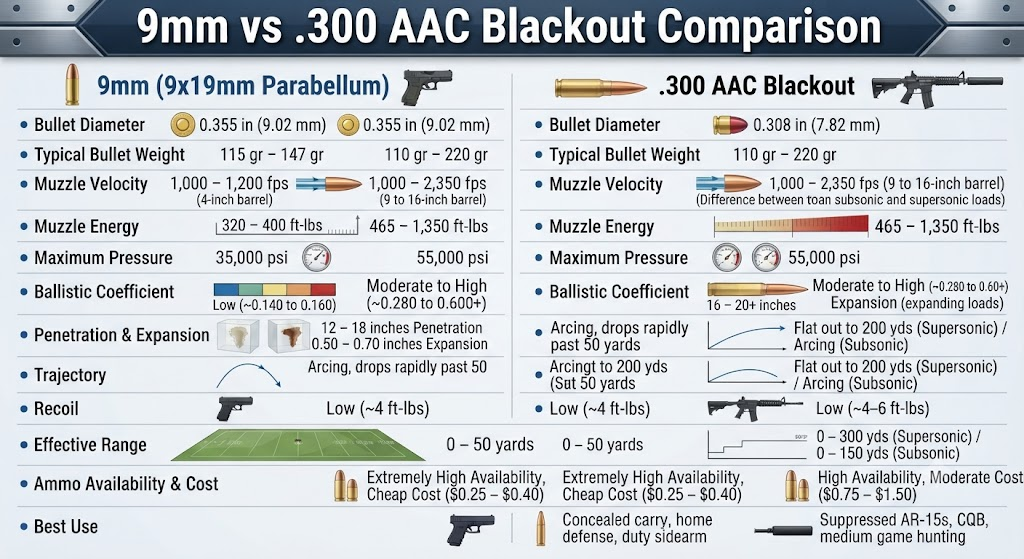
9mm vs 300 Blackout Ballistics
The ballistic profiles of the 9mm and the .300 Blackout are dictated by their intended military origins and internal case capacities. The 9x19mm Parabellum was designed by Georg Luger in 1902. As a straight-walled pistol cartridge operating at a SAAMI maximum pressure of 35,000 psi, it relies on fast-burning pistol powders to accelerate lightweight projectiles (115 to 147 grains) through short handgun barrels.
Conversely, the .300 AAC Blackout (Advanced Armament Corporation) was standardized by SAAMI in 2011 to fulfill a very specific United States Special Operations Command (SOCOM) requirement: to replicate the terminal ballistics of the 7.62x39mm Soviet cartridge within the standard M4/AR-15 platform, while retaining the standard 5.56mm bolt face and standard 30-round magazines. To achieve this, engineers widened the neck of a 5.56mm brass case to accept a .308-caliber projectile. Operating at 55,000 psi, the .300 Blackout utilizes a bottlenecked rifle case that excels in short barrels.
To objectively evaluate these calibers, we must examine real-world factory ammunition across their most common defensive and tactical applications. We cannot use one load to represent every possible load, especially given the .300 Blackout’s dual-nature (supersonic vs subsonic).
- Load A (9mm Standard Pressure): Federal Premium 124-grain HST Jacketed Hollow Point (JHP). Tested from a 4-inch handgun barrel: Muzzle Velocity = 1,150 fps, Muzzle Energy = 364 ft-lbs, Ballistic Coefficient (G1) = 0.150.
- Load B (9mm Heavy Subsonic): Federal Premium 147-grain HST JHP. Tested from a 4-inch handgun barrel: Muzzle Velocity = 1,000 fps, Muzzle Energy = 326 ft-lbs, Ballistic Coefficient (G1) = 0.205.
- Load C (300 BLK Supersonic): Barnes 110-grain VOR-TX TAC-TX (Solid Copper). Tested from a 16-inch AR-15 barrel: Muzzle Velocity = 2,350 fps, Muzzle Energy = 1,349 ft-lbs, Ballistic Coefficient (G1) = 0.289. (Note: Out of a shorter 9-inch barrel, this load achieves roughly 2,100 fps and 1,077 ft-lbs).
- Load D (300 BLK Subsonic): Hornady or standard 220-grain Open Tip Match (OTM) / Subsonic HP. Tested from a 9-inch to 16-inch barrel (velocity is strictly tailored to remain subsonic regardless of barrel length): Muzzle Velocity = 1,050 fps, Muzzle Energy = 539 ft-lbs, Ballistic Coefficient (G1) = ~0.600+.
Manufacturer-rated data is captured under controlled atmospheric conditions using standardized universal receiver barrels. Real-world velocities will vary slightly depending on your specific firearm’s chamber tolerances and barrel length.
9mm vs 300 Blackout Velocity
Velocity determines how flat a projectile shoots and how violently it disrupts soft tissue upon impact. Because the 9mm and .300 Blackout utilize different powder columns and barrel lengths, their velocity outputs are drastically different.
- 9mm Velocity: Being limited by a small case capacity, standard 9mm loads hover between the subsonic and low supersonic threshold. A 115-grain bullet typically achieves 1,150 to 1,200 fps. A 124-grain bullet sits comfortably around 1,100 to 1,150 fps. Heavy 147-grain defensive loads are purposefully engineered to be subsonic, traveling at approximately 990 to 1,000 fps to avoid the supersonic “crack,” making them slightly more pleasant to shoot suppressed.
- 300 Blackout Velocity: The .300 Blackout is uniquely bipolar. In its supersonic configuration (firing 110-grain to 125-grain bullets), it achieves true rifle velocities. From a 16-inch barrel, a 110-grain Barnes bullet reaches 2,350 fps. Even from a microscopic 9-inch barrel—the length the cartridge was explicitly designed around—it achieves roughly 2,100 fps. This speed crosses the critical 2,200 fps threshold required to induce secondary hydrostatic tissue tearing.
- 300 Blackout Subsonic Velocity: When loaded with massive 200-grain to 220-grain bullets, the .300 Blackout is intentionally loaded to travel at approximately 1,000 to 1,050 fps. This is identical to the velocity of a heavy 9mm round, but the rifle bullet weighs nearly twice as much, retaining velocity and energy far better downrange due to its superior aerodynamics.
9mm vs 300 Blackout Muzzle Energy
Muzzle energy is the mathematical expression of a projectile’s destructive potential, calculated using the formula: $Kinetic Energy = frac{1}{2} m v^2$. Because velocity is squared in this equation, the supersonic rifle cartridge possesses an insurmountable advantage.
- 9mm Energy:A standard Federal 124-grain HST generates 364 ft-lbs of energy at the muzzle.High-pressure (+P) variants can push this to roughly 396 ft-lbs, and specialized lightweight boutique rounds might touch 450 ft-lbs. However, the 9mm remains strictly a handgun cartridge. Its energy is sufficient to crush tissue directly in its path and penetrate vital organs, but it does not produce high-velocity shockwaves.
- 300 Blackout Supersonic Energy: The 110-grain Barnes TAC-TX load from a 16-inch barrel generates a devastating 1,349 ft-lbs of muzzle energy. This is nearly four times the kinetic energy of a standard 9mm pistol round, placing it firmly in the medium-game hunting category.
- 300 Blackout Subsonic Energy:When evaluating heavy subsonic loads (e.g., 220-grain at 1,050 fps), the kinetic energy drops to roughly 539 ft-lbs. While this is a massive reduction from its supersonic capabilities, it still generates approximately 48% more kinetic energy than a standard 124-grain 9mm round, solely by virtue of the massive .30-caliber bullet.
9mm vs 300 Blackout Momentum
Momentum ($p = m times v$) is a linear measurement that heavily influences how well a bullet pushes through resistance, defeats intermediate barriers like auto glass or heavy bone, and dictates the amount of heavy “push” felt in recoil.
- 9mm Momentum: A 124-grain bullet traveling at 1,150 fps produces approximately 20.3 lb-fps of momentum. A heavier 147-grain bullet at 1,000 fps generates roughly 21.0 lb-fps.
- 300 Blackout Momentum: A supersonic 110-grain bullet at 2,350 fps yields 36.9 lb-fps of momentum. A subsonic 220-grain bullet at 1,050 fps yields 33.0 lb-fps of momentum.
Despite the 220-grain subsonic rifle round traveling slower than the 124-grain 9mm, its massive weight ensures it carries substantially more momentum. This high momentum allows heavy subsonic .300 Blackout rounds to blast through heavy barriers, brush, and dense bone structure far more effectively than any 9mm handgun projectile.
9mm vs 300 Blackout Trajectory
Bullet drop calculations assume a standard scope height of 1.5 inches above the bore. Due to their distinct operational ranges, we assume a 25-yard zero for the 9mm and a 100-yard zero for the .300 Blackout.
| Distance | 9mm (124 gr at 1,150 fps) Drop | .300 BLK (110 gr Supersonic) Drop | .300 BLK (220 gr Subsonic) Drop |
| Muzzle | -1.5 inches | -1.5 inches | -1.5 inches |
| 25 Yards | 0.0 inches (Zero) | -0.5 inches | +1.8 inches |
| 50 Yards | -1.2 inches | +0.2 inches | +2.5 inches |
| 75 Yards | -3.8 inches | +0.4 inches | +1.2 inches |
| 100 Yards | -8.0 inches | 0.0 inches (Zero) | -2.4 inches |
| 150 Yards | -23.5 inches | -2.2 inches | -16.5 inches |
| 200 Yards | -48.2 inches | -7.3 inches | -41.2 inches |
The supersonic .300 Blackout shoots like a standard intermediate rifle cartridge, dropping only 7.3 inches at 200 yards, requiring minimal holdover. In contrast, the 9mm features a steep, looping trajectory typical of blunt handgun rounds.
Interestingly, the .300 Blackout subsonic round shares a similar arching trajectory with the 9mm. Because both the 9mm and the 220-grain subsonic .300 Blackout begin at roughly 1,000 fps, gravity affects them over time at the same rate. However, the .300 Blackout’s high Ballistic Coefficient (BC) allows it to slip through the wind with far less lateral drift than the blunt-nosed 9mm.
9mm vs 300 Blackout Recoil
Recoil is governed by the conservation of momentum, incorporating the powder charge weight, bullet mass, muzzle velocity, and the reciprocating mass of the host firearm.
- 9mm Recoil: Fired from a standard compact polymer handgun weighing 1.5 pounds (such as a Glock 19), the 9mm generates roughly 4.0 to 4.5 foot-pounds of free recoil energy. In a heavy 6-pound Pistol Caliber Carbine (PCC), this recoil energy drops to a virtually non-existent 1.5 foot-pounds.
- 300 Blackout Recoil: Fired from a standard 6.5-pound AR-15, a supersonic .300 Blackout generates roughly 4.5 to 6.0 foot-pounds of free recoil energy depending on the specific load and buffer system. Subsonic loads generate even less felt recoil.
Both cartridges are considered exceptionally mild-recoiling. The 9mm is widely regarded as the perfect equilibrium of stopping power and low recoil in a handgun, allowing shooters of all statures to land rapid follow-up shots. The .300 Blackout produces slightly more recoil than a 5.56mm AR-15 due to the heavier bullet mass, but the inline gas system and buffer spring of the AR platform absorb the impulse smoothly.
9mm vs 300 Blackout Penetration
Terminal penetration is evaluated using calibrated 10% ordnance gelatin, which simulates the density of human soft tissue.
- 9mm Penetration: Premium defensive 9mm loads, such as the Federal HST or Speer Gold Dot, are meticulously engineered to meet the FBI’s rigorous penetration standard of 12 to 18 inches. Independent testing confirms that the 124-grain HST reliably penetrates between 13.5 and 14.5 inches in bare gelatin and heavy clothing.
- 300 Blackout Penetration (Supersonic): High-velocity rifle rounds easily defeat barriers. The 110-grain Barnes TAC-TX monolithic copper bullet typically penetrates 18 to 22 inches in gelatin, smashing through heavy bone and automotive glass while retaining near 100% of its weight.
- 300 Blackout Penetration (Subsonic): Subsonic terminal ballistics are challenging. Standard 220-grain OTM (Open Tip Match) bullets do not possess the velocity required to expand. If fired into tissue, they will frequently act like an ice pick, over-penetrating deep past 24 to 30 inches without causing massive tissue disruption. To hunt or defend effectively with subsonic .300 Blackout, shooters must use specialty expanding rounds (like the Hornady Sub-X or Maker Rex) which force expansion at low velocities, regulating penetration back down to the 16 to 20-inch range.
9mm vs 300 Blackout Expansion
- 9mm Expansion: Driven by hydraulic pressure forcing fluid into the hollow point cavity, premium 9mm bullets expand impressively. The 124-grain Federal HST consistently expands to a final diameter of roughly 0.65 to 0.72 inches—nearly double its original 0.355-inch diameter.
- 300 Blackout Expansion: Supersonic .300 Blackout hunting bullets, like the Barnes TAC-TX, peel back into four sharp copper petals, expanding to roughly 0.50 to 0.60 inches.
While it may seem counterintuitive that a 9mm pistol bullet physically expands to a wider final diameter than a .30-caliber rifle bullet, diameter is only half the equation. The 9mm pushes through tissue, creating a permanent crush cavity exactly the size of its expanded diameter. The supersonic .300 Blackout bullet, traveling 1,200 fps faster, creates a massive temporary stretch cavity, displacing fluid violently outward and causing secondary tissue damage far beyond the physical diameter of the bullet itself.
9mm vs 300 Blackout Effective Range
- 9mm Effective Range: For defensive handgun use, the 9mm is practically limited to the shooter’s ability, which for most civilians and law enforcement is 0 to 25 yards. When fired from a shoulder-fired Pistol Caliber Carbine (PCC), the effective range extends to roughly 75 to 100 yards before severe bullet drop and energy loss render it ineffective on live targets.
- 300 Blackout Effective Range:The supersonic .300 Blackout is a highly effective combat and medium-game hunting cartridge out to 300 yards. Its bottlenecked case provides enough powder capacity to keep the high-BC bullets supersonic and lethal across football-field distances. The heavy subsonic loads are effectively limited to 100 to 150 yards due to their rapidly dropping trajectory and the minimum velocity required for bullet expansion.
9mm vs 300 Blackout Self Defense
When choosing a platform for home defense or close-quarters protection, the physical size of the weapon and its terminal ballistics must be weighed carefully.
- 9mm for Self Defense: The 9mm is the undisputed king of handgun self-defense. A standard full-size handgun (e.g., Glock 17, SIG P320) holds 17+1 rounds, can be operated with one hand if necessary, and is easily maneuvered through tight hallways, doorways, and vehicles. Inside a home, the 9mm offers adequate stopping power with highly manageable over-penetration risks when using premium hollow points.
- 300 Blackout for Self Defense: A short-barreled AR-15 (SBR) or AR pistol chambered in .300 Blackout is arguably the ultimate home defense weapon for those who can maneuver a longer platform. With a 9-inch barrel and a suppressor attached, it remains compact. When loaded with supersonic ammunition, it delivers overwhelming rifle-level stopping power. When loaded with heavy subsonic expanding ammunition, it becomes hearing-safe indoors, protecting the defender’s eardrums and preserving vital situational awareness while still delivering massive 220-grain projectiles to the threat.
The primary drawback of the .300 Blackout in home defense is the risk of extreme over-penetration through interior drywall if standard FMJ or non-expanding subsonic ammunition is used. Furthermore, an AR-15 requires two hands to operate effectively, making tasks like opening doors or securing family members more difficult than with a handgun.
9mm vs 300 Blackout Concealed Carry
- Concealing 9mm: The 9mm dominates the concealed carry market. Advancements in magazine geometry have resulted in micro-compact pistols like the SIG Sauer P365, Springfield Hellcat, and Glock 43X, which hold 10 to 15 rounds of 9mm in a package that can easily be hidden under a t-shirt in an inside-the-waistband (IWB) holster.
- Concealing 300 Blackout: The .300 Blackout is entirely impractical for on-body concealed carry. It is a rifle cartridge requiring an AR-15 style action, a buffer tube (or specialized internal recoil springs), and a relatively large magazine. While AR pistols chambered in .300 Blackout can be discreetly transported in backpacks or vehicle compartments (often called “truck guns” or “backpack guns”), they cannot be carried concealed on the person in the traditional sense.
Which Has More Stopping Power: 9mm or 300 Blackout?
“Stopping power” is an ambiguous, non-scientific term, but it generally refers to a cartridge’s ability to quickly incapacitate a biological threat. The .300 Blackout, specifically in its supersonic configuration, has vastly more stopping power than the 9mm.
A 9mm pistol bullet destroys tissue solely by crushing what it directly touches (the permanent wound cavity). It lacks the velocity to cause inelastic tissue to tear beyond the bullet’s physical path. The supersonic .300 Blackout, striking a target at over 2,000 fps, transfers massive kinetic energy into the surrounding fluid, creating a violent temporary stretch cavity. This high-velocity shockwave tears organs, shatters bone, and causes rapid catastrophic failure of the central nervous system or circulatory system, far exceeding the incapacitation mechanics of a straight-walled pistol round.
Which Is More Powerful: 9mm or 300 Blackout?
The .300 Blackout is quantitatively much more powerful than the 9mm.
At the muzzle, a supersonic .300 Blackout generates roughly 1,350 to 1,400 ft-lbs of kinetic energy. A standard 9mm generates roughly 350 to 400 ft-lbs of kinetic energy. Even the heavy, slow 220-grain subsonic .300 Blackout loads (roughly 500 to 550 ft-lbs) overpower the 9mm through sheer bullet mass and linear momentum.
9mm Pros and Cons
Pros
- Exceptional portability; fits effortlessly into micro-compact concealed carry pistols
- Incredibly cheap and globally ubiquitous ammunition, allowing for high-volume, low-cost training
- Low recoil impulse permits very rapid, highly accurate follow-up shots
- Proven track record in law enforcement and civilian self-defense scenarios
Cons
- Pistol-level terminal ballistics; lacks the high-velocity hydrostatic shock of a rifle
- Steep trajectory limits practical effectiveness beyond 50 yards
- Struggles to consistently defeat intermediate barriers like heavy auto glass or Level IIIA soft body armor
300 Blackout Pros and Cons
Pros
- Devastating supersonic kinetic energy out of ultra-short 9-inch barrels
- Incredible versatility; transitions from a 300-yard supersonic combat rifle to a whisper-quiet subsonic platform simply by changing the magazine
- Utilizes standard 5.56mm AR-15 bolts, magazines, and lower receivers; only a barrel change is required to convert a standard AR-15
- Heavy bullet mass easily punches through intermediate barriers and bone
Cons
- Ammunition is significantly more expensive than 9mm or 5.56mm NATO
- Subsonic terminal ballistics rely heavily on expensive, specialty expanding bullets to prevent ice-pick over-penetration
- Requires a rifle or large-format pistol platform, making on-body concealed carry impossible
- Risk of catastrophic rifle destruction if a .300 Blackout round is accidentally loaded and fired in a 5.56mm chamber
Final Comparison
| Category | Winner | Reason |
| Velocity | .300 BLK | Supersonic bottlenecked case drives bullets past 2,300 fps |
| Muzzle Energy | .300 BLK | Produces nearly 4x the kinetic energy of a 9mm pistol |
| Momentum | .300 BLK | 110-grain and 220-grain bullets carry immense mass-in-motion |
| Penetration | .300 BLK | Supersonic velocity guarantees barrier and bone destruction |
| Expansion | Tie | 9mm expands wider; 300 BLK creates massive stretch cavities |
| Trajectory | .300 BLK | Spitzer rifle bullets fly much flatter out to 200–300 yards |
| Recoil | 9mm | Extremely low pistol recoil, easily managed one-handed |
| Effective Range | .300 BLK | Effective out to 300 yards; 9mm drops sharply past 50 yards |
| Self Defense | Depends on Space | 9mm for maneuverable indoors; 300 BLK SBR for pure power |
| Concealed Carry | 9mm | Fits in pockets and micro-compact IWB holsters effortlessly |
| Ammo Cost | 9mm | Global production makes it one of the cheapest centerfire rounds |
| Ammo Availability | 9mm | Found on the shelf of every sporting goods store worldwide |
| Suppression | .300 BLK | Heavy 220-grain subs in an AR platform are legendarily quiet |
| Overall Power | .300 BLK | A true intermediate rifle cartridge vastly outclasses a handgun |
9mm vs 300 Blackout: Which Should You Choose?
Comparing the 9mm to the .300 Blackout is comparing a scalpel to a broadsword; they are designed for entirely different mission profiles.
- Choose the 9mm if your primary concern is daily on-body concealed carry, you want a lightweight handgun for home defense that can be operated with one hand, or you wish to engage in high-volume, low-cost training at the range.
- Choose the .300 Blackout if you are building an AR-15 platform for home defense, need a compact short-barreled rifle capable of taking medium game like deer or feral hogs out to 200 yards, or want the ultimate suppressed tactical platform capable of running ultra-quiet subsonic loads.
For many prepared citizens, the correct answer is both: a 9mm on the belt for the grocery store, and a suppressed .300 Blackout AR-15 by the bed for the defense of the home.
FAQs
Is 300 Blackout more powerful than 9mm?
Yes, dramatically so. The .300 Blackout is an intermediate rifle cartridge that generates roughly 1,350 to 1,400 ft-lbs of muzzle energy in its supersonic form, compared to the 350 to 400 ft-lbs generated by a standard 9mm pistol cartridge.
Which has more muzzle energy?
The .300 Blackout has significantly more muzzle energy. Even its slow, heavy subsonic loads (producing ~500+ ft-lbs) carry more kinetic energy at the muzzle than most standard-pressure 9mm rounds.
Which has more stopping power?
The supersonic .300 Blackout has vastly more stopping power. Its rifle-level velocities induce massive temporary stretch cavities in soft tissue, leading to more rapid biological incapacitation than a 9mm can achieve.
Which has more recoil?
Technically, a .300 Blackout generates more free recoil energy due to heavier powder charges and bullet weights. However, because the .300 Blackout is fired from a 6.5-pound AR-15 and the 9mm is fired from a 1.5-pound pistol, the perceived felt recoil of both is considered very mild and manageable.
Which has better penetration?
The supersonic .300 Blackout easily out-penetrates the 9mm, capable of punching through automotive steel, thick glass, and heavy bone while retaining its lethality.
Which expands more?
A premium 9mm hollow point (like the Federal HST) physically expands to a wider final diameter (often 0.65 to 0.70 inches) than a .300 Blackout copper solid (which expands to about 0.55 inches). However, the .300 Blackout causes far more tissue damage due to extreme velocity and hydrostatic shock.
Which has a flatter trajectory?
The supersonic .300 Blackout has a much flatter trajectory, requiring minimal holdovers out to 200 yards. The 9mm is a blunt pistol round that drops rapidly past 50 yards. Subsonic .300 Blackout and heavy 9mm share similar arching trajectories.
Which is better for self defense?
Both are exceptional, but they serve different roles. The 9mm is the ultimate concealable personal defense weapon. A suppressed .300 Blackout short-barreled rifle is arguably the ultimate stationary home-defense weapon due to its stopping power and hearing-safe subsonic capabilities.
Which is better for concealed carry?
The 9mm is the undisputed choice for concealed carry. It fits into micro-compact pistols that can be hidden comfortably all day. The .300 Blackout requires a rifle or large AR pistol platform, making it impossible to carry on the body discreetly.
Is 300 Blackout faster than 9mm?
Yes, in its supersonic loading, the .300 Blackout (averaging 2,200 to 2,400 fps) travels nearly twice as fast as a standard 9mm (1,150 fps). In its subsonic loading, it travels at roughly the same speed as a 9mm.
Is .300 Blackout stronger than 9mm?
Yes, the .300 Blackout utilizes a bottlenecked rifle case that operates at 55,000 psi chamber pressure, compared to the 9mm’s 35,000 psi limit. This allows it to push heavier bullets much faster.
Which is cheaper to shoot?
The 9mm is vastly cheaper to shoot. Global mass production keeps 9mm ammunition prices extremely low, whereas .300 Blackout requires more brass and copper, resulting in significantly higher costs per round.
Which has better ballistics?
The .300 Blackout possesses far superior external and terminal ballistics due to its rifle-centric design, higher ballistic coefficients, and massive kinetic energy advantage over the pistol cartridge.
Which is easier to shoot?
Both are considered easy to shoot in their respective platforms. A full-size 9mm pistol has very little recoil, making it ideal for beginners. A .300 Blackout AR-15 is also highly ergonomic and features mild recoil compared to larger hunting rifles.
Which should you choose?
Choose the 9mm for everyday concealed carry, cost-effective training, and general handgun duty. Choose the .300 Blackout for building a highly capable, suppressed short-barreled rifle for home defense or medium game hunting.