The main difference between the 10mm Auto and the .40 S&W is that the 10mm delivers significantly higher velocities and massive kinetic energy suitable for handgun hunting and defense against large predators, while the .40 S&W provides a manageable recoil impulse and fits into smaller handguns designed for everyday personal defense. Originally developed as a powerhouse combat cartridge, the 10mm proved too difficult for many shooters to quickly control during rapid fire. By shortening the 10mm case and reducing the powder charge, the .40 S&W was created to deliver similar heavy bullet performance with a much softer recoil profile. Today, the .40 S&W remains a highly reliable choice for concealed carry, while the 10mm has seen a massive resurgence among outdoor enthusiasts needing maximum stopping power in the backcountry. Understanding their ballistic realities will ensure you choose the right tool for your specific environment.
10mm vs 40 S&W Ballistics Chart
| Specification / Metric | 10mm Auto (180 gr JHP) | .40 S&W (180 gr JHP) |
| Cartridge | 10mm Automatic | .40 Smith & Wesson |
| Parent Case | Original Design | 10mm Auto |
| Bullet Diameter | .400 inches | .400 inches |
| Typical Bullet Weight | 155 to 220 grains | 135 to 180 grains |
| Muzzle Velocity | 1,250 fps | 1,000 fps |
| Velocity at 50 Yards | 1,110 fps | 920 fps |
| Velocity at 100 Yards | 1,015 fps | 860 fps |
| Muzzle Energy | 624 ft-lbs | 400 ft-lbs |
| Energy at 50 Yards | 492 ft-lbs | 338 ft-lbs |
| Energy at 100 Yards | 412 ft-lbs | 295 ft-lbs |
| Bullet Drop (100 Yds, 50 Yd Zero) | -3.5 inches | -5.5 inches |
| Sectional Density | 0.161 | 0.161 |
| Effective Hunting Range | 75 to 100 yards | 25 to 50 yards |
| Maximum Effective Range | 100+ yards | 50 yards |
| Recoil (Free Recoil Energy) | ~11.0 ft-lbs | ~7.0 ft-lbs |
| Trajectory | Flat for a handgun | Arcs moderately past 50 yds |
| Hunting Performance | Deer, hogs, black bear | Small game, close range pests |
| Defensive Performance | Exceptional barrier penetration | Excellent on human threats |
| Ammunition Availability | High | Exceptionally high |
| Ammunition Cost | High | Moderate |
| Handgun Availability | Common in full size frames | Universal in all sizes |
| Magazine Capacity | 15 rounds (full size) | 15 rounds (compact size) |
| Best Use Cases | Bear defense, handgun hunting | Concealed carry, home defense |
| Main Advantages | Magnum power, deep penetration | Low recoil, cheaper ammunition |
| Main Disadvantages | Heavy recoil, large grip size | Less energy for large animals |
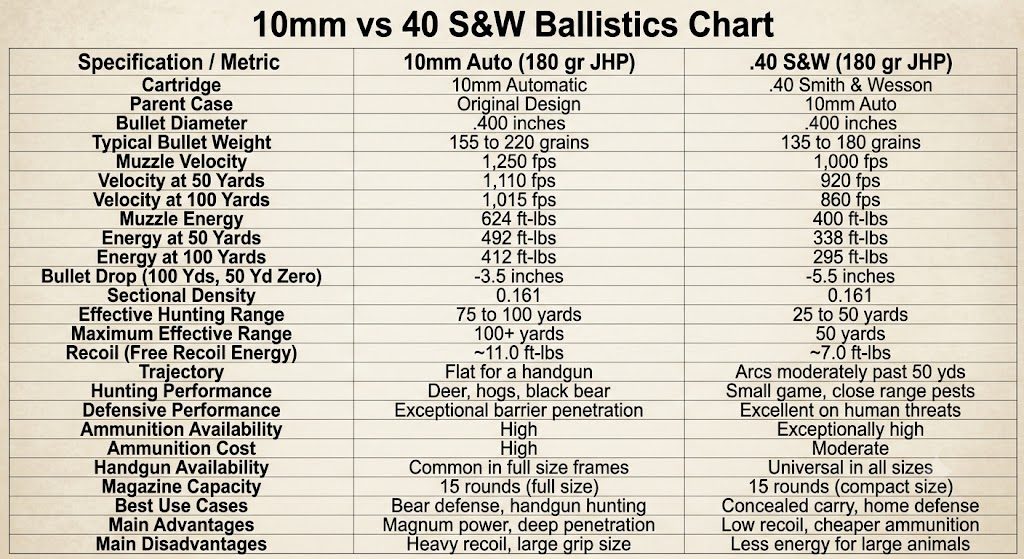
The comparison table above clearly illustrates what happens when you reduce the powder capacity of a cartridge to make it more manageable. Because the .40 S&W is essentially a shortened 10mm, both cartridges fire the exact same .400 caliber bullets. However, the larger case of the 10mm holds significantly more gunpowder. This gives the 10mm a massive velocity advantage right out of the barrel, pushing a heavy 180 grain bullet 250 feet per second faster than the .40 S&W.
This intense speed directly translates into kinetic energy. At the muzzle, the 10mm generates over 200 more foot pounds of energy than the .40 S&W. Even at 100 yards, the 10mm retains more kinetic energy than the .40 S&W produces at 50 yards. This incredible power makes the 10mm highly capable of penetrating the thick bone and muscle of large predators, a task where the .40 S&W often falls short.
However, power comes at a cost. The 10mm produces substantially more felt recoil, making it much harder to shoot quickly and accurately in a stressful self defense situation. Furthermore, the longer 10mm cartridge requires a larger handgun frame, which can be difficult for shooters with small hands to grip properly. The .40 S&W sacrifices that magnum level power to provide a highly controllable, easily concealable package for everyday defensive carry.
Detailed Comparison Sections
Understanding the Comparison Chart
To fully grasp the dynamics between the 10mm Auto and the .40 S&W, you must look at their shared history. The 10mm was designed first to be the ultimate combat handgun cartridge. When law enforcement agencies realized the recoil was too severe for rapid qualification times, they asked ammunition manufacturers to reduce the powder charge. Gunmakers then realized they could shorten the brass casing of these reduced loads and fit the cartridge into smaller 9mm sized handguns. That shortened cartridge became the .40 S&W.
How to Read the Ballistics Chart
When reading handgun ballistics charts, the most critical numbers are muzzle energy and recoil. Unlike rifle bullets that rely on extreme velocity to cause hydrostatic shock, handgun bullets rely on mass and penetration to stop a threat. High energy ensures deep penetration, while the recoil metric tells you how difficult the handgun will be to control during rapid follow up shots.
Velocity Comparison
The 10mm is a high velocity pistol cartridge. When loaded to its full potential, it easily pushes a 180 grain bullet to 1,250 fps. A standard 180 grain .40 S&W round typically tops out around 1,000 fps. This 250 fps difference gives the 10mm a flatter trajectory and ensures reliable bullet expansion even after passing through heavy clothing or thick animal hides.
Energy Comparison
Energy is where the 10mm truly separates itself. At the muzzle, a full power 10mm load generates a staggering 624 foot pounds of kinetic energy, placing it in the same class as the legendary .357 Magnum. The .40 S&W produces a very respectable 400 foot pounds of energy, which is practically identical to a modern 9mm +P load. For human threats, 400 foot pounds is devastating. For a charging grizzly bear, you absolutely need the 600 plus foot pounds provided by the 10mm.
Trajectory Comparison
While trajectory is less critical for handguns than it is for rifles, it matters greatly for handgun hunters who may take shots at 50 or 75 yards.
Bullet Drop Comparison
If you zero both handguns at 50 yards, the 10mm offers a noticeably flatter flight path. At 100 yards, the faster 10mm bullet drops about 3.5 inches. The slower .40 S&W bullet drops roughly 5.5 inches. This flatter trajectory gives the 10mm shooter a better margin of error when taking longer shots in the woods.
Accuracy Comparison
Both cartridges are mechanically accurate. In a fixed test barrel, both will shoot tight groups. However, practical accuracy in the hands of a human shooter heavily favors the .40 S&W. Because the 10mm produces violent recoil and muzzle flip, shooters often develop a flinch in anticipation of the blast. The softer shooting .40 S&W is much easier to shoot accurately under pressure.
Effective Range Comparison
For personal defense against human threats, both cartridges are highly effective at standard engagement distances inside 25 yards. For hunting and wildlife defense, the 10mm easily doubles the effective range of the .40 S&W. A skilled marksman can cleanly harvest a deer with a 10mm at 75 to 100 yards, whereas the .40 S&W loses too much energy past 50 yards for ethical hunting.
Hunting Performance Comparison
The .40 S&W is not a hunting cartridge. While it can dispatch a coyote or feral dog at close range, it lacks the deep penetration required for medium to large game. The 10mm is a phenomenal hunting cartridge. When loaded with heavy 200 grain or 220 grain hard cast lead bullets, it crushes through heavy bone and thick muscle, making it a favorite for hunting feral hogs and whitetail deer.
Defensive Target Performance
For concealed carry and home defense, the .40 S&W is arguably the better choice for the average civilian. It offers excellent expansion and penetration on human sized targets without the extreme risk of over penetration that comes with the 10mm. The blast and flash of a full power 10mm fired indoors without hearing protection can be highly disorienting.
Recoil Comparison
Recoil management is the primary reason the .40 S&W exists. A standard .40 S&W generates about 7.0 foot pounds of free recoil energy in a full size handgun. The 10mm generates roughly 11.0 foot pounds of recoil in a similarly sized gun. This heavy recoil requires excellent grip strength and solid fundamentals to manage. Rapid fire strings with a 10mm are significantly slower than with a .40 S&W.
Ammunition Cost Comparison
Because it uses less brass and powder, the .40 S&W is much cheaper to manufacture. You can easily find budget friendly full metal jacket practice ammunition for the .40 S&W. The 10mm is considered a premium cartridge. Practice ammunition is noticeably more expensive, and high performance hunting loads can be very costly per round.
Ammunition Availability
The .40 S&W dominated the law enforcement market for over two decades. Because of this, ammunition is universally available at almost any gun shop or sporting goods store. While 10mm has grown massively in popularity, you may still struggle to find specific high performance hunting loads on local store shelves and will likely need to order them online.
Handgun Compatibility
Because the .40 S&W is the same overall length as a 9mm, it fits perfectly into compact and subcompact handgun frames designed for concealed carry. The 10mm is a longer cartridge that requires a large frame handgun similar in size to a .45 ACP. If you have small hands, a 10mm grip may feel uncomfortably large, whereas a .40 S&W grip will feel perfectly natural.
Pros and Cons of 10mm
Pros:
- Massive kinetic energy and stopping power.
- Flat trajectory for long range handgun hunting.
- Excellent barrier penetration.
- Highly effective against large, dangerous animals.
Cons:
- Heavy, snappy recoil.
- Requires a large handgun frame.
- Ammunition is expensive.
Pros and Cons of .40 S&W
Pros:
- Fits in compact, concealable handgun frames.
- Very manageable recoil.
- Cheap and abundant ammunition.
- Excellent terminal ballistics for personal defense.
Cons:
- Lacks the penetration for large animal defense.
- Snappier recoil than a standard 9mm.
Which Cartridge Is Better for Beginners?
Neither cartridge is ideal for an absolute beginner, but the .40 S&W is significantly better than the 10mm. The sheer concussive blast and violent recoil of a 10mm will almost certainly cause a new shooter to develop bad habits. The .40 S&W is much more forgiving and allows the shooter to practice affordably.
Which Cartridge Is Better for Hunting?
The 10mm is the undisputed winner for hunting and backcountry defense. It provides the necessary velocity and heavy bullet options required to achieve deep penetration on tough animals. The .40 S&W should not be relied upon for hunting or stopping a grizzly bear.
Which Cartridge Is Better for Concealed Carry?
The .40 S&W is vastly superior for concealed carry. The handguns are smaller, lighter, and easier to hide under everyday clothing. Additionally, the reduced recoil allows for faster, more accurate follow up shots, which is critical in a life or death defensive scenario.
Which Cartridge Should You Choose?
Choose the .40 S&W if you want a reliable, hard hitting personal defense caliber that is easy to conceal and affordable to shoot at the range. Choose the 10mm if you spend your weekends hiking, fishing, or hunting in bear country and need maximum portable firepower on your hip.
Verdict
The 10mm Auto and the .40 S&W are two sides of the exact same coin. They both fire excellent .40 caliber projectiles, but they operate in completely different weight classes. The .40 S&W is an optimized personal defense tool. It balances power, recoil, and capacity in a package small enough to carry every day comfortably. It does exactly what it was designed to do. The 10mm is a specialized powerhouse. It sacrifices concealability and recoil management to deliver absolute maximum kinetic energy. If you are preparing for human threats in an urban environment, the .40 S&W is the practical choice. If you are preparing for four legged predators in the deep woods, the 10mm stands alone as the ultimate semi automatic survival cartridge.
FAQs
Can you shoot .40 S&W in a 10mm handgun?
Yes, but with a major caution. Because the .40 S&W shares the same bullet diameter and case rim dimensions, it will physically fit and fire in many 10mm handguns. However, the shorter case relies entirely on the extractor claw to hold it against the firing pin. Doing this frequently can damage your extractor and cause reliability issues. It is generally not recommended by manufacturers.
Why did the FBI switch from 10mm to .40 S&W?
Following the infamous 1986 Miami shootout, the FBI adopted the 10mm to ensure superior stopping power. However, they quickly discovered that the heavy recoil made it too difficult for many agents to qualify on the shooting range. They requested a reduced power load, which eventually led to the development of the shorter, softer shooting .40 S&W.
Is the 10mm too powerful for home defense?
For most urban and suburban environments, yes. A full power 10mm loaded with heavy bullets carries a severe risk of over penetration, meaning the bullet can easily pass through the threat and travel through multiple drywall walls, endangering family members or neighbors.
Is the .40 S&W a dead caliber?
No. While many law enforcement agencies have transitioned back to 9mm due to advancements in bullet technology, millions of civilians and private security professionals still carry the .40 S&W. Ammunition remains incredibly abundant and affordable.
Does a 10mm kick harder than a .45 ACP?
Yes. A full power 10mm produces a much sharper, snappier recoil impulse than a standard .45 ACP. The .45 ACP is known for a slow, heavy push, whereas the high velocity 10mm creates a fast, violent snap at the muzzle.