The main difference in the 6mm GT Vs 6mm ARC comparison is that the 6mm ARC is engineered to maximize extreme long-range precision within the strict constraints of an AR-15, whereas the 6mm GT is a purpose-built competition cartridge designed for flawless feeding and supreme accuracy in bolt-action rifles. While the ARC brings heavy 6mm ballistics to lightweight semi-automatics, the GT offers higher velocities, greater kinetic energy, and legendary barrel life for dedicated Precision Rifle Series shooters.
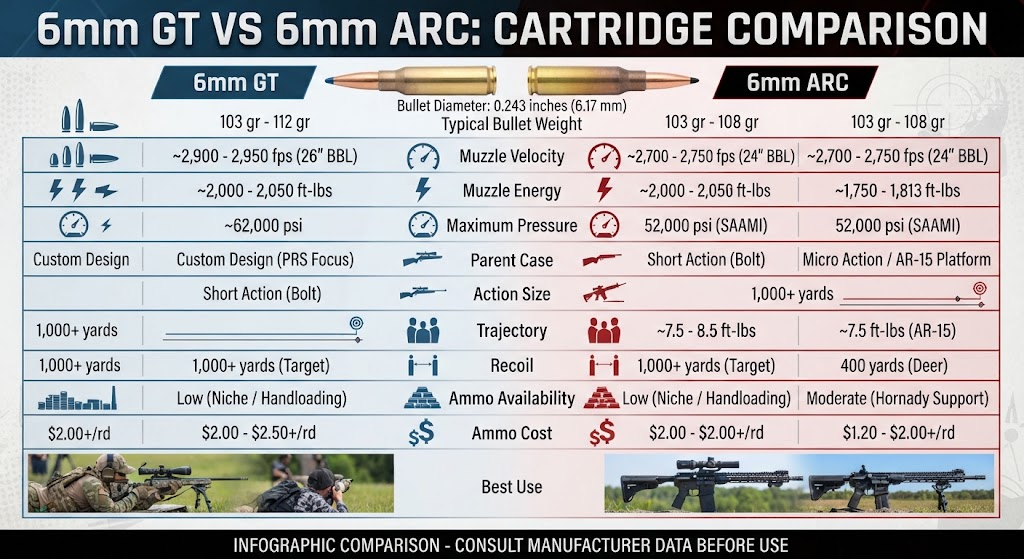
6mm GT Vs 6mm ARC Comparison
| Feature | 6mm GT | 6mm ARC (Advanced Rifle Cartridge) |
| Bullet Diameter | 0.243 inches (6.17 mm) | 0.243 inches (6.17 mm) |
| Typical Bullet Weight | 103 gr to 112 gr (typically 105 or 109 gr) | 103 gr to 108 gr (typically 108 gr) |
| Muzzle Velocity | ~2,900 to 2,950 fps (26-inch barrel) | ~2,700 to 2,750 fps (24-inch barrel) |
| Muzzle Energy | ~2,000 to 2,050 ft-lbs | ~1,750 to 1,813 ft-lbs |
| Momentum | ~44 to ~46 lb-fps | ~41 to ~42 lb-fps |
| Maximum Pressure | ~62,000 psi | 52,000 psi (SAAMI limitation for AR-15) |
| Parent Case | Custom design (PRS focus) | 6.5 Grendel (Modified) |
| Action Size Required | Short Action (Bolt) | Micro Action / AR-15 Platform |
| Trajectory | Flat out to 1,000+ yards | Very flat, excellent wind resistance |
| Recoil | Extremely Low (~7.5 to 8.5 ft-lbs) | Very Low (~7.5 ft-lbs in an AR-15) |
| Effective Range | 1,000+ yards (Target) | 1,000+ yards (Target) / 400 yards (Deer) |
| Ammo Availability | Low (Niche competition / Handloading) | Moderate (Strong commercial Hornady support) |
| Ammo Cost | Expensive ($2.00 to $2.50+/rd) | Moderate to Expensive ($1.20 to $2.00/rd) |
| Best Use | Precision Rifle Series (PRS) matches | Extreme long-range AR-15 shooting, varmints |
The table above illustrates two different paths to achieving 6mm perfection. The 6mm ARC (Advanced Rifle Cartridge) was developed by Hornady and the Department of Defense to give the AR-15 platform true 1,000-yard capability without upgrading to the heavy AR-10 chassis. To keep the AR-15 bolt safe, its maximum pressure is strictly capped at 52,000 psi.
The 6mm GT was designed by George Gardner and Tom Jacobs as the ultimate bolt-action competition cartridge. Because it is fired from robust short-action bolt rifles, it operates at a much higher pressure (~62,000 psi). It features a 35-degree shoulder and optimal case length to ensure it feeds flawlessly out of AICS magazines—solving the notorious nose-diving issues that plague shorter cartridges like the 6mm Dasher or 6mm BR.
6mm GT Vs 6mm ARC Ballistics
To objectively evaluate the ballistic capabilities, we must examine premium match-grade ammunition fired from the standard barrel lengths associated with their respective platforms.
- Load A (6mm GT Heavy Match): Hornady 109-grain ELD Match. Tested from a 26-inch barrel. Muzzle velocity is 2,900 feet per second. Muzzle energy is 2,035 foot-pounds. Ballistic Coefficient (G1) is 0.542.
- Load B (6mm GT Standard Match): Berger 105-grain Hybrid Target. Tested from a 26-inch barrel. Muzzle velocity is 2,950 feet per second. Muzzle energy is 2,029 foot-pounds. Ballistic Coefficient (G1) is 0.536.
- Load C (6mm ARC Heavy Match): Hornady 108-grain ELD Match. Tested from a 24-inch barrel. Muzzle velocity is 2,750 feet per second. Muzzle energy is 1,813 foot-pounds. Ballistic Coefficient (G1) is 0.536.
- Load D (6mm ARC Precision Hunter): Hornady 103-grain ELD-X. Tested from a 24-inch barrel. Muzzle velocity is 2,800 feet per second. Muzzle energy is 1,793 foot-pounds. Ballistic Coefficient (G1) is 0.512.
6mm GT Vs 6mm ARC Velocity
Because the 6mm GT operates at a significantly higher pressure ceiling and holds slightly more powder, it holds a definitive velocity advantage.
When firing nearly identical high-BC match bullets (108 to 109 grains), the 6mm GT consistently leaves the muzzle 150 to 200 feet per second faster than the 6mm ARC. This 2,900 fps node is widely considered the “sweet spot” by competitive shooters, offering a laser-flat trajectory while still being gentle on the barrel throat. The 6mm ARC’s 2,750 fps velocity is highly impressive for an AR-15, but it cannot match the sheer speed of a dedicated bolt-action cartridge.
6mm GT Vs 6mm ARC Muzzle Energy
Muzzle energy represents the raw kinetic work capacity of a projectile.
The 6mm ARC generates roughly 1,750 to 1,800 foot-pounds of energy at the muzzle. This delivers excellent terminal performance on deer and antelope at moderate ranges and easily knocks down steel plates out to 800 yards.
The 6mm GT generates over 2,000 foot-pounds of energy at the muzzle. This extra 200 foot-pounds of kinetic energy provides more authoritative target impacts at 1,000 yards, making it easier for match spotters to hear and see hits on heavy steel silhouettes.
6mm GT Vs 6mm ARC Momentum
Momentum calculates mass in motion, dictating a bullet’s ability to drive straight through tissue or fight through the atmosphere.
Because both cartridges fire 6mm projectiles of nearly identical weight, the momentum advantage belongs entirely to the faster 6mm GT. A 109-grain 6mm GT bullet traveling at 2,900 fps yields approximately 45.2 pound-feet per second of linear momentum, whereas the 108-grain 6mm ARC traveling at 2,750 fps yields approximately 42.4 pound-feet per second.
6mm GT Vs 6mm ARC Trajectory
Understanding external ballistics highlights the trade-offs between a gas-gun cartridge and a bolt-gun cartridge. The calculations below assume a high-profile target optic height of 1.5 inches above the bore and a 200-yard zero using matched aerodynamics.
| Distance | 6mm GT (109 gr at 2,900 fps) Drop | 6mm ARC (108 gr at 2,750 fps) Drop |
| Muzzle | -1.5 inches | -1.5 inches |
| 200 Yards | 0.0 inches (Zero) | 0.0 inches (Zero) |
| 400 Yards | -19.5 inches | -22.5 inches |
| 600 Yards | -62.5 inches | -70.9 inches |
| 800 Yards | -135.2 inches | -154.5 inches |
| 1000 Yards | -245.5 inches | -283.5 inches |
Both cartridges feature exceptional wind-bucking capabilities due to their high-BC bullets. However, because the 6mm GT leaves the barrel faster, it drops significantly less at extreme ranges. At 1,000 yards, the 6mm GT requires nearly 40 inches less elevation adjustment than the 6mm ARC.
6mm GT Vs 6mm ARC Recoil
Both cartridges are famous for their incredibly soft recoil impulses, allowing shooters to easily spot their own bullet trace through the scope.
Fired from a heavy 15-pound PRS bolt-action rifle, the 6mm GT generates practically non-existent recoil (roughly 7.0 foot-pounds), providing a gentle push rather than a sharp kick.
Fired from an 8-pound AR-15, the 6mm ARC generates roughly 7.5 foot-pounds of recoil. While equally mild in absolute terms, the reciprocating mass of the AR-15’s bolt carrier group introduces a slight mechanical “clunk” that bolt-action shooters do not have to manage.
6mm GT Vs 6mm ARC Penetration & Expansion
For medium-game hunting (deer, antelope, feral hogs), the higher velocity of the 6mm GT ensures that hunting bullets expand violently and reliably at slightly extended distances. However, the 6mm ARC is an exceptionally popular hunting cartridge because it allows hunters to carry a highly capable, lightweight AR-15 into the woods. Both will completely pass through a whitetail deer broadside inside 300 yards.
Which Has More Stopping Power: 6mm GT Vs 6mm ARC?
The 6mm GT possesses slightly more stopping power. It hits targets with roughly 200 more foot-pounds of kinetic energy and higher velocity, resulting in superior hydrostatic shock upon impact.
Which Is More Powerful: 6mm GT Vs 6mm ARC?
Based on raw kinetic energy and muzzle velocity, the 6mm GT is the more powerful cartridge.
6mm GT Pros And Cons
Pros
- Purpose-built for flawless feeding from standard AICS double-stack magazines
- Extremely efficient powder burn extends match-grade barrel life to 2,000+ rounds
- Hits the 2,900 fps “sweet spot” for 1,000-yard PRS competition
- Incredibly mild recoil allows for perfect follow-through on targets
Cons
- Primarily a niche competition cartridge; factory ammunition is expensive and scarce
- Strictly designed for short-action bolt rifles, not semi-automatics
6mm ARC Pros And Cons
Pros
- Brings true 1,000-yard precision capability to the standard AR-15 platform
- Requires only a barrel, magazine, and 6.5 Grendel bolt face to convert an existing AR
- Massive commercial backing from Hornady ensures wide ammunition availability
- Outstanding dual-purpose cartridge for tactical target shooting and medium-game hunting
Cons
- Pressure limits (52,000 psi) restrict maximum velocity compared to bolt-action equivalents
- Slower velocities result in more bullet drop and wind drift at 1,000 yards
Final Comparison
| Category | Winner | Reason |
| Velocity | 6mm GT | Higher pressure limits and powder capacity drive bullets 150+ fps faster |
| Muzzle Energy | 6mm GT | Higher speeds yield roughly 200 more ft-lbs of kinetic energy |
| Momentum | 6mm GT | Faster speeds applied to identical bullet mass yield superior momentum |
| Trajectory | 6mm GT | Faster transit time results in noticeably less drop and drift at 1,000 yds |
| Recoil Control | Tie | Both generate exceptionally low recoil (~7.5 ft-lbs) in their respective platforms |
| Platform Utility | 6mm ARC | Upgrades the ubiquitous AR-15 into a long-range precision weapon |
| Magazine Feeding | 6mm GT | 35-degree shoulder ensures flawless AICS double-stack feeding |
| Barrel Life | 6mm GT | Highly efficient design ensures long match-grade barrel longevity |
| Ammo Cost | 6mm ARC | Commercial production makes AR-15 ammo slightly more affordable |
| Ammo Availability | 6mm ARC | Widely adopted and found in major sporting goods stores |
| Overall Performance | Depends on Platform | ARC dominates the AR-15 market; GT rules the bolt-action PRS circuit |
6mm GT Vs 6mm ARC: Which Should You Choose?
Selecting between the 6mm GT and the 6mm ARC is entirely dependent on the rifle platform you intend to shoot.
Choose the 6mm ARC if you want to shoot an AR-15. It is arguably the most capable long-range cartridge ever designed for the standard AR-15 receiver. It allows you to build a lightweight, low-recoil semi-automatic rifle that can ring steel at 1,000 yards or ethically harvest deer, all with the convenience of buying factory Hornady ammunition off the shelf.
Choose the 6mm GT if you are building a custom short-action bolt rifle for precision target shooting or PRS competition. It is a masterclass in cartridge efficiency, offering the perfect balance of low recoil, flat trajectory, extended barrel life, and flawless magazine feeding that competitive shooters demand.
FAQs
Is 6mm GT more powerful than 6mm ARC?
Yes, the 6mm GT is more powerful. Because it operates at roughly 62,000 psi in strong bolt-action rifles, it pushes identical bullets 150 to 200 fps faster than the 6mm ARC, generating roughly 200 more foot-pounds of kinetic energy.
Can an AR-15 shoot 6mm GT?
No. The 6mm GT is too long and generates too much pressure for a standard AR-15 receiver. It requires a short-action bolt rifle or an AR-10 platform. The 6mm ARC was specifically designed to fit and operate safely within the strict confines of an AR-15.
Which cartridge has a flatter trajectory?
The 6mm GT shoots noticeably flatter past 600 yards. Because it leaves the muzzle faster, it reaches the target sooner, resulting in less bullet drop and reduced wind drift compared to the 6mm ARC.
What is the parent case of the 6mm GT and 6mm ARC?
The 6mm ARC is formed by modifying the 6.5 Grendel case (which traces its lineage back to the 7.62x39mm). The 6mm GT is a custom design, loosely utilizing dimensions similar to the 6.5×47 Lapua, but fully optimized from the ground up for competition feeding.
Which is better for deer hunting?
Both are highly effective on deer inside 400 yards. The 6mm ARC is often preferred by hunters who want a lightweight, fast-handling semi-automatic rifle for the woods, while the 6mm GT offers slightly more kinetic energy for those carrying a bolt-action rifle.