The main difference between the cartridges is that the .204 Ruger utilizes a highly specialized ultra light projectile traveling at extreme hyper velocities to provide an incredibly flat trajectory and explosive fragmentation on small varmints, whereas the .223 Remington utilizes slightly heavier bullets at moderate velocities to offer superior versatility for tactical applications, medium game hunting, and universal sporting rifle compatibility. Both cartridges are widely chambered in modern bolt action rifles and AR-15 platforms, but they cater to different operational niches in the firearms world.
The .204 Ruger was introduced in 2004 by Hornady and Ruger as a dedicated predator and varmint elimination tool, maximizing speed to eliminate bullet drop inside three hundred yards. The .223 Remington was developed in the early 1960s as a military combat cartridge and has since become the most ubiquitous civilian rifle chambering in the world, offering limitless ammunition choices ranging from fragile varmint loads to heavy bonded barrier blind projectiles.
204 Ruger vs 223 Comparison
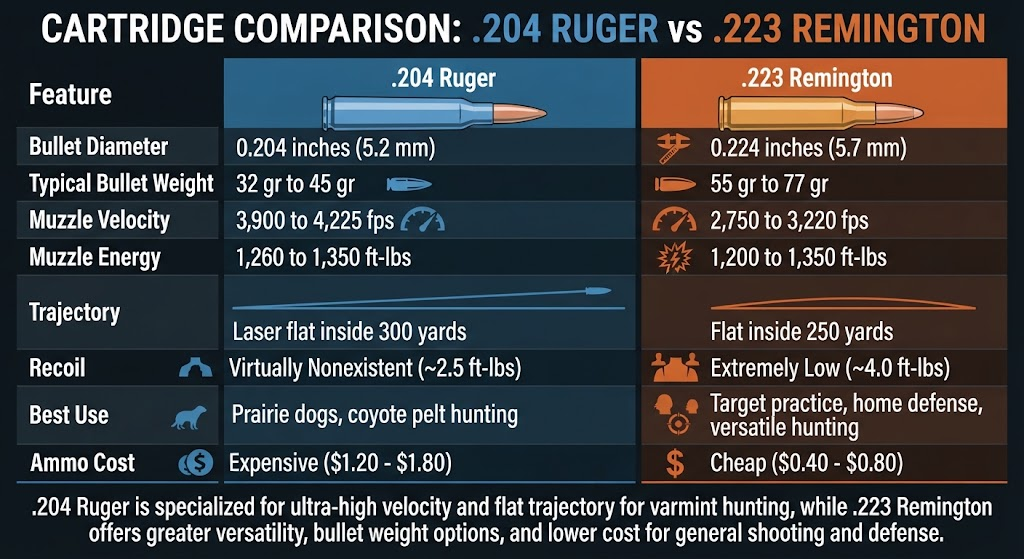
| Feature | .204 Ruger | .223 Remington |
| Bullet Diameter | 0.204 inches (5.2 mm) | 0.224 inches (5.7 mm) |
| Typical Bullet Weight | 32 gr to 45 gr (typically 32 gr or 40 gr) | 55 gr to 77 gr (typically 55 gr or 62 gr) |
| Muzzle Velocity | 3,900 to 4,225 fps (24-inch barrel) | 2,750 to 3,220 fps (24-inch barrel) |
| Muzzle Energy | 1,260 to 1,350 ft-lbs | 1,200 to 1,350 ft-lbs |
| Momentum | ~19 to ~22 lb-fps (depending on load) | ~25 to ~30 lb-fps (depending on load) |
| Maximum Pressure | 57,500 psi (SAAMI) | 55,000 psi (SAAMI) |
| Ballistic Coefficient | Low to Moderate (0.210 to 0.275) | Low to Moderate (0.243 to 0.372) |
| Penetration | Very Shallow (Highly explosive fragmentation) | 12 to 18 inches (Gelatin depending on bullet) |
| Expansion | Instantaneous and violent vaporization | 0.40 to 0.55 inches (Controlled or explosive options) |
| Trajectory | Laser flat inside 300 yards | Flat inside 250 yards with steeper drop beyond |
| Recoil | Virtually Nonexistent (~2.5 ft-lbs) | Extremely Low (~4.0 ft-lbs in a standard AR-15) |
| Effective Range | 400 to 500 yards (Varmint Hunting) | 400 to 600 yards (Varmint and Target) |
| Ammo Availability | Moderate (Specialty varmint and predator lines) | Extremely High (Global civilian and military standard) |
| Ammo Cost | Expensive ($1.20 to $1.80 per round) | Cheap ($0.40 to $0.80 per round) |
| Best Use | Prairie dogs, coyote pelt hunting, zero recoil target | Target practice, home defense, versatile hunting |
The table above details the mechanical and physical foundation of two closely related but highly specialized cartridges. To truly understand how these cartridges perform in the field, one must look at their case geometries and the specific engineering required to make them function. The .223 Remington was designed alongside the M16 military rifle program. It is an intermediate cartridge designed to function flawlessly in semi automatic platforms while providing enough lethal kinetic energy to neutralize threats at combat distances. Its widespread military adoption as the 5.56x45mm NATO ensured that the civilian version would benefit from billions of dollars in commercial research and development over the last six decades.
The .204 Ruger was developed through a joint venture between Hornady Ammunition and Ruger Firearms. The engineering team wanted to create the ultimate modern varmint cartridge that could eclipse the legendary .22-250 Remington in efficiency while fitting inside a standard AR-15 magazine well. To accomplish this, they took the vintage .222 Remington Magnum brass case and necked it down to accept a miniature 0.204 caliber projectile. They altered the shoulder angle to a steep thirty degrees to promote highly efficient powder combustion and maximize internal case capacity. Because the base of the .204 Ruger case is identical to the .223 Remington, converting a standard AR-15 to fire the .204 Ruger simply requires a specialized barrel. The bolt carrier group and the magazines remain exactly the same. This cross compatibility makes the .204 Ruger an incredibly appealing choice for predator hunters who already own modern sporting rifles but desire superior long distance varmint performance.
204 Ruger vs 223 Ballistics
To objectively evaluate the ballistic capabilities of the .204 Ruger against the .223 Remington, we must examine real world factory ammunition across their most common applications in target shooting and hunting. Because the .204 Ruger is strictly a varmint hunting tool, comparing its flagship predator loads against the versatile array of .223 Remington loads provides a perfect benchmark for performance.
For a completely fair comparison reflecting their maximum potential, all loads listed below are recorded from standard twenty four inch test barrels. Shooters utilizing shorter sixteen inch barrels commonly found on tactical carbines will experience proportionally lower velocities, which drastically affects the terminal performance of both calibers.
- Load A (204 Ruger Hyper Velocity Varmint): Hornady 32-grain V-MAX Polymer Tip. Tested from a 24-inch barrel. Muzzle velocity is 4,225 feet per second. Muzzle energy is 1,268 foot-pounds. Ballistic Coefficient is 0.210.
- Load B (204 Ruger Heavy Predator): Hornady 40-grain V-MAX Polymer Tip. Tested from a 24-inch barrel. Muzzle velocity is 3,900 feet per second. Muzzle energy is 1,351 foot-pounds. Ballistic Coefficient is 0.275.
- Load C (223 Remington Standard Varmint): Hornady 55-grain V-MAX Polymer Tip. Tested from a 24-inch barrel. Muzzle velocity is 3,220 feet per second. Muzzle energy is 1,266 foot-pounds. Ballistic Coefficient is 0.255.
- Load D (223 Remington Heavy Target): Black Hills 77-grain Sierra MatchKing Open Tip Match. Tested from a 24-inch barrel. Muzzle velocity is 2,750 feet per second. Muzzle energy is 1,293 foot-pounds. Ballistic Coefficient is 0.372.
Manufacturer rated data provides a standardized baseline for comparison. Independent testing frequently shows minor variations based on gas system length, chamber tolerances, and barrel temperature during firing.
204 Ruger vs 223 Velocity
Velocity is arguably the single most critical metric for small caliber rifle ammunition because it dictates how flat a projectile shoots across unknown distances and how effectively expanding bullets fragment upon impacting soft tissue. High initial velocity also drastically reduces the time of flight to the target, which minimizes the lead calculation required when shooting at moving targets like running coyotes.
When analyzing velocity, the .204 Ruger operates in a tier of speed that very few commercial cartridges ever reach. It is the second fastest commercial cartridge on the market today, surpassed only by the legendary .220 Swift. A 32-grain polymer tipped bullet fired from a .204 Ruger effortlessly exceeds a blistering 4,200 feet per second from a twenty four inch barrel. Even when loaded with the heavier 40-grain projectile, the .204 Ruger approaches 3,900 feet per second. This extreme hyper velocity acts like a laser beam across open fields. The bullet reaches the animal almost instantaneously after the trigger is pulled, completely eliminating the need to calculate complex target leads at normal hunting ranges.
The .223 Remington is a very fast cartridge, but it cannot match the raw muzzle velocity of the .204 Ruger because it pushes much heavier projectiles. A standard 55-grain .223 Remington varmint load exits a twenty four inch barrel at approximately 3,220 feet per second. When tactical shooters load heavy 77-grain bullets to maximize long range target accuracy, the velocity drops substantially to roughly 2,750 feet per second. While the .223 Remington is certainly fast enough to induce devastating hydrostatic shock, it simply cannot rival the sheer blistering speed of the specialized .204 caliber projectiles.
204 Ruger vs 223 Muzzle Energy
Muzzle energy represents the kinetic work capacity of a projectile. The kinetic energy generated by a cartridge is a direct reflection of both the speed of the bullet and its physical mass. One might assume that the .223 Remington generates significantly more kinetic energy because its bullets are almost twice as heavy as the .204 Ruger bullets. However, kinetic energy relies heavily on the velocity component. Because the .204 Ruger travels so incredibly fast, its energy output perfectly matches the heavier .223 Remington.
The .204 Ruger produces roughly 1,260 to 1,350 foot-pounds of energy at the muzzle depending on the exact grain weight chosen by the shooter. This is an exceptional amount of energy for a miniature .20 caliber cartridge. It provides devastating shock on small to medium sized predators. When a 32-grain bullet impacts a coyote at 4,000 feet per second, the kinetic energy transfer is so rapid and violent that the animal is anchored instantly without taking a single step.
The .223 Remington generates an almost identical 1,200 to 1,350 foot-pounds of energy at the muzzle. A standard 55-grain hunting load produces roughly 1,266 foot-pounds of kinetic energy. This energy level is considered the absolute baseline minimum required for ethically harvesting medium game like whitetail deer in jurisdictions where .22 caliber rifles are legal for hunting. While the total energy numbers are identical on paper, the physical way these two cartridges deliver that energy into biological tissue is vastly different.
204 Ruger vs 223 Momentum
Momentum is a linear measurement calculating mass in motion. In terminal ballistics, high momentum correlates closely with the ability of a bullet to crush through dense bone, heavy winter hides, and intermediate barriers without being deflected or stopping prematurely inside the target cavity.
Because momentum relies much more directly on the physical weight of the bullet rather than sheer velocity, the heavier .223 Remington holds a noticeable advantage over the ultra light .204 Ruger.
The .204 Ruger generates relatively low momentum due to its microscopic projectiles. A heavy 40-grain bullet traveling at 3,900 feet per second yields approximately 22.2 pound-feet per second of linear momentum. A lighter 32-grain bullet traveling at 4,225 feet per second yields roughly 19.3 pound-feet per second of linear momentum. While this is more than enough momentum to penetrate the thin skin of a prairie dog or the ribcage of a broadside fox, it is entirely insufficient for punching through the heavy shoulder bones of a large feral hog.
The .223 Remington holds a substantial advantage in penetration mechanics due to its heavier bullet mass. A 55-grain projectile traveling at 3,220 feet per second yields roughly 25.3 pound-feet per second of linear momentum. If a shooter utilizes a heavy 77-grain match bullet traveling at 2,750 feet per second, the momentum climbs over 30 pound-feet per second. This heavy momentum allows the .223 Remington to punch straight through intermediate barriers and heavy bone structures, making it vastly superior for law enforcement tactical applications and medium game hunting where deep penetration is an absolute requirement.
204 Ruger vs 223 Trajectory
Understanding external ballistics and bullet drop is critical for any shooter attempting to hit small targets beyond two hundred yards. The trajectory of a bullet is dictated by its initial velocity, the pull of gravity, and the aerodynamic efficiency of the projectile as it cuts through the atmosphere. The aerodynamic efficiency is mathematically represented as a Ballistic Coefficient.
The calculations below assume a standard rifle optic height of 1.5 inches above the bore and a clearly stated zero distance of 200 yards, which is the standard zero for modern precision and varmint hunting rifles. We will compare the premium varmint loads for both calibers to demonstrate their extreme distance capabilities on small targets.
| Distance | .204 Ruger (40 gr V-MAX at 3,900 fps) Drop | .223 Rem (55 gr V-MAX at 3,220 fps) Drop |
| Muzzle | -1.5 inches | -1.5 inches |
| 100 Yards | +0.9 inches | +1.3 inches |
| 200 Yards | 0.0 inches (Zero) | 0.0 inches (Zero) |
| 300 Yards | -3.8 inches | -6.3 inches |
| 400 Yards | -11.6 inches | -19.4 inches |
| 500 Yards | -24.8 inches | -41.2 inches |
At 300 yards, the trajectory of the .204 Ruger is absolutely spectacular. It drops only 3.8 inches. This means a predator hunter can place the crosshairs directly in the center of a coyote chest at 300 yards and squeeze the trigger without performing any elevation adjustments or dial changes on the optic. The bullet will strike exactly where the hunter aims. This incredibly long maximum point blank range is the defining feature of the .204 Ruger.
The .223 Remington is a flat shooting cartridge by normal standards, but it simply cannot keep pace with the hyper velocity of the .204 Ruger. At 500 yards, the .223 Remington has dropped over 41 inches, while the .204 Ruger has dropped less than 25 inches. For a prairie dog hunter attempting to hit a target the size of a soda can at half a mile, the incredibly flat trajectory of the .204 Ruger makes aiming significantly easier and greatly increases the probability of a first round hit.
204 Ruger vs 223 Recoil
Recoil management is a major factor in rapid and accurate shooting. The physical recoil generated by a firearm is heavily influenced by the weight of the rifle, the mass of the powder charge, and the weight of the bullet. Both of these cartridges are exceptionally mild and can be fired comfortably all day long, but there is a distinct winner for shooters who want absolutely zero muzzle jump.
The .223 Remington is famous for its low recoil. Fired from a standard seven pound AR-15 rifle or a traditional bolt action sporting rifle, a typical 55-grain hunting load generates roughly 4.0 foot-pounds of free recoil energy. This is an incredibly comfortable level of recoil that allows shooters of all ages and statures to practice without experiencing any shoulder pain or flinching habits.
The .204 Ruger produces practically nonexistent recoil. Because it fires bullets that weigh only 32 or 40 grains, the rearward thrust is incredibly minimal. Fired from an identical seven pound rifle, the .204 Ruger generates approximately 2.5 foot-pounds of free recoil energy. This recoil is so minimal that the muzzle of the rifle literally does not move when the gun is fired. Shooters can effortlessly watch their own bullet impacts strike the target through a highly magnified optic without the crosshairs ever bouncing off the animal. This characteristic makes the .204 Ruger the ultimate training tool for introducing new shooters to long range marksmanship.
204 Ruger vs 223 Penetration
Terminal penetration is rigorously evaluated to ensure the ethical harvesting of game animals and the effective neutralization of targets. A bullet must penetrate deep enough into soft tissue to reach critical cardiovascular structures regardless of the angle the target presents.
The .204 Ruger is explicitly designed for extremely shallow penetration. Varmint hunters rely on lightweight, thin jacketed bullets that fragment violently the instant they impact soft tissue. When a 32-grain bullet traveling at 4,000 feet per second strikes a coyote, the bullet practically vaporizes beneath the skin. This rapid energy transfer kills the animal instantly but prevents the bullet from exiting the far side of the body. For professional pelt hunters who sell fur for a living, this lack of an exit wound is highly desirable because it preserves the valuable hide without requiring extensive sewing repairs.
The .223 Remington provides significantly deeper penetration capabilities. While a hunter can certainly load highly fragile varmint bullets in a .223 Remington, the cartridge also supports heavy bonded hunting bullets and solid copper monolithic projectiles. When utilizing a premium 62-grain or 77-grain bullet, the .223 Remington will consistently penetrate 12 to 18 inches in ballistic gelatin. This deep penetration allows the .223 Remington to confidently take quartering shots on medium sized game like deer and feral hogs, making it a far more versatile hunting tool than the shallow penetrating .204 Ruger.
204 Ruger vs 223 Expansion
Bullet expansion dictates the physical diameter of the permanent wound channel inside the target animal. Wide expansion increases the likelihood of severing major arteries and causing rapid incapacitation through catastrophic blood loss.
The .204 Ruger does not expand in a traditional mushroom shape. Instead, it relies on explosive fragmentation. When the ultra fast bullet strikes a target, the intense hydraulic pressure forces the thin copper jacket to disintegrate instantly. The lead core shatters into dozens of tiny fragments that radiate outward in a starburst pattern, creating a massive but shallow temporary stretch cavity. This explosive fragmentation is devastating on prairie dogs, groundhogs, and coyotes, often causing the animal to drop completely motionless upon impact.
The .223 Remington utilizes a much wider variety of expanding bullets. A standard 55-grain polymer tipped varmint bullet will fragment violently just like the .204 Ruger. However, if a hunter loads a premium soft point or bonded hollow point designed for deer hunting, the .223 Remington bullet will initiate expansion immediately upon entering tissue and peel back into a classic mushroom shape measuring roughly 0.45 to 0.55 inches across. Because the bullet is heavier, it retains its core lead weight and continues driving deep into the target while fully expanded, creating a deep permanent crush cavity that leads to very short tracking jobs in the woods.
204 Ruger vs 223 Effective Range
The effective range of a cartridge is determined by the intersection of three specific factors including velocity retention, bullet drop predictability, and the mechanical accuracy of the rifle platform. Both cartridges are highly accurate, but they serve different distance envelopes based on their aerodynamic properties.
The .204 Ruger is highly effective within 500 yards for varmint hunting applications. Because the tiny bullets shed velocity rapidly due to atmospheric drag, the kinetic energy drops to levels that may fail to humanely anchor large coyotes immediately at extreme distances. However, for precision target shooting on small rodents, the insanely flat trajectory allows a skilled marksman to consistently hit targets at 500 yards without calculating difficult holdovers. It is a highly specialized intermediate to long range varmint laser.
The .223 Remington has a slightly shorter effective range for varmint hunting due to its steeper trajectory, but it boasts a longer effective range for precision target shooting. When loaded with heavy 77-grain Sierra MatchKing bullets, the .223 Remington remains supersonic and predictable out to 800 yards and beyond. These heavy bullets require specialized rifle barrels featuring fast twist rates like 1 in 7 or 1 in 8 inches to properly stabilize the long projectiles. Because standard .204 Ruger barrels feature a slow 1 in 12 twist rate, they cannot stabilize heavy bullets, limiting their extreme long range potential compared to modern .223 Remington target setups.
204 Ruger vs 223 Self Defense
When discussing self defense with high powered centerfire rifle cartridges, the conversation typically revolves around home defense and the inherent risks of over penetration in urban or suburban residential environments.
The .223 Remington is universally recognized as the absolute gold standard for modern home defense. This frequently surprises uneducated shooters who incorrectly assume a rifle cartridge will punch through countless walls and endanger neighbors. In reality, lightweight 55-grain expanding or fragmenting .223 bullets shed their energy incredibly fast upon hitting intermediate barriers like interior drywall or wood studs. They tend to break apart, tumble, and stop faster than heavy 9mm or .45 ACP handgun bullets, making the .223 Remington surprisingly safe for indoor use regarding over penetration risks. Furthermore, standard AR-15 magazines hold thirty rounds of .223 Remington, giving the defender a massive tactical capacity advantage during a home invasion.
The .204 Ruger is practically never used for self defense. While it is certainly highly lethal and shares the exact same magazine capacity advantages in an AR-15 platform, it lacks the tactical bullet options available for the .223 Remington. There are no specialized law enforcement barrier blind loads or dedicated self defense rounds manufactured for the .204 Ruger. Additionally, the extreme hyper velocity of the .204 Ruger creates a massive concussive blast and blinding muzzle flash when fired indoors, making it highly disorienting for the defender.
204 Ruger vs 223 Concealed Carry
Concealed carry with either the .204 Ruger or the .223 Remington is impossible and entirely impractical. Both of these cartridges are centerfire rifle cartridges measuring roughly 2.26 inches in overall length. They require long receiver actions and buffer tube assemblies to safely contain their operating pressures and cycle their bolts. While extremely short AR-15 pistol variants exist, they are still far too large, heavy, and awkward to be concealed on the human body in any practical daily carry holster. Their appropriate transport method involves a dedicated rifle bag, a locked vehicle rack, or a tactical sling worn over the shoulder in the field.
Which Has More Stopping Power: 204 Ruger or 223?
Stopping power is an ambiguous term often used to describe the ability of a cartridge to quickly incapacitate a biological target without requiring long tracking jobs into the brush. Stopping power is a combination of kinetic energy, tissue disruption, and penetration depth.
When comparing the two cartridges on medium game such as whitetail deer or feral hogs, the .223 Remington holds a massive advantage in stopping power. The ability to launch heavy 60-grain to 70-grain bullets provides a level of deep penetration that ultra light .20 caliber bullets simply cannot replicate. The .223 Remington creates a wider, deeper permanent wound channel that reaches vital organs from difficult angles, causing rapid blood loss and incapacitation.
On small predators and varmints like coyotes or prairie dogs, the .204 Ruger provides vastly superior instantaneous stopping power. The extreme hyper velocity of the lightweight bullet creates a massive temporary stretch cavity within the small animal, resulting in immediate central nervous system shock and instant anchoring without exiting the hide.
Which Is More Powerful: 204 Ruger or 223?
Power is defined quantitatively by kinetic energy and linear momentum. Based on the laws of physics, the two cartridges are nearly identical in raw kinetic energy output, but the .223 Remington holds the advantage in total destructive power due to its higher mass.
Both cartridges generate roughly 1,250 to 1,350 foot-pounds of muzzle energy depending on the specific factory load chosen. The .223 Remington, however, generates significantly higher linear momentum due to its heavier bullet mass advantage. Because momentum directly translates to the ability to crush through structural resistance and dense bone, the .223 Remington delivers more functional penetration power to the target.
.204 Ruger Pros and Cons
Pros
- Exceptional hyper velocity exceeds four thousand feet per second, making it the second fastest commercial cartridge available
- Incredibly flat trajectory out to 300 yards makes aiming at small moving coyotes completely effortless without holdovers
- Produces practically zero felt recoil, allowing shooters to easily spot their own bullet impacts through magnified optics
- Devastating terminal fragmentation anchors small predators instantly without producing massive exit wounds that ruin valuable fur pelts
- Functions perfectly in standard AR-15 magazines and lower receivers with only a barrel swap
Cons
- Extreme velocities combined with massive powder charges accelerate throat erosion, resulting in shorter barrel life than standard cartridges
- Ammunition is expensive and currently limited to a few specific commercial varmint offerings
- Ultra light bullets lack the mass and momentum required to ethically harvest medium game like deer or punch through heavy shoulder bones
- Standard slow twist rate barrels prevent the use of heavy bullets for extreme long range wind resistance
.223 Remington Pros and Cons
Pros
- The undisputed global standard for modern sporting rifles, ensuring ubiquitous availability of cheap parts, magazines, and rifles
- Extremely cheap surplus ammunition allows for high volume tactical training, target practice, and recreational plinking
- Incredible versatility with bullet weights ranging from 35-grain frangible loads to 77-grain heavy match loads
- Exceptionally low recoil and excellent indoor barrier fragmentation make it the absolute ideal home defense cartridge
- Legal and highly effective for hunting deer and medium game when utilizing premium expanding bonded ammunition
Cons
- Lacks the extreme hyper velocity required to match the flat 300 yard trajectory of dedicated varmint cartridges like the .204 Ruger
- Standard 55-grain bullets are highly susceptible to wind drift, making long range precision shooting past 400 yards difficult without heavy match ammo
- Rapid energy loss limits its ethical medium game hunting envelope to closer ranges inside 200 yards
- Requires specific fast twist rate barrels to properly stabilize the heaviest and most aerodynamic target bullets
Final Comparison
| Category | Winner | Reason |
| Velocity | .204 Ruger | Lightweight 32-grain bullets effortlessly exceed 4,200 fps at the muzzle |
| Muzzle Energy | Tie | Both generate exactly the same kinetic energy hovering around 1,300 ft-lbs |
| Momentum | .223 Remington | Heavier 55-grain and 77-grain bullets carry immense linear driving mass |
| Penetration | .223 Remington | Higher bullet mass pushes heavy projectiles deep through bone and muscle |
| Expansion | Tie | Both expand or fragment massively depending entirely on specific bullet construction |
| Trajectory | .204 Ruger | Extreme hyper velocity produces an incredibly flat curve inside of 300 yards |
| Recoil Control | .204 Ruger | Generates practically zero felt recoil, making it completely effortless to watch impacts |
| Effective Range | .223 Remington | Heavy match bullets confidently extend target shooting out to 800 yards |
| Self Defense | .223 Remington | The global gold standard for home defense capacity and safer indoor fragmentation |
| Concealed Carry | Neither | Both are centerfire rifle cartridges completely unsuitable for concealment on the body |
| Ammo Cost | .223 Remington | Extreme global military popularity has lowered relative cost and increased cheap bulk options |
| Ammo Availability | .223 Remington | Found in massive quantities in literally every sporting goods store worldwide |
| Overall Performance | Depends on Target | .204 Ruger for pure varmint speed; .223 for tactical volume and medium game defense |
204 Ruger vs 223: Which Should You Choose?
Selecting between the .204 Ruger and the .223 Remington requires a practical assessment of your intended shooting distances, your primary targets, and your overall ammunition budget.
Choose the .204 Ruger if your primary goal is building the ultimate dedicated predator and varmint hunting rifle. The ability to launch highly explosive miniature projectiles at over 4,000 feet per second provides incredibly flat trajectories that make hitting small, fast moving coyotes completely effortless. The complete lack of recoil allows you to watch the animal drop immediately through your scope without losing your sight picture. It is the absolute premier choice for professional pelt hunters who want instant ethical kills without tearing massive exit holes in valuable fur.
Choose the .223 Remington if you prioritize tactical versatility, home defense, economical high volume training, and medium game hunting. It fits perfectly into standard AR-15 platforms with universal thirty round magazines, features a trajectory flat enough to confidently take targets at 300 yards, and allows you to buy cheap ammunition in massive bulk quantities. It is objectively the more practical choice for a modern civilian shooter who wants maximum reliability and convenience for general purpose carbine use.
FAQs
Is 204 Ruger more powerful than 223?
No, the two cartridges are nearly identical in raw kinetic power. Both generate approximately 1,300 foot-pounds of muzzle energy. The .223 Remington is slightly more powerful in terms of linear momentum due to its heavier bullet mass.
Which has more muzzle energy?
They are identical. A standard .204 Ruger and a standard .223 Remington both generate roughly 1,260 to 1,350 foot-pounds of energy at the muzzle.
Which has more stopping power?
For deer and medium game, the .223 Remington provides vastly superior stopping power due to its ability to penetrate deep and crush heavy bone. For small varmints and coyotes, the hyper velocity explosive impact of the .204 Ruger provides more instantaneous stopping power.
Which has more recoil?
The .223 Remington produces slightly more recoil than the .204 Ruger. However, both cartridges are considered exceptionally mild and easy to shoot, generating less than five foot-pounds of free recoil energy in standard rifles.
Which has better penetration?
The .223 Remington has drastically better penetration on heavy game. Its heavier bullet mass allows the projectiles to punch through dense muscle and thick bone without deflecting, whereas the .204 Ruger bullets are designed to fragment immediately beneath the skin.
Which expands more?
The .223 Remington expands into a classic wide mushroom when utilizing premium bonded hunting bullets. The .204 Ruger does not expand traditionally; instead, it fragments violently into dozens of tiny pieces upon impact.
Which has a flatter trajectory?
Inside of 400 yards, the .204 Ruger shoots significantly flatter due to its extreme initial velocity. The .204 Ruger provides an incredibly forgiving maximum point blank range for hunting fast moving predators.
Which is better for self defense?
The .223 Remington is widely considered the superior choice for home defense because lightweight expanding bullets fragment quickly in residential walls, reducing dangerous over penetration risks. The .204 Ruger lacks dedicated self defense ammunition and creates an overwhelming concussive blast indoors.
Which is better for concealed carry?
Neither. Both are large centerfire rifle cartridges fired from long, heavy rifles that cannot be concealed.
Is 204 Ruger faster than 223?
Yes, the .204 Ruger is drastically faster at the muzzle. A standard 32-grain .204 Ruger bullet exits the barrel at over 4,200 fps, whereas a standard 55-grain .223 bullet exits at roughly 3,220 fps.
Is 223 stronger than 204 Ruger?
Yes. While both cartridges generate the same kinetic energy, the heavier bullet of the .223 Remington generates more overall momentum, giving it stronger penetration capabilities through physical barriers.
Which is cheaper to shoot?
The .223 Remington is vastly cheaper and easier to shoot due to its massive global popularity and military adoption. Bulk target ammunition is highly affordable and available everywhere.
Which has better ballistics?
The .204 Ruger features better short range hyper velocity ballistics and a flatter trajectory. The .223 Remington features far superior long range target ballistics when utilizing heavy 77-grain match bullets in fast twist barrels.
Which is easier to shoot?
The .204 Ruger is slightly easier to shoot due to its practically non existent recoil impulse, making it the perfect caliber for new shooters to learn precision rifle fundamentals without developing a flinch.
Which should you choose?
Choose the .204 Ruger for dedicated varmint hunting, predator pelt control, and laser flat short range trajectories. Choose the .223 Remington for home defense, high volume tactical training, and cheap ammunition availability.