When comparing 9mm Kurz vs 380, the basic answer is that they are the exact same 9×17mm cartridge, designed by John Moses Browning in 1908. The terms simply represent different regional naming conventions, with “380” referring to the American .380 ACP designation and “9mm Kurz” meaning “9mm Short” in German. Because they are the identical physical cartridge, there is no difference in dimensions, bullet weight, or intended use, though European CIP and American SAAMI pressure testing methods record slightly different maximums. Understanding where these names originated helps clear up the widespread confusion among shooters looking for ammunition.
9mm Kurz vs 380: Main Difference
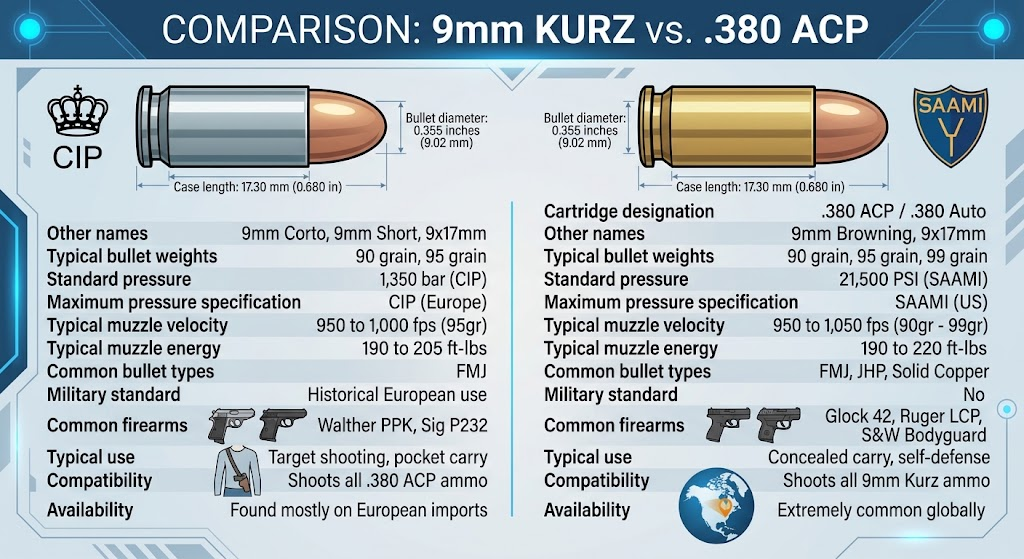
| Specification | 9mm Kurz | 380 |
| Cartridge designation | 9mm Kurz | .380 ACP / .380 Auto |
| Other names | 9mm Corto, 9mm Short, 9×17mm | 9mm Browning, 9×17mm |
| Bullet diameter | 0.355 inches (9.02 mm) | 0.355 inches (9.02 mm) |
| Case length | 17.30 mm (0.680 in) | 17.30 mm (0.680 in) |
| Overall cartridge length | 25.00 mm (0.984 in) | 25.00 mm (0.984 in) |
| Typical bullet weights | 90 grain, 95 grain | 90 grain, 95 grain, 99 grain |
| Standard pressure | 1,350 bar (CIP) | 21,500 PSI (SAAMI) |
| Maximum pressure / applicable specification | CIP (Europe) | SAAMI (US) |
| Typical muzzle velocity | 950 to 1,000 fps (95gr) | 950 to 1,050 fps (90gr – 99gr) |
| Typical muzzle energy | 190 to 205 ft-lbs | 190 to 220 ft-lbs |
| Common bullet types | FMJ | FMJ, JHP, Solid Copper |
| Military standard | Historical European use | No |
| Common firearms | Walther PPK, Sig P232 | Glock 42, Ruger LCP, S&W Bodyguard |
| Typical use | Target shooting, pocket carry | Concealed carry, self-defense |
| Compatibility | Shoots all .380 ACP ammo | Shoots all 9mm Kurz ammo |
| Availability | Found mostly on European imports | Extremely common globally |
Winner: 380 – It is the universally recognized commercial designation in the modern market, making ammunition under this label vastly easier to find and purchase.
What Is 9mm Kurz?
The term 9mm Kurz translates from German to “9mm Short.” It is the European designation for the 9×17mm cartridge. When John Moses Browning developed the cartridge for the Colt Model 1908 pocket hammerless pistol, European arms manufacturers like Fabrique Nationale (FN) quickly adopted it. In German-speaking countries, where the 9×19mm Parabellum was the standard military round, the new, shorter cartridge needed a distinct name to prevent dangerous mix-ups. European ammunition manufacturers use the 9mm Kurz designation (alongside 9mm Corto in Italy and 9mm Short in the UK) to clearly identify the round for iconic firearms like the Walther PPK.
What Is 380?
The term 380 is shorthand for .380 ACP, which stands for Automatic Colt Pistol. This is the original American designation for the cartridge introduced by Colt in 1908. In the United States, cartridges are traditionally named based on their caliber in fractions of an inch, which is where the .380 measurement originates. Today, it is widely marketed as .380 Auto by American ammunition manufacturers. It has become one of the most popular cartridges in the United States for deep concealment and pocket pistols due to its compact size and manageable recoil.
9mm Kurz vs 380 Pressure
Because the two names describe the exact same physical cartridge, the main difference in pressure figures comes entirely from the organizations doing the testing. The American SAAMI standard and the European CIP standard use different methodologies and equipment to measure chamber pressure.
| Specification | 9mm Kurz | 380 |
| Pressure standard | CIP | SAAMI |
| Published pressure specification | Maximum Pressure (Pmax) | Maximum Average Pressure (MAP) |
| Pressure in PSI | ~19,580 PSI (Converted) | 21,500 PSI |
| Pressure in bar or MPa | 1,350 bar | 1,482 bar (Converted) |
It is important to note that a box of European ammunition labeled 9mm Kurz is not necessarily loaded lighter than an American box labeled .380 Auto. The difference on paper exists strictly because CIP measures pressure farther forward in the case using different sensor placements than SAAMI.
9mm Kurz vs 380 Velocity
Velocity figures for both designations reflect the exact same performance envelope. Below is a comparison of representative published ammunition loads from European manufacturers (who often use both designations on the box) and American manufacturers.
| Cartridge | Bullet Weight | Muzzle Velocity | Test Barrel Length | Muzzle Energy |
| Fiocchi 9mm Kurz / 380 Auto FMJ | 95 Grain | 1,000 fps | 3.75 inches | 211 ft-lbs |
| Geco 9mm Kurz / 380 Auto FMJ | 95 Grain | 984 fps | 3.75 inches | 204 ft-lbs |
| Federal Premium 380 Auto HST | 99 Grain | 1,030 fps | 3.75 inches | 233 ft-lbs |
| Hornady Critical Defense 380 Auto | 90 Grain | 1,000 fps | 3.00 inches | 200 ft-lbs |
Velocity will always fluctuate slightly depending on the test barrel length and specific powder charge, not because of the name stamped on the casing.
9mm Kurz vs 380 Dimensions
The physical dimensions of 9mm Kurz and .380 Auto are 100 percent identical.
- Bullet diameter: 9.02 mm (0.355 in)
- Case length: 17.30 mm (0.680 in)
- Overall cartridge length: 25.00 mm (0.984 in)
- Case dimensions: Straight-walled, rimless case. Base diameter is 9.50 mm.
- Rim dimensions: Rim diameter is 9.50 mm with a thickness of 1.14 mm.
Where a shooter might see both names stamped on a single barrel or ammunition box, it is simply to assure the buyer that the cartridge meets the dimensional requirements for their firearm, regardless of their geographic location.
9mm Kurz vs 380 Bullet Weight
Because they are the same cartridge, both 9mm Kurz and 380 utilize the exact same bullet weights.
The standard bullet weights range from 90 to 95 grains for full metal jacket target ammunition. For defensive hollow point loads, manufacturers commonly use 90-grain, 95-grain, and sometimes slightly heavier 99-grain projectiles. Heavy-for-caliber bullets (like 115-grain) are rarely used in this casing because the limited powder capacity cannot generate enough velocity to stabilize them or force proper hollow point expansion.
9mm Kurz vs 380 Compatibility
You can use 9mm Kurz and .380 Auto ammunition interchangeably without any safety concerns.
If you own a European pistol with “9mm Kurz” stamped on the barrel, it will safely fire American .380 Auto ammunition. If you own an American pistol marked “.380 Auto”, it will safely fire European ammunition labeled 9mm Kurz. The specific ammunition designation is purely a matter of language and regional marketing. Always consult your firearm’s manual, but realize that these terms are universally recognized synonyms in the firearms industry.
9mm Kurz vs 380 Ballistics
Ballistically, the 9×17mm cartridge performs exactly the same regardless of what it is called.
- Muzzle velocity: Typically hovers around 950 to 1,000 fps with a standard 95-grain bullet out of a compact pistol barrel.
- Muzzle energy: Averages roughly 200 ft-lbs of energy.
- Trajectory: Adequate for close-range defensive distances (typically tested at 7 to 15 yards) but drops off rapidly beyond 25 yards due to low velocity and poor ballistic coefficients.
- Recoil: Extremely mild in mid-sized handguns, though it can feel “snappy” in ultra-lightweight micro-compact pocket pistols.
9mm Kurz vs 380 for Military Use
Historically, the cartridge saw extensive military use in Europe under the 9mm Kurz and 9mm Corto designations, particularly during World War II. It was issued to officers, pilots, and police forces who required compact sidearms. Conversely, the United States military never adopted the .380 ACP for general issue, relying instead on the much more powerful .45 ACP. Today, neither designation is considered adequate for modern frontline military duty, having been entirely replaced by the 9×19mm NATO.
9mm Kurz vs 380 for Civilian Use
For civilian use, this cartridge is one of the most popular choices in the world for concealed carry.
American civilians overwhelmingly look for .380 Auto ammunition for their everyday carry pocket pistols. Where you will see the 9mm Kurz label in civilian life is usually on imported surplus firearms (like older Walther, Beretta, or CZ pistols) or on imported ammunition boxes from European manufacturers like Prvi Partizan (PPU), S&B, or Fiocchi, who often print both names on the packaging to satisfy all markets.
9mm Kurz vs 380 Pros and Cons
Since they are the exact same cartridge, these pros and cons apply to the 9×17mm round as a whole, along with the quirks of its naming conventions.
9mm Kurz Pros and Cons
Pros:
- Maintains historical accuracy for collectors of vintage European firearms.
- Cartridge design allows for very small, easily concealed pocket pistols.
- Very manageable recoil compared to larger duty calibers.
Cons:
- The naming convention confuses many new American shooters.
- Terminal ballistics and penetration are considered the bare minimum for self-defense.
380 Pros and Cons
Pros:
- The .380 Auto designation is universally understood in retail environments.
- Massive selection of modern defensive hollow point ammunition under this label.
- Firearms chambered in .380 are highly accessible for shooters with weaker grip strength.
Cons:
- Ammunition is often slightly more expensive than 9mm Luger due to lower production volume.
- Micro-compact .380 pistols can be difficult to grip and shoot accurately under stress.
9mm Kurz vs 380 Cost
The cost of the ammunition is identical, as retail price depends entirely on the brand, bullet type, and manufacturing location rather than the specific name printed on the box.
| Ammunition | Bullet Weight | Quantity | Price | Cost Per Round |
| Prvi Partizan (PPU) 380 Auto / 9mm Kurz | 94 Grain | 50 Rounds | $17.99 | $0.36 |
| Fiocchi 380 Auto (9mm Kurz) FMJ | 95 Grain | 50 Rounds | $18.50 | $0.37 |
| PMC Bronze 380 Auto FMJ | 90 Grain | 50 Rounds | $16.99 | $0.34 |
| Federal Punch 380 Auto JHP | 85 Grain | 20 Rounds | $22.99 | $1.15 |
Note: Ammunition prices fluctuate based on market conditions, bulk purchasing, and shipping costs.
9mm Kurz vs 380 FAQs
What is the main difference between 9mm Kurz and 380?
There is no physical difference. The main difference is purely linguistic and geographical. “9mm Kurz” is the German name for the cartridge, while “.380 Auto” is the American name for the exact same 9×17mm round.
Is 9mm Kurz the same as 380?
Yes, 9mm Kurz and .380 ACP (or .380 Auto) are the identical cartridge designed by John Browning in 1908.
Is 9mm Kurz more powerful than 380?
No. Because they are the same cartridge, they produce the same muzzle velocity and muzzle energy when loaded with equivalent powder charges.
Is 9mm Kurz higher pressure?
No. While the European CIP standard lists a different maximum pressure number (1,350 bar) than the American SAAMI standard (21,500 PSI), this is due to differences in testing equipment and sensor placement, not actual internal pressure limits.
Can you shoot 9mm Kurz in a 380 pistol?
Yes. You can safely load and fire European 9mm Kurz ammunition in any modern handgun chambered for .380 Auto.
Can you shoot 380 in a 9mm Kurz firearm?
Yes. American .380 Auto ammunition will chamber and fire perfectly safely in firearms stamped with “9mm Kurz” on the barrel.
What bullet weight does 9mm Kurz use?
Like the .380 Auto, 9mm Kurz typically uses 90-grain and 95-grain bullets for target shooting, with self-defense rounds occasionally weighing up to 99 grains.
What is the velocity of 9mm Kurz?
The typical velocity of standard 9mm Kurz target ammunition is between 950 and 1,000 feet per second.
Which has more muzzle energy, 9mm Kurz or 380?
Neither has a ballistic advantage. Both designations yield roughly 200 ft-lbs of muzzle energy depending on the exact brand of ammunition.
Why is 9mm Kurz called Kurz?
“Kurz” is the German word for “short.” The name was adopted in Europe to clearly differentiate this short 17mm case length cartridge from the longer, more powerful 9×19mm Parabellum military cartridge.